

Modular Kitchen Layout Guide: Which Type Is Right for Your Home?
The right modular kitchen layout depends on one thing: the size and shape of your kitchen space.
L-shaped layouts suit most Indian apartments (80–120 sq ft).
Parallel works best for narrow kitchens-and is the most efficient layout for Indian cooking.
U-shaped is ideal for medium-to-large kitchens where maximum storage matters.
An island needs at least 150 sq ft of open-plan space.
Straight layouts work for studio apartments and very compact kitchens under 60 sq ft.
Choosing the wrong kitchen layout is the most common-and most expensive-mistake homeowners make. You can upgrade the finish, swap the hardware, and repaint the walls. But you cannot fix a bad layout without tearing everything out.
So before you pick a colour palette or a shutter finish, figure out your layout. Everything else follows from that one decision.
This guide breaks down every major modular kitchen layout, tells you exactly which kitchen size each works for, and explains the Indian-cooking-specific reasons why some layouts outperform others day to day.
What Is a Modular Kitchen Layout?
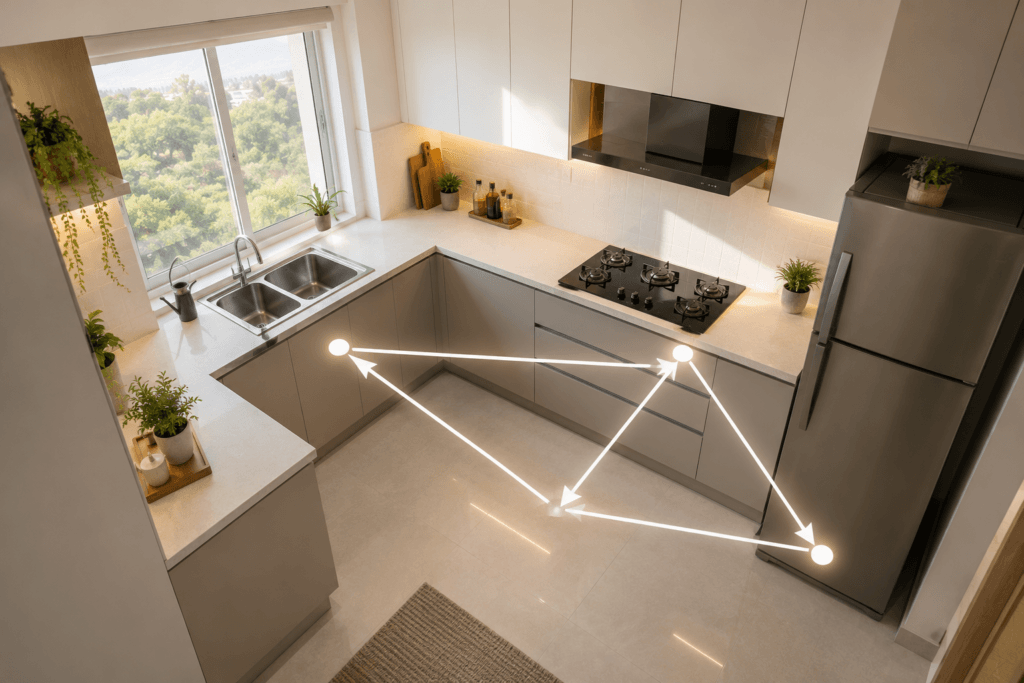
A modular kitchen layout is the arrangement of your cabinets, countertops, and appliances across your kitchen’s available walls. The layout you choose determines your workflow, how much storage you get, how many people can cook comfortably, and whether your kitchen feels open or cramped.
At the center of every good layout is the work triangle-the triangle formed between your hob, sink, and refrigerator. When each side of that triangle measures between 4 and 9 feet, movement during cooking is efficient and fatigue-free. Layouts that break this triangle-or stretch it too far-make daily cooking harder, regardless of how beautiful the finish is.
The 5 Types of Modular Kitchen Layouts-Compared
Layout | Best For | Min Space | Ideal Kitchen Shape | Work Triangle? |
Straight | Studio flats, tiny kitchens | 50–70 sq ft | Long, narrow wall | No triangle-linear flow |
Parallel (Galley) | Narrow kitchens, serious home cooks | 70–100 sq ft | Rectangular with 2 facing walls | Strong linear flow, wet/dry split |
L-Shaped | Most Indian apartments | 80–120 sq ft | Square or open-plan corner | Natural work triangle |
U-Shaped | Medium-large kitchens, joint families | 120–180 sq ft | Square or large rectangular | Efficient 3-point triangle |
Island | Open-plan luxury homes | 150+ sq ft | Open-plan only | Flexible multi-person zones |
1. Straight (One-Wall) Kitchen Layout
All your cabinets, countertops, and appliances run along a single wall. Clean, simple, and cost-effective.
Best for: Studio apartments, 1BHK flats, homes where the kitchen is a compact secondary space. Works especially well in Noida high-rises and small Dehradun apartments where the kitchen wall is 8–10 feet long.
What it gets right: Lowest cost among all layouts. Easiest to install. No wasted corner space. Fits anywhere.
What to watch: There is no work triangle in a straight kitchen-everything is in a line, so you will walk more during a full cooking session. Not ideal if you cook elaborate Indian meals daily. Overhead storage becomes critical because you only have one wall; tall cabinets using height up to 8 feet make a real difference here.
Minimum aisle clearance needed: 3.5–4 feet in front of countertop.
2. Parallel (Galley) Kitchen Layout
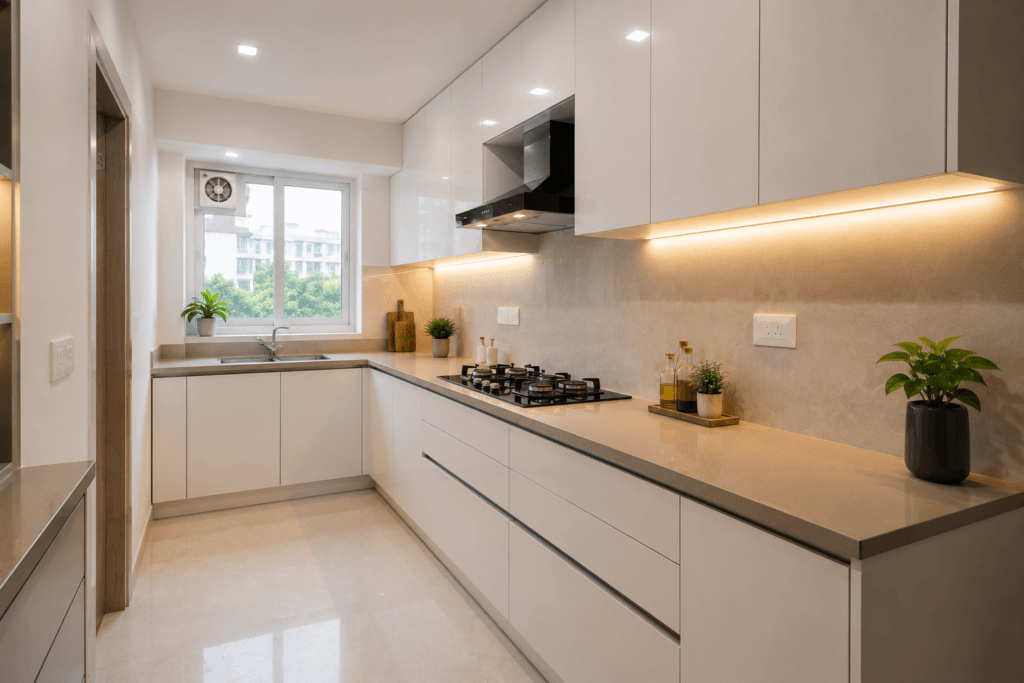
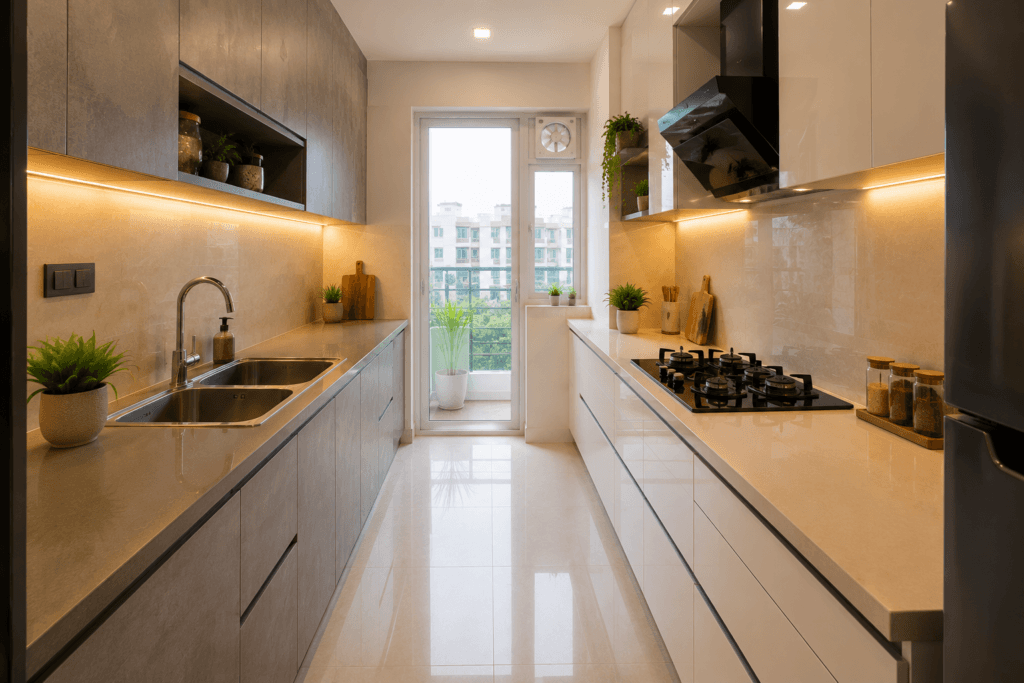
Two countertops run parallel to each other on opposite walls, with a corridor in between.
Best for: Narrow kitchens (8–10 ft wide) where the room is long and rectangular. Works for both compact apartments and medium-sized homes. The most efficient layout for Indian cooking-which is worth explaining.
Why parallel works so well for Indian cooking: Indian cooking usually involves multiple simultaneous tasks-dal simmering on one burner, vegetables being cut, a pressure cooker on the third. The parallel layout naturally divides into a cooking zone (one counter) and a prep + cleaning zone (the opposite counter). You step across, not sideways. This linear, back-and-forth movement reduces fatigue significantly compared to layouts where the sink and hob are on the same counter run.
What to watch: The aisle between counters must be at least 3.5 feet (42 inches). Less than that and two people cannot pass each other. Less than 4 feet and it starts feeling claustrophobic. At 4–5 feet, it becomes the most comfortable working kitchen of any layout.
One honest trade-off: Parallel kitchens are typically closed-they do not open into the living or dining area. If you prefer an open-kitchen feel, the L-shaped or island layout serves that better.
3. L-Shaped Kitchen Layout
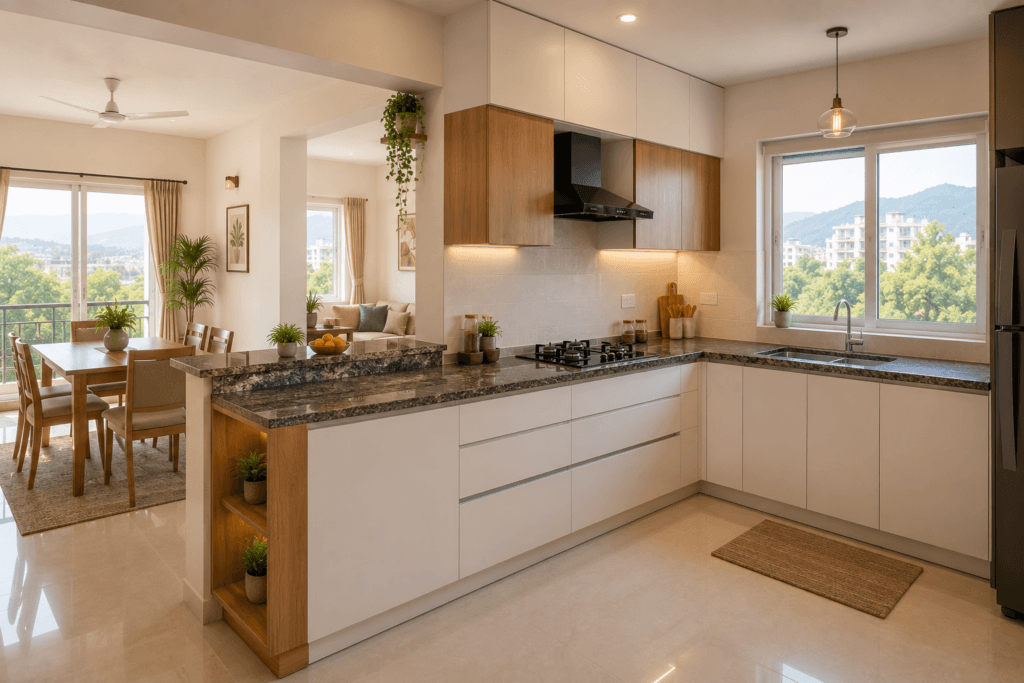
The most common modular kitchen layout in Indian apartments. Cabinets and countertops run along two adjacent walls, forming an L.
Best for: Small to medium kitchens of 80–120 sq ft. Works beautifully in apartments where the kitchen opens into a dining area. The natural corner creates a work triangle between the hob (one wall), sink (transition point), and refrigerator (end of other wall).
What it gets right: Flexible enough for both closed and open kitchens. Leaves two sides open, so the kitchen feels spacious. Easily accommodates a small breakfast counter or dining ledge at the end of one arm. In Bhumim’s experience across Dehradun, Noida, and Roorkee projects, the L-shaped layout is what most Indian families with a 2BHK kitchen (90–110 sq ft) end up choosing.
One thing to plan carefully: The inside corner. That corner cabinet is awkward to access if it’s just a plain door-you lose a large chunk of usable space. A magic corner unit or a Le Mans carousel (₹12,000–₹25,000 per corner) transforms that dead corner into genuinely useful storage. Do not skip this in the design stage.
4. U-Shaped Kitchen Layout
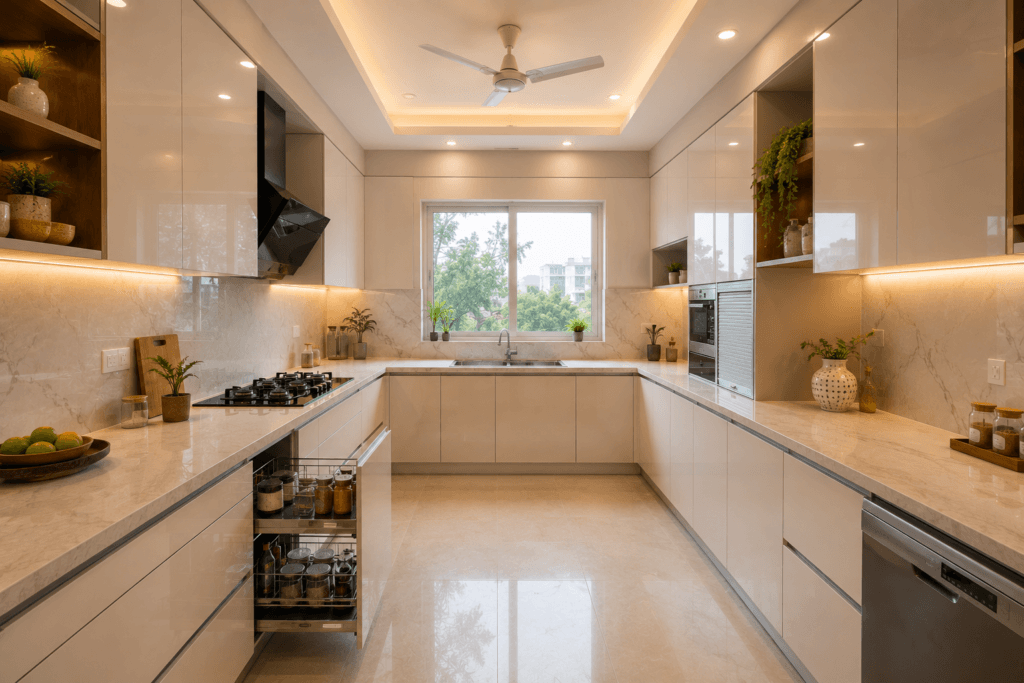
Three walls of cabinets and countertops wrapping around three sides of the kitchen, forming a U.
Best for: Medium to large kitchens of 120–180 sq ft. Ideal for joint families, households with multiple cooks, and anyone who wants maximum storage and counter space in one layout. The work triangle becomes almost effortless because the hob, sink, and refrigerator each sit on a different arm of the U.
What it gets right: Most storage of any closed kitchen layout. The three-wall setup allows clear zone separation-wet zone (sink, dishwasher), cooking zone (hob, chimney), and cold zone (refrigerator, pantry) each get their own space. Cooking for large gatherings-something Indian households do regularly-works well in a U-kitchen.
What to watch: You need at least 4 feet of clearance between the two parallel arms of the U. Less than that and the kitchen feels like a corridor. Also: two corners to solve instead of one. Budget for corner units (magic corner or pull-out carousel) at both inside corners.
5. Island Kitchen Layout
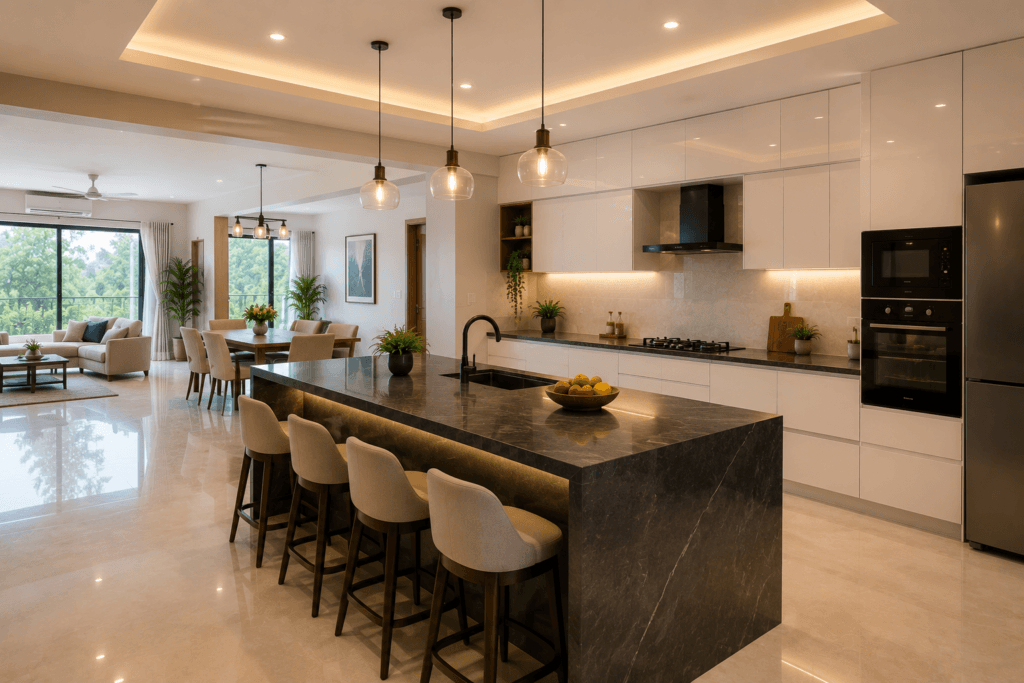
A central island counter-freestanding or connected to the main kitchen-creates an additional workspace in the middle of an open-plan kitchen.
Best for: Large, open-plan homes with 150+ sq ft of kitchen + living area combined. Works best in luxury apartments, independent homes, villas, and penthouses. Needs at minimum 3–4 feet of clearance on all sides of the island for comfortable movement.
What it gets right: The island is a social space as much as a cooking space. You can prep on one side while family sits at the other. It becomes the natural hub for casual meals, homework, and conversation. Add a hob or sink to the island and it becomes a fully functional second station.
What to watch: An island with a hob needs a dedicated chimney or downdraft ventilation-the standard wall-mounted chimney cannot reach it. That adds cost. An island with a sink needs a plumbing line run through the floor or wall-another civil work item. If your kitchen is under 150 sq ft, skip the island. A peninsula (island attached to the main counter on one side) achieves a similar social effect in less space.
Get started with Beautiful Homes
For expert design consultation, send us your details and we’ll schedule a call
How to Choose: A Practical Decision Framework
Here is a simple way to decide-no jargon, no guesswork.
Step 1-Measure your kitchen floor space: Under 70 sq ft: straight. 70–120 sq ft: parallel or L-shaped. 120–180 sq ft: U-shaped. 150+ sq ft open plan: island.
Step 2-Assess the room shape: Long and narrow? Parallel. Square-ish? L-shaped or U-shaped. Open to living area? L-shaped with a peninsula, or island.
Step 3-Think about how you cook: Solo cook? Straight or L-shaped. Two people cook together regularly? Parallel or U-shaped. You love hosting and want the kitchen to be social? Island or peninsula.
Step 4-Open or closed: Want the kitchen to connect to the living/dining area? L-shaped (or island). Want a closed, private kitchen? Parallel or U-shaped.
Step 5-Check the aisle width: Any layout with two counter runs needs at least 3.5 feet between them. Measure before you commit to parallel or U-shaped.
One thing that matters more than layout choice: The corner solution in L and U kitchens. Homeowners who skip the magic corner unit lose 8–10 cubic feet of usable storage in each dead corner. That’s roughly equivalent to 3–4 base cabinets. Budget for it at the design stage-it costs ₹12,000–₹25,000 per corner but is almost always worth it.
When you’re ready to plan your kitchen, Bhumim’s team designs modular kitchens across Dehradun, Haridwar, Noida, Roorkee, and Rishikesh-with BWP-grade plywood carcasses, Blum hardware, and layouts specifically planned for Indian cooking habits.
Materials That Work Across All Layouts
Layout determines function. Materials determine how long that function lasts.
Carcass (the cabinet box): BWP-grade plywood (IS:303 certified) is the right choice for Indian kitchens. It handles the humidity and moisture exposure that Indian cooking generates-especially near the sink and hob-without swelling or delaminating. Standard particle board costs less but typically needs replacement within 5–7 years in kitchens with regular use. In Bhumim’s kitchens, 18mm BWP-grade plywood is used for all carcass construction.
Shutters (the cabinet doors): Laminate is the most practical-durable, hundreds of finishes, easy to clean, cost-effective. Acrylic gives a high-gloss, reflective finish that looks striking but shows fingerprints more. Membrane and PU finishes are mid-tier premium options. The finish you see in the showroom is always more fingerprint-free than the finish in your kitchen after six months of daily cooking.
Hardware: Soft-close Blum hinges and drawer runners last 10–15+ years under daily use. Basic market hinges start failing around year 3–5. This matters more in high-use drawers-spice pull-outs, base cabinet drawers near the hob-than in overhead cabinets. Bhumim kitchens use Hafele, and Blum hardware depending on the project and budget.
Countertops: Granite handles direct heat from Indian cooking (placing a hot kadai directly on the surface) better than quartz. Quartz needs less maintenance, resists staining, and doesn’t need sealing. For Indian kitchens with heavy cooking, granite at the cooking zone and quartz at the prep/cleaning zone is a practical combination.
Frequently Asked Questions
For small apartments (80–120 sq ft kitchen), the L-shaped layout is the most popular choice-it creates a natural work triangle, leaves two sides open for movement, and works well in both open-plan and closed kitchen arrangements. For very narrow kitchens under 8 feet wide, the parallel (galley) layout is more efficient and actually gives you more counter space per sq ft than L-shaped.
An island kitchen needs at least 150 sq ft of combined kitchen and open-plan area, with a minimum of 3–4 feet of clearance on all sides of the island. Any less and the kitchen becomes difficult to navigate. If your space is under 150 sq ft, a peninsula (island attached to one wall) gives a similar effect in less space.
Yes-the parallel kitchen is arguably the best layout for Indian cooking. The two opposite counters create a natural division between the wet zone (sink, prep, cleaning) and the dry cooking zone (hob, chimney, spice storage). This separation reduces the clutter and chaos of multi-dish cooking. The aisle needs to be at least 3.5 feet wide; 4–5 feet is ideal.
The work triangle connects your hob, sink, and refrigerator-the three points you move between most during cooking. When each leg of the triangle is between 4 and 9 feet, movement is efficient and fatigue is reduced. L-shaped, U-shaped, and well-planned parallel kitchens all implement the work triangle effectively. A straight kitchen does not form a triangle-it uses a linear flow instead, which is acceptable for small spaces.
U-shaped kitchens give the most storage, with countertops and cabinets running along three walls. The two corners present the only weakness-both need magic corner units or Le Mans carousels to be properly accessible. L-shaped kitchens are second in storage capacity, with one corner to solve.
An island is a freestanding counter with clearance on all four sides. A peninsula is an island that connects to the main kitchen counter on one end-accessible on three sides instead of four. A peninsula requires less space than a true island and is a practical option for kitchens of 120–150 sq ft where a full island would be too cramped.
Standard modular kitchen counter height in India is 850mm (34 inches) from floor level. This is comfortable for most adults of average height. Taller users (above 5’10”) often prefer 900mm counters to avoid back strain during extended cooking. The counter height is typically customized at the design stage-confirm this with your manufacturer before production.
Minimum clearance between two parallel counter runs is 3.5 feet (42 inches). Less than this and two people cannot pass each other comfortably. 4–5 feet is optimal. More than 5 feet starts reducing efficiency-you walk more than needed between the two counters.
Yes, especially with smart storage planning. For large families cooking together, add a tall pantry unit at one end of the L and a corner magic-corner unit to maximize the inside corner. If the kitchen is above 120 sq ft, consider a U-shaped layout instead-the additional third wall of countertop makes a significant difference for multiple-cook households.
Not typically. U-shaped kitchens need at least 120 sq ft and 4 feet of clearance between the two parallel arms. In smaller homes, a U-shaped layout results in a cramped workspace. For small homes, L-shaped or parallel layouts work better.
Straight and parallel kitchens are the easiest to clean-fewer corners, simpler counter runs, and no corner cabinets that trap grease. L-shaped and U-shaped layouts have inside corners that need attention, especially where the countertop meets the wall. Sealed corner units (magic corners, carousels) with smooth interiors are easier to clean than plain corner cupboards.
A standard 10×10 ft modular kitchen takes 45–60 days from design finalization to installation. This includes 15–20 days of factory manufacturing and 7–12 days of on-site installation. Civil work (plumbing changes, wall prep) adds time. Build in a 1–2 week buffer when planning around a move-in date.
About This Article
Published by: Bhumim India Private Limited-Modular Kitchen Manufacturer & Installer, Dehradun
GST: 05AAOCB1784F1ZM | ISO 9001:2015 Certified
Service Areas: Dehradun · Haridwar · Rishikesh · Roorkee · Noida · Ghaziabad
Contact: 08044630777 | hello@bhumim.com
Note: This article is written from Bhumim’s on-ground manufacturing and installation experience. All material recommendations are based on what we use in real kitchens across our service areas.