

Mandir Unit Design for Home - Vastu-Friendly & Modern Pooja Room Ideas
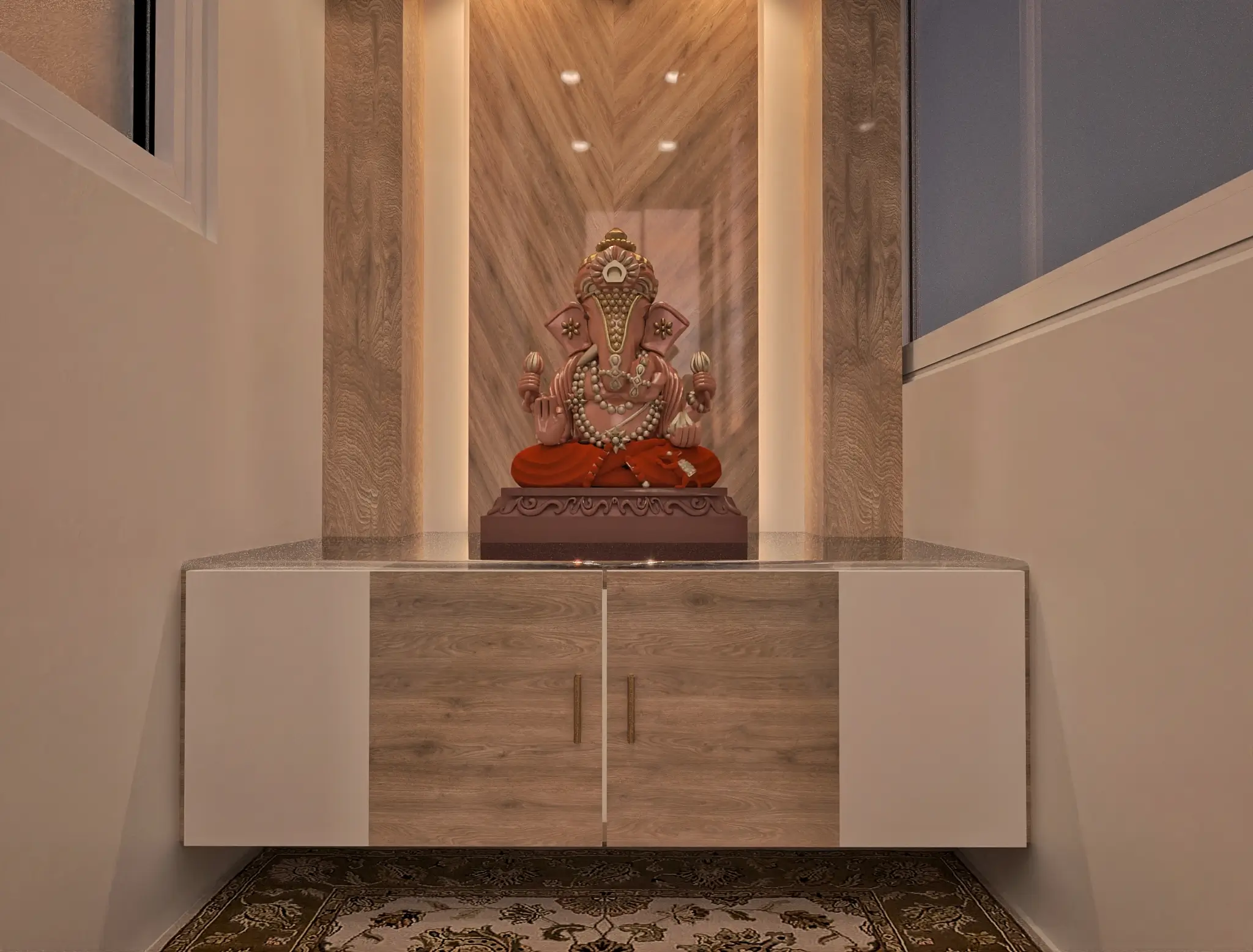
Mandir unit design for home combines vastu guidelines with modern furniture to create a beautiful, dedicated prayer space. The ideal pooja unit faces east or north, uses wood or MDF material, sits at a comfortable height, and includes storage for diyas, agarbatti, and prayer essentials – all within a clean, elegant cabinet design.
Why Your Home Deserves a Proper Mandir Unit
Picture this. It is early morning in Dehradun, the air is cool, and the sound of temple bells drifts in through the window. You sit down for your daily pooja – but your idols are crammed on a dusty shelf, the agarbatti ash falls on your sofa, and there is no proper place to keep anything organised.
Sound familiar?
A well-designed mandir unit design for home solves all of this. It gives your prayer space a proper home – with dedicated shelves, a backlit shrine area, storage for your pooja essentials, and a look that actually matches your living room or bedroom.
The challenge most families face is this: they want something that feels spiritual and traditional, but also looks clean and modern. They want it to fit in a small flat in Rajpur Road or a newly built villa in Sahastradhara Road. And they want it to last for years, not just look good in photos.
That is exactly what Bhumim designs and builds – factory-manufactured, custom-fit mandir units that work for real Indian homes across Dehradun, Haridwar, Rishikesh, and beyond.
In this guide, you will learn everything about choosing, designing, and getting a mandir unit that truly works for your home.
What Is a Mandir Unit and Why Does Design Matter?
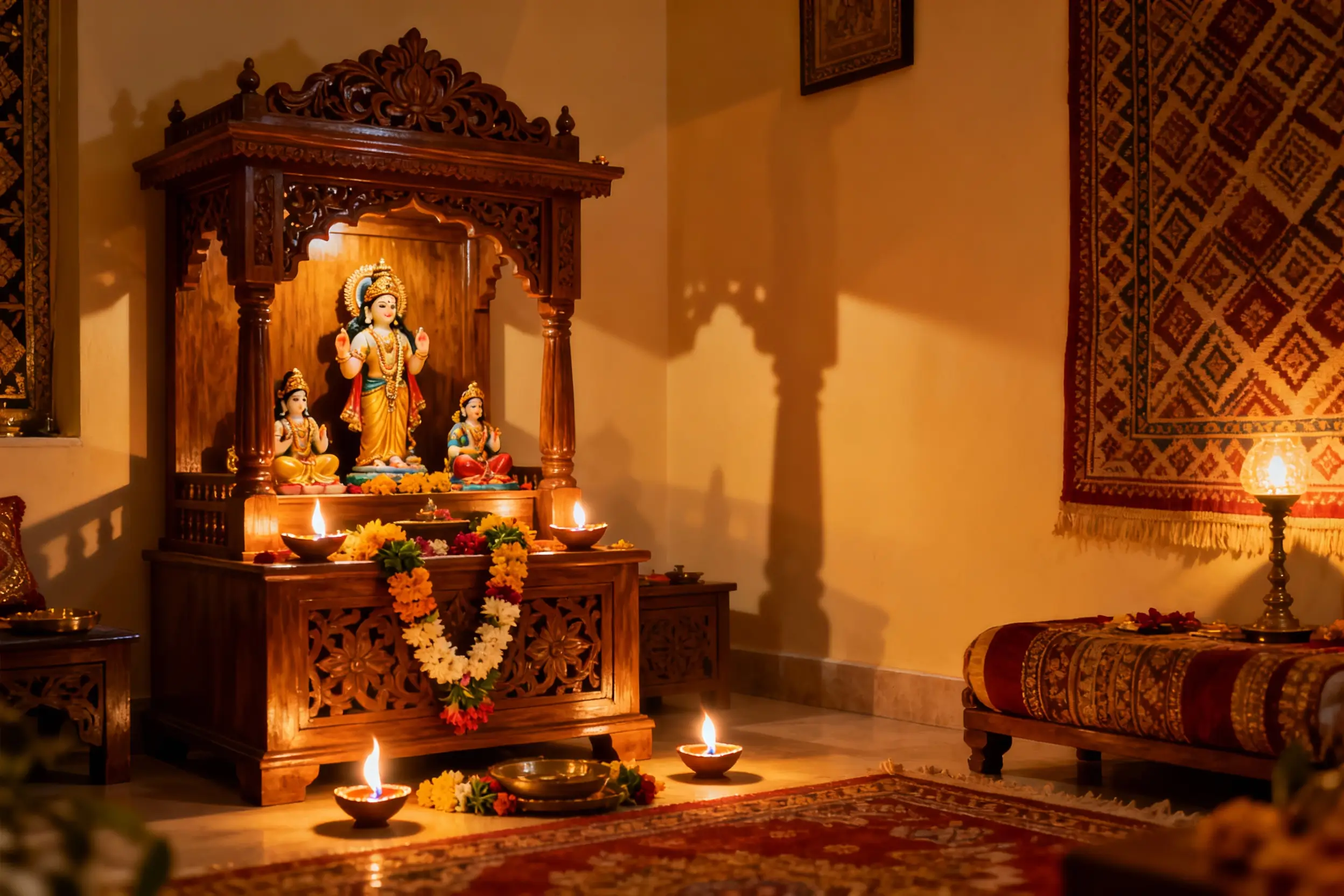
A mandir unit is a dedicated furniture piece – usually a cabinet or wall-mounted shelf system – designed specifically to hold idols, diyas, prayer books, flowers, and other pooja items.
It is not just furniture. For most Indian families, it is the most important corner of the home.
But here is the thing – design really does matter here, not just for looks, but for function. A poorly designed mandir unit creates clutter, makes daily pooja messy, and can even violate vastu principles without you realising it.
A well-designed mandir unit for home on the other hand:
- Keeps everything organised and easy to reach
- Has the right height so you can comfortably sit or stand while praying
- Includes proper ventilation so diyas burn well and smoke escapes
- Looks beautiful and fits naturally into your home’s overall interior
Bhumim designs every mandir unit from scratch, based on your exact room size, ceiling height, and personal preferences – then manufactures and installs it with precision. This is not off-the-shelf furniture. It is made for your home.
Vastu Rules Every Mandir Unit Design for Home Should Follow
The Direction Rule - East or North is Best
According to vastu shastra, the prayer area should ideally face east or north-east. When you place your mandir unit on the north or east wall, you face east while praying – which is considered most auspicious.
Avoid placing the mandir unit on the south wall. The south direction is associated with Yama (the god of death) in vastu, and is generally avoided for prayer spaces.
Height and Placement
The idols should be placed at eye level or slightly above when you are seated. A good rule of thumb is to keep the idol shelf at 3 to 4 feet from the floor if you pray sitting down.
Never place the mandir unit directly on the floor without a raised platform. Even a small base of 4–6 inches is considered respectful.
Avoid These Locations
- Do not place the mandir unit inside a bedroom if possible. If space forces you to, make sure the feet of the bed do not face the idols directly.
- Do not place it under a staircase – this is considered inauspicious in vastu.
- Avoid placing it directly above or below a toilet.
Lighting and Ventilation
Natural light from the east is considered ideal for a mandir space. If natural light is not possible, LED strip lighting inside the unit shelf creates a warm, divine glow and is a very popular choice today.
Good airflow around the mandir area helps the incense and diya function properly without filling the room with smoke.
Get started with Beautiful Homes
For expert design consultation, send us your details and we’ll schedule a call
Types of Mandir Unit Designs - Which One Is Right for You?
1. Wall-Mounted Mandir Cabinet (Modern Design)
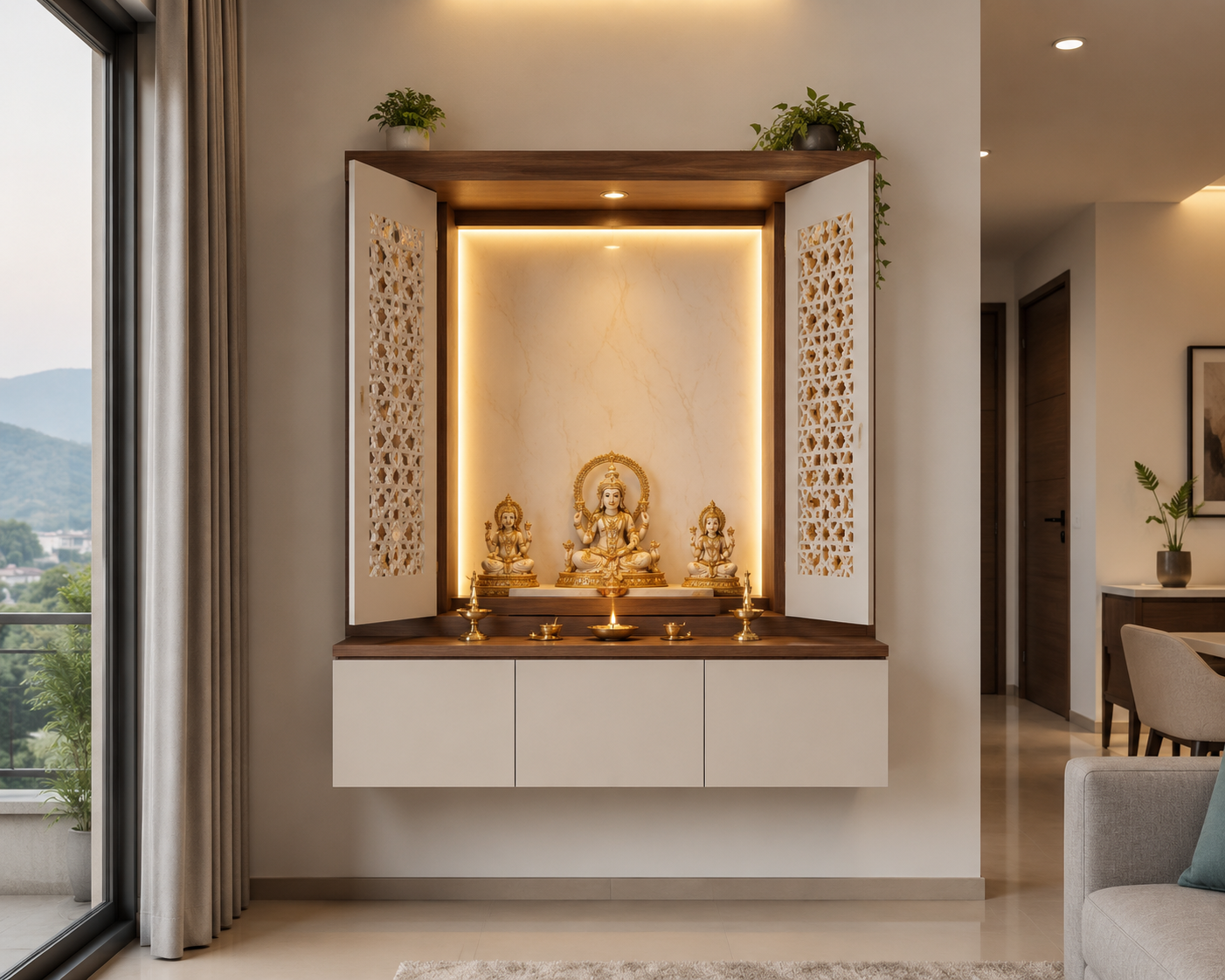
This is one of the most popular mandir cabinet modern designs right now. The unit is fixed to the wall, with a closed cabinet on the lower portion for storing prayer items, and an open shrine area on top with a decorative backboard.
It saves floor space completely – ideal for small apartments in Dehradun where every square foot matters.
Best for: 2BHK and 3BHK apartments, small living rooms, bedrooms
2. Floor-to-Ceiling Mandir Unit (Traditional Style)
A tall, floor-to-ceiling wooden mandir unit is a classic choice for larger homes and villas. These designs often feature carved wooden details, decorative arches, jali (lattice) patterns, and multiple idol shelves.
This style looks grand and feels very traditional – perfect if your home has high ceilings and a classic interior.
Best for: Villas, independent homes, large living rooms, puja rooms
3. Integrated Mandir Unit (Living Room Panel Design)
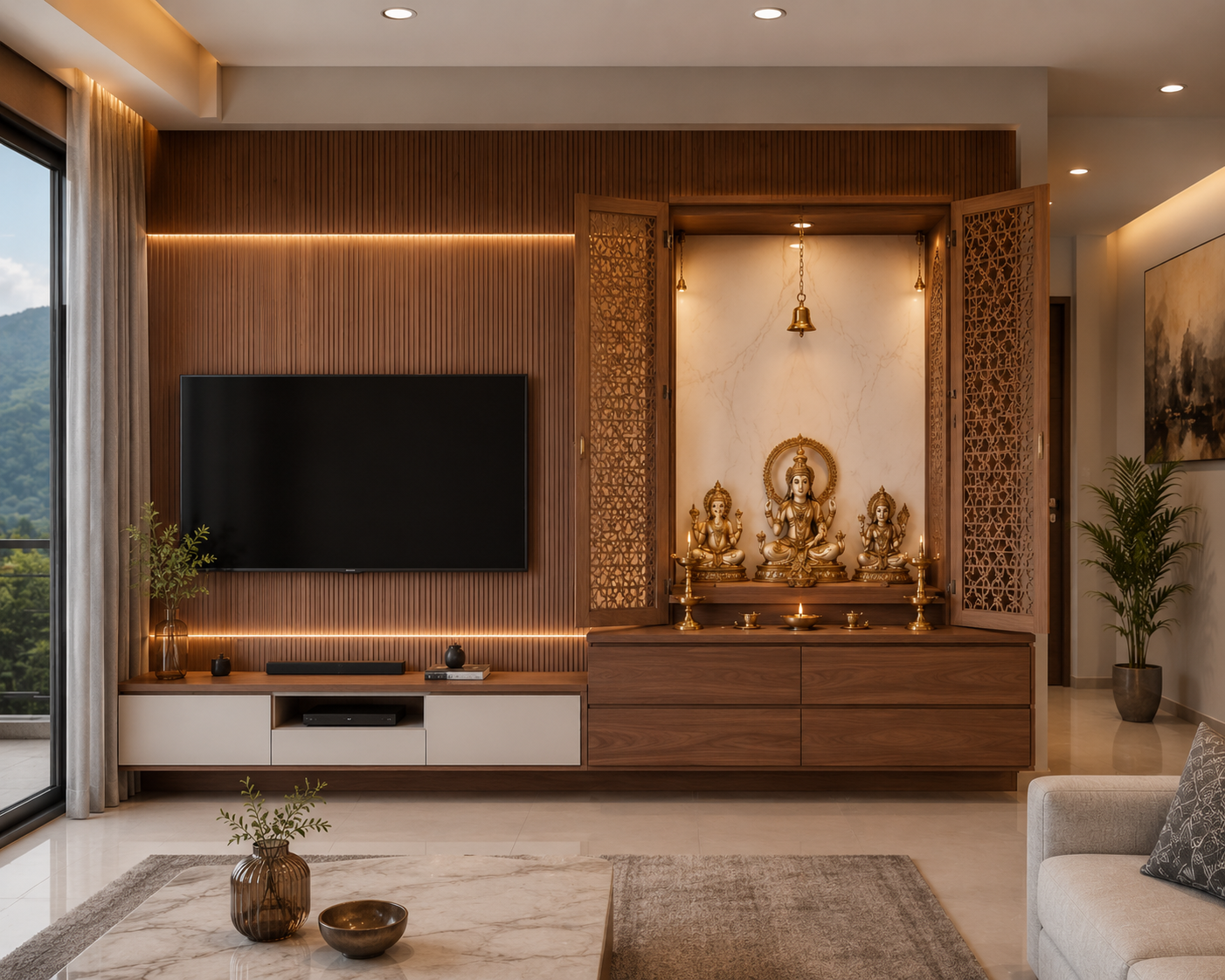
This is a brilliant solution for homes that do not have a dedicated pooja room. The mandir unit is built as part of a larger wall panel – often combined with the TV unit, display shelves, or a crockery unit.
It blends seamlessly into the living room without looking out of place. You get your prayer space and your living room furniture all in one integrated design.
If you are looking at living room furniture ideas for your Dehradun home, this combination approach can be a very smart and space-saving choice.
Best for: Compact homes, modern interiors, people who want everything to flow together
4. Pooja Room Conversion (Dedicated Space)
If you have a small room, a large cupboard space, or an alcove that is going unused, converting it into a full pooja room is an excellent option. Bhumim can design the interior completely – shelves, lighting, storage, and decorative elements – turning that unused corner into a beautiful sacred space.
Best Materials for a Wooden Mandir Unit in India
Material choice is one of the most important decisions when planning a wooden mandir unit in India. Here is what you need to know from a manufacturing standpoint:
BWP Plywood (Boiling Water Proof)
This is the most durable base material for mandir units, especially in regions like Dehradun where humidity levels can fluctuate across seasons. BWP plywood resists moisture, does not warp, and lasts for 15–20 years with proper care.
Bhumim uses ISI-marked BWP plywood as the core structural material for most mandir units.
MDF (Medium Density Fibreboard)
MDF gives a very smooth, clean finish and is perfect for modern, minimal mandir cabinet designs. It takes paint and laminate extremely well. However, it is sensitive to direct water contact, so it works best in dry, well-ventilated spaces.
For a mandir unit that sits in a living room away from humidity, MDF is an excellent and cost-effective material choice.
Solid Wood (Teak, Sheesham, Mango)
Solid wood gives a rich, authentic look that many families prefer for their mandir. Teak and sheesham are particularly popular for traditional carved designs. Solid wood is heavier and more expensive, but it adds a warmth and character that no engineered material can fully replicate.
PU Lacquer and Laminate Finishes
The surface finish protects the material and determines the final look. Options include high-gloss PU paint (for a rich, elegant feel), matte laminates (for a modern look), and natural veneer (for a premium wood grain appearance).
For mandir units specifically, warm tones like walnut, teak, honey oak, and antique white are most commonly preferred.
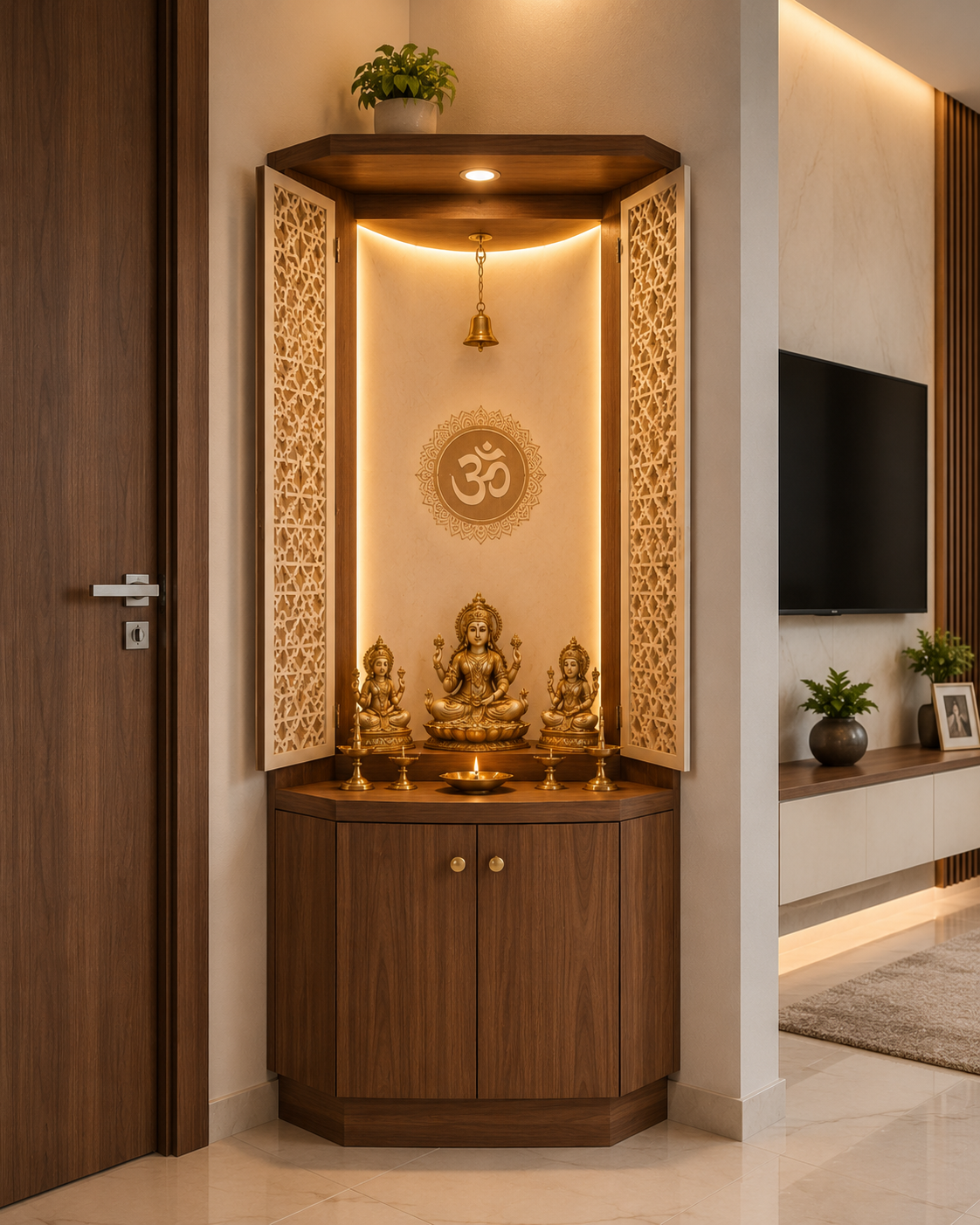
Pooja Room Design for Small Space - Smart Solutions That Work
This is probably the most common challenge Bhumim encounters when working with families in Dehradun – “We want a beautiful mandir, but we only have this small corner.”
Here are some smart solutions for pooja room design in small spaces:
Use Vertical Space
When floor space is limited, go vertical. A tall, narrow mandir unit that extends from waist height to the ceiling uses very little floor area but gives you plenty of space for idols, diyas, and storage below.
Combine with Existing Furniture
As mentioned earlier, integrating the mandir into a wall panel or TV unit is a clever way to give it a proper home without sacrificing extra space. A dedicated section with its own lighting and decorative surround can look very distinct even within a larger panel.
If you are exploring TV unit design ideas for your living room in Dehradun, it is worth discussing an integrated mandir space with your furniture designer at the same time.
Sliding Shutter Mandir Units
For very compact homes, a mandir unit with sliding or folding shutters is extremely practical. You open the shutters during prayer time and close them the rest of the day – keeping the space tidy and dust-free.
This is also useful in bedrooms where you want the mandir to be there but not visually dominate the room.
Corner Mandir Units
A compact corner unit sits neatly in the 90-degree corner of any room and uses space that would otherwise go to waste. These are especially popular in small apartments.
What Works Best for Dehradun Homes?
Dehradun has a unique mix of housing types – old colonial bungalows, new-build apartments in Patel Nagar, spacious villas along Rajpur Road, and independent homes in Sahastradhara, Raipur, and GMS Road. Each of these calls for a slightly different approach to mandir unit design.
Apartments in Dehradun (2BHK and 3BHK)
Most modern apartments in Dehradun do not have a separate pooja room. The mandir unit here needs to be compact, wall-mounted, and preferably integrated into the living room design. White, cream, or warm wood finishes work well with the neutral walls common in Dehradun flats.
Recommendation: Wall-mounted closed-cabinet mandir unit with LED backlight, made in MDF with BWP plywood carcass. Size: 3 feet wide × 5 feet tall. Integrated into the living room feature wall.
Villas and Independent Homes on Rajpur Road
These homes typically have more space and a more premium aesthetic. Families here often want a dedicated mandir room or a large floor-to-ceiling mandir unit in the living or dining area.
Recommendation: Solid teak or sheesham mandir unit with traditional carvings, glass shutters, and multiple shelf levels. Can be 4–6 feet wide with a raised platform base.
Homes in Sahastradhara Road and Raipur Area
These areas have a mix of independent houses and newer residential complexes. Families here tend to have multi-generational setups, and storage around the mandir is very important – space for thalis, diyas, incense boxes, flowers, and seasonal pooja items.
Recommendation: Floor-standing mandir unit with a dedicated shrine above and a closed storage cabinet below with pull-out drawers for organisation.
Humidity and Weather Considerations
Dehradun receives significant monsoon rainfall and the humidity can be high from July to September. For this reason, all mandir units installed by Bhumim in this region use BWP (boiling water proof) plywood for the structural parts. Wooden surfaces are sealed with PU coating to prevent moisture absorption and warping over time.
Large Family Storage Requirements
Many Dehradun families are joint families or have frequent guests during festivals. This means the mandir unit needs generous storage – for multiple thalis, seasonal decorations, puja books, and more.
Bhumim often adds deep pull-out drawers at the bottom of the mandir cabinet, which is both practical and keeps everything out of sight when not in use.
How to Plan Your Mandir Unit Design for Home: A Step-by-Step Guide
Step 1: Choose the Right Wall and Direction
Start by identifying a north or east-facing wall in your home. Measure the available width and height. Note any switches, windows, or vents that might affect placement.
Step 2: Decide on the Style
Do you want a traditional wooden look or a modern minimal design? Look at the overall interior of your home. The mandir unit should feel like it belongs there – not like it was placed as an afterthought.
Step 3: Plan the Shrine Area
Decide how many idols you will keep. This determines the shelf size and height. Taller idols (above 12 inches) need more vertical clearance per shelf.
Step 4: Think About Storage
List everything you store for daily pooja – diyas, matches, agarbatti, kumkum, flowers, thali, bell, and books. Plan how many drawers or shelves you need to hold all of this comfortably.
Step 5: Choose the Material and Finish
Based on your budget and location, choose from BWP plywood, MDF, or solid wood. Pick a finish that complements your room – a walnut veneer, a white lacquer, or a natural teak tone.
Step 6: Plan the Lighting
Add a warm LED strip light (2700K–3000K colour temperature) inside the shrine area. This creates a beautiful glow and highlights the idols beautifully, especially during evening prayer.
Step 7: Get a 3D Design Done
Before manufacturing begins, ask for a 3D visualisation. Bhumim provides 3D design previews so you can see exactly how the mandir unit will look in your space before a single piece of wood is cut.
Step 8: Manufacturing and Installation
Bhumim manufactures the unit at its factory with precision CNC machinery, then delivers and installs it at your home. The entire process – from design approval to installation – typically takes 3 to 6 weeks.
Common Mistakes People Make with Mandir Unit Design
Placing the mandir in the wrong direction. Many people place their pooja corner wherever is convenient, without checking vastu guidelines. Always confirm the direction before finalising placement.
Making it too small. A mandir unit that cannot hold all your idols and items comfortably feels cluttered and frustrating to use every day. Plan generously.
Ignoring ventilation. A closed, unventilated mandir unit causes the smell of incense to linger and can discolour the wood over time. Always leave some open space or a small ventilation gap at the top.
Using the wrong material. Cheap particle board or low-quality MDF can swell and warp within a few years in India’s humid climate. Always insist on BWP plywood as the base material.
Skipping the lighting. Many people plan a beautiful mandir unit but forget to plan for lighting. LED strip lights inside the shrine area make a huge difference to the overall look and feel.
Making it too high. If the idol shelf is too high, you end up looking up at the idol from an awkward angle during prayer. At the same time, make sure the flames from diyas have clearance above – at least 12 inches from any wooden surface.
Expert Tips for the Perfect Mandir Unit Design at Home
Tip 1 – Use a backlit jaali panel. A decorative jaali (lattice) panel as the backdrop for your idol shelf, lit from behind with warm LEDs, creates a stunning visual effect that feels deeply spiritual.
Tip 2 – Add a pull-out prayer platform. A sliding pull-out shelf at the bottom of the shrine section acts as a place to keep your thali during active pooja – and slides back in when done.
Tip 3 – Match the finish to your living room. If your home has warm wood tones throughout (floor, sofa legs, TV unit), carry that same tone into the mandir unit. It creates a sense of cohesion that makes the whole home feel designed with intention.
Tip 4 – Plan for easy cleaning. Smooth, sealed surfaces are far easier to wipe clean of kumkum, haldi stains, and ash than rough or porous materials. PU-coated surfaces are the best choice here.
Tip 5 – Keep wires hidden. If you plan to add a diya warmer (electric), a small light, or a music player inside the mandir unit, plan for hidden cable management from the start. Bhumim can route wiring neatly within the unit so no cables are visible.
Benefits and Challenges of a Custom Mandir Unit
Benefits
It fits your exact space. Unlike ready-made furniture from stores, a custom mandir unit uses every millimetre of your available wall or floor space. No awkward gaps or overhangs.
It matches your home. A custom unit can be designed to perfectly match the colour, finish, and style of your existing furniture – whether that is a modern kitchen, a wardrobe design in Dehradun, or a specific living room aesthetic.
It is more durable. Factory-manufactured units using quality materials like BWP plywood and PU-coated MDF last far longer than most ready-made options.
It gives you proper storage. Customised storage compartments mean every item has a place – reducing the everyday clutter around the prayer area.
It adds to your home’s value. A beautifully installed, built-in mandir unit adds perceived value to your home – especially for families who place high importance on prayer spaces.
Challenges
It takes more time. A custom unit takes 3–6 weeks from design to installation. It is not something you can have in a day.
It requires planning. You need to think through dimensions, placement, materials, and storage needs in advance. This is where Bhumim’s free design consultation process helps.
Budget is higher than ready-made. Custom manufacturing costs more than off-the-shelf options. However, the difference in quality, fit, and longevity makes it a much better long-term investment for most families.
Frequently Asked Questions
Q1: What is the best direction to place a mandir unit design at home as per vastu?
The best direction for a mandir unit design at home is the north-east, east, or north wall. When you place the unit on these walls, you face east while praying, which is considered the most auspicious direction according to vastu shastra. Avoid placing the mandir on the south wall.
Q2: What is the ideal height for a mandir unit in the living room?
The idol shelf in a mandir unit should be at eye level when you are seated – typically between 3 and 4 feet from the floor. If you plan to pray while standing, the shelf can be slightly higher, around 4.5 to 5 feet. The key is that the idol should never be below your waist when you bow or sit.
Q3: Which material is best for a wooden mandir unit in India?
BWP plywood is the most durable structural material for Indian conditions, as it resists moisture and humidity. For the visible surface, you can choose MDF with PU paint for a modern finish, or solid sheesham/teak wood for a traditional look. Bhumim typically combines BWP plywood carcass with MDF or veneer shutters and surfaces.
Q4: Can I have a mandir unit design in a small space or 2BHK flat?
Yes, absolutely. Compact wall-mounted mandir units work beautifully in small homes and 2BHK flats. You can also integrate the mandir into a larger living room wall panel or combine it with the TV unit. Bhumim has designed many pooja room solutions for small-space homes across Dehradun.
Q5: How much does a custom mandir unit cost in Dehradun?
The cost of a custom mandir unit in Dehradun depends on the size, material, and design complexity. A basic wall-mounted MDF mandir unit starts from approximately ₹25,000–₹35,000. Larger floor-to-ceiling units in solid wood or premium finishes can cost ₹60,000 and above. Bhumim offers a free design consultation to give you an exact estimate based on your space and requirements.
Q6: How long does it take to get a mandir unit installed by Bhumim?
From the day you approve the final 3D design, Bhumim typically takes 3 to 6 weeks to manufacture and install the mandir unit. This includes manufacturing at the factory, quality checks, delivery to your home in Dehradun or nearby areas, and professional installation.
Q7: Is it okay to keep the mandir unit in the bedroom?
Vastu generally recommends keeping the mandir in the living room, kitchen area, or a dedicated prayer room. However, if space is a constraint, the bedroom is acceptable – with one important rule: the feet of any bed in the room should not point directly toward the idols. A wall-mounted unit or a closed-shutter cabinet design works best in a bedroom.
Q8: Can I integrate a mandir unit with my TV unit or living room furniture?
Yes, and this is a very popular option in modern Indian homes. An integrated wall panel that includes both the TV unit and the mandir section is a smart, space-saving solution. Bhumim regularly designs and manufactures such integrated setups, giving each section a distinct identity while keeping the overall look unified. You can also explore ideas from our living room furniture ideas guide for Dehradun homes.
Key Takeaways
- Direction matters: Place your mandir unit on the north or east wall for vastu compliance. Avoid the south wall.
- Height matters: The idol shelf should be at comfortable eye level – around 3 to 4 feet from the floor when seated.
- Material matters: Use BWP plywood for the structure and MDF or solid wood for surfaces, depending on your style and budget.
- Storage matters: Plan dedicated drawers and closed shelves for diyas, thalis, agarbatti, and seasonal items.
- Lighting matters: Warm LED strip lighting inside the shrine area transforms the look and feel of any mandir unit.
- Small spaces can be solved: Wall-mounted units, corner designs, and integrated panels all work beautifully for compact homes.
- Dehradun homes need moisture-resistant materials: BWP plywood and PU-coated surfaces are essential for longevity given the city’s humidity levels.
- Custom is better: A factory-made, custom-fit mandir unit lasts longer, fits better, and looks more integrated than any ready-made alternative.
Conclusion: Your Prayer Space Deserves Better
Your mandir is not just a piece of furniture. It is the heart of your home – the first place you visit in the morning and the last thing you see before you sleep. It deserves to be designed with the same care and thought you give to your kitchen, your wardrobe, or your living room.
Getting the mandir unit design for home right means thinking about direction, height, material, storage, and lighting together – not separately. It means choosing a design that respects tradition while fitting naturally into your modern home.
Bhumim specialises in designing, manufacturing, and installing custom mandir units across Dehradun, Haridwar, Rishikesh, Roorkee, and Noida. We handle everything – from the first 3D design sketch to the final installation at your home. You do not need to visit a store and pick from limited options. You tell us your space, your style, and your requirements – and we build it for you.
Whether you live in a compact 2BHK apartment in Dalanwala, a villa on Rajpur Road, or a house in Sahastradhara, we have designed mandir units that fit perfectly and last for years.
Want to see what your mandir unit could look like? Explore Bhumim’s mandir unit designs or contact our team for a free design consultation – and let us create a prayer space that truly feels like home.
You can also explore Bhumim’s complete home furniture solutions to see how a mandir unit can be beautifully coordinated with the rest of your home.
About This Article
Published by: Bhumim India Private Limited-Modular Kitchen Manufacturer & Installer, Dehradun
GST: 05AAOCB1784F1ZM | ISO 9001:2015 Certified
Service Areas: Dehradun · Haridwar · Rishikesh · Roorkee · Noida · Ghaziabad
Contact: 08044630777 | hello@bhumim.com
Note: This article is written from Bhumim’s on-ground manufacturing and installation experience. All material recommendations are based on what we use in real kitchens across our service areas.