

Modular Kitchen Buying Guide & Checklist
A modular kitchen buying guide should walk you through five decisions in order: layout, carcass material, hardware quality, manufacturer credibility, and realistic cost factors. Get these five right before you sign anything, and the finish, layout, or brand of hob becomes a much smaller risk than most first-time buyers assume.
A modular kitchen buying guide, in the simplest sense, is a structured way to compare kitchen manufacturers on the things that actually affect how long your kitchen lasts – not just how it photographs in a 3D render. Most buyers only discover the gaps (soft-close hinges that fail in a year, plywood that swells near the sink, a “designer” who was really just a salesperson) after installation, when it’s expensive to fix.
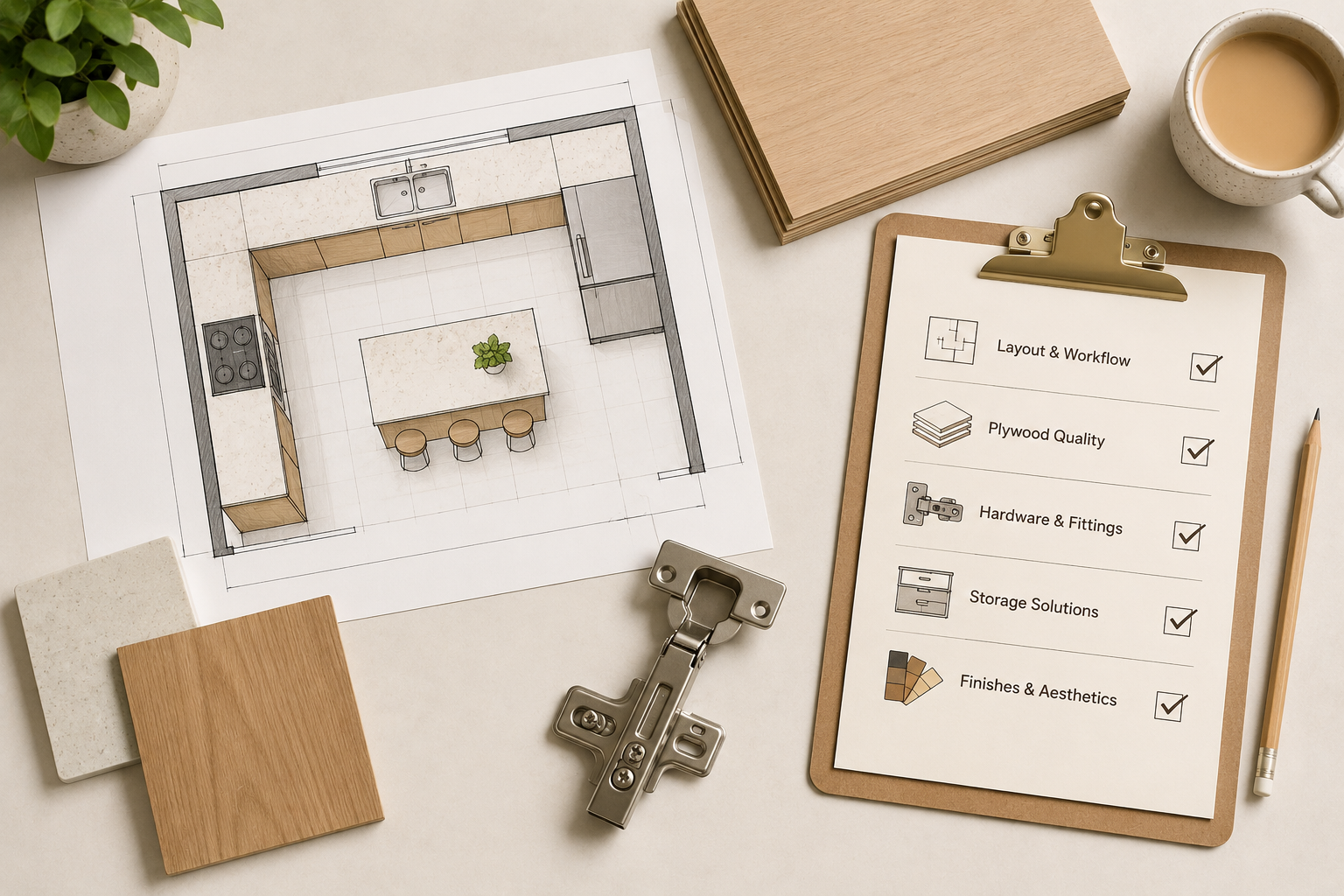
Why a Modular Kitchen Purchase Needs a Checklist, Not Just a Design Sketch
A 3D rendering can make almost any kitchen look identical to the one next to it. What separates a kitchen that holds up for 12 – 15 years from one that starts chipping at year two isn’t the render – it’s the carcass material, the hinge brand, the edge-banding quality, and whether the company installing it also manufactured it. This is exactly why a modular kitchen buying guide has to go deeper than colour swatches and handle styles.
If you’re planning this for a home in Dehradun or nearby hill-station cities, there’s an added layer: monsoon humidity and temperature swings put extra stress on cheap boards and adhesives, so the material checklist below matters even more than it would in a drier climate.
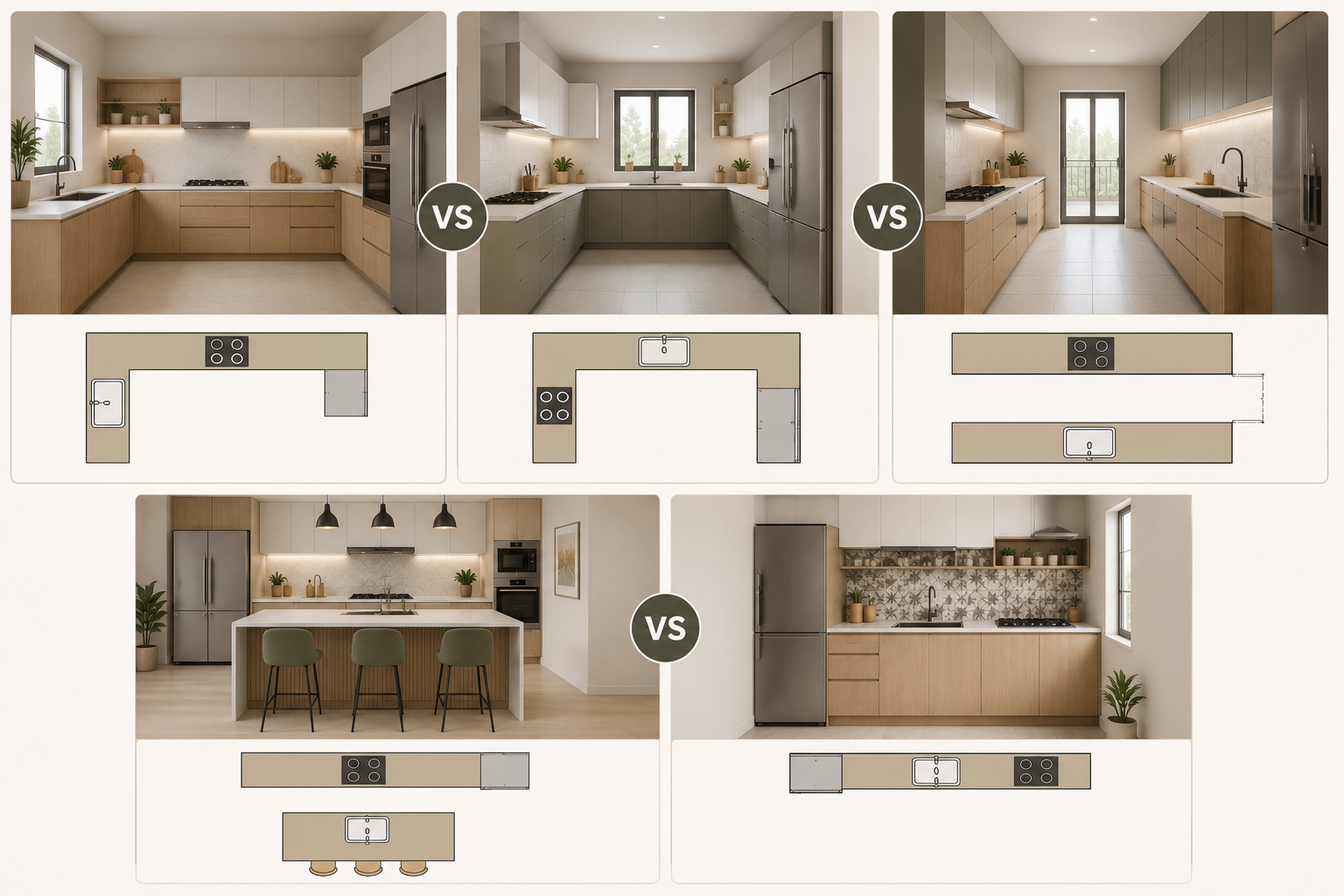
Kitchen Layouts to Shortlist Before You Compare Quotes
Layout decides your workflow, your storage, and – indirectly – your budget, since every extra corner or island adds carcass and hardware cost. Walk through these before requesting quotes so every manufacturer is pricing the same layout, not five different ones:
- L-shaped kitchen – works well for small-to-medium spaces, keeps the work triangle tight. See examples of an L-shaped kitchen design.
- U-shape kitchen – maximises counter and storage for larger kitchens with two adjacent walls plus a back wall; check a U-shape kitchen design if you have the wall length for it.
- Parallel (galley) kitchen – two facing counters, efficient for narrow spaces; browse a parallel kitchen design for aisle-width guidance.
- Island kitchen – needs real floor area (generally 10×10 ft minimum around the island) but adds prep space and a social layout; see an island kitchen design for spacing benchmarks.
- Small/compact kitchen – if you’re working with a tight footprint, a dedicated small kitchen design approach (vertical storage, pull-out units) matters more than the layout label itself.
Common Mistake: Getting quotes for “a modular kitchen” without a locked layout. Two manufacturers pricing two different layouts can look wildly different in cost, and you’ll be comparing apples to oranges.
Materials: The Part of the Buying Guide Most People Skip
This is where a modular kitchen buying guide earns its keep, because material choice is invisible once the shutters are on – until it isn’t.
Carcass (the box behind the shutters):
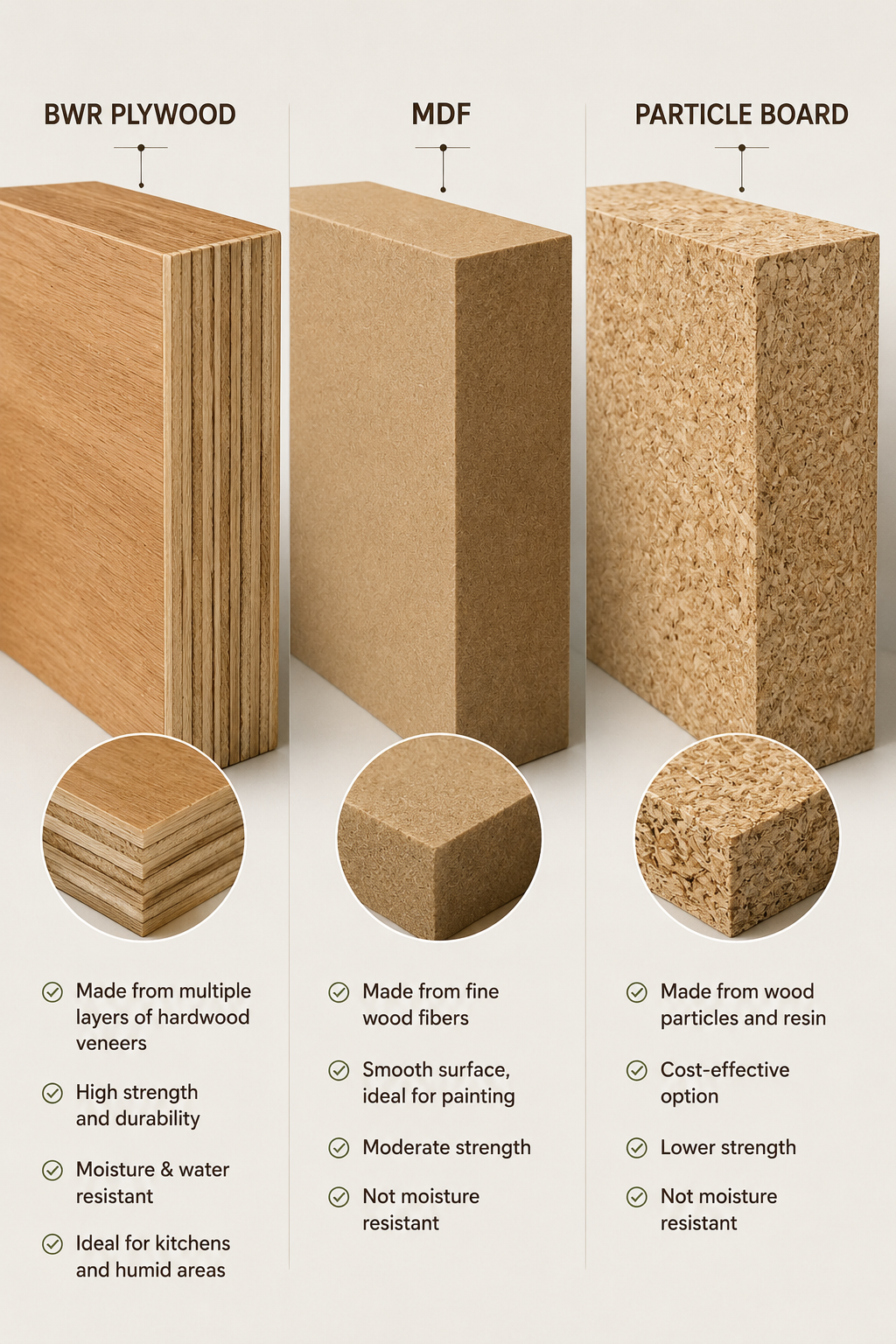
BWR-grade plywood (IS 303)
The most common recommendation for Indian kitchens, bonded with phenolic resin and rated to resist several hours of continuous moisture exposure, which matters directly under the sink and near the hob. The Bureau of Indian Standards’ IS 303 specification is the reference point most manufacturers quote when they say “BWR” or “BWP” grade, so it’s worth asking which grade and licence number your manufacturer is actually using rather than accepting “waterproof plywood” as a description.
MDF (medium-density fibreboard)
Smoother finish, cheaper, but weaker against sustained moisture; fine for wall units, riskier for base units under the sink.
Particle board / pre-laminated
Lowest cost, shortest lifespan in humid zones; acceptable only if budget is the primary constraint and the kitchen sees light daily use.
Shutter finishes: laminate (durable, budget-friendly), acrylic (glossy, shows fingerprints, mid-to-high cost), PU/membrane (smooth matte look, moderate cost), and lacquered glass (glossy reflective finish, needs careful handling, highest cost of the four).
Material | Moisture Resistance | Typical Lifespan | Best For |
BWR Plywood (IS 303) | High | 12 – 15+ years | Base units, sink & hob zones |
MDF | Moderate | 7 – 10 years | Wall units, dry zones |
Particle Board | Low | 4 – 6 years | Tight budgets, low-moisture areas |
Marine/IS 710 Grade | Very high | 15+ years | Extreme humidity, rare in home kitchens |
Hardware and Fittings - the Checklist Inside the Checklist
Ask any experienced modular kitchen buyer where their kitchen actually failed first, and the answer is rarely the shutter – it’s the hardware. This deserves its own checklist within the larger buying guide:
- Hinges – soft-close, named brand (Blum, Hafele are common in India), rated for a minimum cycle count; avoid unbranded hinges even if the quote looks attractive.
- Drawer channels – full-extension, soft-close, weight-rated for the drawer’s intended load (cutlery vs. heavy cookware need different ratings).
- Handles and profiles – check for corrosion resistance, especially near the sink.
- Basket/pull-out units – confirm the wire-basket coating (powder-coated vs. chrome) since uncoated wire corrodes faster in humid kitchens.
- Countertop material – granite, quartz, or solid surface, each with different heat and stain tolerance.
- Sink and hob cutouts – confirm these are factory-cut to spec, not adjusted on-site with a hand tool.
Pro Tip: Ask to see the hardware brand names in writing on the quotation itself, not just verbally during the sales meeting. A written quote that says “branded hinges” without naming the brand is a red flag worth pushing back on.
Get started with Beautiful Homes
For expert design consultation, send us your details and we’ll schedule a call
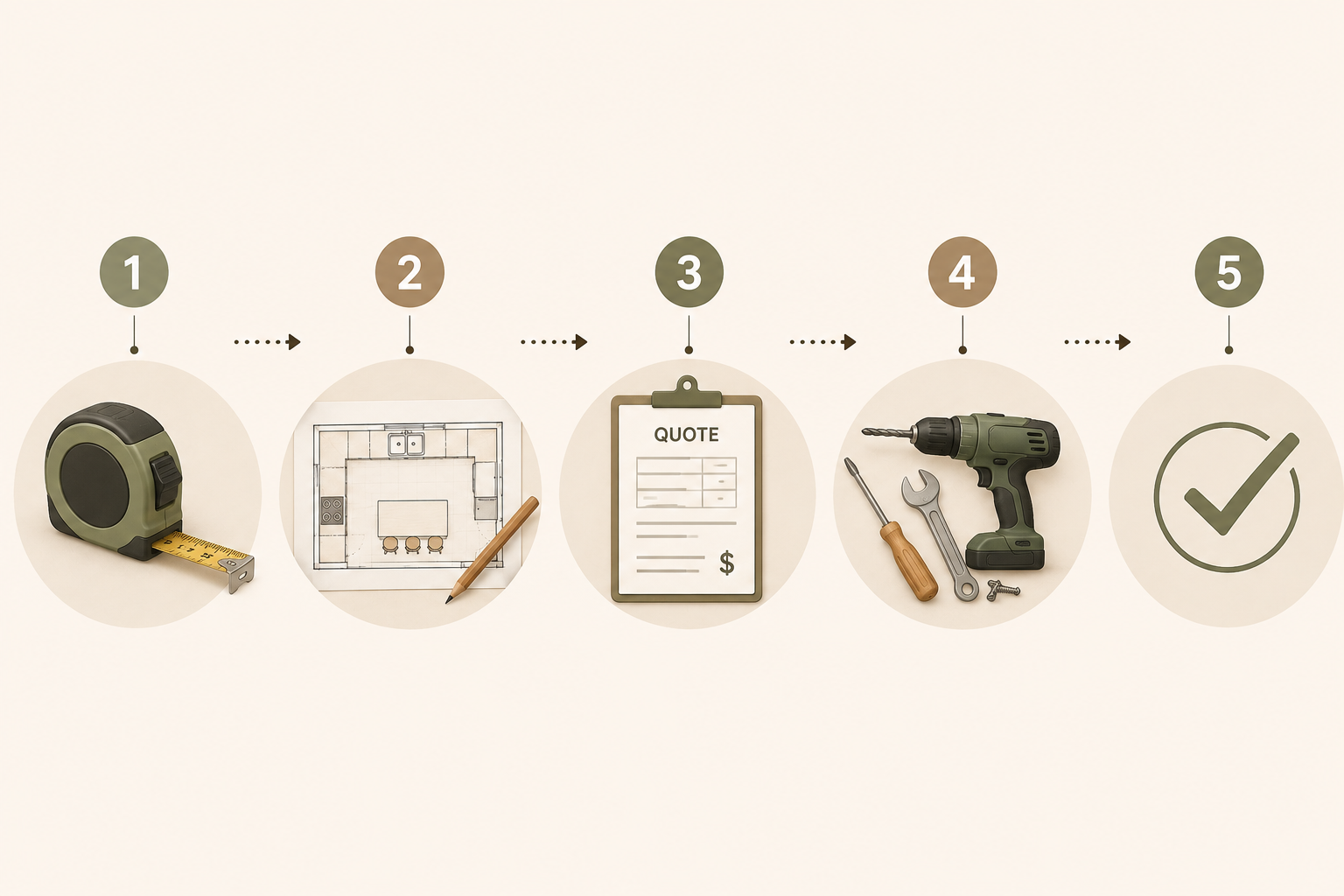
Step-by-Step: How to Actually Buy a Modular Kitchen
- Measure the space and note plumbing, gas, and electrical points before contacting any manufacturer.
- Shortlist 2 – 3 layouts from the section above that fit your space and cooking style.
- Request quotes from 2 – 3 manufacturers for the same layout and material spec, so pricing is genuinely comparable.
- Ask the manufacturer differentiation questions (see the section below) before evaluating price alone.
- Review the 3D design and confirm every hardware brand, board grade, and dimension is written into the quotation – not left as a verbal promise.
- Sign only after cutouts, plumbing points, and electrical points are finalised on the design, since changes after manufacturing starts usually cost extra.
- Schedule installation with a written timeline and confirm who handles post-installation touch-ups.
- Do a handover walkthrough – open every drawer and door, check alignment, and get the warranty terms in writing before final payment.
Cost Factors in a Modular Kitchen Purchase
Modular kitchen pricing varies significantly by city, board grade, hardware brand, countertop material, and layout size – so treat any number you see online (including in this guide) as a rough range, not a quote. As a rule of thumb, the factors that move the price most are:
- Carcass material grade (BWR plywood costs more than particle board)
- Hardware brand (named soft-close hardware vs. generic)
- Countertop material (laminate vs. granite vs. quartz)
- Number of running feet and layout complexity (an island or U-shape typically costs more per square foot than a straight-line kitchen)
- Appliances, if bundled into the same quote
Rather than anchoring to a fixed budget figure, ask each manufacturer for a per-running-foot breakdown by material grade – this makes it far easier to compare two quotes that look different on the surface but are actually pricing similar things.
What to Compare Before Choosing a Modular Kitchen Manufacturer
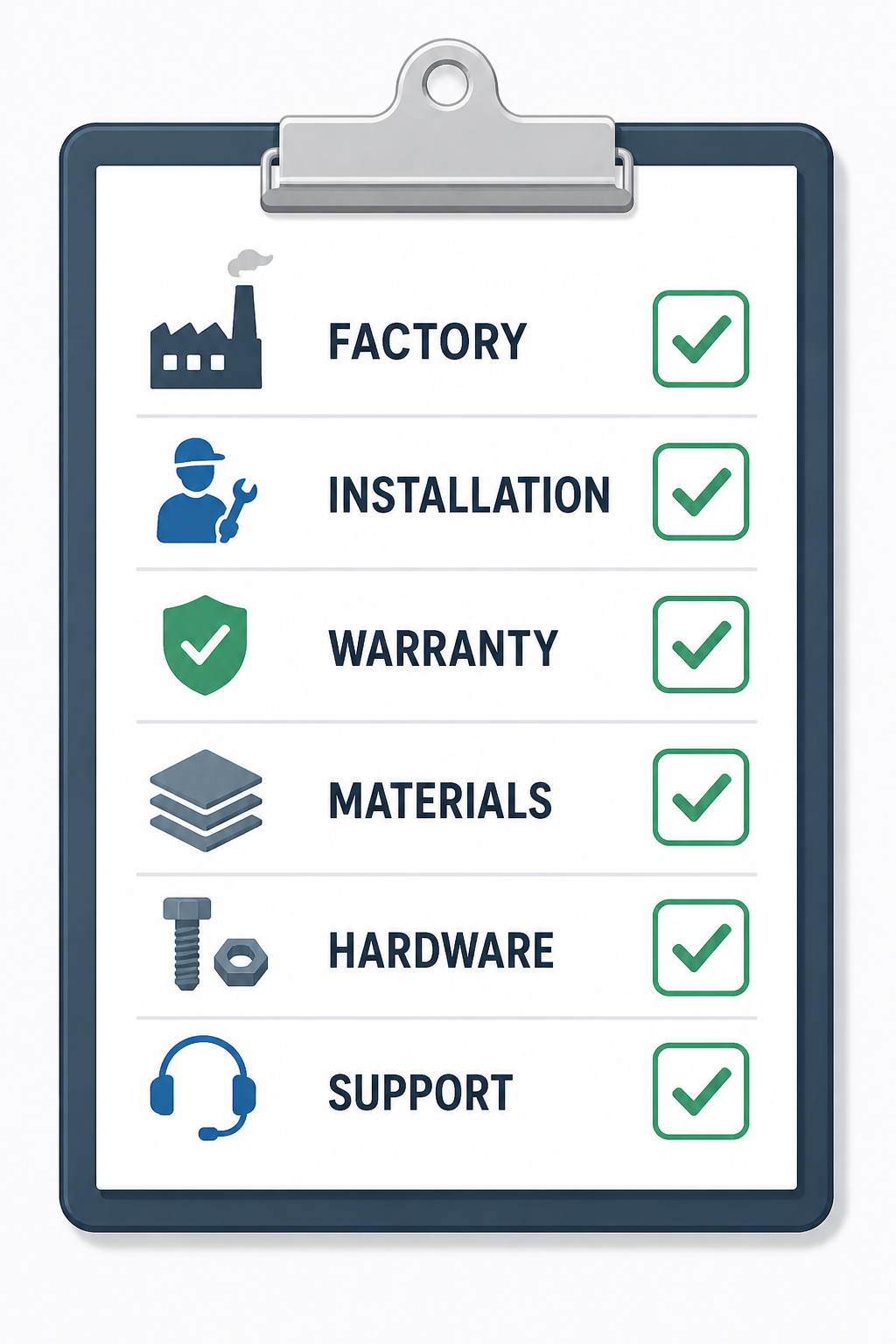
This is arguably the most important section of any modular kitchen buying guide, because the manufacturer matters more than any single material choice. Use this checklist to evaluate any company – Bhumim included:
- Factory ownership – does the company manufacture in-house, or does it outsource to a third-party workshop and resell? In-house manufacturing generally means tighter quality control and clearer accountability if something goes wrong.
- Installation team – an in-house, trained installation team tends to handle cutouts, alignment, and finishing better than a rotating pool of subcontractors.
- Warranty terms – get the coverage period and what it actually covers (hardware, board, or both) in writing rather than relying on a verbal “long warranty” claim.
- Material sourcing – ask which plywood grade (IS 303 BWR/MR) and which hardware brands are used, and whether they’re willing to name suppliers.
- Hardware brands – named brands (again, look for Blum, Hafele, or similar internationally recognised names) tend to outlast unbranded alternatives by years, not months.
- After-sales support – how fast do they respond to a hinge or drawer issue six months after installation? Ask for a typical response-time commitment, not just “we’re always available.”
Bhumim, for context, manufactures its own modular kitchens rather than outsourcing and reselling, and its installation team is in-house – but the point of this checklist is that you should be asking every manufacturer these same six questions, not taking any single company’s word for it.
Common Mistakes to Avoid When Buying a Modular Kitchen
- Comparing quotes without a locked layout – as covered above, this makes price comparison meaningless.
- Choosing shutter finish before carcass material – the part you can’t see matters more than the part you can.
- Accepting verbal hardware promises – get brand names on the written quotation.
- Ignoring plumbing and electrical finalisation before manufacturing starts, which leads to costly on-site adjustments.
- Skipping the factory visit or sample check, if the manufacturer offers one – seeing the actual board and hardware in person catches mismatches that renders hide.
- Underestimating installation timelines – rushed installation is one of the more common causes of misaligned shutters and drawers later on.
How Long Does Modular Kitchen Installation Take?
Installation timelines vary by kitchen size and manufacturing backlog, but as a general pattern: measurement and finalising the design typically take 1 – 2 weeks, manufacturing runs 3 – 5 weeks depending on order volume, and on-site installation itself usually takes 3 – 7 days for an average kitchen. Ask your manufacturer for a written timeline rather than an estimate given verbally, since manufacturing delays are one of the more common sources of frustration in this process.
Which Material Is Best for Modular Kitchen Cabinets?
For most Indian homes, BWR-grade plywood under IS 303 is the widely recommended baseline for base units and any cabinet near the sink or hob, given its moisture resistance. MDF is a reasonable, more affordable option for wall units in drier zones of the kitchen. The “best” material genuinely depends on your budget and how much daily moisture exposure that specific cabinet will see – which is why splitting the material choice by cabinet zone (base vs. wall) often makes more financial sense than using one grade throughout.
Local Considerations for Hill-Station and North Indian Homes
If you’re buying for a home in Dehradun, Haridwar, Rishikesh, Roorkee, or the surrounding areas, monsoon humidity is the factor most buyers underestimate. Boards with lower moisture resistance swell, warp, or delaminate faster in these climates than they would in a drier city. Apartment kitchens with limited ventilation face this more acutely than independent villas with cross-ventilation, so ask your manufacturer specifically how their board grade performs in humid conditions rather than accepting a generic national answer.
Benefits of Following a Structured Buying Process
A kitchen bought against a checklist rather than on render appeal tends to deliver on three fronts: it lasts longer (because the carcass and hardware were actually vetted), it costs less to maintain (fewer callback repairs for hinges or swelling boards), and it’s easier to hold the manufacturer accountable (because warranty terms and material grades were documented upfront, not assumed). None of this requires expertise – it just requires asking the six manufacturer-comparison questions and the material questions above before signing anything.
Frequently Asked Questions
Q1: What is a modular kitchen buying guide supposed to cover?
At minimum, layout, carcass material, hardware brands, manufacturer credibility, and cost factors – the five decisions that affect how the kitchen performs after the first year, not just how it looks on day one.
Q2: Is BWR plywood the same as waterproof plywood?
Not exactly. BWR (Boiling Water Resistant) plywood under IS 303 resists sustained moisture well but isn’t fully waterproof; true marine-grade waterproof plywood falls under IS 710 and is rarely needed for home kitchens.
Q3: How much does a modular kitchen cost in India?
It varies too widely by city, material grade, and layout size to quote a single figure reliably – ask manufacturers for a per-running-foot breakdown by material grade instead of comparing flat totals.
Q4: Should I choose MDF or plywood for kitchen cabinets?
Plywood, particularly BWR grade, generally holds up better in moisture-prone zones like under the sink; MDF is a reasonable, more budget-friendly choice for drier wall units.
Q5: How do I know if a manufacturer actually makes their own kitchens?
Ask directly, and ask to see or visit the factory if possible – companies that outsource manufacturing and resell often can’t answer specifics about board grade or hardware sourcing with confidence.
Q6: What warranty should a modular kitchen manufacturer offer?
Warranty terms vary by manufacturer and product category, so there’s no universal number to expect – get the exact coverage period and what it includes (hardware, boards, or both) in writing before signing.
Q7: Are soft-close hinges worth the extra cost?
Generally yes – named-brand soft-close hinges tend to outlast unbranded hardware by years and reduce wear on the cabinet frame itself from slamming.
Q8: Can I mix materials within one kitchen to save cost?
Yes, and it’s a common, sensible approach – using BWR plywood for base units near water/heat sources and a more economical board for drier wall units.
Q9: How long should I expect the whole process to take, from quote to installation?
Roughly 5 – 8 weeks total is a common range (design finalisation, manufacturing, and installation combined), though this depends heavily on manufacturing backlog – always get a written timeline.
Q10: What's the biggest mistake first-time modular kitchen buyers make?
Comparing price before comparing layout and material specs – two quotes that look far apart in cost are often pricing two different kitchens entirely.
Key Takeaways
- Lock your layout before requesting quotes so comparisons are apples-to-apples.
- Carcass material (BWR plywood vs. MDF vs. particle board) matters more long-term than shutter finish.
- Get hardware brand names written into the quotation, not just promised verbally.
- Use the six-question manufacturer checklist (factory ownership, installation team, warranty, sourcing, hardware, after-sales) on every company you evaluate.
- Treat all pricing as a range that depends on material grade, hardware, and layout – not a fixed number.
- A structured buying process, not a bigger budget, is usually what prevents the most common kitchen regrets.
Conclusion
A modular kitchen buying guide is really just a way of slowing down a decision that most people rush because the render looks finished. Layout, material grade, hardware, and manufacturer credibility are the four things worth genuinely comparing before price – everything else is finish and personal taste. If you’re planning a kitchen in Dehradun, Haridwar, Rishikesh, Roorkee, Noida, or Ghaziabad and want to walk through this checklist against your own space, Bhumim’s team can go through the layout and material options with you – no obligation to commit on the first conversation.
About This Article
Published by: Bhumim India Private Limited-Modular Kitchen Manufacturer & Installer, Dehradun
GST: 05AAOCB1784F1ZM | ISO 9001:2015 Certified
Service Areas: Dehradun · Haridwar · Rishikesh · Roorkee · Noida · Ghaziabad
Contact: 08044630777 | hello@bhumim.com
Note: This article is written from Bhumim’s on-ground manufacturing and installation experience. All material recommendations are based on what we use in real kitchens across our service areas.