

Handleless Ultra-Matte Kitchen Shutters: Complete Buyer & Design in 2026
Handleless ultra-matte kitchen shutters are cabinet doors built without protruding handles, featuring a non-reflective soft-touch surface with a gloss level below 5 Gloss Units (GU)-opened via recessed aluminum Gola channels, integrated J-pull grooves, or push-to-open mechanisms. They suit Indian kitchens well because the matte polymer surface is non-porous, easy to wipe, and far more forgiving of fingerprints and cooking grease than any high-gloss finish.
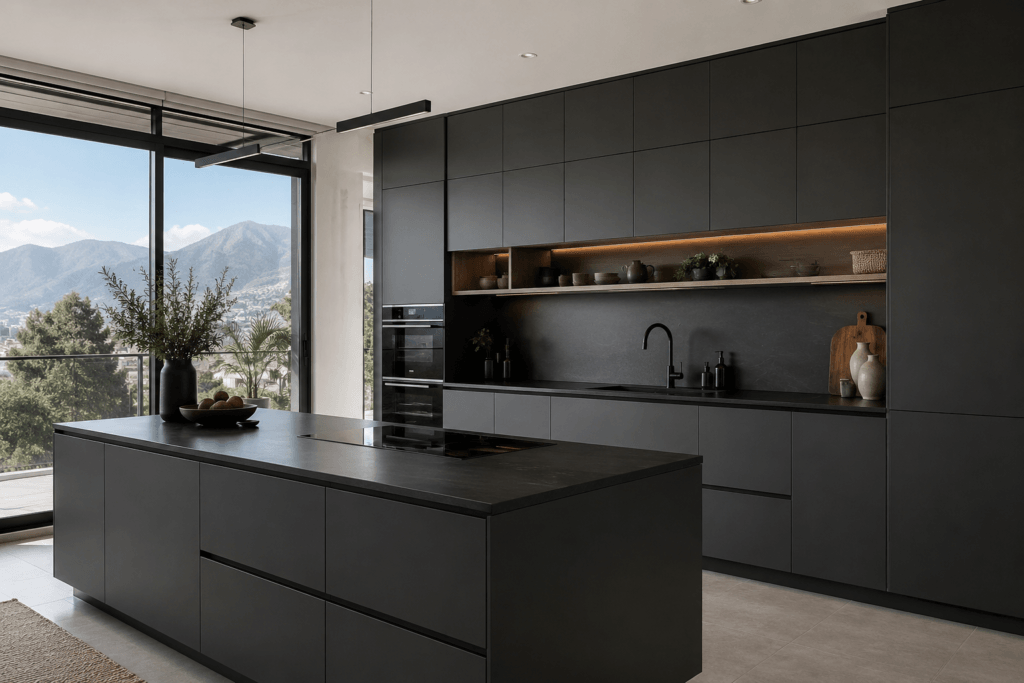
Why Handleless Matte Kitchens Are Everywhere Right Now
A client in Dehradun once told us she’d spent three months staring at kitchen catalogue photos before realizing the kitchens she kept circling had one thing in common: no handles. Not a single one. She didn’t know what Gola profiles were. She didn’t know the surface finish was ultra-matte acrylic. She just knew those kitchens looked clean, calm, and like someone actually thought about the design instead of assembling it from leftover hardware.
That feeling is exactly why handleless ultra-matte modular kitchens have moved from a premium niche to one of the most-requested options across Indian homes in 2026. In Delhi NCR alone, matte textured laminates now account for over half of modular kitchen orders, and handle-less J-profile and Gola-profile shutters have replaced traditional handles as the default choice in new apartment projects across Noida, Ghaziabad, and Dehradun.
This guide covers every material, mechanism, and maintenance question you need answered before making a decision-including the real cost per square foot in Uttarakhand and NCR, and the one material mistake we see homeowners in humid climates make more than any other.
What Exactly Is an Ultra-Matte Surface?
Ultra-matte means a surface gloss level below 5 GU (Gloss Units) measured at 60 degrees. Standard matte laminates typically read between 10 and 15 GU-you’ll notice a soft sheen under direct light. Ultra-matte surfaces absorb light almost entirely, producing that distinctive velvety, non-reflective look that photographs beautifully and feels smooth to the touch.
The practical difference matters in an Indian kitchen. Under a standard matte laminate, cooking grease from a tadka session catches the light and shows. On a true ultra-matte acrylic or anti-fingerprint PU surface, the same greasy smudge is far less visible-and wipes off cleanly with warm water and a soft cloth.
Three materials reach this ultra-matte threshold reliably:
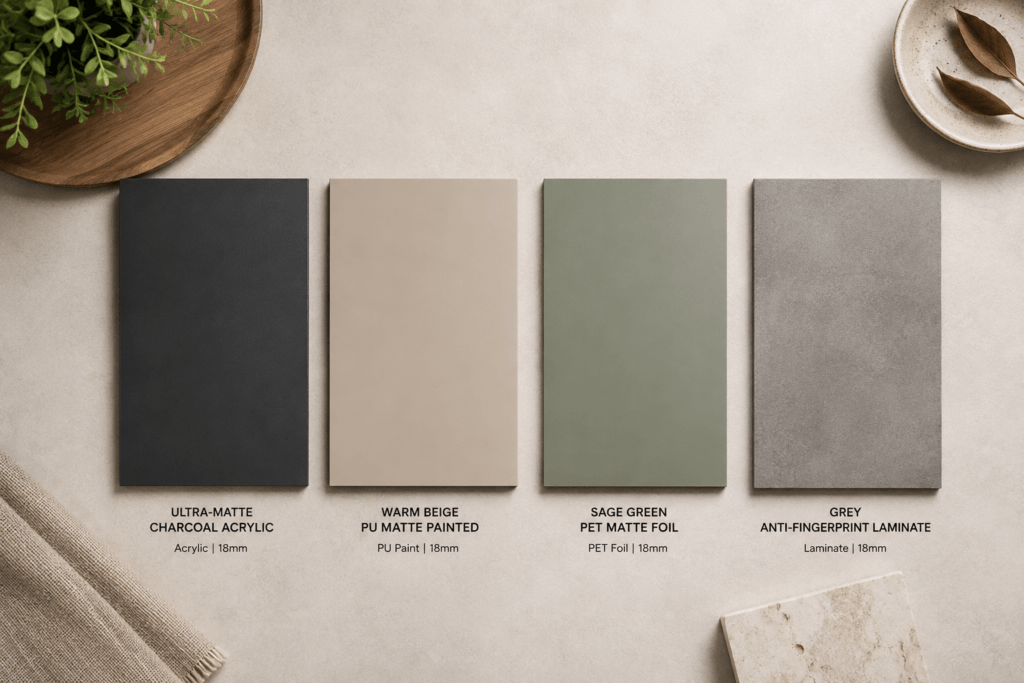
- Ultra-matte acrylic sheets-polymer panels with nanotech or electron beam-cured (EBC) surface treatment, achieving below 5 GU consistently. Leading acrylic surface manufacturers achieve this through electron beam-cured (EBC) polymer treatment.
- PU (Polyurethane) spray paint-applied in a controlled factory environment and baked at high temperatures; gloss level is fully adjustable, including ultra-matte specifications.
- Anti-fingerprint matte laminates-engineered decorative sheets with a textured micro-surface; typically 8–12 GU, so technically not ultra-matte but close and much more affordable.
Manufacturer insight: The gloss rating matters more than the name. A shutter sold as “matte acrylic” without a GU specification could be anywhere from 5 to 20 GU. When you’re evaluating material samples, ask your fabricator for the GU rating-or hold the sample under a bright spot light at an angle. A true ultra-matte surface will show almost no sheen at all.
Get started with Beautiful Homes
For expert design consultation, send us your details and we’ll schedule a call
Handleless Mechanism Options: Gola Profile vs. J-Pull vs. Push-to-Open
Handleless means no protruding hardware on the shutter face. But “handleless” covers three mechanically different systems, and the choice between them affects cost, cleaning effort, and how the kitchen looks from across the room.
Gola Profile-The Recessed Aluminum Channel System
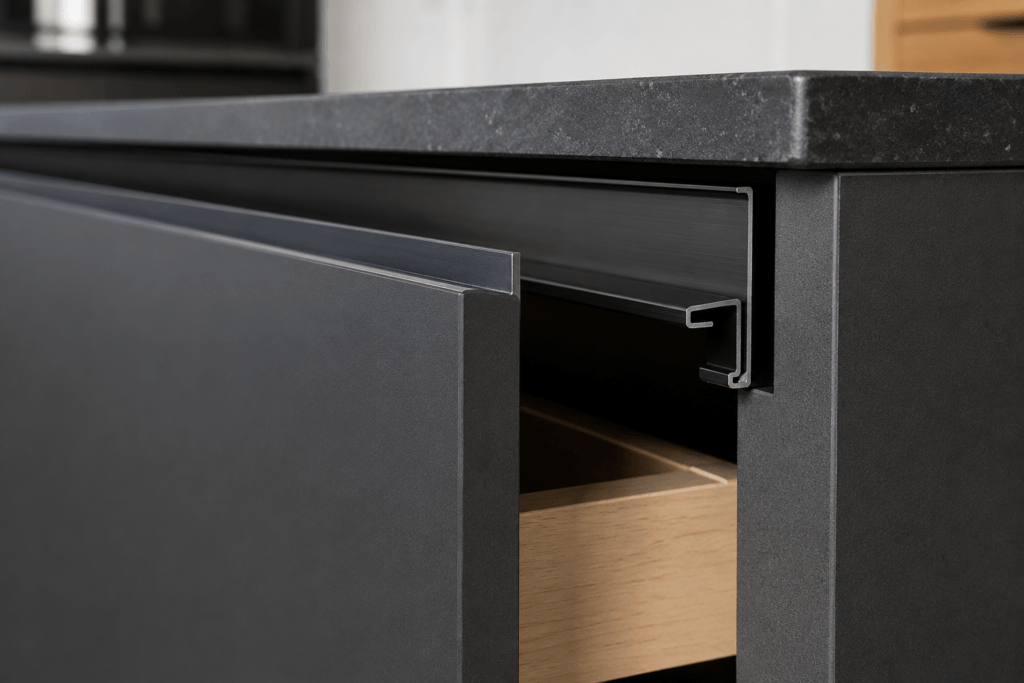
A Gola profile is an aluminum channel fitted directly into the kitchen carcass (the box structure), not onto the shutter itself. The shutter floats slightly in front of the channel gap, and fingers reach behind it to pull. The gap sits invisibly until your hand finds it.
Two Gola variants are used in Indian modular kitchens:
- L-Gola (L-profile): Fitted at the top of wall cabinets or below a countertop for a single door or drawer. The channel runs horizontally along one edge.
- C-Gola (C-profile): A double-recessed channel installed between two stacked drawer banks, giving access to both the upper and lower drawer from one shared channel.
Gola profiles in anodized aluminum are available in silver, matte black, rose gold, and brushed gold finishes. The profile itself becomes a subtle design element rather than a handle. On a 10-foot run of base cabinets, a Gola system reduces total cabinet projection into the room by 20–25 mm compared to D-bar or bar handles-which matters in narrow Indian kitchen corridors.
Trade-off to know: Gola channels do collect fine cooking dust over time, especially in open kitchens. A soft microfiber cloth or a narrow feather duster passed through the channel weekly keeps them clean without damage. Dark anodized finishes hide dust accumulation better than bright silver.
J-Pull-The Integrated Bevel Cut
J-pull is simpler and cheaper than Gola. A CNC router cuts a finger-grip groove directly into the top edge of the shutter panel itself, shaped like the letter J in cross-section. No separate aluminum channel is needed-the shutter IS the handle.
This approach works well on painted shutters (PU matte finish) and some premium HDMR-core shutters. The catch is structural: the routered edge is only as strong as the core board it’s cut into. A minimum core density of 780–850 kg/m³ (found in premium HDMR boards) is needed to keep the J-groove edge crisp and chip-free over years of daily use. Standard MDF at 650–700 kg/m³ is too soft for reliable J-pull edge routing in heavy-use kitchens.
Cleaning note: The inner bevel groove of a J-pull can accumulate grease and fine dust where it’s horizontal (usually the top of a wall cabinet). Wiping the groove weekly during regular kitchen cleaning prevents build-up from hardening into a sticky residue.
Push-to-Open (Tip-On Mechanisms)
Push-to-open systems use a spring-latch mechanism that releases the cabinet door or drawer when you press the shutter face. The result is a completely flat, unbroken visual plane-no channel, no groove.
The visual appeal is striking. The practical trade-off is real: you press the shutter face directly with your bare hand every time you open the cabinet. On dark ultra-matte surfaces, the exact push spots eventually develop a slightly different sheen from accumulated skin oil-even on anti-fingerprint surfaces. For high-frequency cabinets (the drawer you open 20 times a day for spoons or spices), push-to-open requires more wipe-downs than Gola or J-pull.
Push-to-open suits display or low-frequency storage units particularly well. For everyday cooking cabinets, Gola or J-pull is the more practical choice.
Mechanism | Visual Impact | Cleaning Effort | Cost Premium | Best Application |
Gola Profile | Seamless, refined | Low (weekly channel wipe) | Moderate (₹180–350/linear ft for channel) | All cabinet types, high-use |
J-Pull (Bevel Cut) | Minimal, integrated | Low (weekly groove wipe) | Low (routing cost only) | Wall cabinets, dry-area base units |
Push-to-Open | Completely flat | Higher (push-spot buildup) | Moderate (spring hardware cost) | Display cabinets, low-frequency units |
Acrylic vs. PU Paint vs. PET vs. Matte Laminate: Which Surface Finish Is Right for You?
This is the decision most homeowners get wrong-not because the options are confusing, but because most sellers present them as equally valid without explaining where each one actually falls short.
Ultra-Matte Acrylic
Acrylic ultra-matte sheets are factory-laminated onto a core board substrate and then edge-banded with a zero-joint PUR (Polyurethane Reactive) adhesive process that creates a virtually invisible seam. The surface polymer can carry nanotech anti-fingerprint coatings and, in thermal-healing variants, can recover from minor scuffs under friction.
Acrylic gives the deepest, most consistent ultra-matte look-especially in solid dark colors like charcoal, slate, and navy where the finish creates genuine visual depth that laminate can’t replicate. Edge quality is clean and consistent when PUR zero-joint banding is used correctly.
Where acrylic underperforms: it carries no wood-grain or textured surface option-you’re in the world of solid colors and metallic finishes. Deep scratches into the substrate can’t be buffed out and require panel replacement. Starting price is ₹750–₹1,400 per sq ft for the shutter finish alone (excluding core board and hardware).
PU (Polyurethane) Paint-Ultra-Matte Spray Finish
PU matte paint is applied in a controlled factory spray booth, baked at controlled temperatures, and can reach true ultra-matte gloss levels when properly specified. The biggest advantage: no edge banding line. Because PU is painted onto the panel including the edges, the result is a seamless wrap-around surface-particularly valuable on curved or shaped shutter designs.
PU paint is the choice for kitchens where the design involves curved profiles, arched panels, or fluted surface patterns that acrylic sheets can’t accommodate. The trade-off is cost: properly executed factory PU matte work starts at ₹1,100–₹2,200 per sq ft and must be applied in a professional spray environment. Site-applied PU in winter or monsoon conditions cures poorly-a factory-sprayed panel is always more reliable than on-site application.
Super-Matte PET (Polyethylene Terephthalate) Film
PET matte foil is pressed onto the shutter surface in a vacuum-forming process. It lands between laminate and acrylic on both price and performance-typically ₹450–₹800 per sq ft-and offers seamless wrap-around edges without a visible join. The gloss level sits at around 5–10 GU (borderline ultra-matte) rather than a true below-5 GU reading.
PET suits mid-range kitchens where the ultra-matte look is desired but the budget doesn’t stretch to acrylic or PU. Scratch resistance is moderate; deep impacts can lift the film at the edges over time, particularly if the edge bond weakens in humidity.
Anti-Fingerprint Matte Laminate
Matte laminate is the practical workhorse. At ₹280–₹550 per sq ft, it’s the most budget-accessible option and handles the everyday demands of Indian cooking-heat, steam, turmeric, and mustard oil-without complaint. Modern anti-fingerprint textured laminates have a micro-surface structure that reduces skin oil adhesion, making them noticeably easier to maintain than standard matte laminates.
The honest trade-off: laminate’s textured surface catches grease in the micro-ridges over time, requiring slightly more effort to deep-clean than smooth acrylic. And laminate at 10–15 GU doesn’t achieve the same visual depth as true ultra-matte acrylic-the difference is visible side-by-side, less apparent in photos.
Feature | Ultra-Matte Acrylic | PU Matte Paint | Super-Matte PET | Anti-Fingerprint Laminate |
Gloss Level | Below 5 GU | Below 5 GU (controllable) | 5–10 GU | 10–15 GU |
Scratch Resistance | High (thermal healing variants) | Moderate (can chip under impact) | Moderate | High |
Fingerprint Resistance | Superior (nanotech coating) | Good | Moderate | Moderate |
Edge Finish | Zero-joint PUR banding | Seamless (painted edges) | Seamless wrap | PVC edge banded |
Indian Cooking Stain Resistance | Excellent (non-porous) | Excellent | Good | Good |
Price Range (shutter face only) | ₹750–₹1,400/sq ft | ₹1,100–₹2,200/sq ft | ₹450–₹800/sq ft | ₹280–₹550/sq ft |
Which Core Board Should You Choose: HDMR vs. BWP Plywood?
The shutter surface is what you see. The core board is what makes the shutter last.
This matters more in Dehradun, Rishikesh, Haridwar, and Roorkee than in most Indian cities. Uttarakhand’s sub-Himalayan humidity-particularly during the July–September monsoon when relative humidity can climb above 80%-puts real stress on any core board that isn’t moisture-resistant. We’ve seen standard MDF shutters swell shut within two monsoon seasons when installed near a sink, in houses where the material choice was made on aesthetics alone.
HDMR (High-Density Moisture Resistant Board)
HDMR board, manufactured to IS 14587 specifications with a density of 850 kg/m³ or above, provides the moisture resistance needed for Uttarakhand kitchens at a lower cost than marine plywood. The high density also provides a smooth, consistent surface for acrylic and PET lamination-critical for avoiding “telegraphing,” where surface ripples from an uneven substrate show through the finished shutter face.
For carcasses (the cabinet boxes) and shutters in wall-facing and dry-area base cabinet positions, HDMR is the practical choice for most Dehradun and Noida kitchens. At Bhumim, HDMR is the standard carcass material for this reason-it handles Dehradun’s humidity swing without the weight and cost of full plywood construction.
BWP (Boiling Water Proof) Plywood-IS 710
BWP Grade Marine Plywood, governed by IS 710, is the right choice for positions that face direct moisture: base cabinets directly under the sink, floor-level units in humid ground-floor homes, and kitchens in riverfront locations like Rishikesh near the Ganges.
It costs more than HDMR-typically 20–35% more per unit-and adds weight to the structure. For most Noida and Ghaziabad apartment kitchens where humidity is managed better and sink splash is the primary moisture exposure, HDMR handles the job well. For Rishikesh homestays and Dehradun villa kitchens at lower elevations or north-facing aspects, specifying BWP under-sink and base units is a genuinely sound decision.
The practical rule: use HDMR for wall cabinets and standard base units; specify BWP for any cabinet within 600 mm of a water source. This hybrid approach controls cost without compromising the most moisture-exposed positions.
Core Material | Density | Moisture Resistance | Best For | Relative Cost |
Standard MDF | 650–700 kg/m³ | Low | Dry area shutters, paint finishes only | Lowest |
HDMR (IS 14587) | 850+ kg/m³ | High | Kitchen carcasses, shutters in humid zones | Moderate |
BWP Plywood (IS 710) | Varies (solid cross-ply) | Very High | Sink units, base cabinets, high-humidity positions | Higher |
How to Clean Turmeric and Mustard Oil Off Ultra-Matte Kitchen Shutters
The single biggest concern we hear from homeowners before choosing ultra-matte shutters: “Will haldi stick to it permanently?”
It won’t-if you have the right surface finish and clean it correctly. Here’s the actual cleaning protocol for premium ultra-matte acrylic and PU matte surfaces:
Step 1-Immediate spot clean
As soon as oil or turmeric splashes land on the surface, blot (don’t rub) with a dry microfiber cloth to absorb the excess. This takes 30 seconds and prevents the stain from setting.
Step 2-Warm soapy wipe
Mix a few drops of mild dish soap in warm water. Wring a soft microfiber cloth until just damp-not dripping-and wipe the area in one direction. Rinse the cloth, wipe again to remove soap residue, and dry with a clean cloth.
Step 3-Stubborn grease
For oil that’s had hours to set, isopropyl alcohol (70% solution) applied sparingly on a microfiber cloth works on anti-fingerprint acrylic surfaces. Test in a hidden corner first if you’re uncertain about your specific finish.
What not to use
Scrubbing pads, steel wool, abrasive powder cleaners, ammonia-based glass cleaners, or bleach. These destroy the micro-surface texture of matte finishes irreversibly-a mistake that’s immediately visible and can’t be fixed without panel replacement.
For Gola profile channels
Use a narrow microfiber cloth or soft-bristle toothbrush to clear accumulated dust from the aluminum channel. A monthly wipe with a slightly damp cloth prevents grease from hardening inside the channel gap.
Honest trade-off we’ll tell you that many sellers won’t: Light-colored ultra-matte surfaces (cream, off-white) near the cooking zone will require more frequent cleaning than mid-tones (sage green, warm grey) or darks (charcoal, navy). The finish itself is non-staining, but cooking oil vapor deposits show more visibly on pale backgrounds. If your kitchen faces the hob direction frequently, a mid-tone or darker lower cabinet color is genuinely easier to maintain day-to-day.
What Colors Work Best with Handleless Ultra-Matte Shutters?
Ultra-matte finishes look their best in solid, saturated, or earthy tones that benefit from the depth the low-gloss surface creates. In 2026, the most-requested colors for handleless matte modular kitchens across Dehradun and NCR are:
- Charcoal grey and slate-the most requested dark tone; hides everyday kitchen marks, suits both Dehradun villa kitchens and Noida apartment layouts
- Sage green and olive-growing fast in Rishikesh and hill-area homes; the earthy tone suits natural light from hill-facing windows
- Champagne nude and warm beige-the safe neutral that works in any kitchen size; particularly popular in Haridwar and Roorkee where softer palettes are preferred
- Navy blue-a statement choice, works best in larger kitchens with good natural light; pairs well with brass Gola channel finishes
- Soft white and off-white-practical for small kitchen designs because the unbroken vertical lines of a handleless design make compact spaces read as larger
Two-tone layouts-darker lower cabinets with a lighter upper cabinet color-are particularly effective in handleless kitchens because the color break happens at counter height rather than at a handle line, creating a natural visual division without visual clutter.
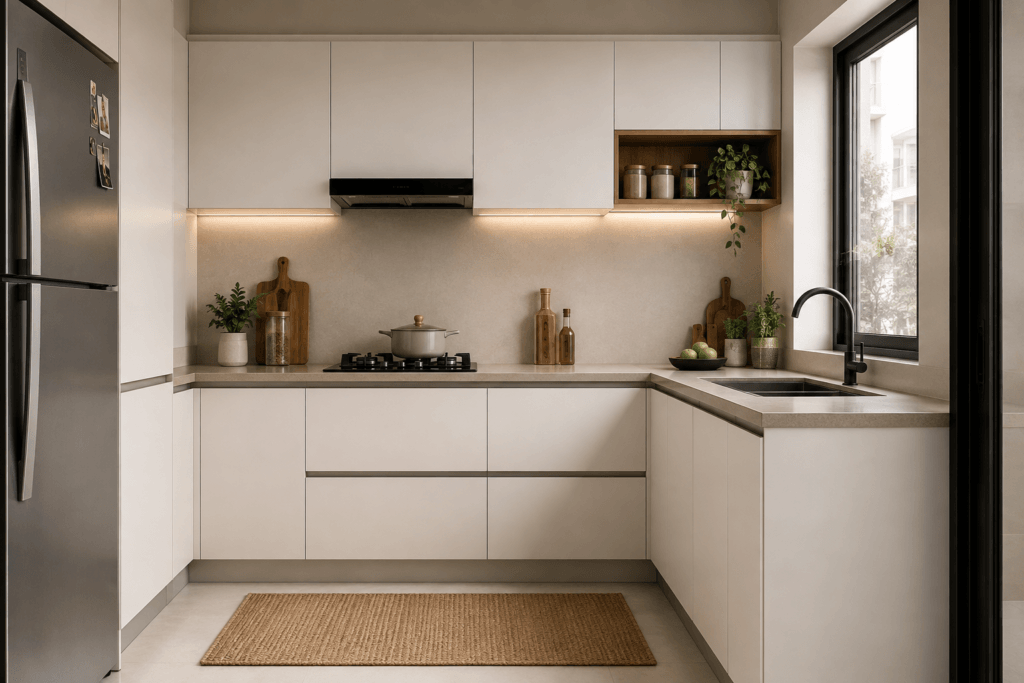
Handleless Ultra-Matte Shutters for Small Kitchens: Does It Work?
Yes-and it works especially well. The handleless system is one of the best choices for compact Indian kitchen designs for two specific reasons.
First, eliminating protruding handles in a narrow corridor layout (parallel kitchen, gallery layout) removes the physical obstruction handles create in tight walkways. In an 1,800–2,000 mm wide parallel kitchen, that 30–40 mm of handle clearance on each side makes a real difference.
Second, the unbroken visual plane of a handleless ultra-matte surface-no handles interrupting the shutter line, no gloss patches catching light unevenly-makes a small kitchen read as a single continuous element rather than a collection of separate cabinet fronts. Light matte colors (off-white, pale grey, cream) amplify this effect. For a small modular kitchen design in a 2BHK Noida apartment, this combination is one of the most effective visual space-expansion techniques available without structural changes.
Local Price Guide: What Does a Handleless Ultra-Matte Kitchen Cost in 2026?
Pricing for handleless ultra-matte shutters has two components that are often quoted separately and should be evaluated together: the shutter finish cost and the hardware profile cost.
Shutter Finish Cost (per square foot of shutter face)
- Ultra-matte acrylic on HDMR core: ₹750–₹1,400 per sq ft
- PU matte paint (factory-sprayed): ₹1,100–₹2,200 per sq ft
- Super-matte PET on HDMR: ₹450–₹800 per sq ft
- Anti-fingerprint matte laminate: ₹280–₹550 per sq ft
Hardware Profile Cost (Gola channels, per linear foot)
Anodized aluminum Gola channels from brands such as Hettich and Hafele typically cost ₹180–₹350 per linear foot depending on finish (silver, matte black, rose gold) and wall or base profile type.
Complete Kitchen Cost Including Carcass and Hardware
Location | Average Complete Cost (incl. carcass + shutter + Gola hardware) |
Dehradun & Uttarakhand (Haridwar, Rishikesh, Roorkee) | ₹950–₹1,850 per sq ft |
Noida & Ghaziabad (NCR) | ₹850–₹1,650 per sq ft |
These are indicative ranges for 2026 and vary with material grade, Gola vs J-pull choice, and hardware brand. A standard 35–45 sq ft apartment kitchen in Dehradun with HDMR core, ultra-matte acrylic shutters, and Gola profiles typically lands between ₹3.5 lakh and ₹5.5 lakh fully installed.
Handleless kitchens cost approximately 15–25% more than comparable handled kitchens-the additional cost comes from the Gola channel hardware and the more precise carcass routing required, not from the shutter material itself.
For a full material cost breakdown based on your specific kitchen size and layout, get a free 3D design and quote from Bhumim.
City-Specific Notes
Dehradun: Modular kitchen manufacturing and installation in Dehradun has grown rapidly in residential villa zones along Rajpur Road, Sahastradhara Road, and Vasant Vihar. Specify HDMR or BWP core for any under-sink or base cabinet position given monsoon humidity levels.
Rishikesh: For riverfront homestays and villas along Tapovan and Pashulok, BWP plywood under-sink cabinets and zero-joint PUR edge banding should be mandatory specifications-not optional upgrades. The Ganges river valley microclimate is genuinely more humid than other parts of the region.
Noida and Ghaziabad: High-rise apartment kitchens in Sectors 75, 128, 137, and Noida Extension are seeing strong demand for Gola profile shutters with anti-static matte surfaces-the fine particulate dust in NCR settles into J-pull grooves more than into Gola channels.
Haridwar and Roorkee: Price sensitivity is slightly higher here, and anti-fingerprint matte laminates on HDMR core are often the right balance-they provide modern handleless aesthetics at a budget accessible to most residential projects without compromising core board quality.
What About Humidity and Winters? Regional Warnings for Uttarakhand Homes
Two questions come up consistently from homeowners in the hill region that most kitchen guides skip entirely.
High monsoon humidity (Dehradun, Rishikesh, Haridwar)
Any ultra-matte surface finish-acrylic, PU, PET, or laminate-is itself non-porous and moisture-resistant. The failure point isn’t the finish; it’s the edge banding. Inferior EVA glue edge banding can lift in sustained high-humidity environments, allowing moisture to wick into the core board from the edges. Zero-joint PUR hot-melt edge banding eliminates this. It cures chemically rather than just adhesively, creating a bond that water cannot penetrate. Specifying PUR edge banding-not EVA-is the single most cost-effective upgrade for any kitchen in a humid location.
Cold winters and PU paint curing (Roorkee, Dehradun winter months)
Site-applied PU paint cures slowly below 15°C and may develop surface haziness or soft spots if applied in cold, damp conditions. Factory-manufactured panels-UV-cured acrylic or baked PU applied in a controlled environment-are not affected by ambient temperature during installation. This is another reason to choose factory-finished panels over site-painted shutters, particularly for kitchens installed between November and February.
Handleless Matte Shutters in Indian Cooking Kitchens: Honest Performance Assessment
We work on kitchens that get used hard-pressure cooker steam, daily tadka, turmeric-heavy cooking, and sometimes more than one person cooking at the same time. Here’s what ultra-matte handleless shutters actually perform like in that environment, without the marketing polish.
What they handle well: Oil vapor buildup on the shutter face wipes off without staining the surface on premium acrylic and PU matte finishes. The low-gloss surface means vapor deposits are less visible than they would be on a high-gloss finish. Opening the cabinet with wet or oily hands via a Gola channel doesn’t transfer oil onto the shutter face at all-your fingers never touch the panel.
What takes more care: J-pull grooves near the hob can accumulate a combination of cooking grease and fine dust if not cleaned weekly. The bevel catch becomes sticky and unpleasant if left longer than 2–3 weeks in a high-use kitchen. This isn’t a design failure-it’s the same reality any kitchen counter faces. But it’s worth knowing before you choose J-pull over Gola for the units closest to your cooking zone.
Safety with children: Gola profiles are genuinely safer around children than traditional bar handles, which are at eye-level height for toddlers and provide sharp corners to run into. The recessed channel has no protruding edges. Push-to-open mechanisms are safe from a pinch-point perspective (soft-close hardware prevents slammed doors) but can be activated by toddlers, which is either a feature or a problem depending on what’s inside the cabinet.
Frequently Asked Questions
A handleless ultra-matte kitchen shutter is a cabinet door without protruding handles, designed with a non-reflective surface finish below 5 Gloss Units (GU), opened via a recessed aluminum Gola channel, an integrated J-pull bevel groove, or a push-to-open spring latch. The combination of the flat shutter face and the velvety matte surface gives modern Indian kitchens their clean, uncluttered appearance.
No-premium ultra-matte acrylic and PU surfaces are non-porous, which means cooking oil, turmeric, and most Indian kitchen stains wipe off with warm water and a soft microfiber cloth without leaving a permanent mark. The surface should not be cleaned with abrasive pads or ammonia-based cleaners. Basic matte laminates (10–15 GU) are slightly more porous and may need a little more effort for grease build-up, but still clean more easily than most homeowners expect.
A Gola profile is a separate aluminum channel fitted into the carcass structure-fingers reach behind the shutter to grip it. A J-pull is a groove routered directly into the top edge of the shutter panel itself. Gola profiles cost more (₹180–350 per linear foot for the aluminum channel) but are easier to clean near cooking zones. J-pull has a lower additional cost but requires a dense core board (HDMR at 850 kg/m³ minimum) to stay structurally sound over years of daily use.
Yes. Wipe immediately with a soft microfiber cloth after splashing, then clean with warm water and mild dish soap. Acrylic ultra-matte surfaces are non-porous, so turmeric pigment doesn’t penetrate the polymer layer-it sits on the surface and comes off cleanly when wiped while still wet. If the stain has dried, a barely-damp cloth with a small amount of mild liquid soap loosens it without damaging the surface.
In Dehradun and the wider Uttarakhand region, a complete handleless ultra-matte kitchen-including HDMR core carcass, ultra-matte acrylic shutter finish, and Gola profile aluminum hardware-typically costs between ₹950 and ₹1,850 per square foot installed. A standard 35–45 sq ft apartment kitchen lands between ₹3.5 lakh and ₹5.5 lakh. PU matte paint options push the upper range higher.
HDMR board (IS 14587, density 850+ kg/m³) handles the moisture demands of most Dehradun kitchens well and costs less than BWP plywood. BWP marine plywood (IS 710) is recommended specifically for under-sink base cabinets and any unit in direct moisture contact, particularly in lower-elevation homes or river-adjacent properties in Rishikesh. A hybrid approach-HDMR for wall cabinets and dry base units, BWP for sink-side base units-is the most cost-effective strategy.
Yes, typically 15–25% more than a comparable handled kitchen of the same size and material grade. The additional cost comes from the Gola profile aluminum channel hardware and the more precise carcass routing required-not from the shutter material. If you’re comparing on a total kitchen budget, factor ₹180–350 per linear foot of aluminum Gola channel on top of the shutter cost.
Soft-close push-to-open hardware (Blum Tip-On and similar) prevents doors from slamming, which eliminates finger-pinch risk. Young children can activate the push latch easily, however-so this mechanism isn’t suitable for cabinets storing cleaning chemicals or sharp items in households with toddlers. Gola profile systems are typically safer for family kitchens because the recessed channel is less intuitive for a child to discover.
Mid-tone matte colors-warm grey, sage green, warm beige, and taupe-are the most forgiving in everyday Indian cooking conditions. They hide cooking vapor deposits and light fingerprint marks far better than pure white (which shows turmeric and oil immediately) and better than very dark shades (which show dust and water marks). If you’re drawn to dark colors like charcoal or navy, specify a surface with a proper anti-fingerprint nanotech coating to reduce daily maintenance.
Yes, if the existing carcass boxes are structurally sound. The shutter panels can be replaced with custom-sized ultra-matte panels, and Gola profile channels can be retrofitted into the carcass tops if the carcass depth allows. A J-pull conversion is simpler-the groove is routed into new replacement shutter panels that drop into existing hinges. The carcass itself doesn’t need replacement in most cases. Ask a Bhumim specialist to assess your existing structure before committing to a retrofit.
High-grade ultra-matte acrylics and factory-baked PU matte finishes include UV stabilizer packages rated to DIN standards that prevent visible color shifting under normal Indian interior sunlight exposure. Cheap matte laminates without UV stabilization can yellow slightly over 5–7 years near bright windows. Asking your fabricator whether the surface carries a UV stability certification is a reasonable quality check.
Factory fabrication of handleless ultra-matte shutters on pre-cut HDMR carcass units takes 14–21 days from confirmed design. On-site installation in a pre-measured apartment kitchen typically takes 3–5 working days for a standard L-shaped or parallel layout. More complex U-shaped or island designs with full Gola profile runs may take 5–7 days on-site.
Key Takeaways
- Ultra-matte means below 5 Gloss Units-not all “matte” surfaces qualify. Check the GU rating before choosing.
- Gola profile (aluminum recessed channel) is more practical near cooking zones than J-pull; push-to-open suits display and low-frequency cabinets best.
- Ultra-matte acrylic gives the deepest visual result; PU matte suits curved or shaped designs; anti-fingerprint laminate is the most budget-accessible option that still looks the part.
- For Dehradun, Rishikesh, Haridwar, and Roorkee kitchens: specify HDMR core for most units and BWP plywood specifically under-sink. The edge banding type (PUR vs EVA) matters as much as the board grade.
- Cleaning ultra-matte surfaces is easier than most homeowners expect-warm water, mild soap, microfiber cloth. No specialist products needed.
- Handleless kitchens cost 15–25% more than handled kitchens of the same specification. The premium comes from Gola profile hardware, not the shutter material.
- Mid-tone matte colors (warm grey, sage green, beige) are the most practical daily maintenance choice for Indian cooking kitchens.
- PUR zero-joint edge banding is non-negotiable for humid locations-it’s the upgrade that keeps edges from lifting during Uttarakhand monsoons.
Conclusion
She came back a few weeks after that first conversation and told us she’d chosen a Gola profile kitchen in warm grey ultra-matte acrylic-HDMR core, zero-joint PUR edge banding. Not because she’d memorized the GU rating or the IS 14587 standard. Because she finally understood what she was choosing and what it would actually feel like to cook in that kitchen for the next ten years.
That’s the real goal of a decision like this: a kitchen that keeps feeling right after the photographs are put away.
If you’re planning a handleless ultra-matte modular kitchen in Dehradun, Rishikesh, Haridwar, Roorkee, Noida, or Ghaziabad-and you want to see the actual material samples and a working Gola profile demo before committing-book a free 3D design consultation with Bhumim. Bhumim is a modular kitchen manufacturer and installer, not a design intermediary, which means every kitchen is planned, fabricated, and installed by the same team.
About This Article
Published by: Bhumim India Private Limited-Modular Kitchen Manufacturer & Installer, Dehradun
GST: 05AAOCB1784F1ZM | ISO 9001:2015 Certified
Service Areas: Dehradun · Haridwar · Rishikesh · Roorkee · Noida · Ghaziabad
Contact: 08044630777 | hello@bhumim.com
Note: This article is written from Bhumim’s on-ground manufacturing and installation experience. All material recommendations are based on what we use in real kitchens across our service areas.