

HDHMR vs BWP Plywood IS 710 for Kitchen Cabinets: Price, Specs & Where to Use Which
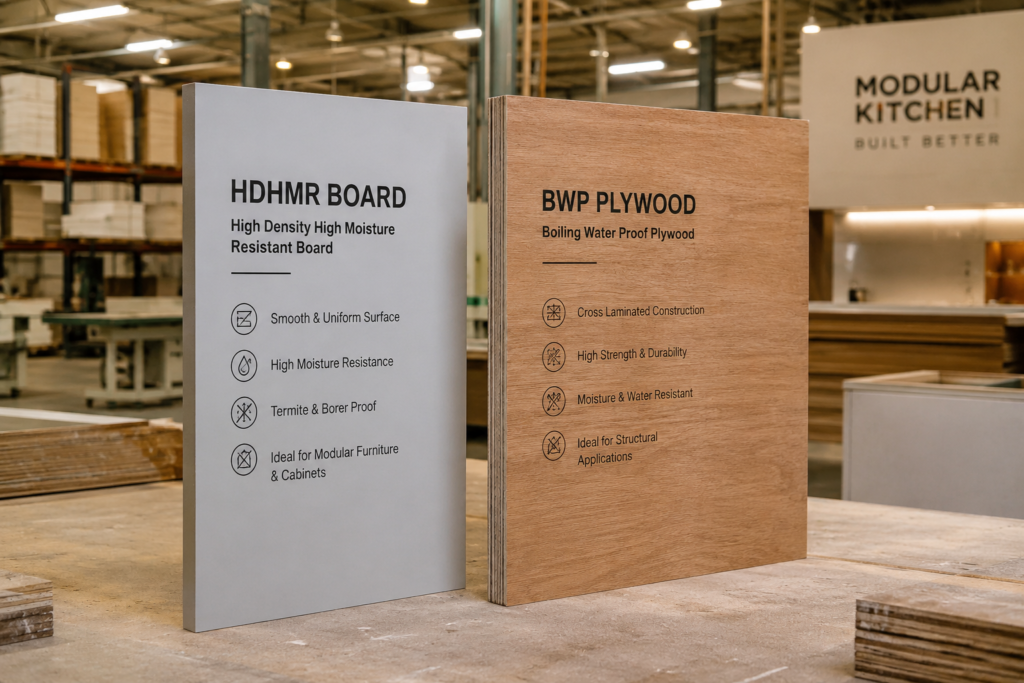
HDHMR vs BWP plywood comes down to one practical question: where in your kitchen will the board actually sit? HDHMR (High-Density High Moisture Resistance board) excels at overhead cabinets, shutters, and dry-zone carcasses because of its ultra-smooth surface and lower cost. IS 710 BWP plywood is the non-negotiable choice for base cabinets near the sink and anywhere with real water-contact risk, because it passes a 72-hour boiling water test that HDHMR cannot.
Both materials are engineered wood. Neither is inherently better across the board. The right answer-and every good modular kitchen manufacturer will say this-is to use each one where it performs.
Why This Question Matters More Than Ever in 2026
After installing modular kitchens across Dehradun, Haridwar, Noida, and Ghaziabad, the single material question we get most consistently at Bhumim is not about finish colour or handle style. It is about what holds up after three monsoons. Specifically: “Should I use HDHMR or BWP plywood for the carcass?”
The honest answer is that you probably need both-placed correctly. Most homeowners planning a modular kitchen design get told either “always use plywood” or “HDHMR is better and cheaper.” Both answers are oversimplifications that have cost people tens of thousands of rupees in cabinet replacements.
This guide cuts through the rivalry. Below you will find verified technical specs, current 2026 pricing from Dehradun and NCR markets, a zone-by-zone kitchen placement map, and the three most common myths that trip up buyers before they place an order.
Get started with Beautiful Homes
For expert design consultation, send us your details and we’ll schedule a call
What Is HDHMR Board?
HDHMR stands for High-Density High Moisture Resistance board. It is manufactured by compressing hardwood fibres-often eucalyptus or poplar-under high heat and pressure, then bonding them with Melamine Urea Formaldehyde (MUF) resin. Think of it as an upgraded version of MDF: same engineered-wood category, but with a density of 850–900 kg/m³ (compared to standard MDF at around 650–750 kg/m³) and significantly better resistance to ambient humidity.
That higher density is the key. Because the fibres are packed so tightly, HDHMR has almost no pore space for moisture to enter through the face or body of the board. It also produces a machine-smooth, perfectly flat surface-which is why it is the substrate of choice for acrylic shutters, PU-painted doors, and CNC-routed decorative panels, where even a slight wood-grain ripple shows through the finish.
What HDHMR Is Good At
- Ultra-flat surface finish for acrylic, PU paint, and high-gloss laminates
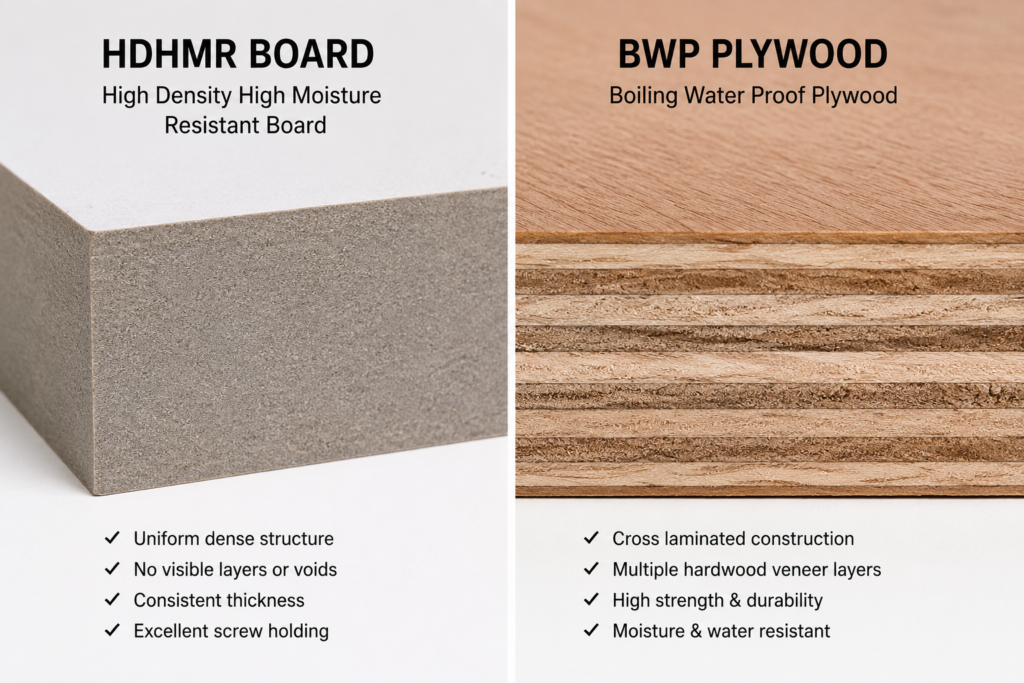
- Consistent density throughout the board-no voids or soft spots
- Built-in termite and borer resistance (from resin treatment)
- CNC milling precision-decorative edge profiles and shaker-style routed patterns
- Dimensional stability on tall cabinet shutters-less warping than plywood over long spans
Where HDHMR Has Limits
Here is the part most competitor articles skip. HDHMR is moisture resistant, not waterproof. Its edges, once cut, are exposed fibre that absorbs water if left unsealed. An HDHMR cabinet installed under a kitchen sink without proper 2mm PVC hot-melt edge banding will swell at the base within one or two monsoon seasons. The board body holds up; the raw edge does not.
This is not a flaw in the material. It is a flaw in how the material is used. Properly sealed HDHMR-machine-banded on every cut edge-performs well even in moderately humid conditions like overhead cabinets or carcasses away from direct water.
What Is IS 710 BWP Plywood?
IS 710 is the Bureau of Indian Standards specification for Boiling Water Proof (BWP) marine plywood. To carry the IS 710 stamp and BIS certification mark, a plywood sheet must survive immersion in boiling water (100°C) for a minimum of 72 hours without delaminating-that is, without the bonded veneer layers separating.
The reason it passes that test comes down to the adhesive: IS 710 plywood uses 100% undiluted Phenol-Formaldehyde (PF) resin between cross-laminated hardwood veneer layers. PF resin does not break down in the presence of water, even boiling water under sustained exposure. That is the chemistry that separates BWP from every other plywood grade-including BWR (Boiling Water Resistant), which uses a diluted or blended resin and cannot pass the same test.
A genuine 18mm IS 710 sheet typically has 13 to 15 cross-laminated veneer layers. The cross-grain construction also gives BWP plywood its structural advantage: load distributes across multiple layers at different grain orientations, which is why it handles heavier loads and resists splitting under screw withdrawal better than a homogeneous fibre board.
What IS 710 BWP Plywood Is Good At
- Direct water-contact zones-under-sink cabinets, near dishwashers, ground-floor base units
- Heavy load-bearing shelves and structural cabinet boxes (carcasses)
- Superior screw withdrawal strength, especially at edges-important for hinge mounting
- Long-term performance in sustained high-humidity environments
- Proven performance record across decades of Indian kitchen installations
Where BWP Plywood Has Limits
BWP plywood is more expensive than HDHMR-typically 30 to 50% higher per sheet. It is heavier, which makes large overhead cabinet panels harder to handle and install. Its natural wood-grain surface also requires sanding, priming, or a laminate layer before a paint finish is applied, which adds labour cost and time. On very long cabinet shutters (over 4 feet), plywood can develop a subtle wave or ripple from veneer stress in high-humidity conditions-a problem HDHMR does not have.
HDHMR vs BWP Plywood IS 710-Technical Head-to-Head
Parameter | HDHMR Board | IS 710 BWP Plywood |
Full Form | High-Density High Moisture Resistance | Boiling Water Proof (per IS 710:2010/2020) |
BIS Standard | IS 14587 (HDF/fiberboard norms) | IS 710-Bureau of Indian Standards |
Density | 850–900 kg/m³ (uniform, no voids) | 650–750 kg/m³ (varies by species/grade) |
Adhesive Resin | Melamine Urea Formaldehyde (MUF) | 100% Phenol-Formaldehyde (PF)-undiluted |
Water Resistance | Moisture resistant-handles humidity & splashes; edges swell if unprotected | Boiling water proof-passes 72-hr immersion test at 100°C |
Screw Withdrawal (Face) | >1,500 N | >1,800 N |
Screw Withdrawal (Edge) | ~800 N | >1,200 N |
Surface Finish | Machine-smooth, zero grain ripple-ideal for acrylic, PU paint | Natural veneer grain-requires sanding/priming for painted finishes |
Termite Resistance | High (resin-treated fibre) | Moderate (add-on treatment available) |
Warping on Long Panels | Low-uniform density resists warping on tall doors | Moderate-veneer stress can cause subtle bow in high humidity |
18mm Sheet Price (2026) | ₹2,000–₹3,500 / sheet (₹60–₹110/sq ft) | ₹3,000–₹5,500 / sheet (₹90–₹170/sq ft) |
Ideal Use | Overhead cabinets, shutters, dry-zone carcasses | Under-sink base, wet-zone base units, structural shelving |
Formaldehyde Emission | E0 or E1 (grade-dependent) | E1 standard |
Pricing based on Dehradun and Noida market survey, mid-2026. Final price varies by brand, thickness, and dealer.
Which Is Better for Modular Kitchen Cabinets in India?
Neither material is universally better-but for each specific zone of your kitchen, the answer is clear.
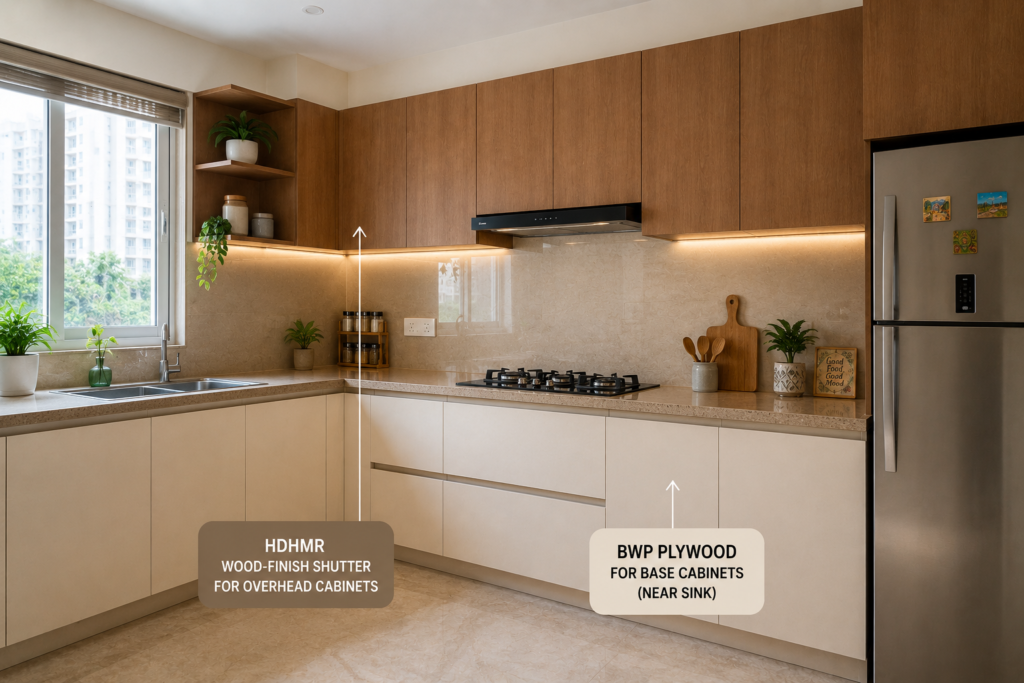
The mistake most buyers make is treating this as an either/or choice. The smarter approach, and the one that saves real money without compromising durability, is a hybrid kitchen: IS 710 BWP plywood where water risk is real, and HDHMR everywhere else.
Here is what that looks like in practice.
Zone 1-Under-Sink Cabinet: Always IS 710 BWP Plywood
The space under your kitchen sink is the highest-risk zone in any kitchen. Even a slow drip from a flexible hose connection, a worn washer, or condensation from cold water pipes can expose the cabinet base to standing water for days or weeks before anyone notices.
HDHMR will not survive this. Given sustained water contact, the unprotected bottom of an HDHMR carcass will begin to swell within weeks, and no amount of edge banding fully eliminates the risk when the board sits directly above a wet floor. IS 710 BWP plywood, by contrast, is engineered for exactly this-its PF resin bond is chemically inert to water, and the cross-laminated layers distribute any absorbed moisture without delaminating.
This is a non-negotiable recommendation. The under-sink unit is the one cabinet to always build in genuine IS 710 BWP plywood, regardless of your overall budget.
Zone 2-Ground-Floor Base Cabinets in Dehradun and Haridwar
If your kitchen is on the ground floor in a hill-city home, or along a wall with suspected seelan (dampness from the soil or adjoining damp wall), use BWP plywood for your base cabinet carcasses-not just the sink unit. The Dehradun monsoon, particularly in areas like Clement Town, Sahastradhara Road, and older constructions near the river corridor, creates sustained wall moisture that wicks upward into floor-level cabinetry.
HDHMR can be used for the shutters on those same base cabinets-the shutter is vertical, does not touch the floor, and benefits from HDHMR’s flat surface. The structural box (carcass) underneath, however, deserves BWP protection.
Zone 3-Overhead Wall Cabinets: HDHMR Is the Smart Choice
Overhead cabinets-the wall-mounted units above the counter-almost never see direct water. Steam rises from cooking, but it is not the same as a sustained soak. For these units, HDHMR is an excellent carcass choice: lighter to install overhead, cheaper per sheet, and equally durable against the ambient humidity that a kitchen in Noida or Ghaziabad generates.
Zone 4-Shutters and Cabinet Door Panels: HDHMR Wins Clearly
This is where HDHMR is definitively superior. Its machine-smooth, uniform surface is the reason modular kitchen manufacturers prefer it for shutters. Acrylic glue bonds without any “telegraphing”-the industry term for when the wood grain or surface variation beneath a gloss finish creates a ripple or wavy reflection. PU paint settles flat and even. CNC-routed profiles cut cleanly without edge tearing.
A plywood shutter, by comparison, requires sanding and filling before any premium finish can be applied, which adds cost and still risks subtle surface irregularity over time. For any kitchen where the visual finish matters-acrylic, high-gloss laminate, or PU paint-use HDHMR for the shutters.
How Does Dehradun's Climate Affect Your Choice?
Dehradun sits in a valley between the Shivalik and outer Himalayan ranges, and that geography creates specific conditions that national-level plywood articles never address. Monsoon humidity from July through September regularly peaks above 80–90%, wall seelan is common in ground-floor rooms and older constructions, and kitchens in hill-facing flats can trap moisture for weeks after rains.
In Noida and Ghaziabad, the challenge is different: hard tap water, plumbing leaks in multi-storey builder flats, and rapid temperature swings between summer heat and winter cold create material stress that shows up as delamination or screw loosening in cheaper boards over 3 to 5 years.
For Dehradun specifically
HDHMR works well for overhead and shutter panels even in the monsoon, provided edge banding is properly applied with machine hot-melt adhesive. However, ground-floor base cabinets in any Dehradun home built before 2010-particularly in Dalanwala, Paltan Bazaar-adjacent areas, and anything within a few hundred metres of seasonal streams-deserve IS 710 BWP plywood for the carcass, not HDHMR.
For Noida and Ghaziabad builder flats
The plumbing leak risk in high-rise societies makes BWP plywood mandatory under the sink. Overhead cabinets are safer territory for HDHMR, and the cost saving on those upper units can offset the premium paid for BWP below.
HDHMR vs BWP Plywood Price in Dehradun and NCR Markets (2026)
Pricing varies by brand tier, sheet thickness, and whether you are buying from a brand-authorised dealer or the open market. The figures below reflect mid-2026 rates at hardware markets in Dehradun (Niranjanpur Mandi, Saharanpur Chowk) and Noida/Ghaziabad (Sector 9, Indirapuram):
Thickness | HDHMR Board (₹/sq ft) | IS 710 BWP Plywood (₹/sq ft) | Approx. Saving with HDHMR |
12mm | ₹50–₹80 | ₹75–₹120 | 30–40% |
16mm | ₹55–₹90 | ₹85–₹140 | 30–40% |
18mm | ₹60–₹110 | ₹90–₹170 | 30–50% |
A standard 8×4 ft sheet at 18mm converts to 32 square feet. At mid-market pricing, that means an HDHMR sheet costs roughly ₹2,500–₹3,000 versus ₹3,500–₹4,500 for a reliable IS 710 BWP sheet of the same size. Across a 10×10-foot modular kitchen with 12 to 15 cabinet boxes, the hybrid approach-BWP for 3 to 4 wet-zone units and HDHMR for the remaining 8 to 11 units-can deliver a realistic saving of ₹25,000 to ₹45,000 compared to building the entire kitchen in IS 710.
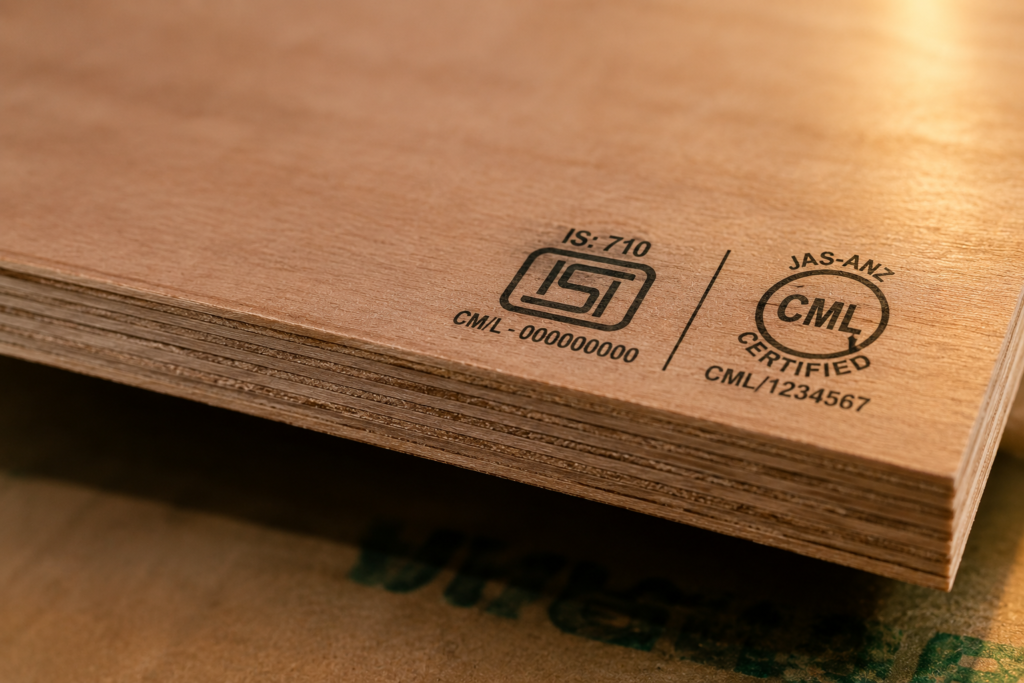
A note on verification: always check for the BIS ISI mark and the CML (Certificate of Merit and Licensing) number stamped on the sheet edge before accepting IS 710 plywood from a dealer. Fake or downgraded plywood-sold as IS 710 but made with diluted resin-is a genuine problem in tier-2 and tier-3 city markets. The BIS website (bis.gov.in) allows public verification of CML numbers.
How to Verify Genuine IS 710 Plywood and Original HDHMR Boards
Checking IS 710 BWP Plywood
- Look for the ISI mark stamped on the sheet edge-a circular mark with the IS 710 code and the manufacturer’s CML number.
- Count the layers. A genuine 18mm IS 710 sheet will have 13 to 15 cross-laminated veneer layers. Fewer layers at the same thickness means thicker individual veneers and reduced structural strength.
- Inspect the edges. The veneer layers should be tight, even, and without visible voids or gaps. Delaminating edges or dark patchy glue lines suggest inferior or diluted resin.
- Cross-check the CML number at bis.gov.in to confirm the manufacturer is currently certified to produce IS 710 material.
Checking HDHMR Quality
- Ask for the density certificate. Reputable HDHMR brands can provide a test certificate confirming density above 850 kg/m³. Accept no substitute claim.
- Check edge colour. Many branded HDHMR boards have a distinctive coloured edge (green, red, or grey depending on the manufacturer) that differentiates them from standard MDF or HDF which they superficially resemble.
- Ask about formaldehyde emission class-E0 is the safest for indoor air quality, E1 is the baseline standard. Boards without any emission classification marked should be avoided.
- Buy from authorised dealers. In Dehradun, authorised dealers for major HDHMR brands are typically found at Saharanpur Chowk and Niranjanpur Mandi. Ask specifically for the manufacturer’s dealer certificate before purchasing.
Three Myths About HDHMR and BWP Plywood That Cost Buyers Money
Myth 1: HDHMR is 100% waterproof
HDHMR is moisture resistant, not waterproof. The face and body of the board resist splashes and ambient humidity well. But raw cut edges absorb water and will swell if left unsealed. This is why machine-applied 2mm PVC hot-melt edge banding is not optional-it is the one step that makes HDHMR genuinely safe in kitchen environments outside direct water-contact zones.
Myth 2: BWP plywood never warps
BWP plywood is structurally strong and water-resistant, but it can develop a bow or warp on long shutter panels (over 4 feet) in climates with high seasonal humidity swings. The cross-laminated veneers handle load well but can experience differential tension in very humid-to-dry cycles. HDHMR, with its uniform fibre density, is actually more dimensionally stable on long cabinet doors.
Myth 3: HDHMR cannot hold hinges properly
This was true of early, lower-density versions. Modern HDHMR boards at density above 850 kg/m³ hold soft-close hinges and heavy-duty drawer slides well, provided pilot holes are drilled correctly before inserting screws. The critical detail is not to over-tighten, which strips the fibre. For very heavy cabinet doors, euro-screws or sleeve anchors provide additional grip on any composite board, including HDHMR.
Frequently Asked Questions
HDHMR is a compressed wood-fibre board with density above 850 kg/m³, optimised for moisture resistance, smooth surface finish, and CNC routing. BWP plywood is a cross-laminated hardwood veneer board bonded with 100% Phenol-Formaldehyde resin that survives 72 hours of boiling water without delaminating. HDHMR suits overhead cabinets and shutters; BWP plywood is mandatory for under-sink cabinets and wet-zone base units. A hybrid of both materials gives the best balance of cost and durability in a modular kitchen design.
No-and this is the single most important placement call in any modular kitchen. HDHMR is moisture resistant, not waterproof. Even a slow pipe drip can cause the bottom of an HDHMR sink cabinet to swell over weeks. For under-sink cabinets, always use IS 710 BWP plywood, which is rated for sustained water contact. HDHMR can be used for the shutter on the same cabinet, but the structural box below the sink must be BWP plywood.
Yes-HDHMR is actually the better choice for kitchen shutters compared to plywood. Its machine-smooth, void-free surface bonds perfectly with acrylic sheets, high-gloss laminates, and PU paint without the grain ripple or surface variation that shows through premium finishes on plywood. For any kitchen where the visual finish quality matters, HDHMR shutters on BWP plywood base carcasses is the standard approach used by most professional modular kitchen manufacturers.
Based on mid-2026 market rates in Dehradun and NCR, 18mm HDHMR boards are priced at roughly ₹60–₹110 per square foot (₹2,000–₹3,500 per 8×4 ft sheet), while 18mm IS 710 BWP plywood runs ₹90–₹170 per square foot (₹3,000–₹5,500 per sheet). The difference-around 30 to 50%-is what makes a hybrid kitchen financially worthwhile. Using HDHMR for overhead and dry-zone units while reserving BWP plywood for wet-zone base cabinets can save ₹25,000 to ₹45,000 on a typical 10×10-foot kitchen.
Yes, with the right placement. Dehradun’s monsoon humidity (peaking at 80–90% from July to September) is manageable for properly sealed HDHMR in overhead cabinets and shutters. The risk zone is the ground-floor base cabinet, especially in homes with wall dampness (seelan) or near-river constructions. For those specific locations, IS 710 BWP plywood is the safer carcass material. A well-designed hybrid kitchen-BWP for ground-floor base and sink units, HDHMR for everything above-performs reliably through Dehradun’s climate.
Look for three things before accepting a sheet: the ISI certification mark stamped on the sheet edge, the IS 710 code printed alongside it, and a CML (Certificate of Merit and Licensing) number that can be cross-checked at bis.gov.in. Count the veneer layers in an 18mm sheet-genuine IS 710 will have 13 to 15 cross-laminated layers. If a dealer cannot show you the CML number or the sheet has fewer than 13 layers, it is not genuine IS 710 material.
Yes, modern HDHMR at density above 850 kg/m³ holds standard soft-close hinges securely when installed correctly. The technique matters: always drill a pilot hole before inserting a hinge screw, and avoid over-tightening, which strips the fibre around the screw thread. For very heavy cabinet doors or tall wardrobe panels, euro-screws or threaded metal inserts add additional grip. The same care applies to quality plywood installations-the material is not the limiting factor when the hardware is installed with proper technique.
For Noida builder-flat kitchens, the recommended approach is BWP plywood IS 710 for the under-sink cabinet and any base unit directly below or beside the dishwasher or washing point. Plumbing leaks in multi-storey flats-from flexible hose joints, washing machine connections, and overhead drainage-are a real and common risk. HDHMR performs well for overhead cabinets and all shutter panels. Using both materials zone-by-zone gives you BWP-grade protection where it is needed and HDHMR efficiency where it is not.
HDHMR requires 2mm thick PVC edge banding applied with machine hot-melt adhesive on every cut edge. This seals the exposed fibre core so moisture cannot enter through the ends of the board. Hand-applied tape-style banding is not equivalent-it does not bond as tightly and can peel at joints exposed to steam or repeated cleaning. In a kitchen environment, any HDHMR cabinet where the edge banding is peeling, chipped, or missing at floor level is at risk of moisture entry and should be repaired before the next monsoon.
For an enclosed space like a kitchen, choose E0 or E1 class boards. E0 has the lowest formaldehyde emission (≤0.5 mg/L), while E1 is the standard indoor threshold (≤1.5 mg/L). Both are safe for residential kitchens. Boards with no emission classification marked-or that come without any product documentation-should be avoided, particularly in compact kitchens with limited ventilation. Premium HDHMR brands and reputable IS 710 plywood manufacturers both offer E0/E1 certified options.
Key Takeaways
- HDHMR and IS 710 BWP plywood are not competitors-they are complements used in different zones of the same kitchen for different reasons.
- Under-sink cabinets must use IS 710 BWP plywood. No amount of edge banding makes HDHMR safe for direct or sustained water contact.
- HDHMR is the better shutter material because of its flat, void-free surface-essential for acrylic, PU paint, and CNC profiles.
- Overhead cabinets and dry-zone carcasses are ideal territory for HDHMR-lower cost, lighter weight, and strong enough for the load.
- The hybrid kitchen approach saves ₹25,000–₹45,000 on a typical 10×10-foot kitchen without compromising durability in the zones that matter.
- Edge banding is not optional for HDHMR. Machine-applied 2mm PVC hot-melt banding on every cut edge is what makes HDHMR safe in a kitchen environment.
- Verify IS 710 with the BIS CML number before accepting sheets from a dealer. Downgraded plywood sold as IS 710 is a real market problem.
- Dehradun and hill-city homes with ground-floor kitchens or wall dampness should use BWP plywood for all base units, not just the sink cabinet.
Conclusion: The Honest Answer for Your Kitchen
You started with a question that sounds like a simple comparison. In practice, it is a placement decision, not a product decision.
After seeing hundreds of kitchen installations across Dehradun, Haridwar, Noida, and Ghaziabad, the pattern is consistent: the kitchens that fail-swollen bases, sagging doors, loose hinges-are not built from the wrong material. They are built from the right material placed in the wrong location. HDHMR under a sink. MDF near a hob. BWP plywood used for an overhead shutter when HDHMR would have given a cleaner finish.
The hybrid kitchen that matches IS 710 BWP plywood to its water-contact zones and HDHMR to everything else is not a compromise. It is the approach that most experienced modular kitchen manufacturers use, because it gives you the best of both materials without paying premium prices across the entire kitchen.
If you are planning a modular kitchen in Dehradun, Noida, Haridwar, or Roorkee and want to know exactly which material makes sense for each unit in your specific space, the Bhumim team can walk you through it during a free 3D design consultation. We manufacture and install-which means the material selection, the edge banding quality, and the installation workmanship are all under one roof.
Book a free 3D kitchen design consultation with Bhumim or call 099997 70388 to speak with our team directly.
About This Article
Published by: Bhumim India Private Limited-Modular Kitchen Manufacturer & Installer, Dehradun
GST: 05AAOCB1784F1ZM | ISO 9001:2015 Certified
Service Areas: Dehradun · Haridwar · Rishikesh · Roorkee · Noida · Ghaziabad
Contact: 08044630777 | hello@bhumim.com
Note: This article is written from Bhumim’s on-ground manufacturing and installation experience. All material recommendations are based on what we use in real kitchens across our service areas.