

Gola Profile vs J-Pull vs Push-to-Open: Handleless Kitchen
Gola profile vs j pull kitchen-the choice comes down to where the opening mechanism lives: a Gola profile uses a recessed aluminum channel mounted to the cabinet carcass, a J-pull uses a J-shaped groove routered directly into the door shutter, and a push-to-open system uses a mechanical or magnetic spring latch to eject the door when pressed. All three give you a handleless look, but each behaves very differently in an Indian kitchen over five years.
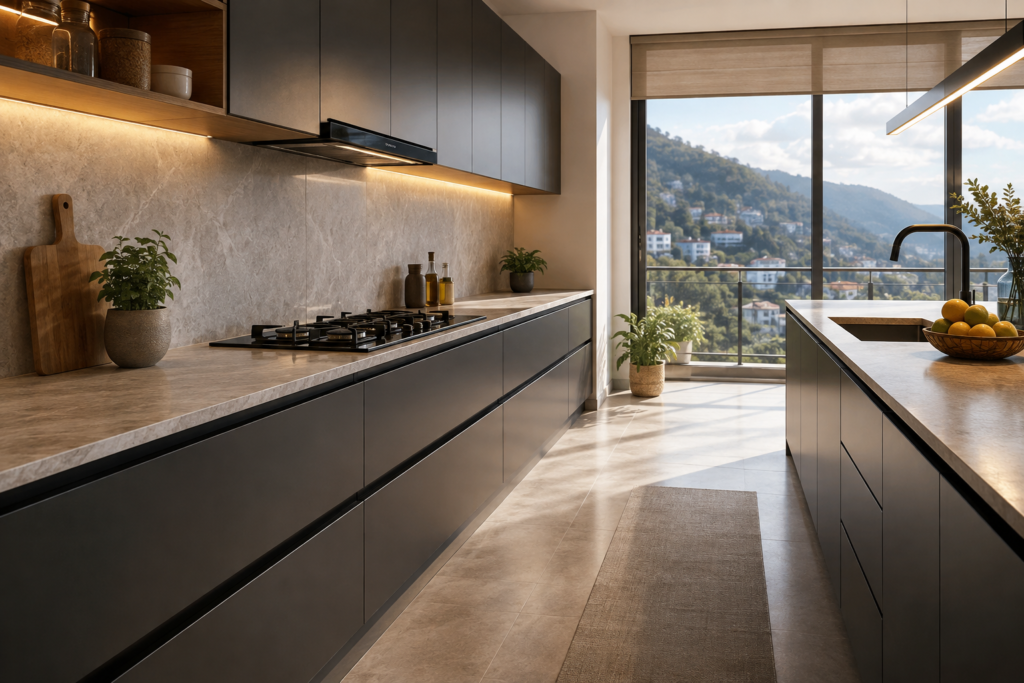
Why This Decision Matters More Than Most Homeowners Expect
You decide between the three systems before a single cabinet is built. That’s the problem. By the time grease is settling inside a J-pull groove after a biryani session, or a push-to-open drawer pops open every time your thigh brushes the base unit, the factory order is long done.
After installing modular kitchens across Dehradun, Haridwar, Noida, and Ghaziabad, the question we hear most often is not about layout or colour-it’s about opening mechanisms. Homeowners who have lived with these systems ask it differently from those who haven’t. This guide is written for both groups.
Get started with Beautiful Homes
For expert design consultation, send us your details and we’ll schedule a call
What Are the Three Handleless Kitchen Systems?
Handleless kitchen design eliminates protruding knobs and pull handles, but the three systems achieve this through completely different engineering approaches. Understanding the anatomy of each mechanism is the essential first step before comparing their real-world performance.
Gola Profile System: The True Handleless Channel
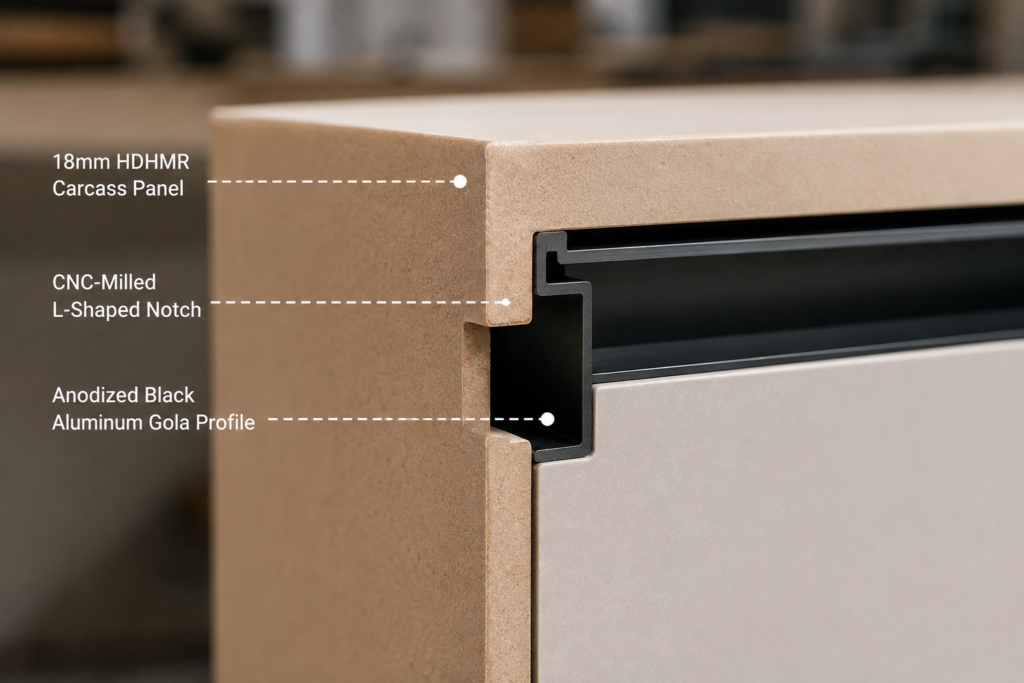
A Gola profile is a continuous aluminum channel-typically anodized or powder-coated-that is built into the cabinet carcass itself, not the door. The channel sits between the carcass structure and the door face, creating a recessed finger space you reach into to pull the door open.
There are two primary Gola types in common use:
- C-Gola (C-shape): Installed between two adjacent drawers so that either can be opened from the same channel-one finger grip serves both the drawer above and the one below. This creates the distinctive continuous horizontal line look typical of European slab-door kitchens.
- J-Gola or L-Gola (J-shape): Fitted at the top edge of base cabinets, running under the countertop overhang. Fingers reach up and in from below. Wall cabinets can use a mirror variant where the channel sits along the bottom edge.
- Vertical Gola: Runs up the side of tall pantry units and built-in appliance housings, creating a continuous vertical grip line.
The critical manufacturing detail: the carcass side panels must be precision-milled with L-shaped or U-shaped cutouts before the cabinet is assembled. This is done on CNC machinery at the factory stage-not on-site with a hand router. Trying to retrofit Gola rails into existing cabinets without these pre-milled notches is not possible without rebuilding the carcass entirely.
The aluminum channels themselves are available in silver-anodized, matte black, rose gold, and brushed stainless finishes. A standard 10-foot Gola profile rail costs approximately ₹595–₹1,200 per piece in North India, depending on profile type and finish grade (B2B pricing from hardware distributors in the Delhi-NCR and Dehradun markets as of 2026).
J-Pull: The Integrated Door Groove
A J-pull (also called J-groove or J-profile) takes a completely different approach: the handle is built into the door shutter itself. A J-shaped channel is routered directly into the top or side edge of the shutter front, creating a curved recess your fingers slip into to pull the door open.
No separate aluminum hardware is required. However, the routing process has its own material requirements. The door substrate must be smooth enough to route cleanly without core chipping or fraying at the edges. This is why J-pull shutters typically use HDHMR (High-Density Moisture-Resistant board) or MDF cores, rather than BWP plywood-the layered wood grain in plywood can splinter when precision-routered into a narrow J-channel.
The routed groove is then sealed with multi-layer Polyurethane (PU) paint or 3D laser edge banding to prevent moisture penetration and ensure the curve stays smooth under repeated use. In Dehradun’s monsoon humidity, the quality of this sealing matters considerably: a poorly sealed J-groove edge will absorb humidity, cause the board to swell at the cut, and eventually create a rough-edged recess that catches on fingers.
J-pull kitchens are generally 10–15% cheaper than Gola profile kitchens because they eliminate the cost of external aluminum channels and the specialized carcass notching that Gola installation requires.
Push-to-Open / Tip-On Systems: The Touch-Trigger Mechanism
Push-to-open removes the opening gesture entirely. Press the shutter face and a mechanical spring, magnetic latch, or soft-close servo system ejects the door. The cabinet face is completely flat-no channel, no groove, no visible hardware element of any kind.
There are three levels of push-to-open technology:
- Mechanical spring latches: The simplest version. A spring-loaded magnetic bumper is mounted inside the carcass. Press the door, the spring compresses and releases, door swings open. These are reliable for light-use cabinets but struggle under sustained heavy loads.
- Soft-close combined systems (e.g., Blum Tip-On Blumotion, Häfele Matrixbox Push): The push mechanism is integrated with a hydraulic soft-close system. The door opens with a push and closes with a controlled, silent deceleration. These are the most comfortable push systems and significantly more durable than standalone mechanical latches.
- Electronic servo-drive systems (e.g., Blum SERVO-DRIVE): Electrically actuated, touch-triggered opening for wall cabinets and appliance panels. Premium category, used in ultra-high-specification kitchens. If power fails, doors can still be opened manually.
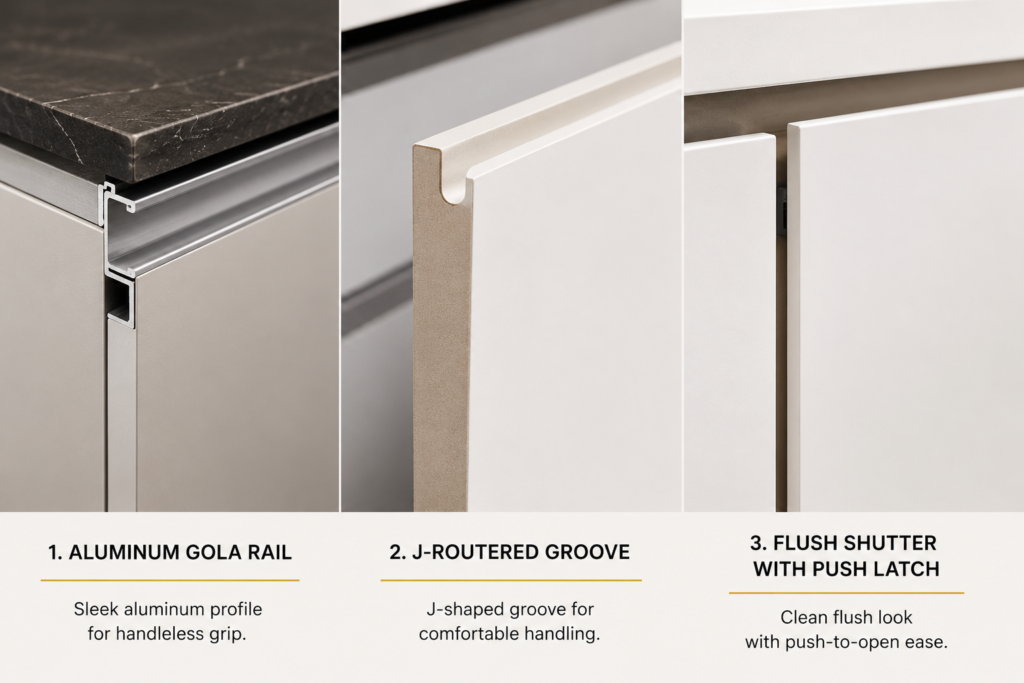
Gola Profile vs J-Pull vs Push-to-Open: Direct Comparison
Feature | Gola Profile | J-Pull | Push-to-Open |
Opening Mechanism | Recessed aluminum rail in carcass | J-groove routered into door shutter | Spring/magnetic/servo latch |
Where Hardware Lives | Cabinet carcass (separate from door) | Door shutter (built-in, no separate part) | Internal carcass latch |
Visual Appearance | Continuous metallic accent line visible | Subtle shadow line at door edge | Completely flat, no visible line |
Cleaning Difficulty | Low-wipe the flat aluminum rail | High-grease and turmeric trap in the groove | Low-flat shutter surface, wipe clean |
Durability Under Heavy Loads | Very High-no mechanical moving parts | High-no mechanical parts, robust door grip | Moderate-spring latches degrade under sustained overload |
Accidental Opening Risk | Negligible | Negligible | Moderate-lower cabinets can be nudged open by contact |
Material Requirement | BWP Plywood or HDHMR carcass (routed notch) | HDHMR or MDF shutter (clean routering) | Any-no carcass modification required |
Approx. Cost (Dehradun, 2026) | ₹1,650–₹2,500 per sq. ft. | ₹1,500–₹2,000 per sq. ft. | Varies by hardware brand; Blum/Häfele tandem systems add ₹3,500–₹7,500 per drawer |
Best Use Case | Full kitchen, all cabinet types, heavy-use zones | Budget-conscious modern look, dry-zone cabinets | Upper wall cabinets, show kitchens, light-use areas |
Retrofitting Existing Cabinets | Not possible without rebuilding carcass | Not possible without new shutter doors | Possible in some cases with surface-mounted latch retrofits |
Child Safety | High-no pop-open risk | High-no pop-open risk | Moderate-young children can accidentally open lower units |
How Does Each System Perform in a Real Indian Kitchen?
European handleless kitchen design developed around very different cooking conditions than a North Indian household. Understanding that gap is what separates a kitchen that looks great on day one from one that still works reliably after three monsoons and ten thousand kadhais of oil tempering.
The Grease and Turmeric Test
Turmeric (haldi) and mustard oil smoke are the twin enemies of any recessed surface. After even one heavy dal tadka session, fine oil particles drift across every vertical surface in the kitchen-including door edges, grooves, and channels.
Gola profiles handle this well. The anodized or powder-coated aluminum surface of the rail is non-porous, wiped clean in one stroke. The recess itself is wide enough that a standard microfiber cloth can reach the back of the channel without tools.
J-pull grooves are harder to clean. The narrow J-curve traps oil residue and spice powder at the curved base of the groove. Over time, if not cleaned daily, haldi residue oxidizes on the routed surface and can permanently stain lighter-colored PU finishes. Cleaning requires a toothbrush or a microfiber cloth wrapped around a narrow-profile tool. On dark matte finishes, this is manageable. On white or cream shutters, it demands daily attention.
Push-to-open systems win on cleaning-the flat shutter surface has no crevice at all. However, the door face itself accumulates more fingerprints and palm grease than the other systems because you press directly on the shutter surface every time. This is why anti-fingerprint thermal structured matte laminates, rather than high-gloss acrylic, are strongly recommended for push-to-open kitchens in Indian households.
The Heavy Utensil Reality
A typical Indian kitchen base drawer carries pressure cookers, steel kadhais, cast iron tavas, and stacks of steel thalis. The total load in a single deep drawer can exceed 25–35 kg without anyone noticing.
Gola profiles and J-pull handles are mechanically passive-they exert no force on the drawer itself. The drawer’s payload capacity depends entirely on the runner system (tandem box, telescopic channel, etc.) and has nothing to do with the door opening mechanism. Both systems are fully compatible with heavy-duty 50 kg and 70 kg rated drawer runners.
Push-to-open latches, however, have a direct load relationship: the spring mechanism must generate enough ejection force to push the door open against the weight pressing the door closed. A 30 kg drawer with a light-duty push latch will either fail to open cleanly or will require a harder push than is comfortable. For heavy base drawers, specify push-to-open systems with Blum Tandembox Antaro or Häfele Matrixbox runners (rated to 40–70 kg), not standard mechanical latches.
Pro Tip: In base units holding heavy kadhais or pressure cookers, Gola profiles or J-pull handles are the more reliable long-term choice. Push-to-open makes most sense for upper wall cabinets-where loads are lighter and the clean flat shutter face is most visible.
The Thigh-Bump Problem
This is the most commonly reported push-to-open complaint from Indian households, and it is almost never mentioned in European kitchen guides. During active cooking-stirring a large pot, rolling chapati dough, washing dishes-the cook frequently brushes against the lower base cabinet doors.
With Gola profile or J-pull kitchens, this makes no difference. With push-to-open lower base units, a hip or thigh brush against the door face can trigger the spring latch, popping the drawer open mid-cooking. This is disruptive, and in a compact kitchen with limited floor clearance, it is a genuine safety concern if a hot utensil is nearby.
The fix is to use push-to-open selectively-wall cabinets and upper units-and to specify Gola profiles or J-pull shutters for all lower base units and heavy drawer stacks.
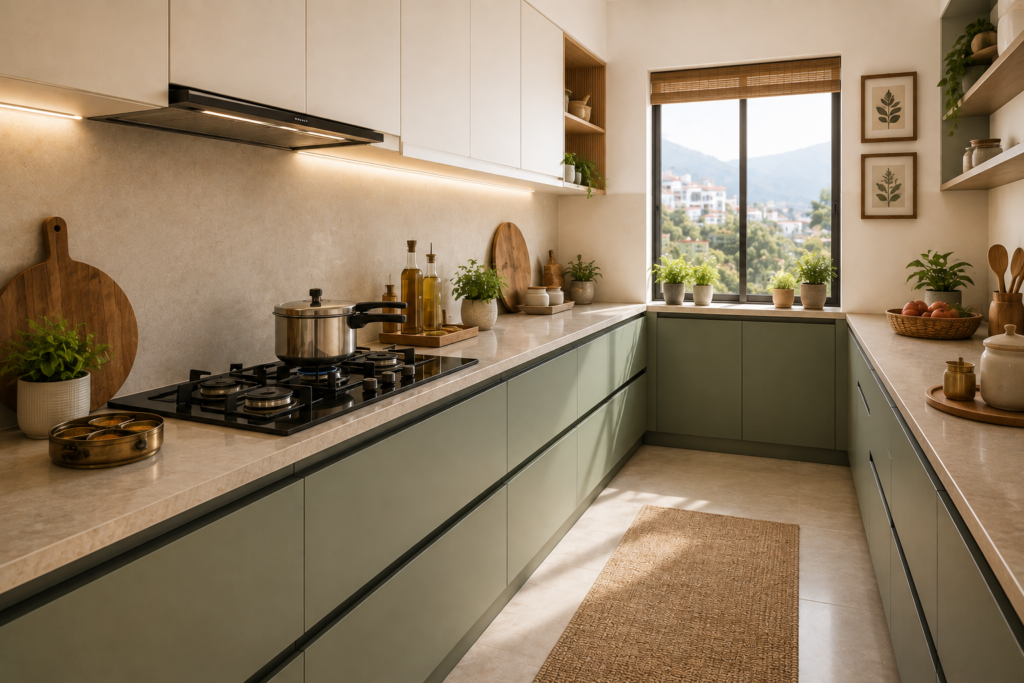
C-Gola vs J-Gola: What Is the Difference and Which Should You Choose?
Within the Gola profile family, the C-shape and J-shape variants serve different positions in the kitchen layout-they are not interchangeable.
C-Gola is placed between two adjacent drawers. The profile faces up on one side and down on the other, creating a shared channel that opens both the drawer above and the drawer below. Think of it as a shared grip point sitting in the horizontal gap between a stack of drawers. C-Gola is the defining visual element of the classic European drawer stack look-a single, uninterrupted metallic line between shutters.
J-Gola (or L-Gola) is placed at the top edge of a base cabinet unit, running horizontally just below the countertop overhang. Fingers reach up from below the channel lip to pull the door open. Because the channel is hidden under the countertop edge, J-Gola creates the most discreet visual line of any Gola variant-you barely see the channel until you look closely.
Vertical Gola runs along the side of tall units-pantry columns, refrigerator housings, and full-height storage towers. Reaching into a vertical channel with the palm facing inward is natural and ergonomic for tall unit access.
Common Mistake: Specifying C-Gola for wall cabinets. C-Gola needs the gap between two adjacent drawers to create its double-sided grip. On a single wall cabinet, there is no lower shutter to complete the C-shape-you end up with a channel that only opens from one direction, which defeats the geometry. Wall cabinets use J-Gola (bottom edge) or a simple angled profile, not C-Gola.
One practical measurement to note: Gola profile installation reduces the usable internal height of a base cabinet by approximately 2 to 2.5 inches. The profile housing occupies that vertical space within the carcass structure. For pull-out drawers with large vessels, confirm final internal clearance before the factory order is placed.
Cost of Handleless Kitchens in Dehradun, Noida, and North India (2026)
Cost comparison in handleless kitchen design has three layers: raw hardware, carcass fabrication, and installed finish cost per square foot.
Raw Hardware Costs
Hardware Component | Approx. 2026 Price (North India) |
Aluminum Gola profile rail (10 ft length, anodized) | ₹595–₹1,200 per piece |
Blum Tandembox Antaro tandem box (push-to-open) | ₹3,500–₹7,500 per drawer unit |
Blum Tip-On Blumotion latch (wall cabinets) | ₹800–₹1,800 per door |
Standard telescopic channel (J-pull compatible) | ₹450–₹900 per pair |
Note: Hardware prices are based on B2B wholesale listings from Delhi-NCR and Uttarakhand distributor markets as of 2026. Retail pricing from modular kitchen showrooms will typically be 15–30% higher.
Installed Cost Per Square Foot
System | Typical Installed Range (Dehradun, 2026) | Typical Range (Noida/NCR, 2026) |
Gola Profile Kitchen | ₹1,650–₹2,500/sq. ft. | ₹1,900–₹3,200/sq. ft. |
J-Pull Kitchen | ₹1,500–₹2,000/sq. ft. | ₹1,700–₹2,800/sq. ft. |
Push-to-Open Kitchen | Varies significantly by hardware brand; base cabinet cost comparable to J-pull, but each drawer adds ₹3,500–₹7,500 for Blum/Häfele hardware |
Local rate data is based on Dehradun fabricator rate cards and regional market observations from 2025–2026. Confirm current pricing directly with your installer, as hardware import costs and local labor rates fluctuate seasonally.
Why Is Gola Profile More Expensive?
The cost premium on Gola profiles has two drivers. First, the aluminum channel itself is an additional material cost that J-pull shutters do not require. Second-and this is the larger cost factor-the carcass side panels must be CNC-milled with precise L-shaped notch cutouts before cabinet assembly. This precision machining step adds 15–20% to the carcass fabrication labor cost and requires factory-level equipment, not site carpentry.
For a kitchen in Dehradun or Haridwar where the total cabinet run is 12–15 running feet, the Gola premium over J-pull typically works out to ₹25,000–₹60,000 for the complete installation. Whether that premium is worthwhile depends primarily on cleaning preference and the intensity of daily cooking-a household that cooks three full Indian meals a day will benefit more from Gola’s easier maintenance than a household that uses the kitchen lightly.
Climate and Material Considerations for Uttarakhand and NCR
This is where most national kitchen guides fall short. The material choices that work in an air-conditioned Mumbai apartment behave differently in Dehradun’s monsoon humidity or Haridwar’s riverbank moisture levels.
Dehradun, Haridwar, and Rishikesh
Dehradun’s annual humidity swing-from 35–45% in winter to 85–92% during the July–August monsoon-puts real stress on cabinet carcass materials and door edge treatments. Two specific vulnerabilities stand out for handleless kitchens:
J-pull edge sealing is critical. The J-groove channels into the core of the board. If the PU paint or laser edge banding at the routed curve degrades-through repeated contact with wet hands, or through UV exposure in a kitchen with a south-facing window-the exposed core can absorb ambient moisture. In Dehradun and Haridwar, this can cause the board to swell at the routed channel edge within two to three monsoon seasons, creating a rough-edged groove that is uncomfortable to use. Specifying HDHMR (High-Density Moisture-Resistant board) as the shutter substrate-rather than standard MDF-significantly reduces this risk. HDHMR’s denser core absorbs substantially less moisture than standard MDF under equivalent humidity conditions.
For Gola profile carcasses: the carcass substrate behind the aluminum rail should be BWP-grade plywood (IS:710-compliant, Boiling Water Proof) for base units and sink zones, and 18mm HDHMR for upper carcasses. Aluminum rails themselves are inherently moisture-proof, so the risk point is the wooden carcass notch that the rail mounts into-not the rail.
Haridwar adds the specific challenge of atmospheric salt and fine particulate from the Ganga river corridor. Anodized aluminum Gola profiles hold up well in this environment; powder-coated profiles should use a marine-grade coating if the kitchen has any open ventilation facing the river direction.
Rishikesh kitchens-particularly in boutique homestays and hillside residences-often combine dust from the valley floor with high humidity. Continuous Gola channels are easier to maintain here than J-pull grooves because the channel interior is accessible from the front with a standard cloth.
Noida and Ghaziabad
NCR kitchens operate in temperature-controlled apartment environments for most of the year, which reduces the humidity concern considerably. The dominant failure mode in Noida and Ghaziabad is not moisture-it’s mechanical wear from high-frequency use in families with multiple cooks.
Push-to-open systems in these kitchens should use Blum Tip-On Blumotion, Häfele Matrixbox, or equivalent hydraulic-assist mechanisms rather than basic spring latches. Mechanical spring latches in Noida kitchens typically show wear within 3–5 years under daily intensive use. Hydraulic-assist systems from these brands are considerably more durable.
For Noida apartment kitchens with enclosed HVAC, standard MDF shutters with J-pull routing perform well-the humidity concern that applies in Dehradun is largely absent in climate-controlled NCR apartments.
Hardware Brands: Häfele vs Blum vs Grass for Handleless Kitchens
The opening mechanism is only as reliable as the hardware brand behind it. For push-to-open systems especially, brand selection directly affects long-term performance.
Häfele (German) is particularly strong in Gola profile hardware-their aluminum channel catalog includes C-Gola, J-Gola, and vertical variants in multiple finishes, and the Matrixbox drawer system integrates push-to-open functionality cleanly. Häfele products are stocked through specialty hardware dealers rather than general building material shops, so confirm dealer availability in your city before specifying. Price point: premium.
Blum (Austrian) is the benchmark for push-to-open technology. The Tip-On Blumotion system-which combines push-open with hydraulic soft-close-is the most reliable push mechanism for wall cabinets in daily Indian kitchen use. Blum’s SERVO-DRIVE electronic opening is the specification-grade option for high-end kitchens. Price point: premium to ultra-premium.
Grass (Austrian) is an increasingly available option in the North India market for tandem box runners and soft-close hinge systems. Grass Nova Pro Scala drawer systems support push-to-open integration and offer load ratings comparable to Blum at a slightly more accessible price point. Price point: mid-to-premium.
Compliance note: Kitchen storage hardware used in India should meet IS 17634:2022 (Bureau of Indian Standards) requirements for structural storage unit load safety. Reputable brands (Häfele, Blum, Grass) test and publish compliance with both IS 17634 and European DIN EN 15338 standards for extension runners. When sourcing hardware through local distributors, confirm compliance rather than assuming it.
Which Handleless System Is Right for Your Kitchen?
Use this decision framework before finalizing your hardware specification:
Choose Gola Profile if:
- You cook Indian meals daily (heavy grease, spices, oil tempering) and want the easiest cleaning surface
- Your kitchen will be used by multiple people and the lower base units will carry heavy kadhais and pressure cookers
- You want the most architecturally refined handleless look-the metallic channel line adds a design accent, not just a functional groove
- Your budget accommodates a 10–20% premium over J-pull for the superior long-term maintenance advantage
- Your kitchen is in Dehradun, Haridwar, or Rishikesh and you want maximum moisture resilience
Choose J-Pull if:
- You want a modern handleless look at a more accessible price point
- Your cooking intensity is moderate-the kitchen is used daily but not for continuous high-volume Indian cooking
- Your shutter will be made from HDHMR with proper PU-paint sealing (not standard MDF in a humid climate)
- You are designing a kitchen in an air-conditioned NCR apartment where humidity management is less critical
- The kitchen layout uses upper wall cabinets heavily-J-pull performs well on wall cabinets where the top-edge groove stays cleaner than base unit grooves
Choose Push-to-Open if:
- The kitchen is lightly used or primarily decorative (holiday homes, guest-area kitchens)
- You are specifying a show kitchen where the completely flat shutter face is a non-negotiable design requirement
- You apply it selectively-upper wall cabinets and display units only, not lower base drawers
- You specify Blum, Häfele, or Grass hardware (not generic spring latches) and the drawer load stays under 30 kg
When Push-to-Open is NOT the right choice:
- Lower base units carrying heavy Indian cookware
- Kitchens where the cook frequently leans against or brushes the lower cabinet fronts
- Coastal, riverine, or highly humid environments where fine particulate can clog spring latch mechanisms over time (Rishikesh near the Ganga, hill-facing Dehradun villas with open ventilation)
Common Mistakes to Avoid
- Specifying C-Gola for wall cabinets. C-Gola needs a drawer below it to work. On a solo wall cabinet, you’ll have a one-sided channel that’s awkward to use. Use J-Gola on wall cabinets and C-Gola between drawer stacks.
- Routing J-pull into BWP plywood shutters. The cross-layered grain in plywood splinters during precision routing, creating rough-edged grooves. J-pull routing belongs on HDHMR or MDF substrates.
- Specifying push-to-open for a full kitchen without hardware budgeting. Basic spring latches cost very little. Blum Tip-On Blumotion or Häfele Matrixbox Push hardware adds ₹800–₹1,800 per door. On a 20-door kitchen, that’s an extra ₹16,000–₹36,000 that many homeowners don’t see in the initial quote.
- Assuming you can retrofit later. Gola profiles cannot be added to an existing kitchen without CNC-notching the carcasses-which means rebuilding the cabinets. J-pull grooves cannot be routed into installed shutters cleanly. Choose your system before the factory order, not after.
- Ignoring the vertical height loss from Gola installation. Each Gola channel occupies approximately 2–2.5 inches of vertical cabinet space inside the carcass. For base units with tall vessels, account for this in the internal storage plan before finalizing cabinet heights.
Frequently Asked Questions
A Gola profile uses a continuous aluminum channel mounted to the cabinet carcass-the door shutter itself is flat and featureless. A J-pull has a J-shaped groove routered directly into the door shutter edge. Both deliver a handleless look, but Gola’s channel is easier to clean and does not require special door substrate treatment, while J-pull is typically 10–15% cheaper to install.
Not without the right hardware. Basic mechanical spring latches struggle when base drawers carry heavy kadhais, pressure cookers, or steel vessels exceeding 25–30 kg. For heavy-load drawers, Blum Tandembox or Häfele Matrixbox runners rated at 40–70 kg are required-and even then, J-pull or Gola profiles provide a more reliable manual grip for heavy drawer pulls.
For daily heavy Indian cooking, Gola profiles are easier to maintain. The flat aluminum rail wipes clean in one stroke, while turmeric and oil residue settles into J-pull grooves and requires more careful daily cleaning. That said, J-pull performs well in moderate-use kitchens and air-conditioned apartments where cleaning habits are consistent.
Gola profile modular kitchens in Dehradun typically range from ₹1,650–₹2,500 per square foot of cabinetry, depending on shutter finish (acrylic vs. PU paint), carcass material (HDHMR vs. BWP plywood), and hardware brand. A standard 10–12 sq. ft. kitchen runs approximately ₹1.8 lakh–₹3.5 lakh fully installed. Confirm current pricing with your local installer, as hardware costs fluctuate seasonally.
C-Gola is a C-shaped profile installed between two adjacent drawers, creating a shared grip channel that opens both drawers above and below it. J-Gola (or L-Gola) is installed at the top edge of a base cabinet, with fingers reaching upward from below to pull the door open. C-Gola is used in drawer stacks; J-Gola is used on single-door base units and sometimes on wall cabinet bottom edges.
It depends on the cooking habits and hardware quality, but lower base cabinets near the cooking hob are the riskiest location for push-to-open. Thigh or hip contact during active cooking-particularly while stirring or rolling dough-can accidentally trigger the spring latch and pop the drawer open. For lower base units used daily for heavy cookware, Gola profiles or J-pull handles are safer and more reliable.
Gola profiles paired with BWP-grade (IS:710) plywood carcasses for base units and 18mm HDHMR for upper carcasses are the most monsoon-resistant combination. J-pull shutters in Dehradun must use HDHMR substrates-not standard MDF-with proper PU-paint or laser edge-banded sealing at the routed groove to prevent moisture absorption during the monsoon season.
No, not practically. Gola rails require L-shaped or U-shaped notch cutouts to be CNC-milled into the carcass side panels before cabinet assembly. These cutouts cannot be added to an assembled cabinet on-site without compromising the structural integrity of the carcass. To switch to Gola profiles from a standard kitchen, the carcasses must be rebuilt at the factory.
Yes. The J-shaped groove routes into the board core, exposing the internal substrate at the curved recess. This exposed core must be sealed with multi-layer Polyurethane (PU) paint or 3D laser edge banding to prevent moisture ingress-particularly in humid environments like Dehradun and Haridwar. Unprotected J-groove edges in high-humidity kitchens will eventually show swelling or surface peeling.
Basic mechanical spring latches typically show wear within 3–5 years under daily heavy use. Hydraulic-assist systems from Blum (Tip-On Blumotion) or Häfele (Matrixbox Push) last considerably longer-typically 8–12 years with normal use-because the hydraulic damper absorbs the repeated impact force that wears out spring-only mechanisms.
Key Takeaways
- Gola profiles live in the cabinet carcass; J-pulls live in the door shutter; push-to-open lives inside the carcass as a latch. Understanding that difference resolves most confusion about the systems.
- For Indian kitchens with daily heavy cooking, Gola profiles offer the easiest cleaning-the flat aluminum rail wipes in one stroke, unlike J-pull grooves that trap turmeric and oil.
- Push-to-open is best reserved for upper wall cabinets and lightly used zones. Lower base drawers carrying heavy Indian cookware are not ideal push-to-open locations.
- J-pull routing requires HDHMR or MDF substrates-not BWP plywood-and proper edge sealing. In Dehradun and Haridwar’s humid climate, HDHMR is the safer substrate choice over standard MDF.
- Gola installation costs 10–20% more than J-pull due to CNC carcass notching and aluminum profile material costs.
- C-Gola goes between drawer stacks; J-Gola goes at the top edge of base cabinets. They are not interchangeable.
- Hardware brand matters for push-to-open durability. Blum Tip-On Blumotion, Häfele Matrixbox, and Grass Nova Pro systems outlast generic spring latches by years in daily use.
- None of these systems can be easily retrofitted into an existing kitchen-the decision must be made before the factory order.
Conclusion
You started with a terminology problem-Gola, J-pull, push-to-open-and ended up with a mechanism decision that affects how your kitchen cleans, holds up, and feels to use every single day.
The right choice isn’t the one that looks best in a showroom photo. It’s the one that matches your cooking intensity, your maintenance willingness, your local climate, and your budget. For most households in Dehradun, Haridwar, and Rishikesh that cook full Indian meals daily, Gola profiles paired with HDHMR or BWP plywood carcasses represent the most durable and maintainable combination. For budget-conscious buyers in NCR apartments with moderate cooking habits, J-pull shutters on HDHMR with quality edge sealing deliver a modern handleless look at a lower entry cost.
Push-to-open has its place-wall cabinets in premium show kitchens, lightly used zones-but it is not a universal replacement for physical grip systems in an Indian household context.
If you’re planning a kitchen in Dehradun, Noida, Haridwar, Rishikesh, Roorkee, or Ghaziabad and want to see these systems side by side in a working installation, the Bhumim showroom has live demo kitchens featuring each mechanism. The team can walk you through the carcass construction, show you the actual profile hardware, and help you match the right system to your layout and cooking habits.
Book a free 3D kitchen design consultation with Bhumim-WhatsApp, call, or fill the estimate form to get started.
About This Article
Published by: Bhumim India Private Limited-Modular Kitchen Manufacturer & Installer, Dehradun
GST: 05AAOCB1784F1ZM | ISO 9001:2015 Certified
Service Areas: Dehradun · Haridwar · Rishikesh · Roorkee · Noida · Ghaziabad
Contact: 08044630777 | hello@bhumim.com
Note: This article is written from Bhumim’s on-ground manufacturing and installation experience. All material recommendations are based on what we use in real kitchens across our service areas.