

Hinged vs Sliding Wardrobe - What Dehradun Homeowners Actually Choose
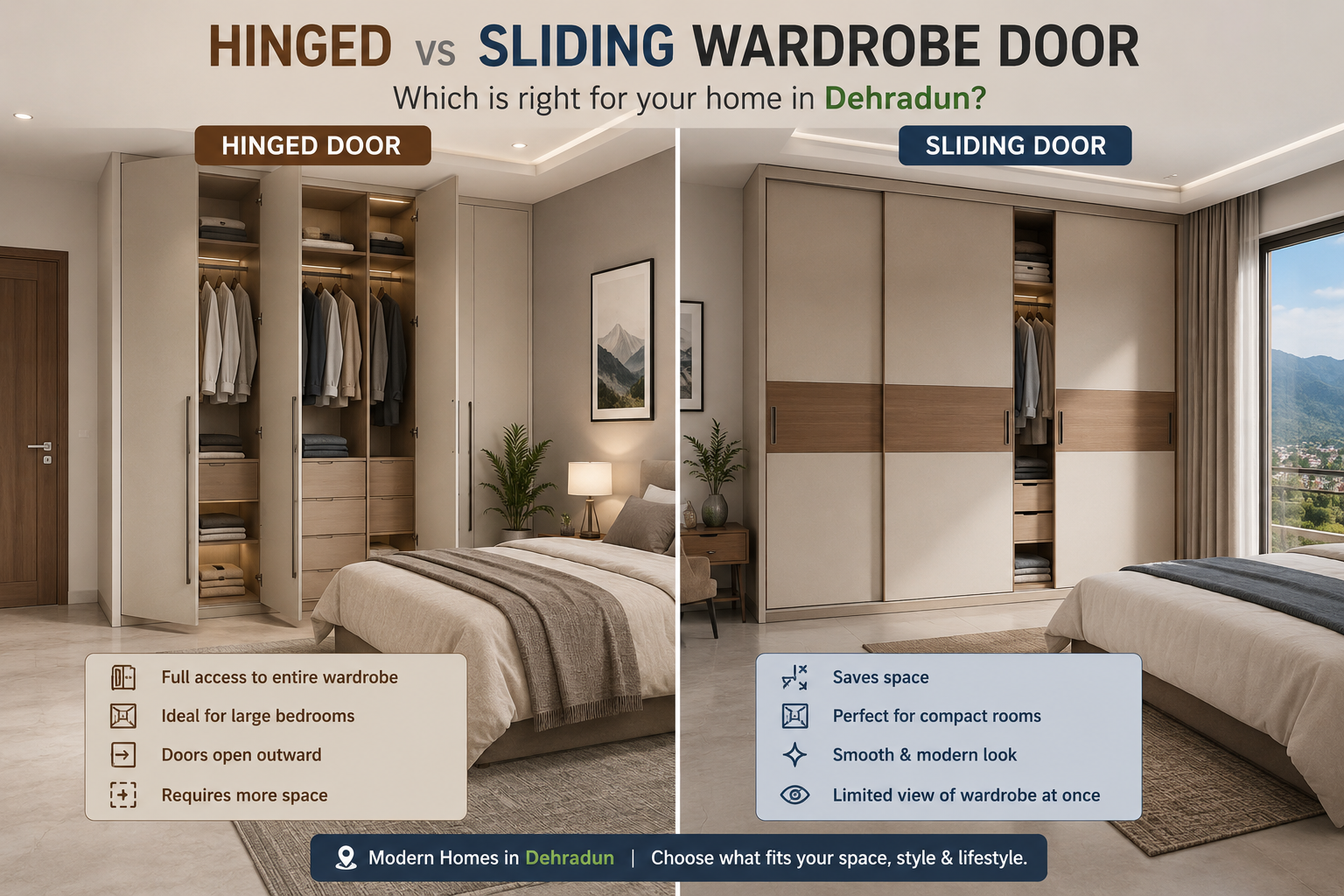
Hinged vs sliding wardrobe – which one wins? For small Indian bedrooms with limited floor space, sliding doors are usually the smarter pick. But if you want easier access to everything inside and have a room wider than 12 feet, hinged wardrobes give you more storage flexibility. Your room size, budget, and daily habits decide the winner.
Which Wardrobe Door Type Is Right for Your Lifestyle?
Picture this: you just moved into your new flat in Dehradun. The bedroom looks great. But then the carpenter shows up and asks, “Sir, hinged door wardrobe chahiye ya sliding?” And suddenly your mind goes blank.
You don’t want to make the wrong call. A wardrobe is not something you replace every two years. Once it’s fixed to the wall, it’s there for a long time.
This is the exact problem hundreds of families in Dehradun, Haridwar, and Rishikesh face when they plan their bedrooms. The hinged vs sliding wardrobe decision seems simple on the surface, but there are real differences in cost, space use, ease of access, and long-term durability that most people don’t find out until it’s too late.
In this guide, we break everything down clearly – no confusing terms, no fluff. By the end, you’ll know exactly which wardrobe door type works for your bedroom, your budget, and your lifestyle.
And if you want expert help making that choice for your home in Dehradun or nearby areas, the team at Bhumim designs, manufactures, and installs custom modular wardrobes – built specifically for your space.
Get started with Beautiful Homes
For expert design consultation, send us your details and we’ll schedule a call
What Are Hinged and Sliding Wardrobes?
Before we get into the wardrobe comparison, let’s understand what we’re actually talking about.
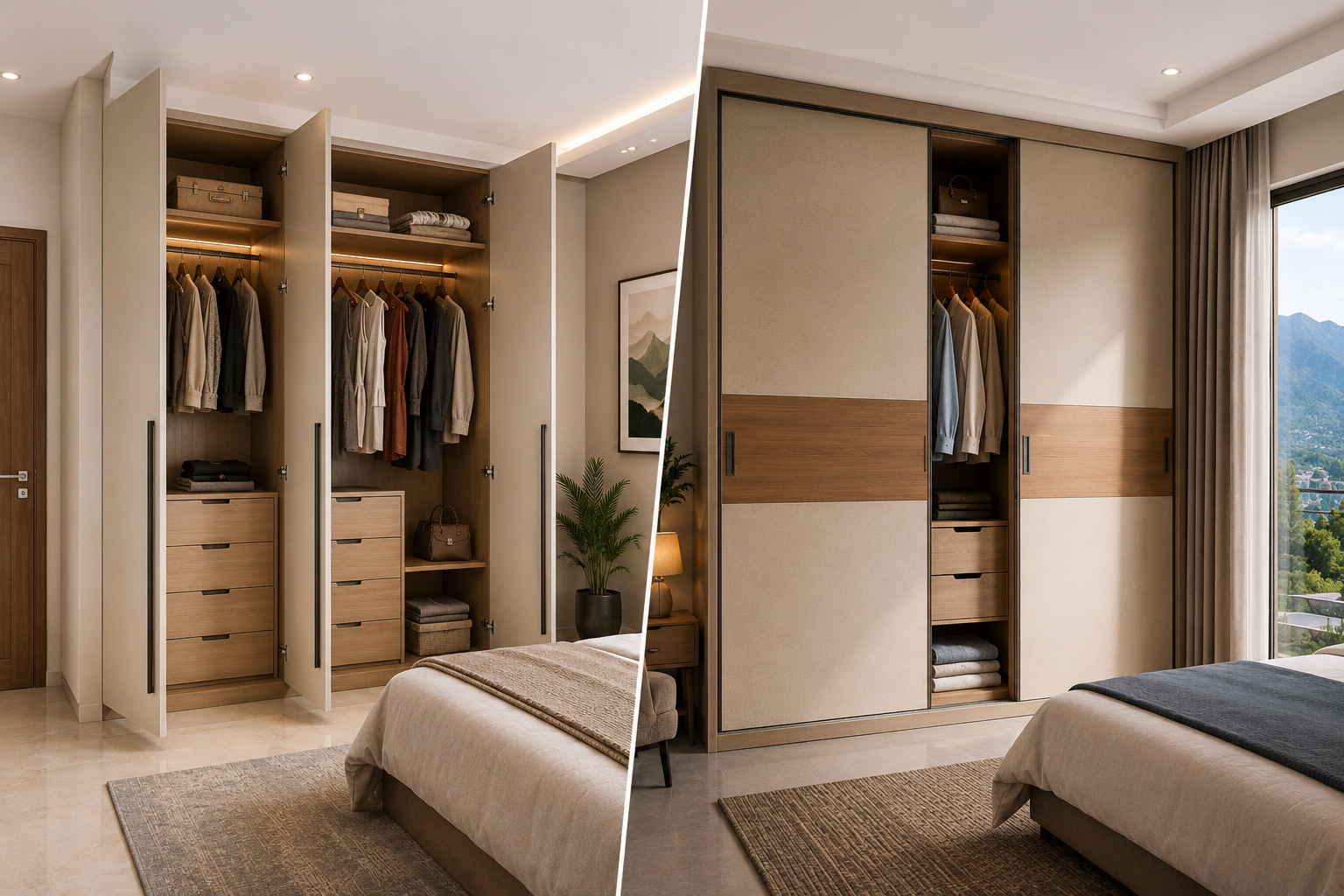
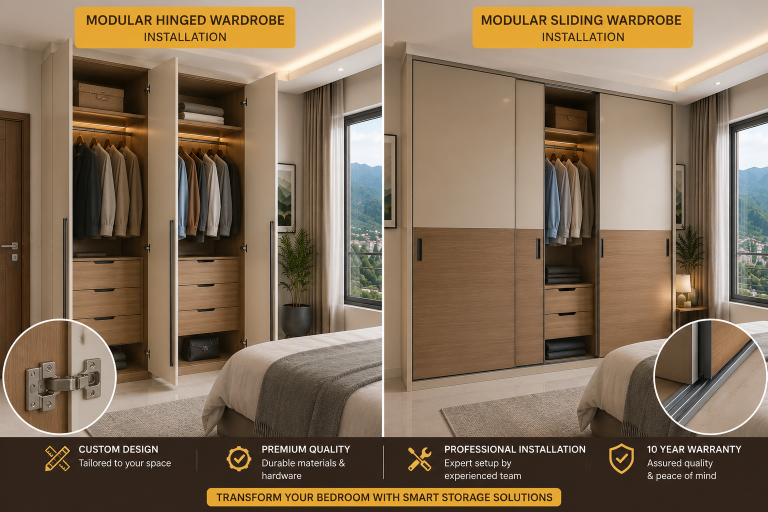
Hinged wardrobes have doors attached with hinges on one side. The door swings outward when you open it – just like a regular room door. You’ve probably seen this style in older homes and traditional Indian bedrooms.
Sliding wardrobes have doors that move sideways on a track, either on the floor or hanging from the top frame. One panel slides behind the other. No door swings out. This is the style you’ll see in most modern homes today.
That’s the basic difference. But where things get interesting – and where most people get confused – is everything else that comes with each option.
Hinged vs Sliding Wardrobe - The Key Differences
Let’s do a proper wardrobe comparison side by side.
Door Movement and Access
With hinged doors, you can open one door fully and see everything inside at once. You can reach the full width of any shelf without the door being in the way.
Sliding doors, on the other hand, always block one side. If your wardrobe has two sliding panels, only half the wardrobe is open at any time. To access the other half, you have to slide the first door across.
This seems like a small thing until it’s 7 AM, and you’re trying to find that one shirt buried on the left side of a sliding wardrobe.
Space Used Outside the Wardrobe
Here’s where sliding wardrobes clearly win.
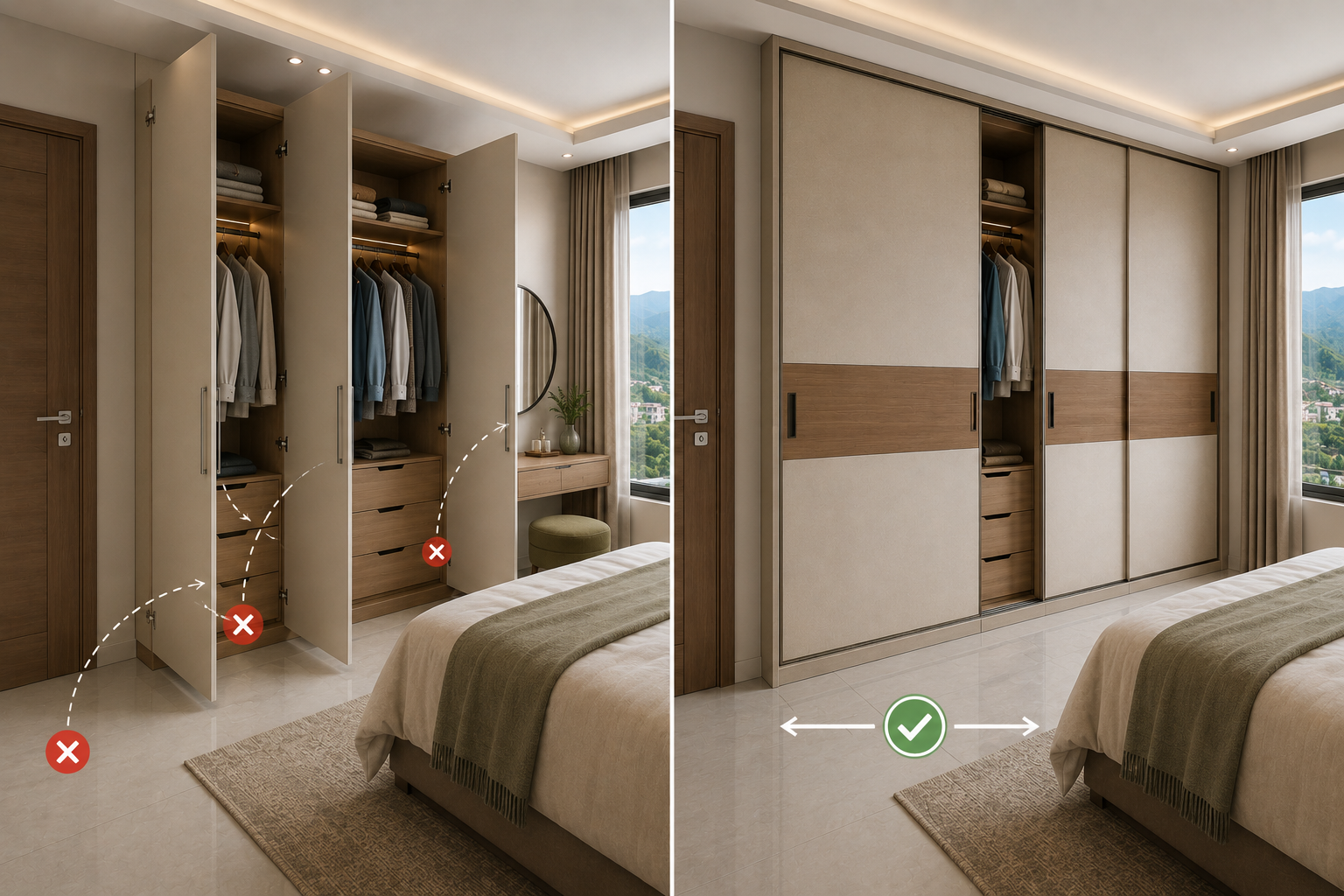
A hinged door on a 2-foot-wide wardrobe panel swings out 2 feet into the room. If your bedroom is small – which most bedrooms in Dehradun’s apartments and independent houses are – that 2 feet matters a lot.
Sliding doors stay within the wardrobe frame. They use zero extra floor space when opened.
Internal Storage Design
Hinged wardrobes are more flexible inside. You can fit deeper shelves, pull-out drawers, and accessories more easily because the full opening is available.
With sliding wardrobes, you sometimes have to compromise on internal layout because the track system takes up a little depth at the top or bottom.
Space Saving Wardrobe: Which Door Type Wins?
If space saving is your top priority, sliding wardrobes win every time.
Most bedrooms in Indian cities – including in Dehradun’s popular areas like Rajpur Road, GMS Road, and Sahastradhara Road – are between 100 and 150 square feet. In these rooms, every foot counts.
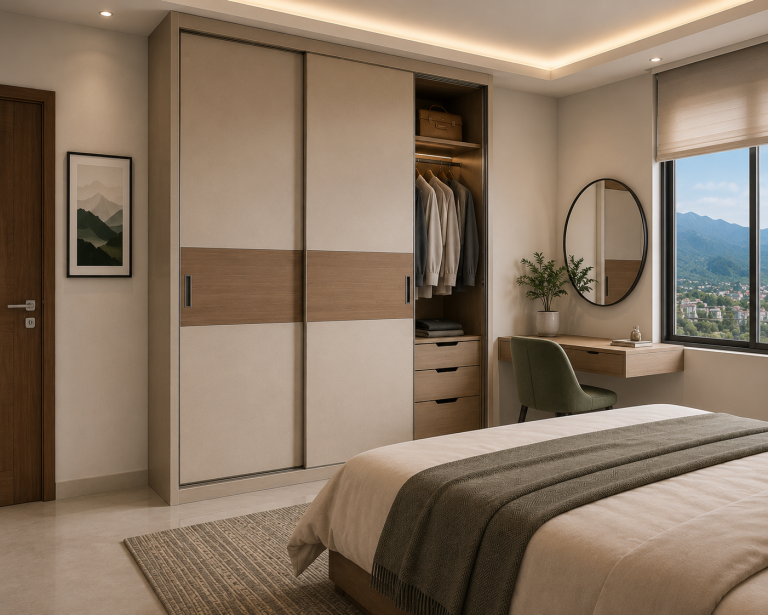
A sliding wardrobe that fits floor to ceiling along one wall can hold everything a family needs while keeping the walking area in the room completely clear. No doors swinging out, no hitting the bed, no banging into the dressing table.
When Hinged Doors Make Sense for Space
Hinged doors actually work fine if:
- Your bedroom is larger than 12 feet wide
- The wardrobe is placed in a corner where the door won’t hit furniture
- You want a walk-in style wardrobe with a dedicated dressing area
For compact bedrooms, though, a hinged door can turn the area in front of the wardrobe into a danger zone.
Cost Comparison: Wardrobe Comparison on Budget
This is usually the first question families ask. And the honest answer is – hinged wardrobes are generally cheaper.
Here’s why:
- Hinged door hardware (hinges, handles) costs less than sliding track systems
- Sliding wardrobes need quality aluminum or steel tracks and rollers, which add to the cost
- If you want a mirror on a sliding door, it fits perfectly and looks great – but a good mirror panel adds cost
Rough Cost Estimate (Dehradun Market, 2026)
Type | Basic (per sq ft) | Mid-range | Premium |
Hinged Wardrobe | ₹900–₹1,200 | ₹1,200–₹1,800 | ₹1,800+ |
Sliding Wardrobe | ₹1,100–₹1,500 | ₹1,500–₹2,200 | ₹2,200+ |
These are rough estimates. Actual cost depends on material, size, internal fittings, and finish.
The price gap is not huge. And when you consider that a sliding wardrobe saves space and looks more modern, many families in Dehradun choose it even at a slightly higher price.
Bhumim manufactures wardrobes at its own facility, which means there’s no middleman markup. You get a better-quality wardrobe at a fair price – and everything from design to installation is handled in-house.
Style and Look - What Suits Indian Bedrooms?
Let’s talk about how they actually look, because style matters.
Hinged Wardrobes - Classic and Versatile
Hinged wardrobes have a traditional, warm look. They suit bedrooms that have a classic or ethnic feel – wood grain finishes, carved patterns, brass handles. You’ll often see this style in older Dehradun homes and builder flats where traditional styling is preferred.
You can also get modern-looking hinged wardrobes with clean panels, matte finishes, and minimal handles. So hinged doesn’t always mean old-fashioned.
Sliding Wardrobes - Clean and Contemporary
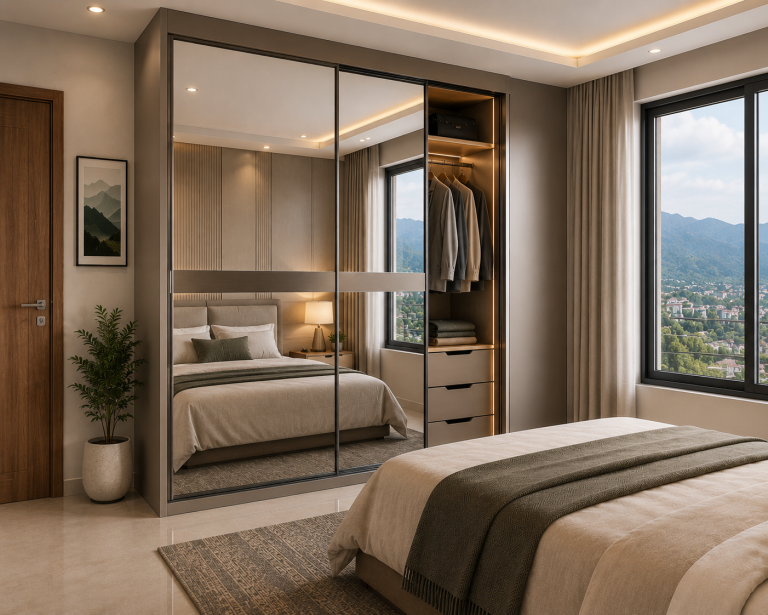
Sliding wardrobes define modern bedroom design. The large flat panels give the bedroom a seamless, clean look. Glass panels, mirrors, or high-gloss finishes make the room feel bigger and brighter.
If you’ve seen a bedroom on Instagram or in a home catalogue and thought “wow, that looks sleek” – there’s a very good chance it had a sliding wardrobe.
For Dehradun homes designed with a modern touch – especially new construction in areas like Dalanwala, Balliwala, or Niranjanpur – sliding wardrobes fit right in.
Durability: Which Wardrobe Lasts Longer?
This is where many people get surprised.
A well-made hinged wardrobe, with quality hinges (like soft-close hydraulic hinges), can last 15–20 years with almost no maintenance. Hinges are simple mechanical parts with very few points of failure.
Sliding wardrobes depend heavily on the quality of the track system. A cheap track will start to feel rough or get stuck within 3–4 years. A premium aluminum track system, however, can last just as long as hinged hardware – sometimes longer, because the rollers handle weight smoothly.
The lesson here: quality of hardware matters more than door type.
At Bhumim, both hinged and sliding wardrobes are built with durable materials and precision-fitted hardware. The focus is on wardrobes that still feel smooth and solid 10 years after installation – because a wardrobe that breaks in 3 years is not a saving, it’s a loss.
Dehradun’s climate – humid summers, cool winters, and occasional heavy rain – can affect wood-based wardrobe bodies if poor materials are used. Bhumim uses moisture-resistant boards and quality laminates specifically suited for this region’s weather conditions.
How to Choose the Right Wardrobe for Your Bedroom
Here’s a simple step-by-step way to make the decision.
Step 1: Measure Your Bedroom
Measure the length, width, and height of your bedroom. Also, measure how much wall space you have for the wardrobe. Note how far the bed, dressing table, and other furniture are from the wardrobe wall.
If the space in front of the wardrobe is less than 3 feet, a hinged door will be very uncomfortable to use. Go sliding.
Step 2: Think About How Many People Will Use It
A wardrobe for one person is different from one for a couple. Couples often need two separate sections – one on each side. Sliding doors can sometimes make this trickier since you can only open one side at a time.
A wardrobe for kids needs easy access at all times. Sliding works well for children’s rooms because there are no swinging panels that can hurt small fingers.
Step 3: Decide Your Budget
If the budget is tight, a well-designed hinged wardrobe gives you more value for the same money. If you have a bit more to spend and want a cleaner look, sliding is worth it.
Step 4: Think About the Room's Personality
Traditional bedroom with wooden furniture and warm tones? Hinged works beautifully. Contemporary bedroom with clean lines and neutral tones? Sliding fits perfectly.
Step 5: Get a Professional Opinion
This is where Bhumim helps. Their team visits your home, takes proper measurements, and shows you how both options would look in your actual space – including a 3D design preview so you can see it before it’s built.
You can explore their full range of wardrobe options at Bhumim’s Wardrobe Design – including both hinged wardrobes and sliding wardrobes.
Common Mistakes People Make When Choosing Wardrobes
Mistake 1: Choosing by Look Alone
A sliding wardrobe looks amazing in a showroom. But if your bedroom is only 9 feet wide and the wardrobe will be placed opposite the bed, you need to check whether a hinged door would work better for access without becoming awkward.
Mistake 2: Ignoring Internal Layout
People spend a lot of time picking the door type and forgetting to plan the inside. A wardrobe with the wrong internal layout will frustrate you every single day. Think about how many shelves, hanging spaces, drawers, and accessory areas you actually need.
Check out Bhumim’s wardrobe accessories page to see what smart internal fittings are available.
Mistake 3: Going for the Cheapest Track
For sliding wardrobes, don’t cut costs on the track system. A cheap track feels heavy, gets stuck in humidity, and wears out fast. Paying a bit more for a quality track is worth every rupee.
Mistake 4: Not Accounting for Floor-to-Ceiling Height
Many people get a standard 7-foot wardrobe in a room with 10-foot ceilings. That 3-foot gap at the top just collects dust and wasted space. A floor-to-ceiling wardrobe – whether hinged or sliding – uses the full height and gives you much more storage.
Mistake 5: Skipping the 3D Preview
You can’t always judge from a catalogue photo how a wardrobe will look in your room. A 3D visualization – which Bhumim provides as part of their process – lets you see the final result before anything is manufactured.
Expert Tips from Bhumim's Design Team
Based on hundreds of wardrobe installations across Dehradun and surrounding areas, here’s what the Bhumim team recommends:
For bedrooms smaller than 120 sq ft: Always go sliding. The floor space you save makes a huge daily difference.
For master bedrooms with attached dressing areas: Consider a hinged wardrobe for the main clothing storage, with a smaller sliding unit near the dressing area for easy-access items.
For kids’ rooms: Sliding wardrobes work well. No swinging doors, safer for kids, and the panels can have fun finishes or colours.
For humid areas or ground-floor homes in Dehradun: Use an HDHMR or BWP-grade plywood core with a quality laminate finish. This resists moisture far better than cheap MDF. You can learn more about kitchen and wardrobe materials here – many of the same material principles apply to wardrobes.
Mirror on sliding door: If your bedroom doesn’t have a separate full-length mirror, adding one to a sliding wardrobe panel is a brilliant idea. It saves space, makes the room look bigger, and is very practical.
Soft-close on hinged doors: Always ask for soft-close hinges. The doors close gently without banging, they last longer, and they make the bedroom feel more premium every time you use them.
Benefits and Challenges of Each Door Type
Hinged Wardrobe - Benefits
- Full access to the entire interior when open
- Generally lower cost
- Easier to repair (hinges are simple to replace)
- Works with a wider range of internal layouts
- Suits classic and traditional bedroom styles
Hinged Wardrobe - Challenges
- Needs 2–3 feet of clear space in front to open
- Can feel cramped in small rooms
- Multiple doors can look busy in some designs
Sliding Wardrobe - Benefits
- Zero floor space needed to operate
- Modern, clean appearance
- Great for mirror panels and reflective surfaces
- Fits floor-to-ceiling seamlessly
- Works beautifully in compact Indian bedrooms
Sliding Wardrobe - Challenges
- Only half the interior is accessible at a time
- Costs slightly more due to the track hardware
- Track quality directly affects long-term satisfaction
- Not ideal if you need constant access to both sides at once
Both door types are available at Bhumim – designed, manufactured, and installed by the same team, ensuring quality at every step. You can see all wardrobe design options at Stylish Wardrobe Design.
Also, if you’re planning your full bedroom setup – including bed design and storage – check out Bhumim’s bedroom furniture options for a complete, coordinated look.
And if you’re also redoing your kitchen along with the bedroom, the best modular kitchen and wardrobe manufacturer in Dehradun page will give you a full picture of what Bhumim offers.
Frequently Asked Questions
Q1. Which is better - a hinged or a sliding wardrobe for a small Indian bedroom?
For small bedrooms (under 120 sq ft), sliding wardrobes are the better choice. They don’t require any floor clearance to open, keeping your walking space free. Hinged doors need 2–3 feet of clear space to swing open, which is hard to spare in compact rooms.
Q2. Are sliding wardrobes more expensive than hinged wardrobes?
Yes, sliding wardrobes are generally 15–25% more expensive than hinged ones due to the cost of the track hardware and roller mechanism. However, the difference narrows at mid-range and premium quality levels. The space and aesthetic benefits of sliding doors often make them worth the extra investment.
Q3. Which type is better for Dehradun's climate?
Dehradun experiences humidity, especially during the monsoon. Both door types can perform well if the wardrobe body is made from moisture-resistant material like HDHMR or BWP plywood with a good laminate finish. The door type itself doesn’t affect weather performance as much as the core material does.
Q4. Can I add a mirror to a hinged wardrobe door?
Yes, you can add a mirror to a hinged wardrobe door. However, mirrors work even better on sliding wardrobe doors because the larger, uninterrupted panels make a full-length mirror look more seamless. A mirrored sliding panel can also make a small bedroom appear much bigger.
Q5. How long do sliding wardrobe tracks last?
A good-quality aluminum track system lasts 12–15 years with basic care. Cheap tracks may start to feel rough or get stuck within 3–5 years. Always ask for the track quality specification when getting a sliding wardrobe made, and avoid going for the cheapest option available.
Q6. What is the minimum room size for a hinged wardrobe?
If your room is at least 10–12 feet wide and there is a clear wall of at least 5 feet for the wardrobe, a hinged wardrobe can work well. If the space in front of the wardrobe is less than 3 feet, consider sliding instead.
Q7. Does Bhumim offer both hinged and sliding wardrobes in Dehradun?
Yes. Bhumim designs, manufactures, and installs both hinged and sliding modular wardrobes for homes across Dehradun, Haridwar, Rishikesh, Roorkee, Noida, and Ghaziabad. Every wardrobe is customized to your room dimensions, storage needs, and preferred finish – with a 3D design preview before manufacturing begins. Contact the Bhumim Designer Experts team directly.
Key Takeaways
- The hinged vs sliding wardrobe decision depends mainly on your room size, budget, and daily habits.
- Sliding wardrobes are better for small rooms – they save floor space and have a modern look.
- Hinged wardrobes give you full access to the interior and are slightly more affordable.
- Track quality is the most important factor for a sliding wardrobe’s long-term performance.
- Material quality matters more than door type for durability in Dehradun’s climate.
- A floor-to-ceiling wardrobe maximizes storage in any Indian bedroom, regardless of door style.
- Bhumim offers both types – custom-designed, manufactured in-house, and installed end-to-end across Dehradun and surrounding areas.
Conclusion
There’s no universal winner in the hinged vs sliding wardrobe debate. The right answer depends on your room, your budget, and how you use your wardrobe every day.
If your bedroom is small, sliding is your friend. If you have space and want full, unrestricted access, Hinged gives you that freedom. In many homes, a thoughtfully designed wardrobe – whether hinged or sliding – solves multiple problems at once: storage, style, and smart use of space.
The good news is you don’t have to figure this out on your own.
Bhumim’s team works with families across Dehradun to design wardrobes that actually fit their lives – not just their walls. From the first measurement to the final installation, every step is handled with care. They manufacture everything in-house, which means better quality control, faster delivery, and no middleman inflating your cost.
Now that you understand the difference between hinged and sliding wardrobes, whether you’re setting up a new home or upgrading your current bedroom, reach out to Bhumim for a free design consultation. Step into your bedroom upgrade with confidence, knowing exactly what you’re getting, how it will look, and how it will work for your family for years to come.
About This Article
Published by: Bhumim India Private Limited-Modular Kitchen Manufacturer & Installer, Dehradun
GST: 05AAOCB1784F1ZM | ISO 9001:2015 Certified
Service Areas: Dehradun · Haridwar · Rishikesh · Roorkee · Noida · Ghaziabad
Contact: 08044630777 | hello@bhumim.com
Note: This article is written from Bhumim’s on-ground manufacturing and installation experience. All material recommendations are based on what we use in real kitchens across our service areas.