

Laminate vs Acrylic vs Membrane vs PU Finish for Kitchen: The Honest Comparison for North Indian Homes
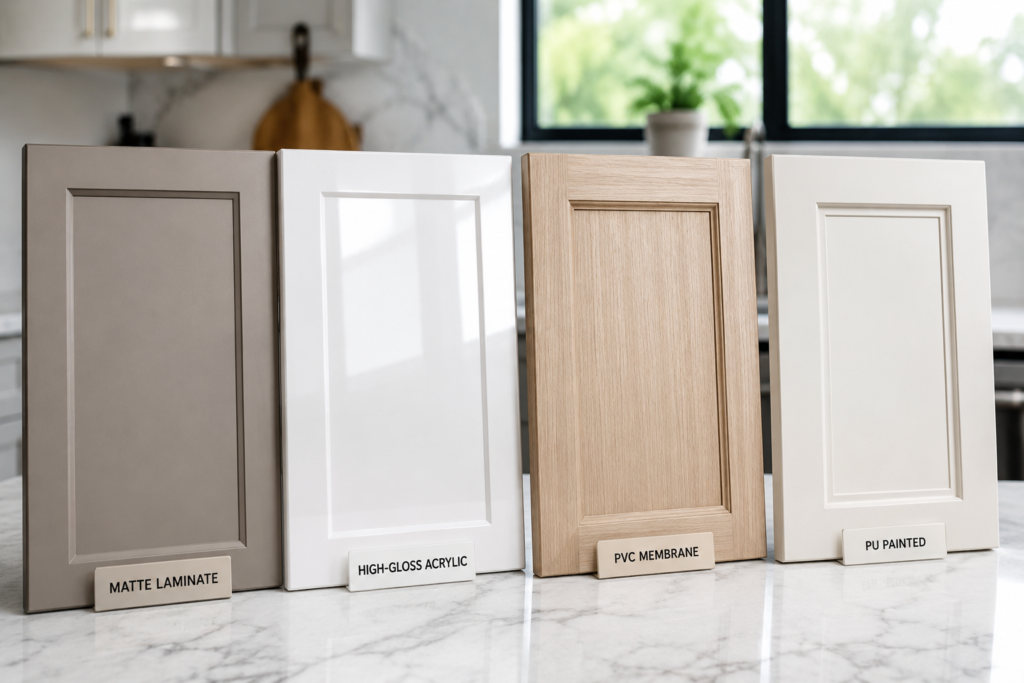
Laminate vs acrylic vs membrane vs PU finish for kitchen cabinets describes the four most common shutter surface options available in India today-each differing in look, substrate requirement, moisture tolerance, repairability, and cost per square foot-with the right choice depending on your kitchen’s heat exposure, humidity level, budget, and design goals, not on what a salesperson tells you sounds best.
What Every Homeowner Gets Wrong Before Choosing a Kitchen Finish
After installing modular kitchens across Dehradun, Haridwar, Rishikesh, Noida, and Ghaziabad, the question we hear most often isn’t about layout or storage. It’s this: “My contractor says go for acrylic, but my cousin got membrane and it started peeling in two years. What should I actually choose?”
Both can be right. Both can be wrong. The finish that holds up beautifully in a Noida high-rise apartment with a chimney over the hob may bubble and lift within months in a Dehradun kitchen that sees heavy monsoon humidity from June to September. The finish that adds visual depth to a compact 7×8 ft kitchen may need constant microfiber maintenance in a household with three children and daily deep-frying.
This guide doesn’t tell you which finish is “best.” Instead, it tells you what each finish actually is, how it behaves under Indian cooking conditions and North Indian climate patterns, what it costs per square foot in 2026, what happens when it gets damaged, and-specifically-which finish suits which type of home in Dehradun, Noida, Haridwar, Rishikesh, Roorkee, and Ghaziabad.
Quick Comparison: Laminate vs Acrylic vs Membrane vs PU at a Glance
Before going deep, here’s the decision-level summary. Think of it as the one table your contractor probably doesn’t show you.
Feature | Laminate (HPL) | Acrylic | Membrane (PVC) | PU Paint Finish |
Cost (shutter finish only) | ₹180–₹350/sq ft | ₹450–₹850/sq ft | ₹280–₹480/sq ft | ₹750–₹1,800+/sq ft |
Best substrate | BWP Plywood or HDHMR | HDHMR or high-density MDF | High-density MDF or HDHMR only | HDHMR, HDF, or seasoned wood |
Scratch resistance | High (9/10) | Moderate (6/10) | Moderate-Low (5/10) | High (8/10) |
Moisture resistance | High (with PUR edge tape) | Excellent | Moderate (fails if edge unsealed) | Excellent (6-sided seal) |
Heat tolerance | High (up to ~180°C) | Good (keep away from direct flame) | Low (peels near stove heat) | Good |
Edge aesthetics | Visible seam unless laser-edged | Near-seamless with matching tape | Fully seamless (wrapped) | Fully seamless (spray-coated) |
Repairability | Low-panel must be replaced | Moderate-buffable with polish | Low-complete re-wrap needed | High-sand, touch up, re-spray |
Lifespan (well-maintained) | 15+ years | 10–12 years | 5–8 years | 12–15 years |
Best for | Budget to mid-range, any layout | High-gloss modern, small kitchens | Carved/3D profiles, medium budget | Seamless custom, handleless designs |
One honest note on pricing: these are shutter finish costs-the price of the surface material and factory application. Overall modular kitchen costs (including carcass, hardware, countertop, and installation) typically range from ₹1,200–₹5,000 per sq ft depending on the full specification. The finish is one line in that budget, not the total.
Get started with Beautiful Homes
For expert design consultation, send us your details and we’ll schedule a call
What Is a Kitchen Shutter Finish, and Why Does It Matter?
A kitchen shutter finish is the outermost decorative and protective layer applied to the visible face and edges of your cabinet doors. It is not the structural material-that is the carcass (the box itself, made from HDHMR board, BWP plywood, or MDF). The finish determines what you see, what you touch, how easy it is to clean, and how the cabinet holds up to humidity, heat, oil, and daily impact over 10 or 15 years.
Think of the carcass as a phone and the finish as its case. A good case protects a good phone. A bad case on a good phone still fails. And no case in the world makes a bad phone last.
This distinction matters because most kitchen quotations bundle finish and carcass costs together under vague terms like “modular shutter.” Getting those costs separated-in writing-before signing is one of the most useful things you can do before committing to a kitchen project.
Deep Dive 1: High-Pressure Laminate (HPL)-The Reliable Workhorse
High-Pressure Laminate is made from multiple layers of kraft paper saturated with phenolic resin, bonded together under high pressure and heat, then faced with a decorative print paper sealed with melamine. The result is a dense, stable sheet-typically 0.8mm to 1.5mm thick-that is pressed onto a plywood or HDHMR substrate using adhesive.
In India, laminate is commonly referred to by a popular brand name that has become a generic term over decades-the same way people say “Xerox” for any photocopy. Several established national laminate manufacturers operate in India, and their product quality across equivalent grades is broadly comparable.
What Types of Laminate Are Available?
Laminate comes in more varieties than most homeowners realize, and the type matters more than the brand:
High-Pressure Laminate (HPL): The standard kitchen-grade option, 1mm to 1.5mm thick, pressed at high temperature. Handles heat, impact, and moisture well when edge-banded correctly.
Low-Pressure Laminate (LPL / Melamine): Thinner (0.2–0.4mm), applied under lower pressure. Used mainly for interior carcass surfaces where cost matters more than durability. Not recommended for shutter faces in active kitchens.
Anti-fingerprint laminate: A specialty matte finish with a micro-structured surface coating that repels natural oils from fingers. Especially useful for dark-coloured kitchens where smudges would otherwise be visible after every meal.
Textured and wood-grain laminates: Digitally printed surface layers that replicate stone, wood, concrete, or metallic textures. The detail has improved significantly in recent years-a quality wood-grain laminate from a reputed national manufacturer is now difficult to distinguish from veneer at normal viewing distance.
Substrate Compatibility: Where Laminate Works Best
One fact most competitor articles skip entirely: laminate is the only major finish that bonds well on both BWP-grade plywood and HDHMR board. This matters for one reason-plywood is still the correct choice for carcass sections that carry heavy loads or sit in constant moisture proximity (sink base units, corner carousels).
Acrylic and membrane, by contrast, require the perfectly smooth and stable surface of HDHMR or MDF to avoid a waviness effect called “orange peel.” On plywood, which has a slightly grainy face veneer, those finishes can show grain texture through the surface within a year. Laminate doesn’t have this problem-it’s thick enough to bridge minor surface irregularities.
What Makes Laminate Fail in Indian Kitchens?
Almost always: the edge. The shutter face lasts a long time. The edge-banding is where laminate kitchens degrade-specifically when carpenters apply thin PVC tape with EVA (hot-melt) glue instead of factory-applied PUR (polyurethane reactive) glue.
EVA glue weakens when exposed to steam, moisture, or temperatures above 60°C. In a kitchen near a pressure cooker vent or under a chimney, EVA edge-banding starts lifting within 2–3 years. PUR glue, on the other hand, forms a chemical bond that resists moisture and holds up to approximately 150°C. A factory-applied PUR edge on an 18mm HDHMR-based laminate shutter is genuinely durable for 15+ years under normal Indian cooking conditions.
Ask specifically for PUR edge-banding, not just “factory edge-banding,” when getting your kitchen quoted.
Laminate: Pros, Cons, and Ideal Use Cases
Where laminate genuinely excels:
- Budget-to-mid-range kitchens where total cost is a constraint
- Any kitchen that sees daily heavy Indian cooking-turmeric, tamarind, deep frying, pressure cooker steam
- Homes in high-humidity zones like Dehradun and Rishikesh where moisture ingress is a real risk (provided PUR edge-banding is used)
- Large kitchens where covering tall units and hidden inner-facing panels affordably makes financial sense
- Homeowners who want low-maintenance cleaning-laminate wipes clean with a damp cloth and doesn’t require microfiber-only handling
Where laminate has real limitations:
- If you want a seamless, high-gloss, mirror-like appearance-the edge seam is always slightly visible on laminate shutters, even with factory edge-banding
- Damaged sections must be replaced entirely, not spot-repaired
- Textured-finish laminates can trap grease in their surface grain over years of heavy cooking
Deep Dive 2: Acrylic Finish-The High-Gloss Statement
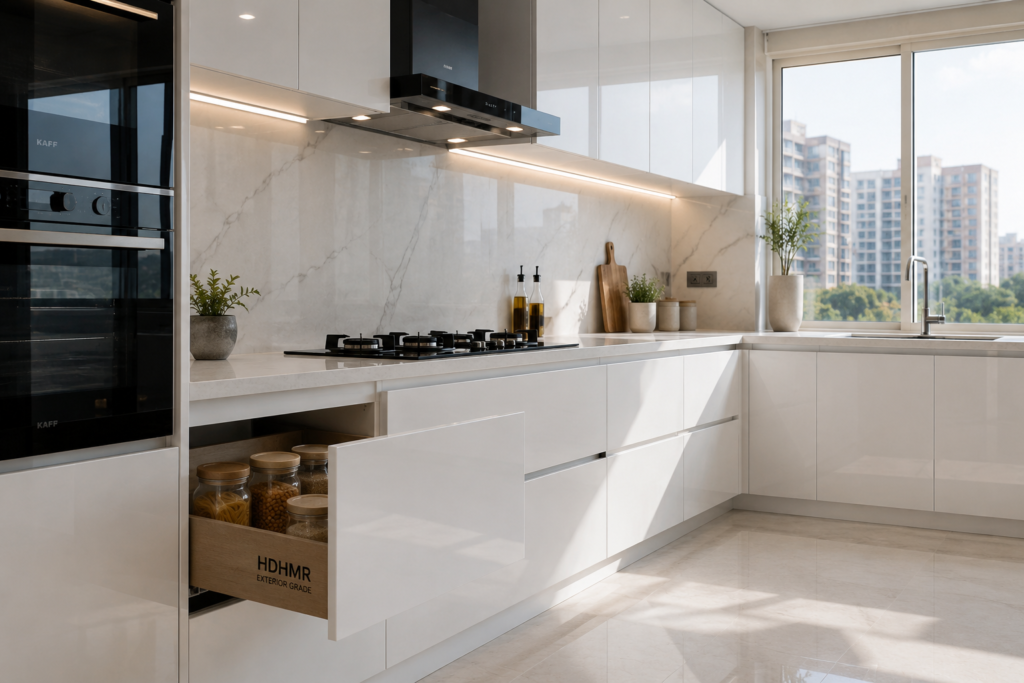
Acrylic finish refers to a high-gloss acrylic plastic sheet-typically 1.5mm to 2mm thick-that is hot-pressed or cold-bonded onto a smooth HDHMR or high-density MDF substrate. The result is a surface with near-mirror reflectivity, completely smooth to the touch, and visually deeper than anything laminate can match.
The most important thing to understand about acrylic: it is a shutter material, not a coating. You’re applying a solid sheet, not spraying a finish. That distinction affects how it behaves, what substrate it needs, and what happens if it gets damaged.
Solid Acrylic Sheets vs. Acrylic-Faced MDF
Solid acrylic-faced sheets (2mm, German or Korean grade): These are premium-grade sheets where the acrylic layer is thick enough to allow polishing if scratched. Established European and Korean acrylic sheet manufacturers supply these to Indian factories. The reflection quality is significantly better than domestic acrylic sheets.
Domestic acrylic-faced MDF (1mm or less): More commonly used by budget modular kitchen suppliers. The sheet is thinner, the gloss depth is shallower, and polishing scratches out is much more difficult. The price is lower, but so is the lifespan.
When you’re comparing quotes, ask specifically: What grade and thickness is the acrylic sheet? A 2mm premium imported acrylic on HDHMR and a 1mm domestic acrylic on MDF are described identically in a quotation as “acrylic finish”-but they perform very differently over 8–10 years.
Why Acrylic Scratch Resistance Gets Misrepresented
Acrylic is frequently marketed as “scratch-resistant.” This is misleading without context. Compared to PVC membrane, yes-acrylic is more scratch-resistant. Compared to HPL laminate, no-laminate is significantly more scratch-resistant.
Acrylic’s surface is harder than PVC but softer than the phenolic resin in HPL. Microscopic dust particles act as abrasives against a high-gloss acrylic surface. The result: wiping an acrylic kitchen door with a dry cloth or a rough sponge creates micro-scratches visible in direct sunlight. Over time, these accumulate into what homeowners describe as the kitchen “losing its shine.”
The protocol that prevents this is simple but requires discipline: clean only with a clean, wet microfiber cloth. Never use abrasive scrubbing pads, steel wool, or harsh surface cleaners. For deep scratches, a professional polishing compound can restore the surface on 2mm premium imported acrylic-domestic-grade sheets may not fully recover.
Acrylic and Turmeric (Haldi) Staining: The Real Answer
Turmeric staining on acrylic is one of the most commonly asked questions we hear from homeowners planning white or light-coloured kitchens. The answer: haldi does not permanently stain high-quality acrylic if wiped immediately with warm, soapy water. However, if left overnight-and this happens more than people expect in busy households-haldi can penetrate surface micro-pores on lower-grade acrylic and leave a permanent yellow shadow.
This isn’t an argument against acrylic. It’s an argument for understanding the maintenance commitment before committing to the finish.
Acrylic: Pros, Cons, and Ideal Use Cases
Where acrylic genuinely excels:
- Modern, handleless kitchen designs where the gloss creates a premium visual impact
- Small or medium kitchens in Noida and Ghaziabad apartments where high-gloss reflectivity makes the space feel visually larger
- Homeowners who clean regularly and are comfortable with microfiber-only maintenance
- Combined specifications-acrylic on the visible front shutters, matching laminate on hidden tall unit sides-to get the visual impact at a lower total cost
Where acrylic has real limitations:
- Cannot be applied directly over BWP plywood without risking orange-peel waviness; needs HDHMR or MDF substrate
- Not ideal as a backsplash or within 15 cm of an open gas flame
- Households with children, heavy daily cooking, or abrasive cleaning habits will see surface degradation faster
- Matching shade codes for replacement sections can be difficult 5–8 years after installation if the specific batch is discontinued
Deep Dive 3: PVC Membrane (Vacuum-Pressed) Finish-The Seamless Budget Option
PVC membrane finish is made by heating a thin PVC foil (0.4mm to 0.6mm) and pressing it over an MDF or HDHMR board using vacuum suction. The heat allows the foil to stretch around routed grooves, curved edges, and 3D profiles-creating a seamless, edge-free surface with no visible joint or tape line.
This is membrane’s single biggest advantage over laminate: it can wrap around carved shapes. If you want a kitchen design with raised panels, grooved profiles, or a classic cottage aesthetic-membrane is the only shutter option in this price range that makes it possible. Laminate and acrylic are flat-surface-only finishes. PU is another option for carved profiles, but it costs 3–4× more.
The Heat Risk Near Stoves: Why Membrane Peels
This is the most commonly reported problem with membrane kitchens, and it’s almost entirely preventable with correct installation-but rarely is, especially in carpenter-built kitchens.
PVC membrane foil is applied with heat-sensitive adhesive. When that adhesive is re-exposed to sustained heat-from a chimney exhaust, steam from a pressure cooker, or the convective heat rising from an open hob-it softens. The foil, which was stretched under vacuum, contracts back toward its original shape. The result is the edge lifting away from the MDF board.
This doesn’t happen to every membrane kitchen, and it doesn’t happen quickly. It happens over 2–5 years, specifically to shutters within approximately 30–40 cm of a heat source, and specifically when the MDF base isn’t properly sealed at the back and underside. A fully sealed HDHMR panel with quality adhesive and correctly vented chimney placement holds up significantly better.
The honest recommendation: if your hob is directly below an overhead cabinet-common in small Indian kitchens-membrane is a risk. Use laminate or acrylic in that run. Reserve membrane for the island or peninsula cabinet doors, lower base cabinets away from the cooktop, or bedroom wardrobes where heat is not a factor.
The Substrate Requirement Nobody Mentions
Membrane finish requires a substrate that can be routed (carved) cleanly. Standard commercial plywood cannot be used-the ply grain tears when routed, leaving a rough groove that the foil wraps imperfectly. High-density MDF or HDHMR at a minimum density of 800–850 kg/m³ is required for membrane pressing.
This also means membrane cannot be used on the structural carcass of sink base units-those need plywood or HDHMR for load and moisture reasons, and plywood doesn’t membrane well. In practice, membrane shutters work best on upper wall cabinets and lower base cabinets that don’t sit in direct moisture contact.
Membrane: Pros, Cons, and Ideal Use Cases
Where membrane genuinely excels:
- Classical, traditional, or Rajasthani-inspired kitchen designs with carved profiles and raised panelling
- Medium-budget kitchens where laminate looks too plain but acrylic is unaffordable
- Wardrobes and bedroom furniture where heat exposure is not a concern
- Rental properties where visual impact matters more than 10-year durability
Where membrane has real limitations:
- Shutters within the heat zone of a gas hob or chimney exhaust
- Kitchens in Dehradun, Rishikesh, or Haridwar with sustained monsoon-season humidity-moisture can seep through improperly sealed edges and cause the MDF substrate to swell even if the foil stays intact
Any situation where repairability matters-a peeling membrane shutter requires complete re-wrapping, which at that point usually costs close to new shutter replacement
Deep Dive 4: Polyurethane (PU) Paint Finish-The Seamless Custom Coating
PU finish is not a sheet material. It is a liquid polyurethane paint sprayed onto a pre-prepared HDHMR, HDF, or solid wood panel in a factory spray booth, built up in multiple coats (primer, base coat, clear coat), sanded between coats, and cured before installation. The result is a monolithic coating that envelops all six sides of the shutter-face, back, and all four edges-without a single seam, tape joint, or bond line.
That six-sided seal is PU’s defining technical advantage. Unlike laminate (which requires separate edge tape) or acrylic (which uses matching edge strips), PU coats the entire panel as one continuous surface. There is no gap, no interface, and no weak point for moisture to enter.
1K vs 2K PU: The Difference That Matters in India
Not all PU paint is the same, and this distinction affects both longevity and yellowing resistance significantly.
1K (Single-Component) PU: Standard polyurethane that air-dries without a hardener. Easier to apply, less expensive, but softer and more prone to yellowing under UV exposure. In white kitchens with good natural light, a 1K PU finish can develop a visible warm-yellow tint within 3–5 years.
2K (Two-Component) PU: A two-part system where polyurethane resin is mixed with an isocyanate hardener catalyst immediately before spraying. The chemical cross-linking reaction creates a significantly harder, more chemical-resistant film that is nearly twice as durable as 1K. More critically: aliphatic 2K PU, which uses non-aromatic chemical bonds, does not yellow under UV exposure even after 10+ years. This is the correct specification for white, off-white, or cream kitchen shutters.
Several established certified paint manufacturers supply 2K PU coating systems to factory applicators in India. When requesting PU-finish shutters, specify: “2K aliphatic PU, applied in a spray booth with a minimum of 3 coats.” A contractor who cannot confirm these details is likely offering 1K PU or site-spray application-both of which degrade faster.
Handleless Designs: Where PU Has No Competition
PU’s liquid application means it coats routed channels and handle profiles seamlessly-no visible cut, no edge tape, no interruption in the surface. This makes it the only finish compatible with true handleless kitchen designs: J-pull channels (a horizontal groove routed into the shutter top edge), Gola rail profiles (an aluminium rail running the full cabinet face), or finger-pull grooves routed directly into the shutter.
Laminate can’t be applied inside a deep J-pull channel without visible joins. Acrylic can’t be bent around any profile. Membrane wraps into shallow grooves but doesn’t hold in deep channels under heat. PU, sprayed in a booth, flows into every contour and cures as a single surface.
If your kitchen design includes handleless profiles-increasingly common in Noida and Ghaziabad high-rise apartments-PU is the correct finish choice.
PU Finish: Pros, Cons, and Ideal Use Cases
Where PU genuinely excels:
- Handleless and minimalist kitchen designs with J-pull or Gola profiles
- Clients who want completely custom RAL colour matching-PU paint is available in the full RAL spectrum, unlike laminate (which is limited to catalog options) or acrylic (which is catalog-limited and difficult to match later)
- High-end independent villas in Dehradun’s Rajpur Road or Sahastradhara Road belt where seamless finish is a visual priority
- Any application where repairability over time matters-a scratched or chipped PU surface can be sanded locally, re-primed, and re-sprayed. You rarely need to replace an entire shutter.
Where PU has real limitations:
- The most expensive shutter finish category-at ₹750–₹1,800+/sq ft, it is 4–10× the cost of laminate
- Must be factory-applied; site spraying delivers inconsistent results and creates VOC hazards in enclosed spaces
- Prone to chipping at sharp corners under hard impact-a dropped steel kadhai landing on a PU shutter edge can chip the coating, whereas laminate would dent without separating
How Much Does Each Kitchen Cabinet Finish Cost in India? (2026 Rates)
These are shutter finish costs per square foot-material and factory processing only. Site installation, carcass cost, countertop, and hardware are separate.
Finish | Material Cost (shutter only) | Notes |
Laminate (HPL, 1mm, standard brand) | ₹180–₹280 / sq ft | Anti-fingerprint and 1.5mm HPL add 20–30% |
Laminate (premium, branded + PUR edge) | ₹280–₹350 / sq ft | Reputed national brand with factory PUR edge-banding |
Acrylic (domestic, 1mm) | ₹450–₹600 / sq ft | Common in budget modular kitchen packages |
Acrylic (2mm, imported sheet on HDHMR) | ₹650–₹850 / sq ft | European/Korean grade; better polish-recovery |
Membrane (PVC foil on MDF/HDHMR) | ₹280–₹480 / sq ft | Carved-profile designs add to processing cost |
PU (1K, standard factory spray) | ₹750–₹1,000 / sq ft | Adequate for opaque colours in low-light areas |
PU (2K aliphatic, booth-sprayed) | ₹1,000–₹1,800+ / sq ft | Correct spec for white kitchens; 3-coat minimum |
City-Level Price Context
Pricing varies by city due to labour costs, raw material transit, and local market competition. As a general pattern for North India:
Dehradun / Haridwar / Rishikesh / Roorkee: Labour costs are 10–20% lower than NCR, but imported sheet materials (German acrylic, PUR adhesive) carry freight premiums. Net effect: material quality matters more than labour negotiation in Uttarakhand markets.
Noida / Ghaziabad: Larger manufacturing ecosystem means more competition, which typically pushes shutter prices 8–15% lower than hill cities for equivalent specification-but also makes low-grade substitutions easier to hide. Specifying exact material grades in writing protects against this.
The Edge-Banding Factor: Where Kitchen Finishes Actually Fail
Edge-banding is the sealing strip applied to the visible edge of a shutter-the 18mm thickness you see when a cabinet door is open. It’s the most important detail most homeowners never think about, and the single most common failure point in Indian kitchens across all finish types.
EVA Hot-Melt Glue (Standard, Insufficient for Humid Zones)
EVA (ethylene-vinyl acetate) is the glue used in most budget kitchen installations. It melts and flows under heat, which is what makes it easy to apply-and also what makes it fail. Steam, consistent moisture, and temperatures above 60°C soften the bond over time. In a Dehradun monsoon kitchen or near a Noida apartment hob, EVA-bonded edge tape typically starts lifting within 2–4 years.
PUR Reactive Hot-Melt Glue (Correct Specification)
PUR (polyurethane reactive) glue forms an irreversible chemical bond after application-it doesn’t simply cool and solidify the way EVA does. It reacts with ambient moisture, curing into a flexible, waterproof adhesive layer that holds up to approximately 150°C. PUR-bonded edge-banding does not lift under steam, humidity, or sustained kitchen heat.
The cost premium over EVA is minimal-typically ₹15–₹30/sq ft on a finished kitchen quotation. The longevity difference is 10+ years vs 2–4 years. Ask specifically for PUR.
Laser Edge-Banding (Zero-Joint Aesthetic)
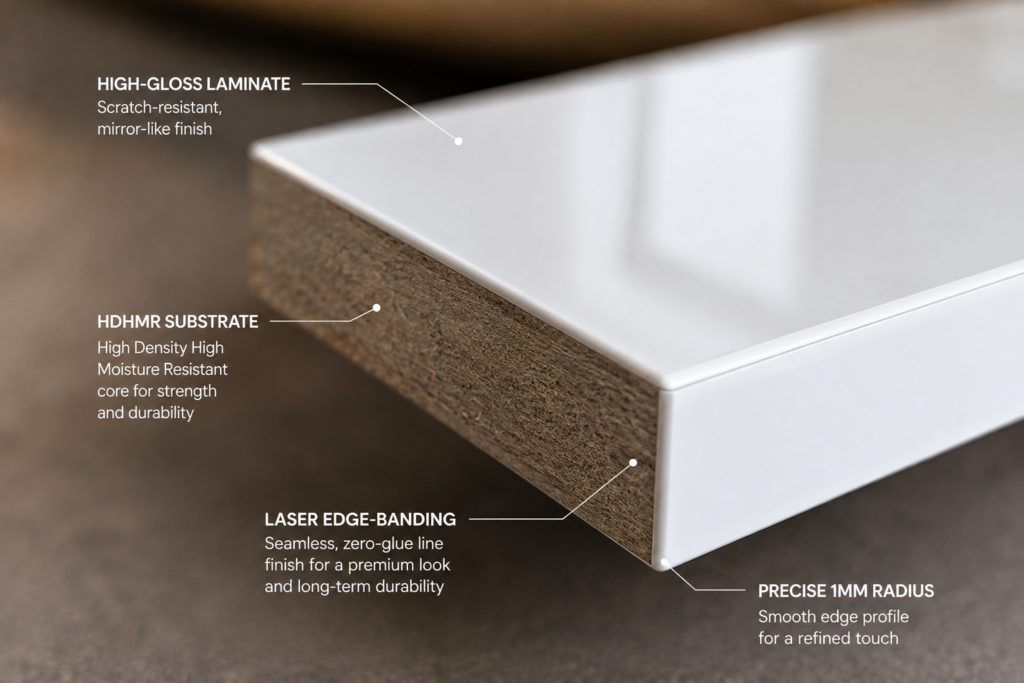
Laser edge-banding is the current ceiling of shutter edge quality. Instead of glue, a polymer layer pre-applied on the edge tape is activated by a laser at the factory, creating a zero-gap bond where the tape and substrate surface appear to merge. The result is a shutter with no visible seam between the face and edge-a floating, monolithic appearance similar to membrane or PU.
Laser edge-banding adds cost (typically ₹40–₹80/sq ft) but is the correct choice for high-gloss acrylic or laminate shutters where the edge seam would otherwise be visible.
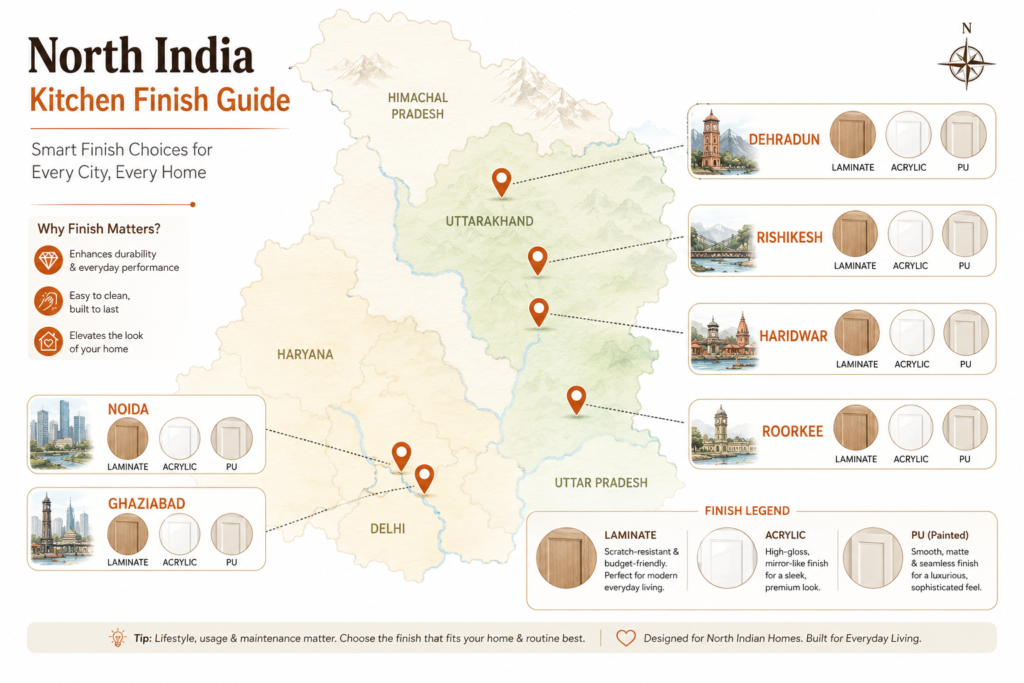
Climate and Location Guide: Which Finish Works Where in North India?
This section is the one missing from almost every national kitchen content site-because no Delhi or Bengaluru-based content team has installed kitchens in Dehradun’s monsoon belt and Noida’s dust-laden summer heat and knows how those environments actually affect each finish.
Dehradun and Rishikesh: High Humidity and Monsoon Moisture
Dehradun receives significant rainfall from June to September, with ambient humidity regularly exceeding 80% RH during peak monsoon weeks. Rishikesh, sitting lower along the Ganges valley, adds high moisture during winter fog cycles on top of monsoon humidity. Both cities see moderate to warm temperatures year-round, unlike the extreme summer heat of NCR plains.
Recommended finish approach: The substrate choice matters more here than the finish itself. HDHMR carcass with BWP-grade plywood for sink base and corner units is the correct starting point. For the shutter finish:
- Laminate with PUR edge-banding is the most reliable and cost-effective choice. HPL itself is moisture-resistant; PUR edge-sealing closes the only entry point for water.
- Acrylic with PUR edge-banding works well on HDHMR substrates-acrylic’s non-porous surface doesn’t absorb moisture. Just ensure the back panel is sealed.
- Membrane carries risk in high-humidity zones if the MDF base isn’t fully sealed. A kitchen near a Rishikesh hillside with evening condensation can push moisture through unsealed membrane edges into the MDF core within a monsoon season.
- PU finish is excellent in these climates precisely because of its six-sided seal-no interface for moisture. The premium cost is partly justified by that climate performance.
Noida and Ghaziabad: Dry Heat, Dust, and Intense Daily Cooking
Noida and Ghaziabad summers are long and extreme-40–45°C ambient temperatures from April to June-combined with high particulate dust levels and cooking habits (high-temperature deep frying and tadka are more common in north Indian plains cooking than in hill cities). The moisture concern shifts from ambient humidity to kitchen steam and oil vapour.
Recommended finish approach: Heat tolerance and cleanability are the priorities here.
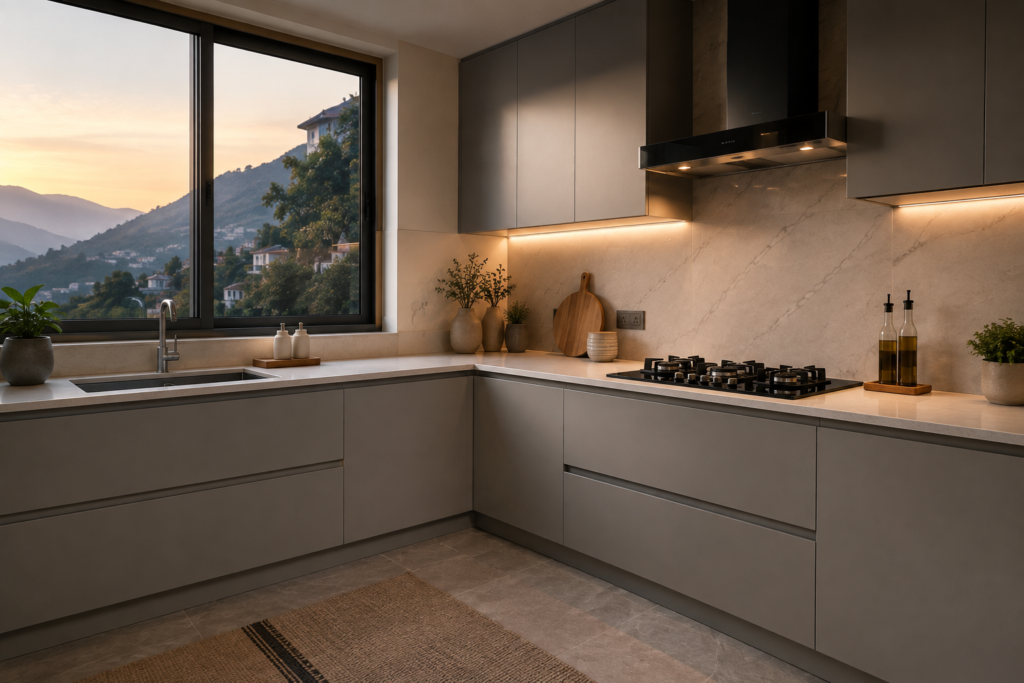
- Laminate remains the smart cost-efficiency choice. Anti-fingerprint matte laminate from a reputed national manufacturer handles Noida’s dust and daily cleaning well.
- Acrylic works well in Noida’s lower-humidity environment-less risk of moisture ingress, and the high-gloss visual suits the modern flat aesthetic. Reflectivity also helps compact tower flat kitchens feel larger.
- Membrane is the highest risk in heat-intensive Noida kitchens. Cabinet runs directly above or near a 4-burner hob see sustained convective heat that EVA-bonded membrane edges cannot tolerate.
- PU (2K) is the specification of choice for larger, premium Noida and Ghaziabad residences-Expressway villas, Indirapuram floor properties-where the budget accommodates it. Handleless J-pull or Gola designs are trending in this market, making PU the natural finish pairing.
Haridwar and Roorkee: Balanced Climate, Budget Priority
Haridwar and Roorkee have moderate humidity near the Ganga belt and seasonal temperature swings without the extremes of either Dehradun’s monsoon intensity or Noida’s peak heat. The kitchen market here trends toward value-for-money solutions over premium finishes.
Recommended: Laminate (HPL with PUR edge-banding) for most projects. Membrane is acceptable for bedroom wardrobes and dry-area kitchen shutters. Acrylic is a reasonable upgrade for buyers wanting a contemporary look without the full premium of PU.
Substrate Guide: What Goes Under the Finish Matters as Much as the Finish
We’ve mentioned substrate repeatedly because it’s the factor most contractors bury in vague language. Here’s a direct guide to what each finish needs and why.
Substrate | Best Finish Pairings | Humidity Tolerance | Weight | Cost Index |
BWP Marine Plywood (IS:710) | Laminate only | Excellent-true waterproof | Heaviest | Highest |
HDHMR Board (HMR grade) | Laminate, Acrylic, Membrane, PU | Very good | Moderate | Mid-range |
High-Density MDF | Acrylic, Membrane, PU | Moderate-avoid wet zones | Moderate | Lower |
Commercial Plywood | Laminate only | Poor-swells in moisture | Moderate | Budget |
Standard MDF | Dry-area use only | Low | Lightest | Budget |
Our honest recommendation for Dehradun and Rishikesh kitchens: HDHMR carcass throughout, BWP plywood for the sink base unit and any base cabinet within 30 cm of the sink. For Noida and Ghaziabad apartments where moisture is less of a structural concern, HDHMR throughout is sufficient.
Refer to our guide to the best modular kitchen in Dehradun for a deeper breakdown of carcass material choices and cost implications by budget tier.
Cleaning and Maintenance: What Each Finish Needs Daily
The finish you choose changes your maintenance routine for the next 10–15 years. These aren’t minor differences.
Laminate Maintenance
- Wipe with a damp microfiber or cotton cloth and mild dish soap
- Stubborn grease: warm water with a few drops of dishwashing liquid; let it sit 30 seconds before wiping
- Never use: abrasive scrubbing pads, abrasive powders, thinner-based cleaners, or steam cleaners
- The textured surface of matte laminates can accumulate oil vapour in porous textures over time-clean regularly rather than letting buildup develop
Acrylic Maintenance
- Exclusively wet microfiber cloth-a dry cloth (even soft) drags microscopic dust particles across the surface, creating swirl marks
- For turmeric, oil, or curry stains: warm water with mild soap immediately after cooking; never let stains dry
- Every 6–12 months: a professional liquid polishing compound restores surface depth on premium-grade acrylic
- Never use: any abrasive surface, spray cleaners with ammonia, acetone-based products, or rough kitchen paper towels
Membrane Maintenance
- Damp cloth for regular cleaning; most PVC foil surfaces are stain-resistant to normal kitchen splashes
- Avoid: direct steam from pressure cooker vents, hot cookware placed near cabinet surfaces, and sharp objects dragging across the surface (knives, steel utensils)
- Lift edge repairs: minor edge lifting can be temporarily re-adhered with cyanoacrylate adhesive, but this is a short-term fix; full re-wrapping is the correct solution
PU Finish Maintenance
- Soft, damp cloth with mild soap for daily cleaning
- Avoid: abrasive pads, solvent-based cleaners, anything acidic (tamarind, vinegar) left in contact for extended time
- The greatest risk with PU is edge chipping from hard impact at corners-steel utensils, pressure cooker handles, or drawers pulled out too aggressively. Touch-up kits from the original paint supplier can address minor chips without full refinishing.
Repairability: What Happens When Something Goes Wrong?
This is the question nobody asks until it’s too late. Here’s what each finish looks like after 3–5 years of real use when something fails.
Laminate: A single shutter can be replaced without affecting adjacent panels, as long as the exact shade code was recorded at installation. Finding a matching shade 5 years later can be challenging if the color was a limited run-another reason to request and keep the manufacturer’s shade code in writing.
Acrylic: Deep scratches can be polished out on 2mm premium-grade acrylic using automotive or furniture polishing compound. Hairline surface marks respond well; deep gouges typically don’t fully disappear. Edge damage requires professional repair or panel replacement.
Membrane: There is no partial repair for peeling membrane. Once the foil separates from the MDF at an edge, re-adhering it holds temporarily. The only proper fix is complete re-wrapping, which costs almost as much as a new shutter.
PU Finish: The most repairable of all four options. A chipped or scratched PU shutter can be sanded, primed locally, and re-sprayed by a skilled painter using matching paint. The color match is accurate if the original RAL shade code is documented. This is the finish most likely to look near-original 10 years after installation with minimal intervention.
Choosing Between Finishes: A Simple Decision Framework
If you’re still uncertain after all of the above, use this sequential logic:
- What is your shutter finish budget? Under ₹350/sq ft >> laminate. ₹350–₹500/sq ft >> laminate (premium) or membrane. ₹500–₹900/sq ft >> acrylic. Above ₹900/sq ft >> PU finish.
- Does your kitchen design have carved profiles, grooves, or 3D raised panels? Yes >> membrane or PU (membrane is more affordable; PU is more durable). No >> all four options are available.
- Is any shutter directly above or within 30 cm of the hob? Yes >> avoid membrane for that run; use laminate or acrylic.
- Are you in Dehradun, Rishikesh, or Haridwar? Prioritize PUR edge-banding regardless of finish. If using MDF substrate, seal the back panel completely before installation.
- Do you want a handleless kitchen? Yes >> PU is the only finish that coats routed J-pull channels seamlessly. Laminate and acrylic require visible edge inserts.
- Is the kitchen in a rental property you won’t occupy long-term? Laminate or membrane. Long-term home >> laminate or PU for the best total-cost-of-ownership.
For small or compact kitchens-particularly in Noida and Ghaziabad apartments-see our dedicated small kitchen design guide for layout and storage planning alongside finish selection.
Frequently Asked Questions
For high-humidity environments, the substrate choice matters as much as the finish. BWP marine plywood for sink base units and HDHMR for the remaining carcass gives the structural protection. For the shutter finish, high-pressure laminate with factory-applied PUR edge-banding is the most reliable and cost-effective option. Acrylic with PUR edge-banding also works well. PVC membrane carries higher risk near sink splashback and steam zones in a humid climate. PU finish is excellent if budget allows, because the six-sided spray seal eliminates any joint or interface for moisture to enter.
PVC membrane foil is bonded to the MDF board with heat-sensitive adhesive. When that cabinet area is repeatedly exposed to steam, heat from the chimney exhaust, or convective warmth from the hob, the adhesive softens over time and loses its grip. The foil-which was stretched under vacuum during pressing-then contracts and begins lifting at the edges. This typically happens within 2–5 years on shutters within 30–40 cm of a cooking source. Keeping overhead cabinets at least 60 cm above the hob and ensuring the chimney is correctly positioned reduces but doesn’t eliminate this risk with membrane.
Acrylic is more scratch-resistant than PVC membrane but less scratch-resistant than high-pressure laminate. The key variable is how the surface is cleaned. Acrylic cleaned exclusively with a wet microfiber cloth maintains its gloss for 8–10 years. Acrylic cleaned with dry cloths, rough sponges, or abrasive scrubbing pads develops surface micro-scratches within months, causing visible loss of shine over time. For households with young children or heavy daily cooking, laminate’s superior scratch resistance is a practical advantage.
It depends entirely on whether 1K or 2K aliphatic PU is used. Single-component (1K) PU or aromatic PU formulations do yellow under UV light exposure within 3–5 years. Two-component (2K) aliphatic PU-supplied by several established certified paint manufacturers in India-uses chemical bonds that do not break down under UV, so white shutters remain white for 10+ years. If you are choosing PU for white kitchen cabinets, specifically request 2K aliphatic PU, confirmed in writing by the supplier.
Laminate shutter finish costs range from approximately ₹180 to ₹350 per square foot in India as of 2026, depending on laminate brand and grade, surface type (standard vs. anti-fingerprint vs. textured), and edge-banding specification (EVA vs. PUR). These are shutter-only costs-the HDHMR or plywood carcass, hardware (hinges, channels, carousels), countertop, and installation are priced separately. Total modular kitchen costs, inclusive of all components, typically range from ₹1,200 to ₹5,000 per square foot of kitchen cabinetry.
Not without compromising the finish quality. BWP plywood has a face veneer with a subtle grain texture. When thin acrylic sheet (1–1.5mm) is pressed onto that surface, the grain can telegraph through the acrylic, creating a wavy “orange peel” effect visible in certain lighting conditions. Acrylic requires the perfectly flat surface of HDHMR or high-density MDF as its substrate for a smooth, distortion-free result. BWP plywood can still be used for carcass construction-but the visible shutter panels bonded with acrylic should use HDHMR or MDF as the shutter base material.
HDHMR stands for High-Density HMR (Humidity-Moisture-Resistant) board-an engineered wood panel made from wood fibres bonded under high pressure with water-resistant adhesive. Unlike standard MDF, HDHMR resists swelling and delamination in the humidity swings common in Indian kitchens. It is denser and heavier than standard MDF, which makes cabinet boxes slightly heavier but significantly more durable near sinks and hobs. For kitchens in Dehradun, Haridwar, and other humid North Indian environments, HDHMR is the correct carcass specification. Standard MDF is acceptable for dry-area shutters-painted profiles, bedroom wardrobes-but is not recommended within the splash zone of a sink or under a steam source.
They serve different purposes. Acrylic delivers a deeper, more reflective high-gloss appearance at a lower cost. PU delivers a seamless, six-sided protective coat, unlimited colour options, and superior repairability. PU is the better long-term investment and the only option for handleless J-pull or Gola profile kitchens. Acrylic is the better value choice for a premium gloss kitchen where the budget doesn’t extend to PU. The honest answer is: if your budget allows PU, choose PU for its repairability and climate resilience. If not, premium acrylic on HDHMR with PUR edge-banding is a genuinely strong option.
Yes, but it requires surface preparation. The smooth, non-porous laminate face must be sanded with 180–220 grit sandpaper to create a mechanical key for adhesion, then primed with a dedicated laminate bonding primer available from reputed paint manufacturers. After that, two coats of enamel or PU paint can be applied. The result won’t match a factory-sprayed PU finish-site spraying lacks the consistency of a booth-but for a budget refresh it can extend the kitchen’s visual life by 3–5 years without full replacement.
With correct substrate, PUR edge-banding, and appropriate maintenance: high-pressure laminate lasts 15 or more years; premium 2K PU finish lasts 12–15 years; high-quality acrylic (2mm imported sheet) lasts 10–12 years; PVC membrane lasts 5–8 years before heat and edge degradation risk increases significantly. These timelines assume proper installation-specifically PUR edge-banding and correct substrate selection. Kitchens with EVA edge-banding in humid environments see all these lifespans reduced by 30–50%.
Key Takeaways
- The finish is the skin, not the structure. Substrate (HDHMR, BWP plywood) and edge-banding (PUR, not EVA) determine longevity more than the finish material itself.
- Laminate is not the “cheap option”-it is the highest scratch-resistance, widest climate tolerance, and most forgiving maintenance option across the price range.
- Acrylic delivers the best visual impact for the money in the ₹450–₹850/sq ft range, but requires a cleaning discipline that not every household maintains.
- Membrane’s seamless, 3D-profile capability is unique and valuable-but it does not belong near a gas hob without excellent ventilation and a minimum 60 cm hob-to-cabinet clearance.
- 2K aliphatic PU is the correct specification for white PU kitchens; 1K PU yellows. Confirm this before signing any quotation.
- In Dehradun, Rishikesh, and Haridwar, always specify PUR edge-banding regardless of which finish you choose-monsoon humidity is the variable that distinguishes a 15-year kitchen from a 4-year one.
- Ask for the shade code and board grade in writing at installation. These two items determine whether a replacement shutter matches 5 years later.
Conclusion
You walked into this comparison with four options that sounded similar. Hopefully, you’re walking out knowing they behave very differently under Indian cooking, North Indian climate, and real daily use.
The right finish isn’t the most expensive one, or the most popular one in your neighbour’s kitchen. It’s the one matched to your cooking habits, your climate zone, your layout, and your maintenance willingness. A beautifully specified laminate kitchen with PUR edge-banding on HDHMR in Dehradun will outlast a carelessly installed acrylic kitchen in the same city by a decade.
If you’re planning a modular kitchen-in Dehradun, Haridwar, Rishikesh, Roorkee, Noida, or Ghaziabad-and want to see the finishes in person before committing, that’s exactly what you should do. Compare physical samples, not catalogue photos. Understand what’s in your BOQ. And get the substrate specification, edge-banding type, and finish brand confirmed in writing before the first module is manufactured.
Ready to see the finishes in person and get a 3D kitchen design with a clear per-square-foot quote? Contact Bhumim for a free design consultation for Dehradun and Noida kitchens, or WhatsApp our team directly at 08044630777.
About This Article
Published by: Bhumim India Private Limited-Modular Kitchen Manufacturer & Installer, Dehradun
GST: 05AAOCB1784F1ZM | ISO 9001:2015 Certified
Service Areas: Dehradun · Haridwar · Rishikesh · Roorkee · Noida · Ghaziabad
Contact: 08044630777 | hello@bhumim.com
Note: This article is written from Bhumim’s on-ground manufacturing and installation experience. All material recommendations are based on what we use in real kitchens across our service areas.