

Budget-Friendly Modular Kitchen Designs for Stylish Indian Homes
A budget-friendly modular kitchen in India starts around ₹50,000 for a basic straight layout and typically runs ₹1.5–₹3 lakh for a mid-range L-shaped setup with laminate shutters, an HDHMR or BWP plywood carcass, and a granite countertop. The biggest money-savers are layout choice, shutter finish, and keeping your plumbing and electrical points where they are.
Most people who walk into a modular kitchen showroom walk out confused-showroom photos show quartz countertops and handle-less acrylic shutters that cost ₹4,000 per square foot. The budget version is sitting in a factory, not a showroom. This guide is about that version.
Whether you’re fitting out a 2BHK in Noida, a hill-facing flat in Dehradun, or a compact home in Ghaziabad, the principles are the same: layout first, material grade second, finish last. Get those three in the right order, and you can build a kitchen that looks considered and works hard-without the showroom price tag.
What Is a Modular Kitchen? (And Why It Matters for Your Budget)
A modular kitchen is built from factory-manufactured base cabinets, wall cabinets, tall storage columns, and drawer systems-assembled on-site, not built on-site. That distinction is where the budget advantage hides.
With a carpenter-built kitchen, every mistake is permanent and expensive. With a modular kitchen, a damaged drawer unit gets swapped. One section fails-you replace that section, not the whole kitchen. Over 8–10 years, that difference in maintenance cost often offsets the slightly higher upfront investment compared to basic carpentry work.
The other budget factor people miss: modular manufacturing happens in controlled factory conditions, so you’re not paying for a carpenter’s on-site trial-and-error. Tolerances are tighter, waste is lower, and installation typically takes 7–12 working days from delivery-not the 4–6 weeks a fully carpenter-built kitchen takes.
For a rental or a home you’re only in for 2–3 years? A carpenter-built kitchen may actually cost less overall. Modular makes the most financial sense when you’re staying 5+ years, because that’s when the lower maintenance cost and part-replaceability start to pay.
Which Layout Saves the Most Money?
Layout is the single biggest cost lever. It determines how much cabinetry you need, how long the countertop runs, and whether your plumber needs to move a pipe (which immediately adds ₹15,000–₹40,000 to the project).
Straight (One-Wall) Kitchen-Lowest Cost
All cabinets, the hob, sink, and fridge sit on one wall. This is the cheapest layout to build because there’s one countertop run, fewer corner fittings, and minimal material waste. It works well for studio apartments and 1BHK homes under 60 square feet. If your kitchen has a single wall, don’t fight it-straight kitchens can look excellent with good lighting and a single accent backsplash.
Cost range (approximate): ₹50,000–₹1.2 lakh for a basic 8-foot straight kitchen with laminate shutters and a granite countertop.
L-Shaped Kitchen-Best Budget-to-Space Ratio
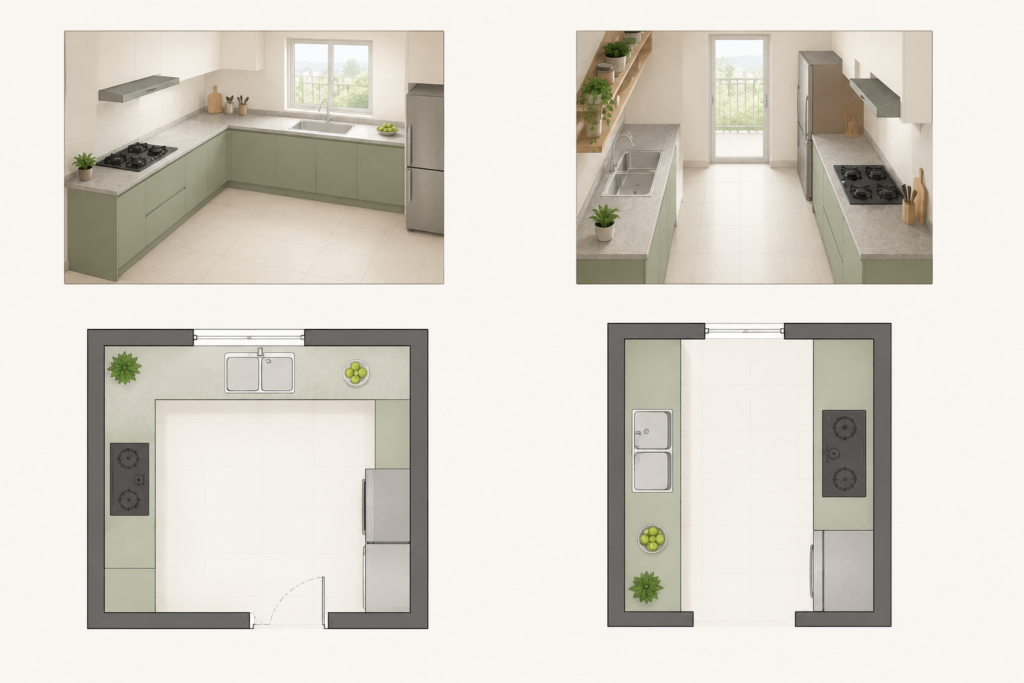
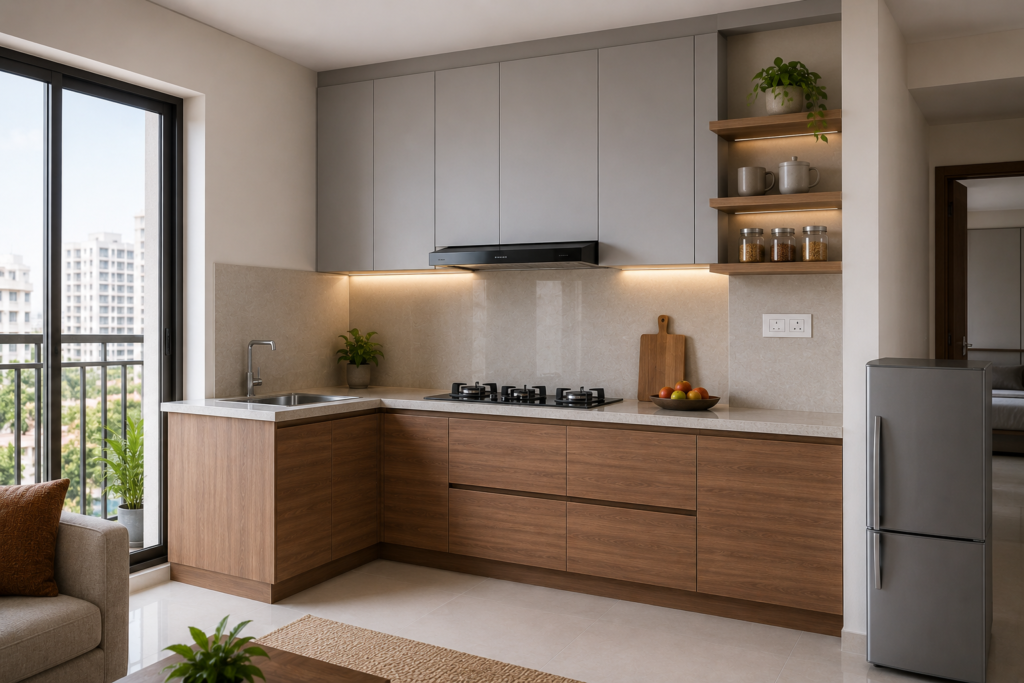
Two walls, a corner unit, and a natural work triangle between hob, sink, and refrigerator. This is the most popular layout in Indian apartments for a reason: it uses the corner space efficiently, leaves floor space for movement, and costs noticeably less than a U-shaped layout because you’re building on two walls instead of three.
The corner unit is where most people spend unnecessarily. A basic corner shelf or a wire corner basket works fine. A Le Mans carousel adds ₹20,000–₹45,000-worth it if you cook heavily, unnecessary if the corner just stores the pressure cooker.
Cost range: ₹1.2–₹2.5 lakh for a mid-range L-shaped kitchen (laminate shutters, HDHMR carcass, granite countertop, standard hardware).
Parallel (Galley) Kitchen-Efficient for Narrow Spaces
Two counters facing each other ( Parallel Kitchen ) with a corridor in between. If your kitchen is narrow (5–6 feet wide) and long, this is often the best layout because it gives you more countertop and storage than a straight kitchen without needing corner units. It’s also easier to clean and organise because everything is within arm’s reach.
Cost range: ₹1.0–₹2.2 lakh, similar to L-shaped depending on length.
U-Shaped Kitchen-Most Storage, Highest Cost
Three walls of cabinetry ( U-Shaped Kitchen). Best for larger kitchens in independent houses where more than one person cooks. The extra wall means extra cabinetry, extra countertop, and typically two corner units-which pushes cost up 20–30% compared to an L-shaped layout of equivalent height and finish.
Cost range: ₹2.5–₹5 lakh for a standard mid-range setup. This is not a budget layout plan; use it only if the space genuinely needs it.
The single most expensive thing you can do: move your sink or gas point to a different wall. Keep utilities where they are and plan the layout around them.
Get started with Beautiful Homes
For expert design consultation, send us your details and we’ll schedule a call
Materials: Where to Spend and Where to Save
This is where most budget kitchens go wrong-either over-spending on shutter finish while using a cheap carcass, or under-spending on everything and ending up with swollen cabinets within three monsoons.
The Carcass (Body of the Cabinet): Don't Compromise Here
The carcass is the structural skeleton-what the shutters attach to, what holds the weight of your utensils and grains. Two materials dominate the budget segment:
HDHMR (High-Density HMR board)-moisture-resistant, dimensionally stable, and holds screws better than standard MDF. For most Indian apartments, especially in humid areas like Dehradun, Haridwar, or Rishikesh, HDHMR is the right call for carcasses. It’s more affordable than BWP plywood but performs better than standard MDF in wet conditions.
BWP-grade plywood (IS:710 certified)-the most durable option, particularly for base cabinets under the sink and hob area where water exposure is highest. BWP stands for Boiling Waterproof; the IS:710 certification confirms it has been tested, not just labelled. BWP typically costs 15–25% more than HDHMR, but it adds years of life in high-humidity kitchens.
Standard MDF-fine for dry-area wall cabinets or painted shutter designs. Not suitable near sinks or hobs in humid climates, where it swells and delaminates within 2–3 years.
Shutters (Cabinet Doors): The Biggest Visual Impact, Many Price Points
|
Shutter Finish |
Cost Range (approx.) |
Best For |
|
HPL Laminate |
₹120–₹250/sqft on MDF/HDHMR |
Budget + durability; 300+ colour options; matte or gloss |
|
Acrylic |
₹300–₹500/sqft |
High-gloss look; scratches more easily; premium budget |
|
PU (Polyurethane) Paint |
₹400–₹700/sqft |
Smooth, matte luxury look; requires careful maintenance |
|
Membrane/Vinyl Wrap |
₹200–₹350/sqft |
Budget-friendly gloss; not as durable as laminate long-term |
For most budget kitchens: laminate on HDHMR is the right combination. Matte laminates hide fingerprints better than gloss (especially important in an Indian kitchen with frequent frying). A two-toned approach-say, off-white laminate wall cabinets with a warm wood-grain base-adds visual interest without extra cost.
Switching from acrylic to laminate alone can reduce your shutter cost by 30–40%.
Countertops: Granite Is Still the Budget Champion
Granite remains the most practical and affordable countertop for Indian kitchens-heat-resistant (you can put a hot tava directly on it), durable, and available in neutral tones like Kashmir White, Black Galaxy, or Tan Brown for ₹80–₹150 per square foot installed. For a standard 8–10 foot kitchen, a granite countertop costs ₹8,000–₹18,000.
Quartz looks cleaner and is easier to maintain (it’s non-porous, so spices and turmeric don’t stain it), but it typically costs 2–3× more than granite. Reserve quartz for compact kitchen islands or breakfast counters where the visual impact is high. For base cabinet countertops in a budget kitchen, granite wins.
Avoid marble in an Indian kitchen-it stains from turmeric and acidic foods within months.
Hardware: Invest in Hinges and Drawer Channels; Save on Handles
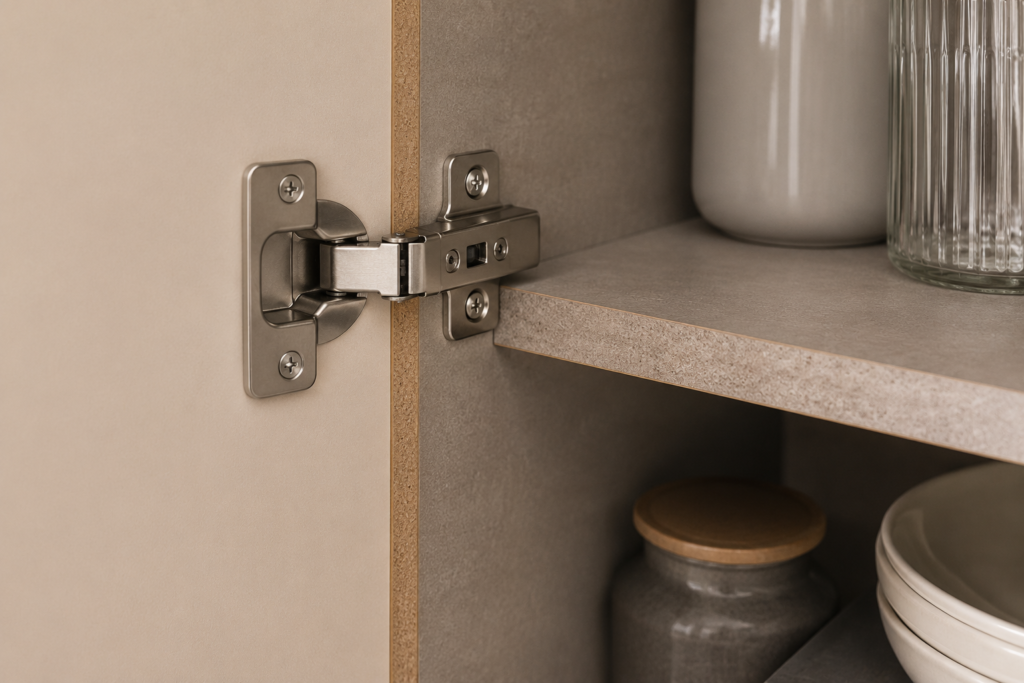
The hardware you notice every single day is the part most people scrimp on. Soft-close Hafele hinges (rated for 100,000+ opening cycles) cost ₹300–₹600 per pair installed-worth it for every frequently-used drawer and cabinet door. Blum tandem box drawer runners are the other hardware item worth spending on; poor-quality channels start dragging within a year.
Handles, on the other hand, are largely cosmetic. Standard stainless-steel bar handles cost ₹80–₹200 each and look perfectly clean. Handle-less push-to-open systems add ₹1,500–₹3,000 per door and look sleek, but they require more precise installation and increase the risk of smudges in daily use.
The Bhumim principle: spend on what you touch every day (hinges, drawer channels), save on what you see (handles).
8 Design Ideas That Look Premium Without the Price Tag
1. Open Shelving on the Upper Level
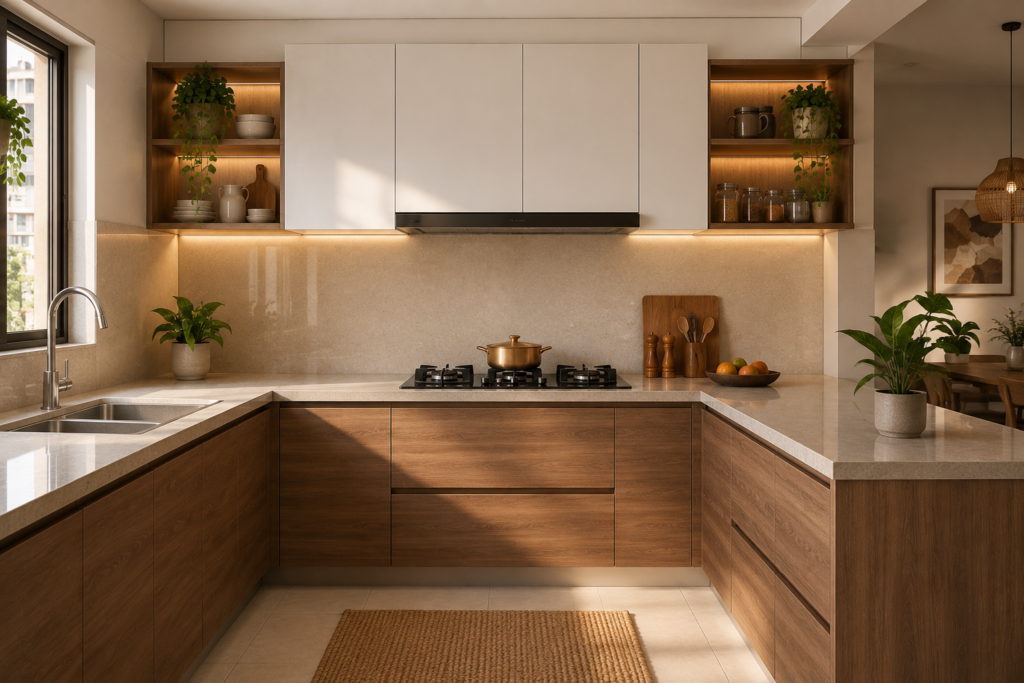
Replacing two or three upper wall cabinets with open shelves can save ₹8,000–₹20,000 on shutters and hardware-and it makes a small kitchen feel larger. Store daily-use items (plates, cups, dabbas) on open shelves. Keep items you’d rather not display in closed base cabinets.
2. LED Under-Cabinet Strips
LED strip lights installed under upper cabinets cost ₹800–₹2,500 for a standard kitchen. The effect-a glowing task light over the countertop-looks like something from a design magazine and costs less than one cabinet shutter. If you do nothing else on this list, do this.
3. A Single Accent Backsplash
Instead of tiling the entire wall (which adds cost for both tiles and labour), tile only the backsplash behind the hob-typically a 2-foot-tall strip across 3–4 feet. Subway tiles in off-white or pale sage cost ₹40–₹80 per tile installed. One striking panel does more visual work than a uniform tile job across the whole kitchen.
4. Two-Tone Cabinet Colours
White or light grey upper cabinets + a warm wood-grain or charcoal base is the single most cost-effective way to make a budget kitchen look intentional. You’re using the same laminate material throughout-just different colours-so there’s no extra cost, only a different order placed with the same manufacturer.
5. Tall Pantry Unit Instead of an Island
An island adds cost and takes floor space. A 7-foot-tall pantry pull-out unit gives you the same storage in the space of one base cabinet. Pull-out basket systems from Hafele (₹8,000–₹18,000 for a full-height pull-out) hold as much as a well-organized island and don’t require extra floor area.
6. Standard Cabinet Widths, Not Custom
Modular manufacturers build standard widths: 300mm, 450mm, 600mm, and 900mm. Design your kitchen around these widths and you’ll pay for stock modules, not custom fabrication. Custom sizes add 15–25% to the cabinetry cost.
7. Retain Your Existing Plumbing and Electrical Points
Every time a plumber reroutes a pipe, add ₹5,000–₹25,000. Every time an electrician moves a point behind a wall, add similar. The fastest way to blow a budget kitchen budget is to decide mid-project that the sink should move to the opposite wall.
8. Phase the Kitchen If Budget Is Tight
Install base cabinets, countertop, and essential storage first. Add tall pantry units, glass-shutter wall cabinets, or a chimney upgrade in a second phase 6–12 months later when budget allows. The modular system is designed for this-modules add on, not rip out.
How to Budget Your Modular Kitchen: The 60-30-10 Rule
A useful starting framework: allocate roughly 60% of your total kitchen budget to cabinets and fitting (carcass, shutters, hardware, installation), 30% to countertop and backsplash, and 10% to lighting and accessories. Keep a 5–8% contingency for surprises-in older homes, walls are rarely as flat as they look.
What this looks like in practice for a ₹1.5 lakh L-shaped kitchen:
- Cabinets, shutters, and hardware: ~₹90,000
- Granite countertop and subway tile backsplash: ~₹22,000
- LED lighting, handles, and accessories: ~₹8,000
- Contingency: ~₹10,000–₹15,000
This is not a luxury kitchen. It’s a well-built, well-organised kitchen that will last 10+ years with decent materials and will still look clean in 2035.
For a mid-range ₹2.5 lakh version: allocate for HDHMR carcasses throughout, a tall pantry pull-out, soft-close hinges on all doors, a branded chimney, and a granite countertop with a quartz accent strip near the hob.
Modular Kitchen in Dehradun (and Haridwar, Rishikesh, Roorkee)
Modular Kitchen in Dehradun
Dehradun’s July–September monsoon pushes indoor humidity to 80–90%. That level of moisture is why HDHMR or BWP-grade plywood (IS:710) is the right carcass choice here-standard MDF swells and delaminates within 2–3 monsoon cycles near sinks and hobs. Laminates should be fully sealed at all edges; unsealed edge banding is the most common failure point in humid-zone kitchens.
Cooking style matters here too. Uttarakhand kitchens typically cook heavy Indian meals daily-that means large pressure cookers, heavy kadais, and significant steam. A chimney rated at minimum 1,100–1,200 m³/hour suction handles this without letting grease accumulate on cabinet surfaces. Brands have models in this range at ₹12,000–₹22,000.
Modular Kitchen in Rishikesh and Haridwar
In Rishikesh and Haridwar, where apartments tend to be smaller and kitchens more compact, straight or parallel layouts are often the most practical choices. Storage for large utensils (pressure cookers, steamers) is a priority-tall pantry pull-outs or deep base drawers handle this better than standard shelf cabinets.
Modular Kitchen in Roorkee
Roorkee’s tech and academic community trends toward compact, low-maintenance kitchens. Matte laminate shutters (avoid high-gloss acrylic in dusty environments) and a wipe-clean quartz or granite countertop are practical choices.
For a detailed cost guide and material comparison specific to Dehradun homes, see: Best Modular Kitchen in Dehradun: Complete 2026 Guide
Modular Kitchen in Noida and Ghaziabad (NCR)
NCR buyers trend toward handle-less, monochrome kitchen designs-matte white or light grey uppers with a darker base, often in acrylic or PU finish rather than laminate. The aesthetic preference is for seamless, minimal kitchens.
Budget-conscious NCR buyers often make the mistake of prioritising finish over carcass. In Noida and Ghaziabad’s builder-floor apartments where kitchen humidity is lower than Dehradun, standard MDF carcasses can work-but HDHMR is still worth the marginal cost difference for longevity.
Festival seasons, especially October–November (pre-Diwali), often bring attractive discounts from many kitchen and interior vendors. If your timeline is flexible, planning your purchase around Diwali can save 10–15% on hardware or appliance packages.
Noida apartment kitchens frequently need storage for a large number of utensils without the physical pantry space-tall pull-out units and corner carousels solve this more efficiently than adding overhead cabinets, which can make small kitchens feel closed-in.
Modular vs. Carpenter-Built: A Straight Comparison
Factor | Modular Kitchen | Carpenter-Built |
Upfront cost (typical mid-range) | ₹1.5–₹4.5 lakh | ₹1.0–₹3 lakh |
Installation time | 7–12 working days | 3–6 weeks |
On-site dust and disruption | Low (modules pre-made) | High (cutting and fitting on site) |
Damage repair | Replace one module | Often rebuild a section |
Quality consistency | Factory-controlled tolerances | Depends on carpenter skill |
Resale value impact | Positive (branded modular is a selling point) | Neutral |
Best for | 5+ year stay, quality-focused | Short-term rental or very tight budget |
The honest case for a carpenter-built kitchen: if your budget is under ₹60,000 and you’re renting the flat, a carpenter can build something functional for less. The honest case against: the savings often disappear within 3–5 years as joints loosen and surfaces degrade.
What Does a Good Modular Kitchen Quote Look Like?
When you get a modular kitchen quotation, it should itemise: carcass material and grade (HDHMR, BWP ply, or standard MDF), shutter material and finish, countertop material and thickness, hardware brand (and which items are soft-close vs standard), chimney brand and model, installation, and any plumbing or electrical work.
A quote that says “modular kitchen, L-shaped, laminate finish-₹1.8 lakh” without listing material grades is not a quote-it’s a number. Ask for the itemised version. Two kitchens quoting ₹1.8 lakh can be completely different products depending on what grade of materials sits behind that number.
Red flags: no brand names for hardware, no specification of plywood grade, no written warranty for either the product or the installation workmanship.
Frequently Asked Questions
A basic straight modular kitchen starts around ₹50,000–₹80,000 for a small space with laminate shutters and a granite countertop. A mid-range L-shaped kitchen typically runs ₹1.2–₹2.5 lakh. Full U-shaped setups with branded hardware cost ₹2.5–₹5 lakh and above. The biggest variables are layout, carcass grade, shutter finish, and hardware brand.
Straight (one-wall) and L-shaped layouts. They minimise cabinetry, use fewer corner fittings, and keep plumbing in a predictable position. A straight kitchen is the cheapest to build; an L-shaped kitchen gives the best balance of storage and counter space for a slightly higher cost.
Granite. Local varieties like Black Galaxy, Kashmir White, or Tan Brown cost ₹80–₹150 per square foot installed, are heat-resistant, scratch-resistant, and require minimal maintenance. Quartz looks cleaner and is stain-resistant, but costs 2–3× as much. Marble is not recommended for Indian cooking-turmeric and tamarind stain it permanently.
HDHMR stands for High-Density HMR (Humidity Resistant) board. It’s a moisture-resistant engineered wood product that performs significantly better than standard MDF in humid Indian climates, particularly in monsoon-prone areas like Dehradun, Haridwar, and parts of NCR. It holds screws better, resists swelling near sinks, and costs less than BWP plywood while outperforming regular MDF in humid conditions.
With BWP plywood or HDHMR carcasses, branded hardware (Hafele), and laminate shutters, a well-installed modular kitchen lasts 10–15 years with standard maintenance. Budget-grade kitchens using standard MDF or particleboard in humid zones may need partial replacement within 5–7 years.
Yes. For Dehradun apartments, a mid-range modular kitchen typically costs ₹1.2–₹2.5 lakh. This budget generally includes HDHMR carcasses, HPL laminate shutters, premium hardware, and a granite countertop—a combination that handles monsoon humidity well without the higher cost of using BWP plywood throughout.
For compact kitchens (below 80 square feet), either a straight or parallel (galley) layout. L-shaped works if you have a corner to use. Avoid U-shaped designs in small spaces-the three-wall layout eats floor area and makes the kitchen feel more cramped. Use vertical space: ceiling-height cabinets, open upper shelves, and pull-out pantry units add storage without expanding the footprint.
For homes where you’ll stay 5+ years: yes. The modular advantage-factory quality, fast installation, and individual module replaceability-is most valuable over a long time horizon. For temporary rentals or a very tight budget, a carpenter-built kitchen may make more financial sense. Be honest about your timeline before choosing.
For a basic straight kitchen in Noida or Ghaziabad, expect to start at ₹60,000–₹1 lakh for laminate-shutter units with standard hardware. Mid-range L-shaped kitchens with HDHMR carcasses and branded hardware typically run ₹1.5–₹3 lakh in the NCR region. NCR pricing can be 10–15% higher than Dehradun for equivalent specifications due to higher labour costs.
Look for IS:710 on BWP plywood (Boiling Waterproof rating-the highest moisture resistance grade for structural wood panels). For furniture storage units, the BIS standard IS 17634:2022 sets safety and durability benchmarks for modular kitchen cabinets. Ask your manufacturer if their products meet this standard; reputable manufacturers should be able to confirm.
Use BWP-grade plywood (IS:710) for base cabinets and the sink unit-this is the most durable option for water exposure zones. Ensure all edges are sealed with PVC edge banding or hardener, as unsealed edges are the most common entry point for moisture. Apply silicone sealant around the sink basin annually. For areas away from the sink, HDHMR is a cost-effective alternative to full BWP plywood.
About This Article
Published by: Bhumim India Private Limited-Modular Kitchen Manufacturer & Installer, Dehradun
GST: 05AAOCB1784F1ZM | ISO 9001:2015 Certified
Service Areas: Dehradun · Haridwar · Rishikesh · Roorkee · Noida · Ghaziabad
Contact: 08044630777 | hello@bhumim.com
Note: This article is written from Bhumim’s on-ground manufacturing and installation experience. All material recommendations are based on what we use in real kitchens across our service areas.