

Modular Kitchen in India: Complete 2026 Buying Guide
A modular kitchen in India is a factory-manufactured kitchen system made of pre-built cabinet modules assembled on-site. It costs between ₹1.5 lakh and ₹8 lakh depending on size, materials, and finishes. The main advantages over a carpenter-built kitchen are precision manufacturing, faster installation (3–5 days vs 3–4 weeks), and the ability to replace individual units if damaged. For most Indian apartments, a modular kitchen is worth the investment-but only if the carcass material and hardware quality are specified correctly before you sign.
Walk through any new apartment complex in Noida, Dehradun, Gurugram, or Pune today, and almost every show flat has one. Modular kitchens have moved from a luxury category to a standard expectation in Indian urban housing in under a decade.
But the category has a problem: the name sounds specific, and the product is not. A ₹60,000 kitchen from a local fabricator and a ₹5 lakh kitchen from a manufacturer are both called “modular” on a quote-even though the carcass material, hardware quality, and finish durability are completely different.
This guide is about helping you understand what you are actually buying. Before the showroom visit, before the quote, before the contract.
What Is a Modular Kitchen?
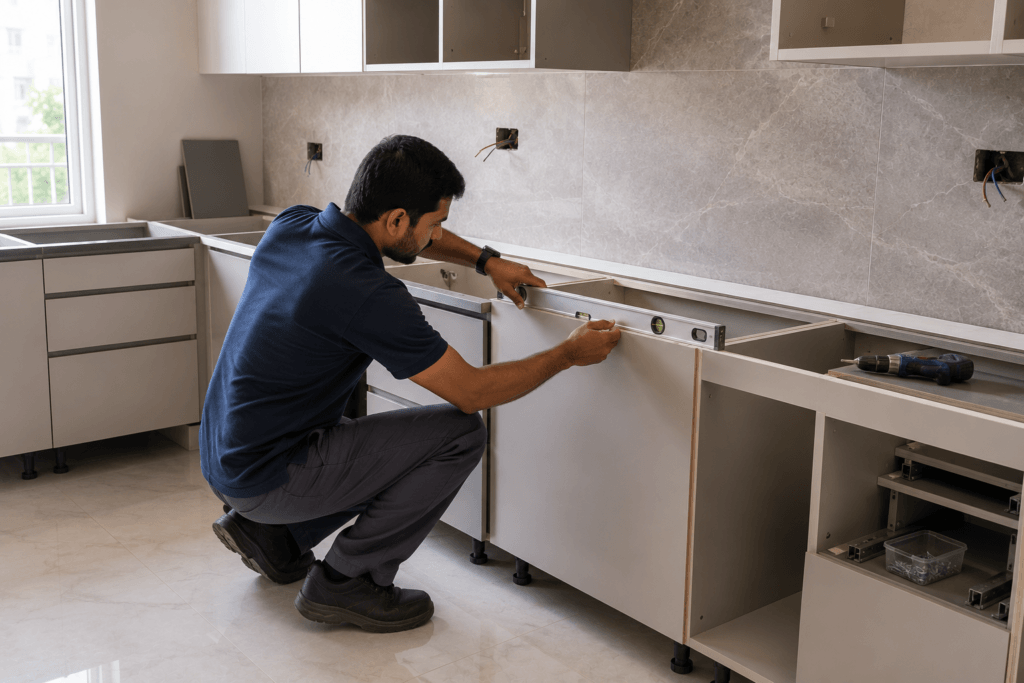
A modular kitchen is a kitchen system made from factory-built, standardized cabinet units-called modules-that are manufactured off-site and assembled at your home. Unlike a carpenter-built kitchen where a carpenter works on-site for weeks, modular kitchen components arrive complete from a factory and are typically installed in 3–5 days.
Each module is a specific unit: a base cabinet, a wall cabinet, a tall pantry, a corner unit, a pull-out drawer tray. These modules snap together to form a complete kitchen. The precision comes from factory manufacturing-every edge is sealed, every panel is cut to dimension, and every hinge is installed on a calibrated machine, not by hand on a dusty floor.
The result is a kitchen where drawers close smoothly, doors hang level, and surfaces are sealed against moisture and pests-qualities that are difficult to replicate consistently with site carpentry.
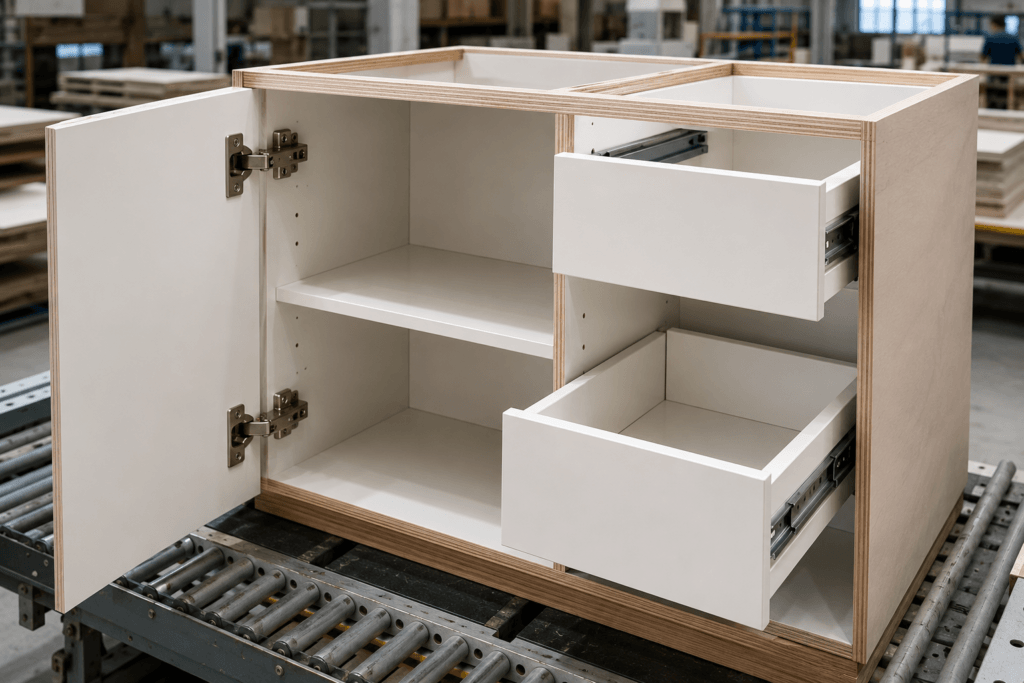
Modular Kitchen vs Carpenter-Built Kitchen: The Honest Comparison
This is the first question most Indian homeowners need to answer-and most articles avoid answering it directly.
Factor | Modular Kitchen | Carpenter-Built Kitchen |
Manufacturing | Factory-controlled, consistent quality | Site-built, quality varies by carpenter |
Installation time | 3–5 days on-site | 3–4 weeks on-site |
Precision | Panel tolerances tight, gaps uniform | Depends entirely on the carpenter’s skill |
Repairability | Individual module replacement; needs manufacturer | Any local carpenter can repair/modify |
Cost (standard L-shape) | ₹1.8–₹4.5 lakh (mid-range) | ₹1.3–₹3 lakh (mid-range) |
Warranty | Hardware warranty from named brands; structure warranty from manufacturer | No formal warranty |
Resale value | Adds measurable resale value if from a reputable manufacturer | Rarely photographs as well or adds value |
Customization for odd spaces | Limited to standard module widths | Can be custom-built to any dimension |
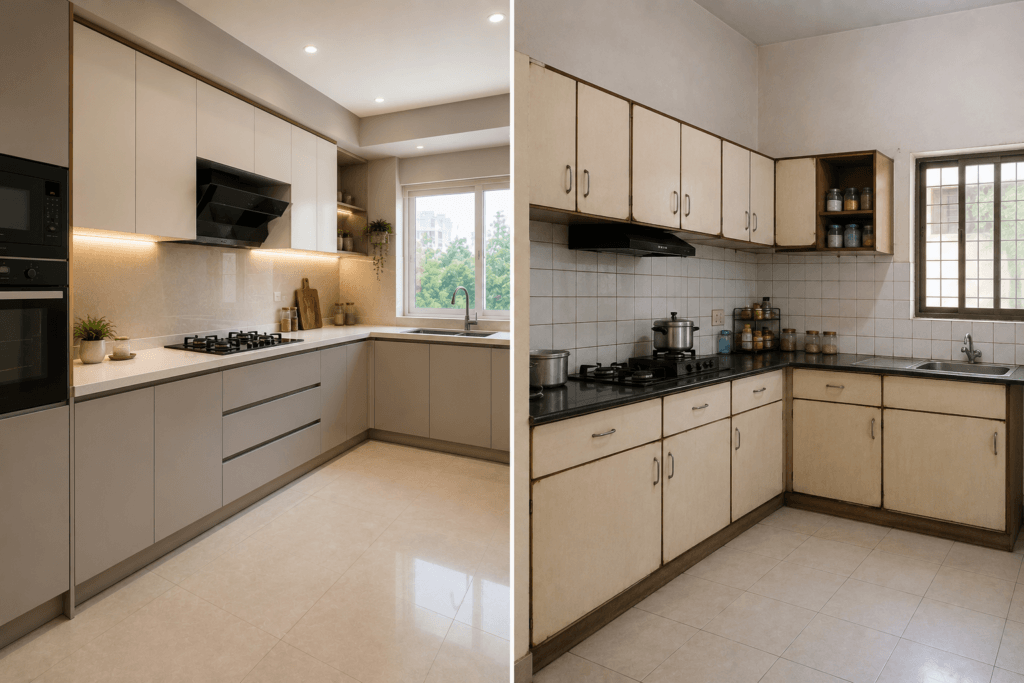
When modular makes more sense: New apartment, standard kitchen dimensions, you want factory-level quality and branded hardware, you are investing ₹1.5 lakh or more in the kitchen.
When carpenter-built may make more sense: Very unusual kitchen dimensions (very low ceiling, angled walls, awkward alcoves), budget under ₹1 lakh where good modular quality is not accessible, or if you have an exceptional carpenter who specifies materials properly.
The uncomfortable truth: A ₹2 lakh modular kitchen with a particle-board carcass and generic hinges will fail faster than a ₹1.5 lakh carpenter-built kitchen done with 18mm BWP plywood and branded hardware. The word “modular” does not guarantee quality. The material specification does.
Get started with Beautiful Homes
For expert design consultation, send us your details and we’ll schedule a call
Key Benefits of a Modular Kitchen in India
1. Precision Manufacturing Delivers Better Finishing
Factory manufacturing means each panel is cut on a CNC machine to exact dimensions, edges are sealed with edge-banding, and hinges are installed at calibrated positions. The result is doors that hang flush, drawers that open and close quietly, and shelves that sit perfectly level-outcomes that depend on a good day and a skilled carpenter when work is done on-site.
2. Space Optimization Built Into the Design
Modular kitchens use every dimension of the available space. Overhead cabinets reach the ceiling using loft units, corners are handled with magic-corner units or Le Mans carousels, and base cabinets use deep-pull drawer systems instead of fixed shelves that leave 60% of the depth unused. In compact Indian apartments in Noida, Dehradun, or Mumbai, this systematic space use makes a measurable difference.
3. Faster Installation With Less Disruption
A carpenter-built kitchen requires 3–4 weeks of continuous on-site work-sawdust, noise, and an unusable kitchen throughout. A modular kitchen arrives manufactured and is typically installed in 3–5 days. For families in occupied homes, this is a significant quality-of-life difference during the renovation period.
4. Individual Module Replacement
If a shutter peels, a carcass gets water-damaged, or a drawer unit fails, the affected module can be replaced without touching the rest of the kitchen. In a carpenter-built kitchen, matching a specific panel, finish, and edge profile years later is often impossible.
5. Designed for Indian Cooking Specifically-When Done Right
Indian cooking involves higher heat, heavier pots, more oil in the air, and more smoke than most European kitchen designs account for. A well-specified modular kitchen for Indian use means: a chimney with at least 1,200 m³/hour suction for proper smoke extraction, BWP-grade plywood carcass that withstands the humidity from daily cooking, a heat-resistant granite countertop at the hob zone, and deep base cabinets that accommodate large pressure cookers and kadais.
6. Measurable Resale Value
A modular kitchen from a reputable manufacturer photographs well, reads as an upgrade in property listings, and is one of the few interior upgrades that buyers specifically look for in the resale market. A site-built kitchen in an older finish rarely adds equivalent value.
Modular Kitchen Cost in India (2026)
Modular kitchen pricing in India is typically quoted per running foot (RFT) or per square foot. Here are realistic 2026 cost tiers across India:
Tier | Total Cost (L-shaped, ~10 ft) | Carcass | Shutter Finish | Hardware |
Basic | ₹1–2 lakh | Particle board / MDF | Laminate | Generic |
Mid-range | ₹2–4.5 lakh | 18mm BWP plywood | Laminate / Acrylic | Hafele |
Premium | ₹5–8 lakh+ | 18mm BWP plywood | Acrylic / PU / Lacquer | Blum / Grass |
Per sq ft rates by finish:
- Laminate shutters on BWP plywood: ₹1,200–₹2,500/sq ft
- Acrylic shutters: ₹2,000–₹3,500/sq ft
- PU paint / lacquer: ₹2,500–₹5,000/sq ft
Countertop add-on costs:
- Indian granite: ₹150–₹400/sq ft
- Quartz (Indian brands): ₹800–₹2,000/sq ft
- Quartz (imported-Silestone, Caesarstone): ₹2,000–₹4,000/sq ft
Where the money goes (approximate breakdown):
- Carcass + shutters: 40–50% of budget
- Hardware (hinges, channels, baskets): 15–20%
- Countertop: 10–20%
- Installation + civil work: ₹20,000–₹50,000
- Accessories (organizers, pull-outs): 10–25%
The most important thing to know about modular kitchen pricing in India: Two quotes for the same kitchen size at the same headline price can contain completely different quality levels inside. Always ask for the carcass material (by grade), the hardware brand (by name), and the shutter material (laminate, acrylic, PU) before comparing quotes. A quote that does not specify these three things is not a real quote.
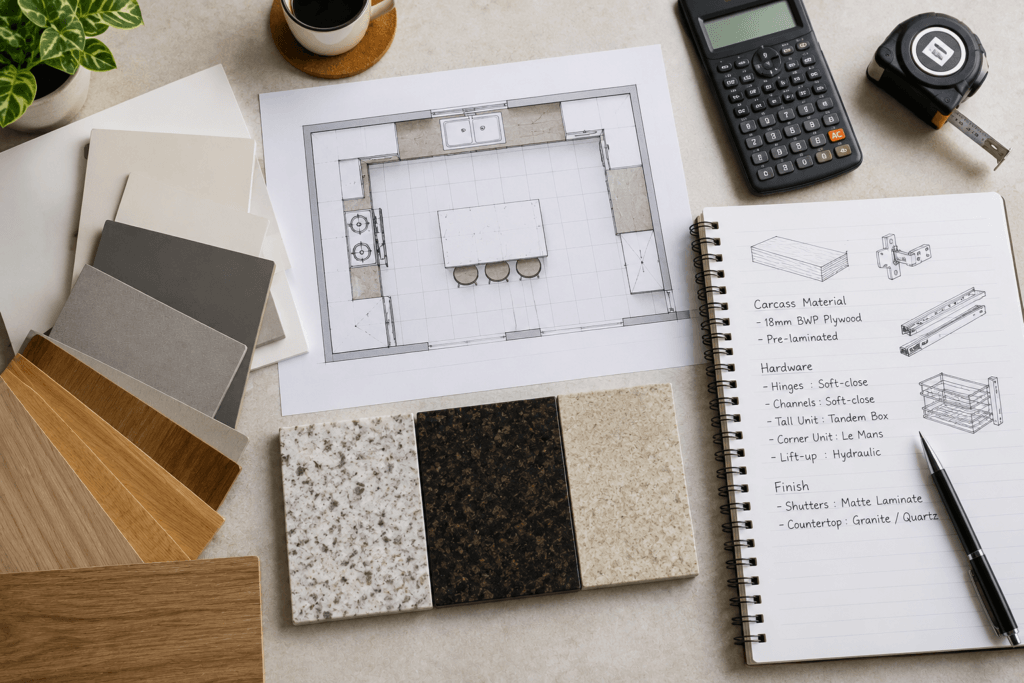
What Materials Are Used in Indian Modular Kitchens?
Carcass (The Cabinet Box)
The carcass is the structural skeleton of every cabinet. It is hidden behind the shutter door and under the countertop-which is exactly why it is the part most frequently compromised to reduce quote prices.
BWP-grade plywood (IS:303): The right material for Indian kitchen carcasses. BWP (Boiling Water Proof) plywood resists moisture, humidity, and the steam generated by daily Indian cooking. Bhumim uses 18mm BWP-grade plywood for all kitchen carcass construction. Lasts 15–20 years with normal use.
MDF (Medium Density Fibreboard): Acceptable for overhead wall cabinets that are not exposed to regular water. Should not be used for base cabinets near the sink-MDF swells and degrades with repeated moisture exposure within 3–5 years.
Particle board: The cheapest option and the most commonly substituted material when quotes are being cut. Particle board swells with humidity, chips at edges, and typically fails within 5–7 years in Indian kitchens. If a quote does not specify the carcass material, it is almost certainly particle board.
Shutters (The Cabinet Doors)
- Laminate: Most practical for Indian kitchens-durable, hundreds of design options, affordable, easy to clean. Matte and textured laminates hide oil smudges better than high-gloss.
- Acrylic: High-gloss reflective finish that photographs beautifully. Shows every fingerprint in daily use. Costs 40–60% more than equivalent laminate.
- PU paint / Lacquer: Smooth, colour-accurate finish. Premium appearance. More susceptible to chipping at edges than laminate.
- Membrane press: Heat-pressed film on MDF-a mid-price option with reasonable looks. Not suitable for high-humidity zones.
Hardware
Hardware is what you interact with every single day in your kitchen-not the shutter finish. This is the most under-appreciated line item in a modular kitchen budget.
Blum: Premium tier. Clip-top soft-close hinges, Tandembox drawer systems. 15+ year performance under daily use. Costs 20–30% more than equivalent items.
Hafele: Strong in accessories, baskets, and pull-out systems. Also used in Bhumim’s kitchen projects.
Generic hardware: Hinges at ₹20–₹30 per unit that fail within 2–4 years. The most common source of kitchen regret in year three.
Countertops
- Indian granite: Most heat-resistant option-you can place a hot kadai directly on the surface. Needs sealing every 2–3 years. Cost: ₹150–₹400/sq ft.
- Quartz: Consistent appearance, no sealing needed, resists staining better than granite. Cannot handle direct heat from hot vessels-use trivets near the hob. Cost: ₹800–₹2,000/sq ft for Indian brands.
- Stainless steel: Hygienic, heat-resistant, extremely durable. Scratches over time. Works well as the hob surround even if the rest of the countertop is granite.
5 Mistakes to Avoid When Buying a Modular Kitchen in India
1. Not specifying the carcass material in writing
The shutter is the first thing you see in a showroom. The carcass is what holds everything up for the next 15 years. Always get “18mm BWP-grade plywood carcass” written into the contract-not “plywood carcass” or “marine ply carcass” (both are vague enough to substitute particle board). If a contractor resists this, that is a clear signal.
2. Choosing hardware by feel in the showroom, not by brand name
Any demonstration hinge in a showroom slides smoothly. Specify the exact hinge and drawer channel model in writing. Generic alternatives look identical and feel similar on day one. They don’t on day 1,000.
3. Paying more than 50% upfront
A reasonable modular kitchen payment schedule: 30% on signing, 40% on delivery of materials to site, 30% on completion and snag clearance. Contractors asking for 70–80% upfront before installation have less incentive to resolve snags after handover.
4. Not asking who supervises the installation
Many kitchen companies outsource site installation to daily-wage labourers they have no ongoing relationship with. Ask directly: “Is the installation team your own employees or a subcontract?” The answer tells you everything about what happens when there is a problem at installation.
5. Designing for how the kitchen looks, not how you cook
Most kitchen regrets in India trace to the chimney specification, counter height, and deep storage for Indian vessels-not the shutter colour. Confirm: chimney suction is at least 1,200 m³/hour. Counter height is 850mm (or customized if you are above 5’10”). Base cabinets accommodate your largest pressure cooker and kadai. Every detail of the Indian cooking workflow should be built into the design before production starts.
Space-Saving Tips for Compact Indian Kitchens
Most Indian apartments have kitchens of 70–120 sq ft-not large. These are the space-saving strategies that make the biggest difference:
Go vertical with tall cabinets
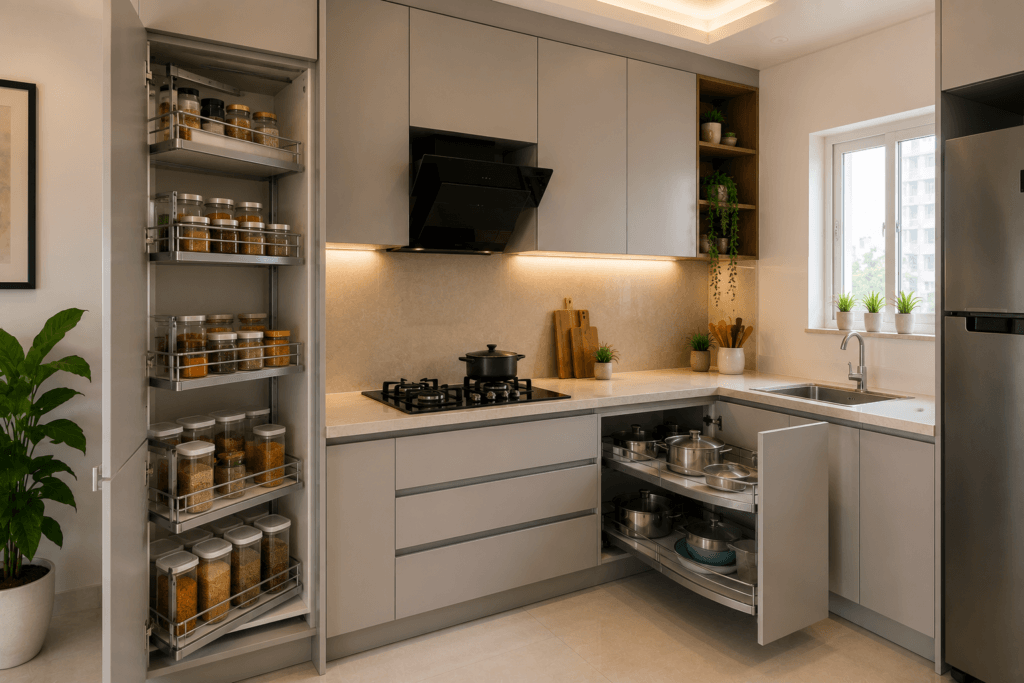
Tall pantry units that reach the ceiling (floor to 8 ft) store as much as 3–4 base cabinets combined. Use them for rice, pulses, grain storage, and infrequently used appliances. This is the single highest-return investment in a small kitchen.
Solve the corner with a carousel or magic corner unit
Dead corners in L and U kitchens waste 8–10 cubic feet of storage. A Le Mans carousel or magic corner unit (₹12,000–₹25,000) converts that into the most accessible storage in the kitchen.
Use drawer systems instead of fixed shelves in base cabinets
A base cabinet with a fixed shelf and a single door forces you to reach into the back for anything stored behind the front items. A tandem drawer system with two pull-out drawers gives you full access to the entire depth at eye level. The difference in daily usability is significant.
Add under-cabinet LED lighting
Not an aesthetic choice-it is a functional one. Under-cabinet LEDs illuminate the countertop directly and make a small kitchen feel significantly larger and more pleasant to cook in.
Plan appliance zones before finalizing the layout. Chimney, hob, microwave, mixer, kettle, water purifier-every appliance needs a dedicated space and an electrical point. Deciding appliance placement after the kitchen layout is finalized forces compromises that affect daily use for years.
See Bhumim’s complete modular kitchen layout guide to choose the right configuration for your space
What to Ask Before Hiring a Modular Kitchen Manufacturer
These questions separate serious manufacturers from showrooms that get better at talking than building:
- “What is the carcass material, grade, and thickness?”-Expected answer: 18mm BWP-grade plywood (IS:303). Anything less specific is a red flag.
- “Which hardware brands do you use-and can I see a sample?”-Expected: Hafele, or Blum. Ask to hold a hinge and open a drawer in that actual hardware.
- “Do you conduct a site visit before finalizing the quote?”-Any quote without a personal site visit is not a real quote.
- “Who installs-your own team or a subcontractor?”-Your own team is the right answer.
- “What is the warranty on carcass and shutters?”-Get specific years in writing, not “lifetime warranty” verbal assurances.
- “Can I speak with a customer whose kitchen you installed 3+ years ago?”-A manufacturer confident in their work will say yes.
Bhumim’s modular kitchen process: design consultation >> 3D visualization >> manufacturing at our Dehradun facility >> professional installation by our own team across Dehradun, Haridwar, Rishikesh, Roorkee, and Noida. Get a free estimate →
Frequently Asked Questions
A modular kitchen is made from factory-built cabinet modules assembled on-site, rather than being built from scratch by a carpenter on your premises. The difference shows up in precision-factory manufacturing delivers tighter tolerances, more consistent finishes, and properly installed hardware than on-site carpentry. A modular kitchen also installs in 3–5 days versus 3–4 weeks for carpenter-built work.
A standard mid-range modular kitchen in India for an L-shaped layout of 10–12 running feet costs ₹2–₹4.5 lakh in 2026, with BWP plywood carcass, laminate or acrylic shutters, and Hafele hardware. Basic kitchens start at ₹1–₹2 lakh with laminate shutters and standard hardware. Premium kitchens with Blum hardware, acrylic or PU-paint shutters, and quartz countertops cost ₹5–₹8 lakh and above. Price varies significantly by city, manufacturer, and material specification.
Yes-for most Indian homeowners investing ₹1.5 lakh or more in a kitchen, a modular kitchen offers better precision, faster installation, easier replacement of damaged parts, and measurable resale value. The caveat: the quality depends entirely on the carcass material and hardware specification. A cheap modular kitchen with particle board and generic hinges is not worth more than a well-specified carpenter-built kitchen.
BWP-grade plywood (IS:303 certified) is the best carcass material for Indian kitchens-it handles humidity, steam, and water exposure without swelling or delaminating, and lasts 15–20 years. For shutters, laminate is the most practical (durable, affordable, many design options). Hafele or Blum hardware lasts significantly longer than generic alternatives. For countertops, granite suits the cooking zone (heat-resistant for direct contact); quartz suits the prep zone (low maintenance, stain-resistant).
On-site installation for a standard modular kitchen takes 3–5 days once the modules are delivered. Total project timeline (design to installation) runs 45–60 days: 1–2 weeks for design finalization, 15–20 days of factory manufacturing, and 3–5 days of installation. Build in a 1–2 week buffer when planning around a move-in date.
A full modular kitchen consists entirely of factory-made modules-all cabinets, shelves, and storage are manufactured units. A semi-modular kitchen combines some pre-made modules (typically base cabinets and specific storage units) with some site-built or open elements. Semi-modular is often chosen to reduce cost or accommodate unusual kitchen dimensions.
Hafele are the standard mid-to-premium choices in Indian modular kitchens-reliable, widely serviced, and priced reasonably. Blum is the premium tier with longer rated lifespans. For drawer systems specifically, look for tandem-box drawer runners rather than basic telescopic channels-tandem-box handles heavier loads and lasts longer in daily Indian kitchen use.
Indian cooking-with high-flame cooking, daily tadka, and multi-dish meals-requires a chimney with at least 1,200 m³/hour suction capacity for a standard 3-burner hob. A 60cm chimney width is the minimum for a standard Indian kitchen; 90cm is preferable for larger hobs or frequent high-flame cooking. Most European-spec chimneys (rated for lower-volume cooking) are undersized for Indian cooking habits.
Yes, with some limitations. Modular kitchen units can be dismantled and reassembled in a new home-this is one of the advertised advantages of modular kitchens. In practice, the countertop (granite or quartz) is almost never relocated as it is cut to fit the specific space. The carcass units and shutters can typically be moved. Whether it is worth relocating depends on the new kitchen’s dimensions versus the existing module sizes.
Compare quotes by asking each vendor to specify: (1) carcass material and grade, (2) shutter material and thickness, (3) hardware brand and model, (4) countertop material, and (5) whether civil and installation work is included. Do not compare total prices without these details-two quotes at the same headline price can have completely different actual quality levels inside the cabinets.
The most common issues reported by Indian homeowners: (1) shutter peeling or warping within 1–3 years-caused by low-quality carcass material or improper edge-banding, (2) hinge droop-caused by generic hinges rather than branded soft-close, (3) chimney insufficient for Indian cooking volumes, (4) contractor delays exceeding the committed timeline, and (5) counter height too low or too high for daily comfort.
Yes. Bhumim manufactures and installs modular kitchens across Dehradun, Haridwar, Rishikesh, Roorkee, and Noida. All kitchens are factory-manufactured at Bhumim’s facility with BWP-grade plywood carcasses, Hafele hardware, and installed by Bhumim’s own professional team.
About This Article
Published by: Bhumim India Private Limited-Modular Kitchen Manufacturer & Installer, Dehradun
GST: 05AAOCB1784F1ZM | ISO 9001:2015 Certified
Service Areas: Dehradun · Haridwar · Rishikesh · Roorkee · Noida · Ghaziabad
Contact: 08044630777 | hello@bhumim.com
Note: This article is written from Bhumim’s on-ground manufacturing and installation experience. All material recommendations are based on what we use in real kitchens across our service areas.