

Waterproof Modular Kitchen in Dehradun
A waterproof modular kitchen in Dehradun uses IS 710 BWP (Boiling Water Proof) plywood for main cabinet carcasses and high-density WPC (Wood Plastic Composite) boards for under-sink units-materials that resist Dehradun’s 2,000+ mm annual monsoon rainfall and >85% humidity without swelling, delaminating, or attracting subterranean termites. Factory-sealed PUR edge banding and SS 304 hardware complete the system.
Why Standard Kitchens Fail in Dehradun's Monsoon Climate
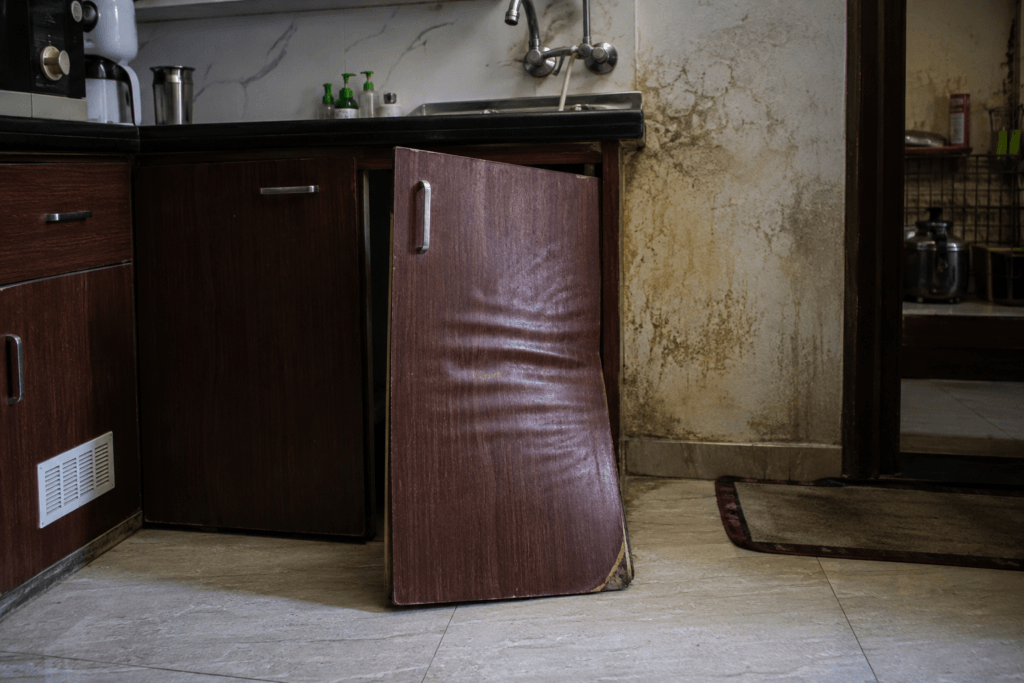
A homeowner in Vasant Vihar spent ₹2.2 lakh on a new kitchen in March. By September-after two months of Dehradun monsoon-the under-sink cabinet door had swollen shut. Pulling it open revealed the inside of the carcass: soft, dark, streaked with mold, with a faint musty smell that no amount of phenyl would fix. The installer had used “moisture-resistant” commercial plywood. On paper, it sounded fine. In Dehradun’s monsoon, it wasn’t even close.
That story isn’t unusual. It’s the pattern we see across ground-floor homes and first-floor apartments alike, across Rajpur Road and GMS Road, across Vasant Vihar and Clement Town. The Doon Valley has a specific microclimate that most national kitchen brands and local carpenters don’t plan around-and homeowners pay for that oversight two monsoons later.
Here’s what makes Dehradun harder on kitchen cabinets than almost anywhere else in north India.
What 2,000+ mm of Annual Rain Actually Does to a Kitchen Cabinet
Dehradun receives over 2,000 mm of rainfall annually, with July and August alone accounting for more than 600 mm each month. But standing water isn’t even the primary threat to cabinets. The real damage mechanism is subtler: relative humidity in the Doon Valley climbs above 85% during peak monsoon months and stays elevated for weeks at a stretch.
At that humidity level, standard commercial plywood (IS 303 grade) absorbs moisture from the air itself-not just from splashes. The urea-formaldehyde glue used in IS 303 boards begins breaking down. Board edges swell. Laminates lift at corners. Hinges loosen as the wood behind the hinge plate expands and contracts across repeated wet-dry cycles. Within two to three seasons, what looked like a solid kitchen becomes a cabinet system that smells, sticks, and creaks.
And that’s before you add the specific issue of Dehradun’s sub-Himalayan topography: hydrostatic pressure from high water tables pushes moisture through brick mortar into ground-floor walls, creating dampness directly behind kitchen cabinets even on days with no rain. The wall you mount your base units on may be wet from the inside year-round.
The Subterranean Termite Problem No One Warns You About
Subterranean termites-specifically Coptotermes formosanus and Heterotermes species-thrive in the clay-loam soils of the Doon Valley. The Indian Council of Forestry Research and Education (ICFRE), headquartered in Dehradun itself, has documented high subterranean termite activity across the valley’s ground-level residential zones.
What makes these termites particularly damaging is the way they travel. They don’t enter through a crack in a cabinet door. Instead, they build mud tubes through invisible micro-cracks in wall masonry, through plumbing penetrations, through electrical conduit entry points, and through the gap between a cabinet’s back panel and the wall. Once inside an organic wooden carcass, they work from within-eating the internal veneers first, leaving the laminate surface intact until the structure collapses under its own weight.
Post-construction termite spray offers limited protection. The chemical doesn’t penetrate into the glue layers of non-factory-treated boards. A board treated externally with pesticide will still be eaten from the inside if the glue layer itself isn’t phenolic-resin based.
The honest fix isn’t treating the termites. It’s choosing materials they cannot digest.
What Makes a Modular Kitchen Truly Waterproof?
A genuinely waterproof kitchen uses materials that undergo no structural change-no swelling, no delamination, no loss of screw-holding strength-even under prolonged water contact or sustained high ambient humidity.
That definition matters because the word “waterproof” is used loosely in the local market. Many installers describe HDHMR boards and even basic MR-grade plywood as “waterproof” when these materials are, at best, moisture-resistant-meaning they tolerate splashes and high ambient humidity to a point, but fail under prolonged water pooling.
The Difference Between Waterproof and Water-Resistant (and Why It Matters for Dehradun Kitchens)
Classification | What It Means | Example Materials | Dehradun Risk Level |
Waterproof | Zero water absorption; survives prolonged immersion without structural change | WPC board, Stainless Steel 304 | ✅ Safe in all zones |
Boiling Water Proof (BWP) | Survives 72-hour boiling water test per IS 710; phenolic resin glue | IS 710 BWP Plywood (Marine Grade) | ✅ Safe for carcasses, wall units |
Moisture Resistant | Tolerates high ambient humidity and surface splashes | HDHMR, BWR IS 303 | ⚠️ Safe in dry zones; risky near sink |
Standard Commercial | No waterproofing; urea-formaldehyde glue | IS 303 MR Grade Plywood, standard MDF | ❌ Fails in Dehradun monsoon |
This table is the single most useful thing to carry into any conversation with an installer. When someone tells you a material is “waterproof,” ask them which classification it sits in and whether it carries an IS 710 or WPC certification.
Get started with Beautiful Homes
For expert design consultation, send us your details and we’ll schedule a call
IS 710 BWP Plywood: Why It's the Gold Standard for Waterproof Kitchen Carcasses
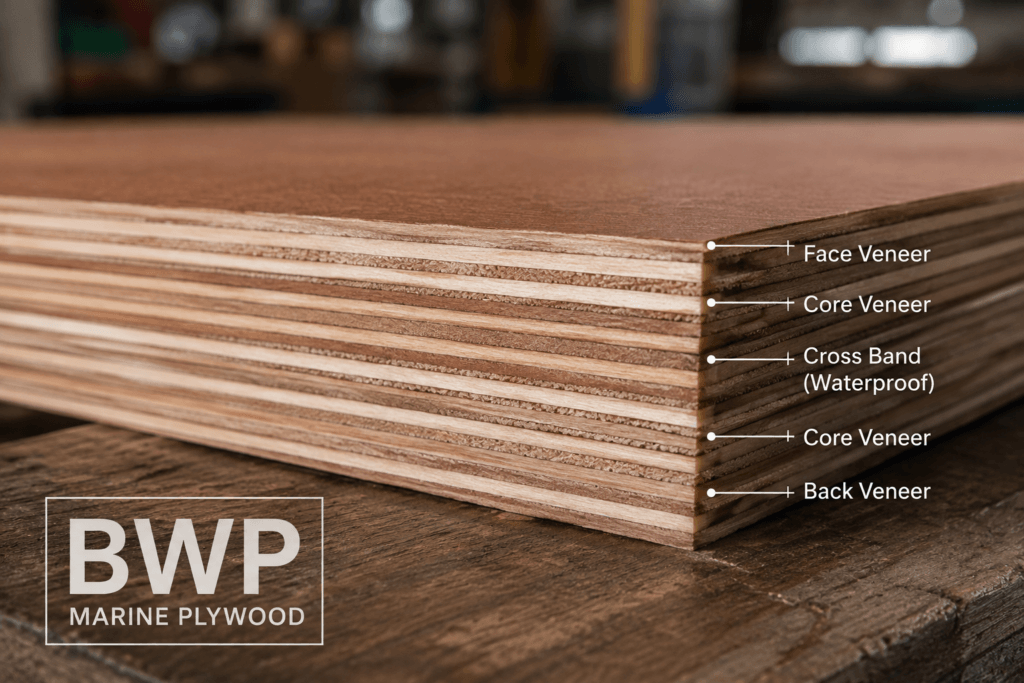
IS 710 BWP (Boiling Water Proof) plywood is the right carcass material for Dehradun kitchens because it uses 100% phenol-formaldehyde resin-not the cheaper urea-formaldehyde used in standard commercial plywood-and must survive a 72-hour continuous boiling water test without any glue-line failure or delamination, as certified by the Bureau of Indian Standards.
That test matters. Boiling water puts more stress on a board’s adhesive layer than any real-world kitchen condition. A board that passes it won’t fail under ambient humidity at 87% or under a slow sink-pipe drip that runs unnoticed for a week.
Why the IS 710 Standard Is More Reliable Than a Sales Claim
Every BWP-grade plywood sheet from a certified manufacturer carries a red BIS CML license stamp. If the sheet in front of you doesn’t have that stamp, it’s commercial plywood being called BWP. This is one of the most common material substitutions in local kitchen projects: installers order IS 710 on paper, use IS 303 MR grade on site because it’s 20-30% cheaper, and apply the same laminate finish on top. You can’t tell the difference from outside.
Ask your installer to show you the board before lamination begins. Check for the BIS stamp. If possible, request a batch certificate from the supplier.
Where BWP Plywood Works Best (and One Honest Limitation)
IS 710 BWP plywood is the right choice for:
- All base cabinet carcasses
- Wall-mounted overhead units
- Tall pantry columns
- Drawer boxes and shelf boards in the main kitchen body
- The structural framing behind any countertop
One limitation worth knowing: even IS 710 BWP plywood can show edge swelling under a sustained direct pipe leak-say, a dripping connection under the sink that goes unnoticed for several weeks. The board’s faces will survive. The raw edges, if not sealed with PUR edge banding, can absorb water. The practical fix is using WPC for the under-sink cabinet specifically, and BWP plywood for everything else. That combination handles Dehradun conditions without over-spending on the most expensive materials throughout.
WPC Boards: The Right Choice for Under-Sink and High-Moisture Zones
WPC (Wood Plastic Composite) is the right material for under-sink cabinets in Dehradun because it is completely waterproof-certified at less than 0.5% water absorption after 24-hour immersion-and contains no organic cellulose that subterranean termites can digest.
WPC is a blend of recycled wood fibers and thermoplastics pressed at high density. At densities above 0.60 g/cm³ (kilograms per cubic metre), WPC panels hold screws reasonably well and resist the deflection that occurs under heavy stoneware storage. At densities above 0.65 g/cm³, it handles moderate loads without bowing-suitable for base units carrying everyday kitchen weight.
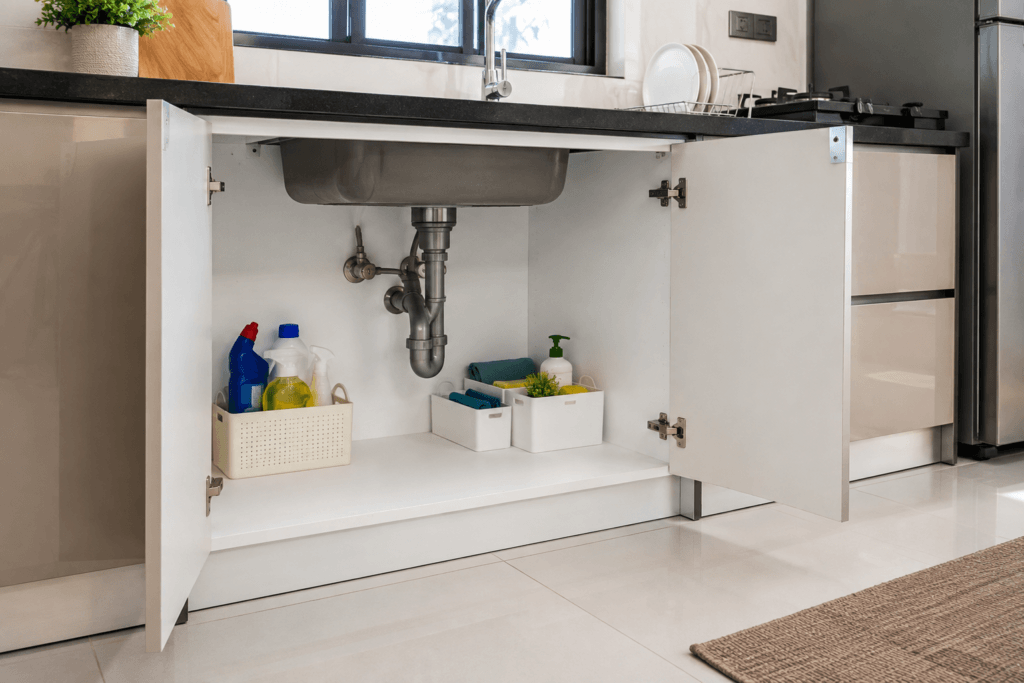
The under-sink zone is the single highest-risk location in any kitchen. It sits directly below running water, faces humidity from pipe condensation, and often has poor ventilation. Using IS 710 BWP plywood here is better than IS 303 MR grade, but WPC is better still. The plastic-wood matrix simply doesn’t react to water in any measurable way.
When NOT to Use WPC (The Honest Trade-Off)
WPC is softer than IS 710 BWP plywood and loses screw-holding strength under repeated hinge cycling. For cabinets that will carry very heavy loads-granite countertops, large SS utensil collections, industrial-weight appliances-BWP plywood provides better structural integrity. Also, WPC costs 10–25% more per square foot than IS 710 BWP plywood, so using it throughout an entire kitchen adds budget without proportional benefit.
The smart approach: WPC for under-sink and any cabinet zone within direct plumbing range; IS 710 BWP plywood for the rest of the carcass.
HDHMR Boards: Excellent for Dry Zones, Risky Near Sinks
HDHMR (High-Density High-Moisture Resistance) board is a good material for Dehradun kitchen wall cabinets and dry storage zones-but it is not waterproof, and using it near a sink or in ground-floor homes with persistent wall dampness will eventually cause edge swelling.
The name creates the confusion. “High-Moisture Resistance” sounds stronger than it is. HDHMR boards handle elevated ambient humidity-the kind that occurs during monsoon months when indoor air moisture climbs above 80%-without showing visible swelling. That’s genuinely useful. However, under direct and sustained water contact-a dripping pipe, a sink splash zone that stays wet for hours, or a wall with active moisture ingress-HDHMR edges will absorb water and expand.
Where HDHMR Fits in a Monsoon-Ready Kitchen
Use HDHMR confidently for:
- Upper wall cabinet carcasses (away from direct water)
- Dry storage tall units
- Shutter boards-its smooth, dense surface takes finishes like acrylic and PU paint exceptionally well
- Study-room or TV-unit carcasses in the same home
Avoid HDHMR for:
- Under-sink cabinets
- Base units on ground-floor homes with wall moisture
- Any cabinet directly adjacent to the dishwasher or washing zone
The practical recommendation: use HDHMR for shutters and upper wall units, WPC for under-sink, and IS 710 BWP plywood for base carcasses. These three materials work as a system, not a competition.
Stainless Steel 304 Modular Kitchens: When Zero Compromise Is the Goal
Stainless Steel 304 grade modular kitchens are the ultimate termite-proof and waterproof option-there is simply no organic material for pests to eat and no board core for moisture to penetrate. The 18% chromium and 8% nickel alloy composition of SS 304 gives it complete corrosion immunity in even the highest-humidity Indian climates.
In practice, SS 304 carcass kitchens in Dehradun are specified for two distinct situations: ground-floor homes with severe wall moisture where even BWP plywood eventually shows wear, and premium kitchens where the homeowner wants a 25-year-plus product with no maintenance concerns.
The honest trade-off: SS 304 modular kitchens cost 30–50% more than an equivalent BWP plywood kitchen, and the aesthetic is distinctly industrial-which some homeowners love and others find too cold for a home kitchen. Hardware selection matters more with steel carcasses; the shutter finish (lacquer, glass, acrylic panel) does most of the aesthetic work.
Hardware, Edge Banding and Sealing: Where Most Waterproof Kitchens Secretly Fail
You can use IS 710 BWP plywood throughout a kitchen and still end up with swollen boards and rusted hinges after two monsoons-if the hardware, edge banding, and sealing decisions are wrong. This is the part that most online material guides skip, and it’s where a large number of Dehradun kitchen complaints originate.
Edge banding is the thin strip sealed onto the exposed raw edges of board panels. Standard PVC edge banding uses EVA (ethylene-vinyl acetate) hot-melt adhesive. EVA holds fine in dry conditions but breaks down under sustained high humidity, leaving a micro-gap between the banding and the board edge. Moisture enters through that gap and reaches the board core.
PUR (Polyurethane Reactive) edge banding uses a moisture-curing adhesive that actually strengthens under humidity exposure. It creates a zero-joint seal that outlasts the board itself. On a Dehradun kitchen, specifying PUR edge banding over standard PVC edge banding is a meaningful difference-not a luxury upgrade.
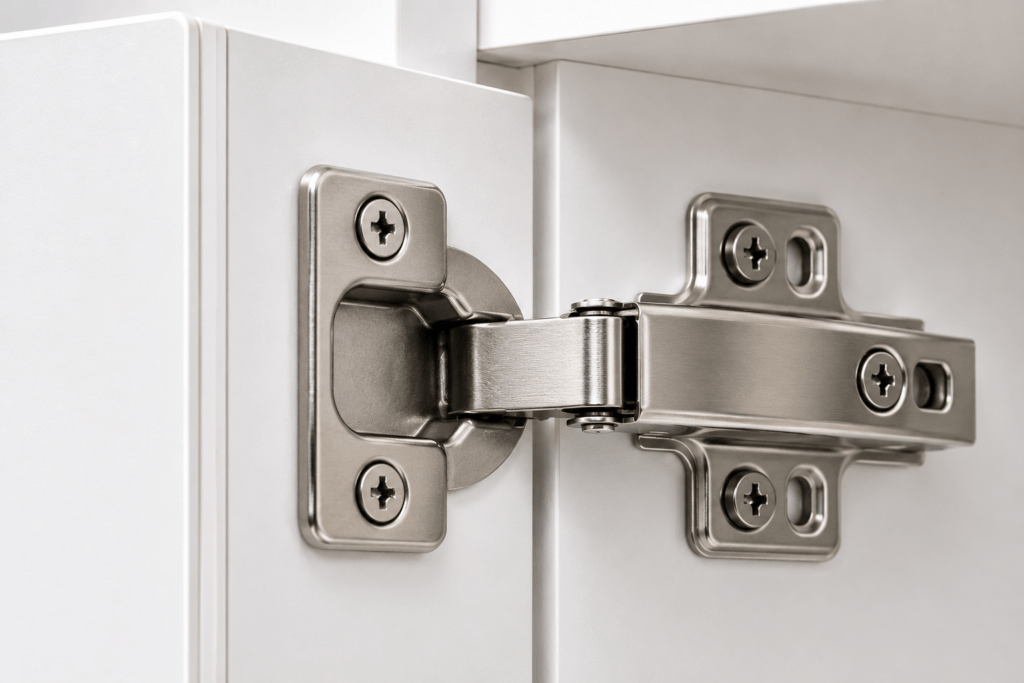
Hardware is equally important. Standard iron-alloy hinges begin oxidizing when ambient relative humidity crosses 70%. Dehradun’s July-August average sits well above that. SS 304 grade soft-close hinges and drawer channels from certified European-grade hardware brands won’t rust regardless of monsoon duration. The price difference between SS 304 hardware and standard hardware across a full kitchen is roughly ₹8,000–₹20,000-a fraction of what replacement costs once rusted hinges start pulling out of swollen carcass boards.
Wall sealing is the pre-installation step most homeowners don’t know to ask about. Before any cabinet is mounted on a Dehradun ground-floor or first-floor wall, the bare wall should receive a dual coat of rubberized or epoxy waterproofing chemical. A 6mm PVC back-shield sheet behind each base cabinet creates a further moisture barrier between the wall and the cabinet back panel. Cabinets mounted directly on untreated damp walls absorb moisture from behind regardless of the carcass material used.
Plumbing penetrations-the gaps where water supply and drain pipes enter the cabinet-need to be sealed with waterproof expanding PU foam or food-grade silicone sealant. Subterranean termites enter through these gaps more commonly than through any other route.
How to Protect Kitchen Cabinets from Monsoon Dampness: The Installation Protocol
Getting the material selection right is half the work. The other half is installation sequence. Even the right materials can underperform if the pre-installation preparation steps are skipped-and they often are, because they add a day or two and the homeowner doesn’t know to insist on them.
Here is the correct installation sequence for a waterproof modular kitchen in Dehradun:
- Resolve active water sources first. Any plumbing leak, seeping wall, or structural water ingress must be fixed before cabinet installation begins. Mounting waterproof cabinets on a leaking wall doesn’t solve the problem; it hides it until the smell arrives.
- Apply waterproofing chemical to bare walls. Two coats of rubberized or epoxy waterproofing compound on the walls where base units will sit. Allow 48 hours curing time before installation proceeds.
- Install a 6mm PVC back-shield. A thin PVC sheet between the wall surface and the cabinet back panel adds a physical moisture barrier and makes future cabinet removal cleaner.
- Elevate cabinets 50–75mm off the floor. Height-adjustable PVC or SS legs keep the base cabinet bottom away from floor moisture, mopped water, and potential flooding. This is standard in professionally manufactured modular systems-carpenter-built kitchens rarely include it.
- Seal all plumbing penetrations. Every pipe entry hole gets filled with food-grade silicone or expanding PU foam before the sink unit is closed.
- Use PUR edge banding throughout. Verify this at the manufacturing stage, before modules arrive. Once modules are on-site with standard EVA edge banding, the option is gone.
- Specify SS 304 hinges, drawer channels, and leg adjusters. Ask the installer to name the hardware brand and verify the grade before signing off.
Material Comparison: What to Use Where in a Dehradun Kitchen (2026)
Kitchen Zone | Best Material | Second Choice | Avoid |
Under-sink base cabinet | High-density WPC (>0.60 g/cm³) | IS 710 BWP Plywood + PUR banding | HDHMR, MDF, IS 303 |
All other base carcasses | IS 710 BWP Plywood | HDHMR + PUR banding | IS 303 commercial ply |
Overhead wall cabinets | IS 710 BWP Plywood or HDHMR | — | Standard MDF |
Tall pantry column | IS 710 BWP Plywood | HDHMR | — |
Shutters / door fronts | HDHMR, Acrylic, High-gloss PU | Laminate on BWP | MDF near wet zones |
Hardware (hinges, channels) | SS 304 grade certified soft-close hardware | Zinc-alloy with rust coating | Iron-alloy standard hardware |
Edge banding | PUR reactive hot-melt | — | Standard EVA PVC banding |
Full kitchen (max durability) | Stainless Steel 304 carcass | IS 710 BWP + WPC hybrid | — |
Waterproof Modular Kitchen Cost in Dehradun and Uttarakhand (2026)
Waterproof modular kitchen pricing in Dehradun typically runs ₹1,100–₹2,500 per square foot for BWP plywood and HDHMR-based kitchens, rising to ₹2,500–₹4,000+ per square foot for WPC-heavy or SS 304 carcass systems. These are supply-and-install rates inclusive of basic hardware-countertops, sinks, chimneys, and hobs are quoted separately.
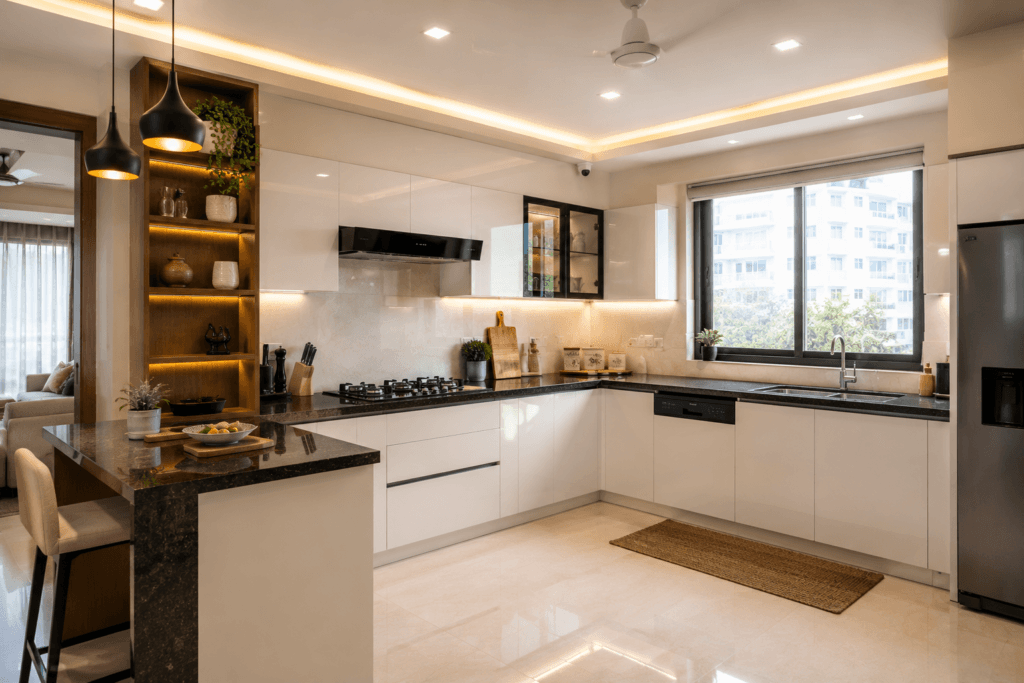
For a standard 10×10 ft L-shaped kitchen in Dehradun, expect:
Configuration | Estimated Total Cost (2026) |
HDHMR carcass + laminate shutters + standard hardware | ₹1.4L – ₹2.0L |
IS 710 BWP carcass + WPC under-sink + laminate + SS 304 hardware | ₹1.8L – ₹2.8L |
IS 710 BWP carcass + WPC under-sink + acrylic shutters + certified SS 304 hardware | ₹2.4L – ₹3.8L |
Full SS 304 carcass + glass/acrylic shutters + premium hardware | ₹4.0L – ₹7.0L+ |
These are reference ranges, not fixed quotes. Pricing varies by kitchen size, wall conditions, number of accessory units (corner carousels, pull-outs, cutlery inserts), and the specific hardware brands specified.
Cost Factors That Move the Price Up or Down
Several factors affect final cost beyond material choice:
- Wall condition: a ground-floor home with active wall dampness needs pre-treatment work before cabinet installation. That adds ₹8,000–₹25,000 depending on wall area and severity.
- Accessory units: corner carousels (₹12,000–₹35,000 each), tall pull-out pantry units (₹18,000–₹45,000), and tandem drawer systems add significantly to base cabinet cost.
- Hardware brand: Mid-premium and premium certified SS 304 hardware each add ₹15,000–₹40,000 across a full kitchen compared to standard iron-alloy hardware.
- Countertop: granite runs ₹80–₹180 per sq ft installed; quartz runs ₹150–₹350 per sq ft-always quoted separately from kitchen cabinet pricing.
What to Budget in Haridwar, Rishikesh and Roorkee
For Bhumim’s secondary service cities, pricing benchmarks shift slightly due to local transportation and installation logistics:
- Haridwar: similar to Dehradun pricing; ground-moisture risk is higher due to Ganges plain flooding patterns; WPC for under-sink is strongly recommended
- Rishikesh: slightly higher (5–10%) for riverbank locations such as Tapovan and Muni Ki Reti where ambient humidity stays elevated year-round; WPC for base units recommended throughout
- Roorkee: typically 5–8% lower than Dehradun pricing; agricultural groundwater proximity makes termite-grade materials (WPC or IS 710) non-negotiable for ground-floor homes
- Noida and Ghaziabad: pricing tracks NCR market rates at ₹1,200–₹3,000 per sq ft; wall seepage from adjacent bathroom shafts in high-rise apartments makes PUR edge banding and SS 304 hardware the key upgrades
Three Common Misconceptions About Waterproof Kitchens in Dehradun
“HDHMR is 100% waterproof.” It isn’t. The full name is High-Density High-Moisture Resistance-not waterproof. HDHMR handles air humidity extremely well and outperforms standard MDF in every monsoon-related metric. But its edges will swell under sustained direct water contact such as a slow sink leak or ground-level moisture ingress. Use it in the right zones and it’s an excellent material; position it as waterproof and it will eventually disappoint.
“Post-construction termite spray fully protects a wooden kitchen.” Chemical spray applied to finished cabinet surfaces doesn’t penetrate the glue layers inside the carcass board. Subterranean termites enter from wall penetrations and eat from within. The external spray is a deterrent, not a solution. Factory-level termite treatment-where the board’s glue line itself is chemically treated during manufacturing-is more reliable, but the only truly termite-proof materials are those with no organic content at all: WPC and stainless steel.
“WPC boards are too weak to hold heavy granite countertops.” High-density WPC (above 0.65 g/cm³) with proper structural framing handles standard Indian kitchen loads including granite and quartz slabs. The structural load of a countertop is distributed across the full carcass frame-not carried by the WPC panel alone. WPC is softer than BWP plywood and loses screw-holding strength under repeated hinge cycling, so it’s not ideal for hinge-heavy door carcasses. But as a base unit material supporting a countertop, it performs reliably.
Frequently Asked Questions
For most Dehradun homes, the best combination is IS 710 BWP plywood for all main base and wall cabinet carcasses, and high-density WPC board for the under-sink cabinet. This combination handles the Doon Valley’s 2,000+ mm annual rainfall and high monsoon humidity without swelling or attracting termites. PUR edge banding and SS 304 hardware complete the waterproofing system. If budget allows for maximum durability, a full Stainless Steel 304 carcass kitchen removes all moisture and termite risk entirely.
HDHMR is moisture-resistant, not waterproof. It handles high ambient humidity and surface splashes well, which makes it useful for wall cabinets and dry storage zones in a Dehradun kitchen. However, HDHMR edges will absorb water and swell under prolonged direct water contact-such as a leaking sink connection or wall moisture ingress. For under-sink units and base cabinets in ground-floor homes, WPC or IS 710 BWP plywood is the safer choice.
The most reliable termite protection comes from the material itself, not from spray treatment. WPC boards and Stainless Steel 304 contain no organic cellulose and are biologically immune to termites. IS 710 BWP plywood, when factory-treated with phenol-formaldehyde resin, provides high (though not absolute) termite resistance. Beyond material choice, seal all wall pipe penetrations with silicone or PU foam, and apply anti-termite waterproofing chemical on bare walls before cabinet installation.
IS 710 is the Bureau of Indian Standards certification for Boiling Water Proof (BWP) Marine Grade plywood. Boards with this certification must survive a 72-hour continuous boiling water test without glue-line failure or delamination. The phenol-formaldehyde resin used in IS 710 plywood is far more durable than the urea-formaldehyde glue in standard commercial plywood (IS 303 grade). Every sheet should carry a red BIS CML stamp-that stamp is how you verify the grade before laminate covers the board.
Yes, high-density WPC boards above 0.65 g/cm³ can support standard kitchen countertop loads including granite and quartz slabs, provided the carcass frame is correctly constructed. The countertop load distributes across the full cabinet structure rather than resting on a single WPC panel. WPC is softer than plywood and offers lower screw-holding strength, so hinge placement and the number of support points matter more with WPC than with BWP plywood.
Waterproof modular kitchen pricing in Dehradun in 2026 typically ranges from ₹1,100 to ₹2,500 per square foot for IS 710 BWP plywood and WPC-based systems with SS 304 hardware. Acrylic-finish kitchens with premium certified SS 304 hardware reach ₹2,500–₹3,800 per square foot. Full Stainless Steel 304 carcass kitchens start at ₹4,000+ per square foot. These rates cover cabinets and hardware only-countertops, sink, chimney, and hob are quoted separately.
Standard kitchen hinges use iron alloy or low-grade steel. When ambient relative humidity crosses 70%-which happens throughout Dehradun’s July-August monsoon-oxidation accelerates on iron surfaces. Rusted hinges lose torque, pull out of softened cabinet boards, and eventually fail entirely. SS 304 grade soft-close hinges from certified European hardware manufacturers contain 18% chromium and 8% nickel and are chemically immune to corrosion regardless of humidity levels.
Yes, but only when the right pre-installation protocol is followed. Before any cabinet is mounted, active wall moisture must be resolved, bare walls should receive two coats of rubberized or epoxy waterproofing, and a 6mm PVC back-shield sheet should be installed between the wall and cabinet backs. WPC or IS 710 BWP plywood carcasses with PUR edge banding should be used throughout. Without these steps, even the best materials will eventually show moisture damage.
Bhumim serves Haridwar, Rishikesh, and Roorkee as part of its Uttarakhand service area, with the same factory-manufactured product range available in Dehradun. Pricing is similar to Dehradun, with minor variation for transportation. Rishikesh riverbank locations (Tapovan, Muni Ki Reti) benefit from WPC for all base units due to year-round high humidity. Roorkee ground-floor homes face high subterranean termite risk from agricultural groundwater proximity, making IS 710 BWP plywood or WPC carcasses non-negotiable.
For a short-term rental property, carpenter-made can be cheaper upfront. For a permanent home in Dehradun-where the monsoon cycle runs every year-factory-made modular is significantly better. Factory manufacturing uses precision CNC boring and PUR edge banding machines that hand-cutting and manual gluing cannot replicate. The edge seals are tighter. The board tolerances are more consistent. And if a unit is damaged, you replace that module rather than rebuilding the entire kitchen.
Key Takeaways
- Dehradun’s 2,000+ mm annual rainfall and >85% monsoon humidity mean standard commercial plywood (IS 303) is the wrong material for any Dehradun kitchen carcass.
- IS 710 BWP plywood (phenol-formaldehyde resin; 72-hour boiling water test certified) is the right base-cabinet carcass material for most kitchens.
- WPC boards (less than 0.5% water absorption; 100% termite-proof) are the right choice for under-sink units and any cabinet in direct contact with plumbing.
- HDHMR is a good material for dry wall cabinets and shutters-not for under-sink zones or ground-floor homes with wall moisture.
- PUR edge banding and SS 304 hardware are non-negotiable in a Dehradun kitchen; they’re where most otherwise-good kitchens fail after two monsoons.
- Pre-installation wall waterproofing, PVC back-shield panels, and sealed plumbing penetrations matter as much as the board material itself.
- Post-construction termite spray does not replace termite-proof carcass materials. WPC and SS 304 are biologically termite-immune; IS 710 BWP plywood with phenolic glue offers high but not absolute resistance.
- Waterproof modular kitchen pricing in Dehradun in 2026 ranges from roughly ₹1,100–₹2,500 per square foot for BWP/WPC combinations, rising to ₹4,000+ for full SS 304 systems.
Ready to Plan Your Waterproof Kitchen?
The homeowner in Vasant Vihar who started this story eventually replaced that under-sink cabinet-this time, with a WPC unit and proper wall waterproofing behind it. Two monsoons later, it’s still clean, dry, and closed without effort. That’s what the right material selection actually looks like in practice.
If your Dehradun home is approaching the first or second monsoon with a kitchen that’s already starting to show signs-sticky doors, a faint smell under the sink, hinges that need to be pushed hard to latch-this is the moment to plan before the damage compounds.
Bhumim manufactures and installs modular kitchens across Dehradun, Haridwar, Rishikesh, Roorkee, Noida, and Ghaziabad. Every kitchen is factory-built using verified board grades, PUR edge banding, and SS 304 hardware-and our team will tell you exactly which material goes where in your specific home and why.
About This Article
Published by: Bhumim India Private Limited-Modular Kitchen Manufacturer & Installer, Dehradun
GST: 05AAOCB1784F1ZM | ISO 9001:2015 Certified
Service Areas: Dehradun · Haridwar · Rishikesh · Roorkee · Noida · Ghaziabad
Contact: 08044630777 | hello@bhumim.com
Note: This article is written from Bhumim’s on-ground manufacturing and installation experience. All material recommendations are based on what we use in real kitchens across our service areas.