

Modular Kitchen Accessories: The Complete Storage Guide
Modular kitchen accessories are the hardware fittings – pull-out baskets, corner units, cutlery trays, tall units, and bin systems – that organize a kitchen’s storage space. The right mix depends on your kitchen’s layout, how you cook, and your budget, not on buying every accessory available.
Modular kitchen accessories are essentially the internal hardware that turns empty cabinet space into usable, accessible storage. Think of them as the difference between a cabinet you have to crouch into and dig through, and one where everything slides out and sits at eye level. A fitted kitchen or modular kitchen cabinet system is only as functional as the accessories fitted inside it.
If you’ve ever stood in your kitchen holding a bag of onions with nowhere obvious to put them, or dug through three shelves to find a lid that matches your pan, that’s usually not a design problem – it’s an accessory problem. Cabinets without the right internal fittings waste 30-40% of their storage potential because deep corners, tall gaps, and narrow gaps between cabinets go unused.
Expert Tip: Before choosing accessories, walk through your actual cooking routine for a week and note what you reach for most. That list should drive your accessory priorities more than any showroom display.
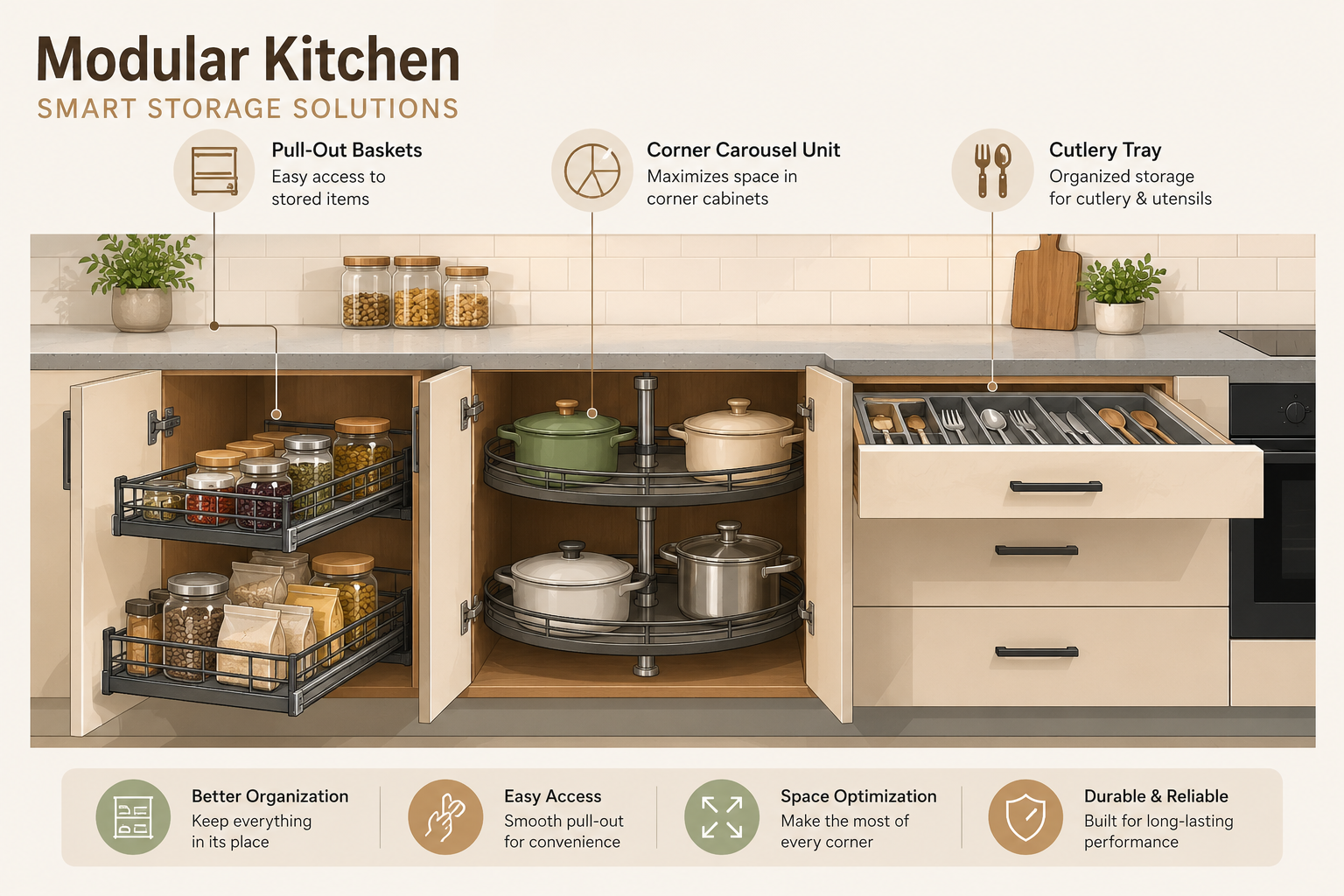
What Modular Kitchen Storage Accessories Actually Include
A complete modular kitchen storage system typically covers five categories:
- Base unit accessories – pull-out baskets, bottle pull-outs, drawer systems
- Corner unit accessories – magic corners, LeMans units, carousel units
- Wall unit accessories – plate racks, glass racks, wall-mounted organizers
- Tall unit accessories – larder units, pantry pull-outs, appliance garages
- Small-item organizers – cutlery trays, spice racks, knife blocks, thali racks
Each category solves a different storage headache, and most kitchens need a combination of all five rather than heavy investment in just one. Wardrobe accessories follow a similar logic on the wardrobe side of a home – internal fittings, not just the box, decide how usable the storage actually is.
Why Storage Accessories Matter More Than the Cabinet Itself
Two kitchens can have identical carcass dimensions and look completely different in daily use, purely because of what’s fitted inside. A base unit with a static shelf forces you to remove everything in front just to reach the back. The same unit with a pull-out basket gives you full access in one motion.
This matters even more in Dehradun, Haridwar, and the surrounding hill and plains towns, where kitchens tend to run smaller than in metro apartments, and every inch of a base unit or corner cabinet has to earn its place. A poorly planned corner can waste close to two cubic feet of dead storage in a compact kitchen.
Did You Know? Corner cabinets are typically the single most wasted space in any kitchen layout – without an accessory like a magic corner or carousel, up to half of a corner unit’s volume is functionally unreachable.
Get started with Beautiful Homes
For expert design consultation, send us your details and we’ll schedule a call
Types of Modular Kitchen Accessories and What They Solve
Pull-Out Baskets: The Everyday Workhorse
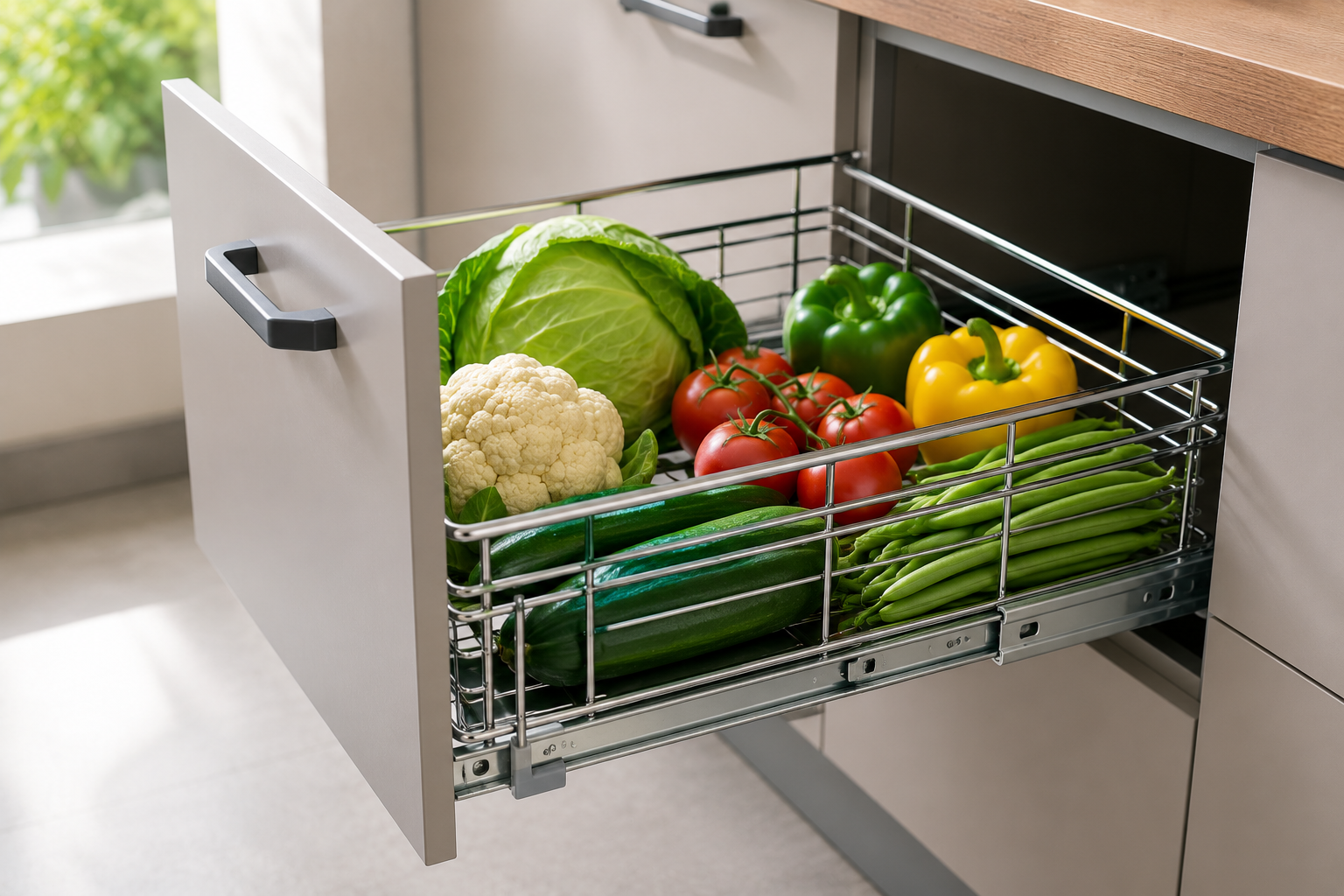
Pull-out baskets are wire or coated-steel baskets mounted on telescopic channels inside base units. They’re used for vegetables, dry rations, or bottles, and they solve the single biggest complaint about traditional cabinets – having to bend and dig.
- Wire baskets – ventilated, good for vegetables and onions
- Bottle pull-outs – narrow vertical units for oil bottles and tall jars
- Tandem/double-tier baskets – stack two levels in one base unit for extra capacity
Corner Units: Turning Dead Space Into Storage
Corner cabinets are notoriously hard to use without an accessory. Two common solutions:
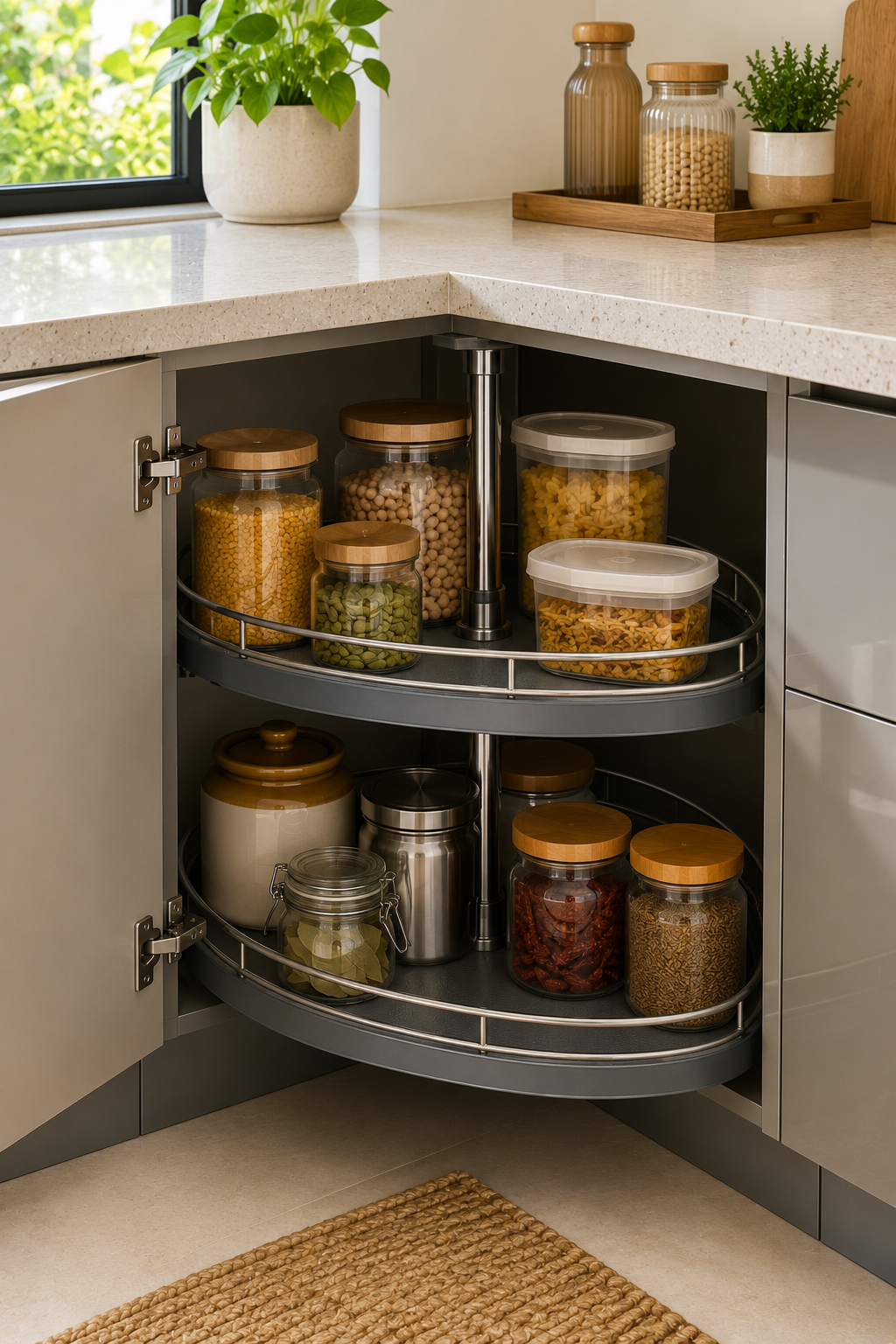
- Magic corner units – swing out in a two-part mechanism, pulling items from deep inside the corner toward you
- LeMans/carousel units – rotate on a curved track, bringing stored items around to the cabinet opening
Magic corners generally hold more weight and suit larger corner cabinets, while carousel units work well in tighter spaces. Either way, a corner unit is one of the few accessories where “skip it and use a plain shelf” genuinely costs you usable storage, not just convenience.
Tall Units and Larder Pull-Outs
A tall unit runs floor to ceiling and, fitted with a larder pull-out, functions like a walk-in pantry compressed into one column. These work especially well for households that stock rations in bulk, which is common where monthly grocery runs are the norm rather than frequent small trips.
Cutlery Trays and Drawer Organizers
Cutlery trays sit inside drawers and divide the space for spoons, knives, and serving ware. Beyond basic cutlery trays, drawer organizer inserts can hold spices, chopping boards, or thalis vertically, which keeps them visible and accessible instead of stacked.
Wall-Mounted Racks
Wall units above the counter benefit from dedicated plate racks, glass racks with integrated drip trays, and small wall organizers for daily-use items – reducing how often you need to reach into deeper wall cabinets.
How to Choose Accessories: A Step-by-Step Approach
- Map your kitchen zones – cooking, washing, storage, prep – and note which zone feels most cluttered today
- List your top five daily frustrations – the specific things you dig for or trip over
- Match accessories to frustrations, not to a catalogue – a magic corner solves a different problem than a bottle pull-out
- Prioritize by cabinet type you already have – base units, corner units, tall units, wall units
- Set a per-category budget before visiting a showroom, so add-ons don’t creep past your total kitchen budget
- Confirm hardware compatibility – not every accessory brand fits every cabinet channel width, so this needs checking against your actual carcass dimensions
Quick Checklist - Before You Finalize Accessories
- Have you accounted for at least one corner solution if your layout has an L-shape or U-shape corner?
- Does your cutlery drawer organizer match your actual drawer depth?
- Have you checked the channel/runner brand and its expected smoothness over years of daily use, not just on day one?
- Is there a tall unit or larder pull-out if you stock rations in bulk?
- Have you left room in the budget for at least basic wall unit organizers?
Materials and Hardware: What to Compare
Accessory Type | Common Material | What to Check |
Pull-out baskets | Powder-coated or chrome-plated steel wire | Coating quality – poor coating chips and rusts faster in humid months |
Drawer channels/runners | Steel with soft-close mechanism | Load rating and soft-close consistency over repeated use |
Corner units | Steel frame with plastic/metal basket trays | Swing mechanism smoothness, weight capacity |
Cutlery trays | Plastic, acrylic, or wood-finish inserts | Fit precision to your drawer size – loose trays shift and rattle |
Tall unit pull-outs | Steel frame, wire or laminate shelves | Full-extension vs partial-extension runners |
Pricing varies by city, material grade, and hardware brand, so treat any number you see online as a rough starting point rather than a fixed quote – the right way to budget is to get a written, itemized quote based on your actual kitchen layout.
Common Mistakes Homeowners Make With Kitchen Accessories
- Over-accessorizing small kitchens – fitting a magic corner, a larder unit, and multiple pull-outs into a compact kitchen can eat into usable cabinet volume instead of adding it
- Choosing accessories before finalizing the layout – accessory choice should follow the cabinet plan, not the other way around
- Ignoring runner/channel quality – a cheap channel on a heavily used base unit basket tends to stick or sag well before the cabinet itself shows wear
- Skipping the corner solution to save cost – this is usually the accessory that’s hardest to retrofit later, since it’s tied to the carcass structure
- Not checking maintenance access – some pull-out systems are harder to clean than others, which matters in kitchens with heavy daily cooking
Common Mistake: Assuming every accessory needs to be top-of-the-range. A mid-range pull-out basket with a reliable soft-close runner will often outperform a premium-branded static shelf in daily practicality – spend where the accessory does the most work.
What to Compare Before Choosing a Manufacturer
Accessories are only as good as the company fitting and standing behind them. Whoever you choose – Bhumim or otherwise – it’s worth checking these points directly:
- Factory ownership – does the company manufacture cabinets and fit accessories in-house, or outsource and resell under their own name? In-house manufacturing generally means tighter quality control on fit and finish.
- Installation team – an in-house trained installation team tends to handle accessory alignment (drawer runners, corner unit swing clearance) more consistently than a rotating cast of third-party contractors.
- Warranty coverage – ask specifically what’s covered on hardware (runners, hinges, baskets) versus the cabinet body, and for how long – warranty terms vary by product category, so confirm current coverage directly with the manufacturer rather than assuming a blanket figure.
- Material sourcing – where the boards, laminates, and hardware come from, and whether there’s any quality check before installation.
- Hardware brands used – named hinge, channel, and fitting brands matter because generic, unbranded hardware is where most long-term accessory failures happen (sticking drawers, sagging baskets, hinges that lose tension).
- After-sales support – how quickly the company responds if a runner sticks or a hinge loosens six months in, and what the actual service process looks like.
Bhumim manufactures its own cabinet units and fits accessories using named hardware brands, with an in-house installation team handling the fitting, but this same checklist applies whether you’re evaluating Bhumim or any other manufacturer in Dehradun near me.
What's the Difference Between Kitchen Accessories and Wardrobe Storage Fittings?
The underlying hardware logic is similar – pull-outs, soft-close channels, corner solutions – but kitchen accessories are built to handle moisture, oil residue, and heavier daily use, while wardrobe fittings prioritize garment protection and lighter-weight organization. If you’re planning storage across the whole home, it’s worth reviewing both together – see how dressing table and wardrobe dressing units compare for a related storage decision in the bedroom.
How Much Should You Budget for Kitchen Accessories?
Accessory cost depends on how many units need fitting, the hardware brand chosen, and your city’s material rates – so instead of a fixed number, budget by category:
- Basic pull-out baskets for a few base units: lower-cost category
- Corner unit (magic corner or carousel): mid-to-higher cost, but high functional payoff
- Tall unit with larder pull-out: adds meaningfully to cost but reduces need for separate pantry furniture
- Cutlery trays and small organizers: lowest cost category, easiest to add incrementally
A written, itemized quote against your actual modular kitchen design is the only reliable way to know your real number, since generic online estimates rarely reflect current material and hardware pricing.
Benefits and Challenges of a Fully Accessorized Kitchen
Benefits
- Faster daily cooking workflow with less bending and searching
- Better use of corner and vertical space that would otherwise go unused
- Easier to keep organized long-term, since everything has a defined place
Challenges
- Higher upfront cost compared to basic shelving
- Requires accurate cabinet measurements to fit accessories properly
- Some mechanisms (soft-close, carousel swings) need occasional maintenance checks over the years
Frequently Asked Questions
Q1: What are the most essential modular kitchen accessories for a small kitchen?
Pull-out baskets for base units and a corner solution (if your layout has one) tend to deliver the biggest functional improvement in a small kitchen, ahead of larger additions like a full larder unit.
Q2: Do I need a corner unit if my kitchen doesn't have an L-shaped corner?
No – corner units like magic corners and carousels are specifically for L-shaped or U-shaped layouts with a blind corner cabinet. A straight-line kitchen won’t need one.
Q3: Are wire baskets better than solid-base pull-outs for vegetables?
Wire baskets ventilate better, which helps with vegetables and onions that need airflow, while solid-base pull-outs suit bottles, jars, or items you don’t want visible from below.
Q4: How long do modular kitchen accessories typically last before needing replacement?
It varies by hardware brand and usage intensity – soft-close runners and hinges are usually the first components to show wear, so checking the brand and warranty terms upfront matters more than guessing a lifespan.
Q5: Can accessories be added to an existing kitchen, or only during initial installation?
Some accessories, like cutlery trays or small organizers, can be retrofitted easily. Corner units and full pull-out systems are harder to add later since they depend on the original cabinet’s internal dimensions.
Q6: What's the difference between a magic corner and a carousel unit?
A magic corner swings out in a two-part mechanism to pull items from deep in the corner, while a carousel rotates on a curved track – magic corners generally suit larger corners, carousels suit tighter spaces.
Q7: Do modular kitchen accessories need special maintenance?
Soft-close mechanisms and swing/rotation hardware benefit from periodic checks, but day-to-day maintenance is mostly about keeping runners free of spills and residue, especially near the cooking zone.
Q8: Is it worth paying more for branded hardware over generic accessories?
Named hardware brands tend to hold up better under years of daily opening and closing – generic hardware is where most long-term sticking, sagging, or loosening issues show up first.
Q9: How do I know if my kitchen accessories will fit my existing cabinets?
Channel width, drawer depth, and corner cabinet dimensions all need to match the accessory’s specifications – this is best confirmed against your actual carcass measurements before ordering.
Q10: Should accessories be chosen before or after finalizing the kitchen design?
After the layout is finalized but before manufacturing begins – accessory choice should follow the cabinet plan, since retrofitting some accessories later is difficult or impossible.
Key Takeaways
- Modular kitchen accessories are the internal hardware – baskets, corner units, trays, pull-outs – that determine how usable your storage actually is, not just the cabinet shell
- Corner cabinets waste the most space without a dedicated accessory like a magic corner or carousel
- Match accessories to your actual daily frustrations, not a full showroom catalogue
- Hardware brand and channel/runner quality matter more long-term than the visible finish
- Get an itemized quote against your real kitchen layout – pricing varies too much by city and material to trust a generic number
- Check factory ownership, installation team, warranty, material sourcing, hardware brands, and after-sales support with any manufacturer you’re considering
Conclusion
Getting modular kitchen accessories right isn’t about buying the longest list of add-ons – it’s about matching a handful of well-chosen fittings to how you actually cook and store things day to day. Start with your biggest daily frustration, work outward from there, and confirm hardware quality before finalizing anything. If you’d like a layout-specific accessory plan and quote for your kitchen, Bhumim’s design team can walk through your space and put one together.
About This Article
Published by: Bhumim India Private Limited-Modular Kitchen Manufacturer & Installer, Dehradun
GST: 05AAOCB1784F1ZM | ISO 9001:2015 Certified
Service Areas: Dehradun · Haridwar · Rishikesh · Roorkee · Noida · Ghaziabad
Contact: 08044630777 | hello@bhumim.com
Note: This article is written from Bhumim’s on-ground manufacturing and installation experience. All material recommendations are based on what we use in real kitchens across our service areas.