

Dressing Table vs Wardrobe Dressing Unit - What's the Difference?
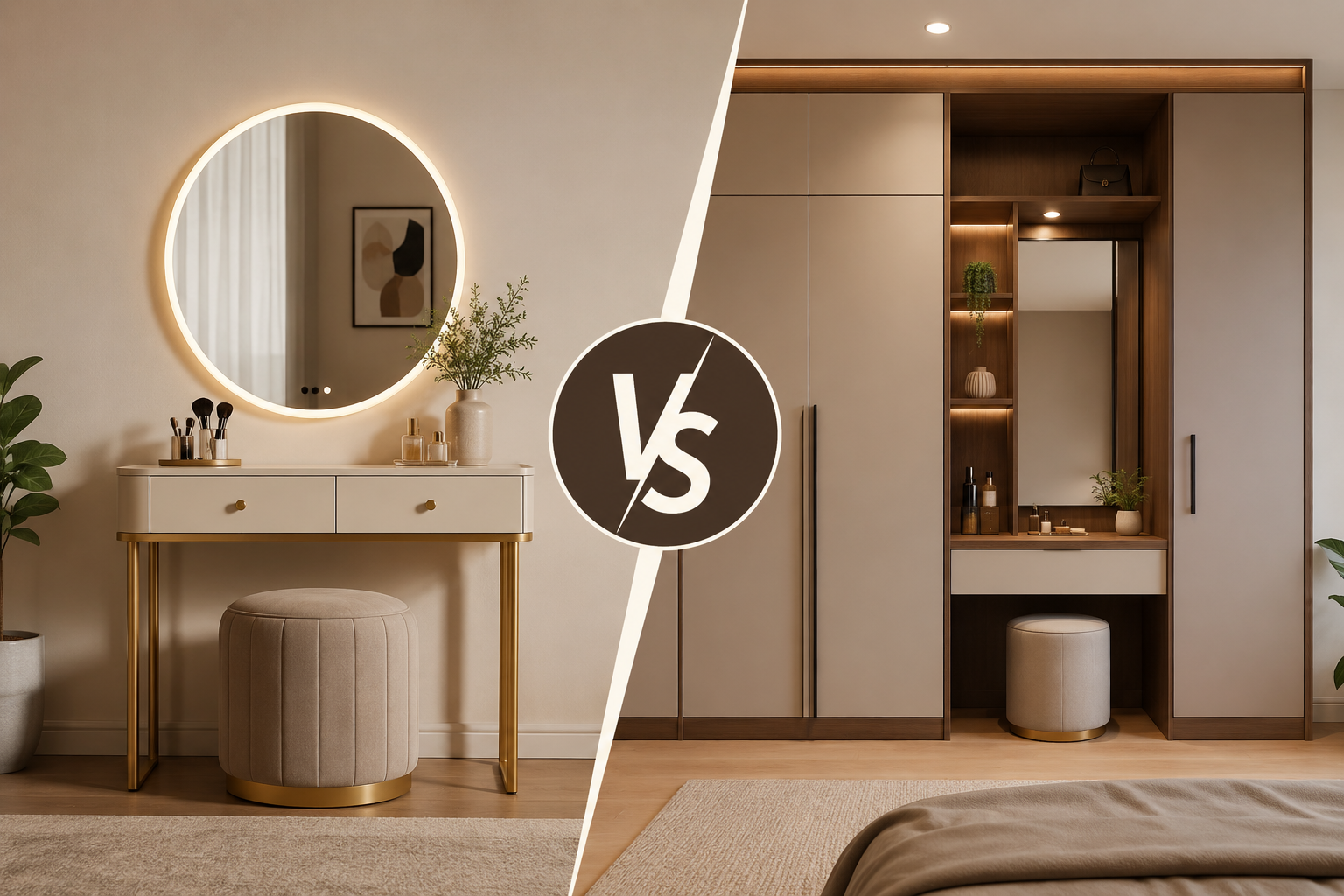
Dressing table vs wardrobe dressing unit – here’s the short answer: a standalone dressing table is a separate piece of furniture with a mirror and small storage, while a wardrobe dressing unit combines your clothing storage and dressing area into one built-in unit. For bedrooms smaller than 120 sq ft, a built-in dressing wardrobe saves more floor space and keeps the room feeling open. For larger rooms where a dedicated beauty corner is needed, a separate dressing table may work better.
Why This Choice Matters More Than You Think
Picture this: you just moved into a new 2BHK apartment in Dehradun. The bedroom is a decent size, but once the bed goes in, the space gets tighter than you expected. You want a nice place to sit and get ready in the morning – but where does it go? Do you squeeze in a separate dressing table beside the wardrobe? Or do you get a wardrobe with a built-in dressing unit that handles both storage and grooming in one go?
This is a real decision thousands of homeowners face every year, especially in cities like Dehradun where apartments are getting smarter but not necessarily bigger.
At Bhumim, we manufacture and install custom modular wardrobes, bedroom furniture, and complete home furniture solutions across Dehradun, Haridwar, Rishikesh, Roorkee, and Noida. Over the years, we have helped hundreds of families solve exactly this problem – and what works depends on your specific room, lifestyle, and budget.
What Is a Standalone Dressing Table?
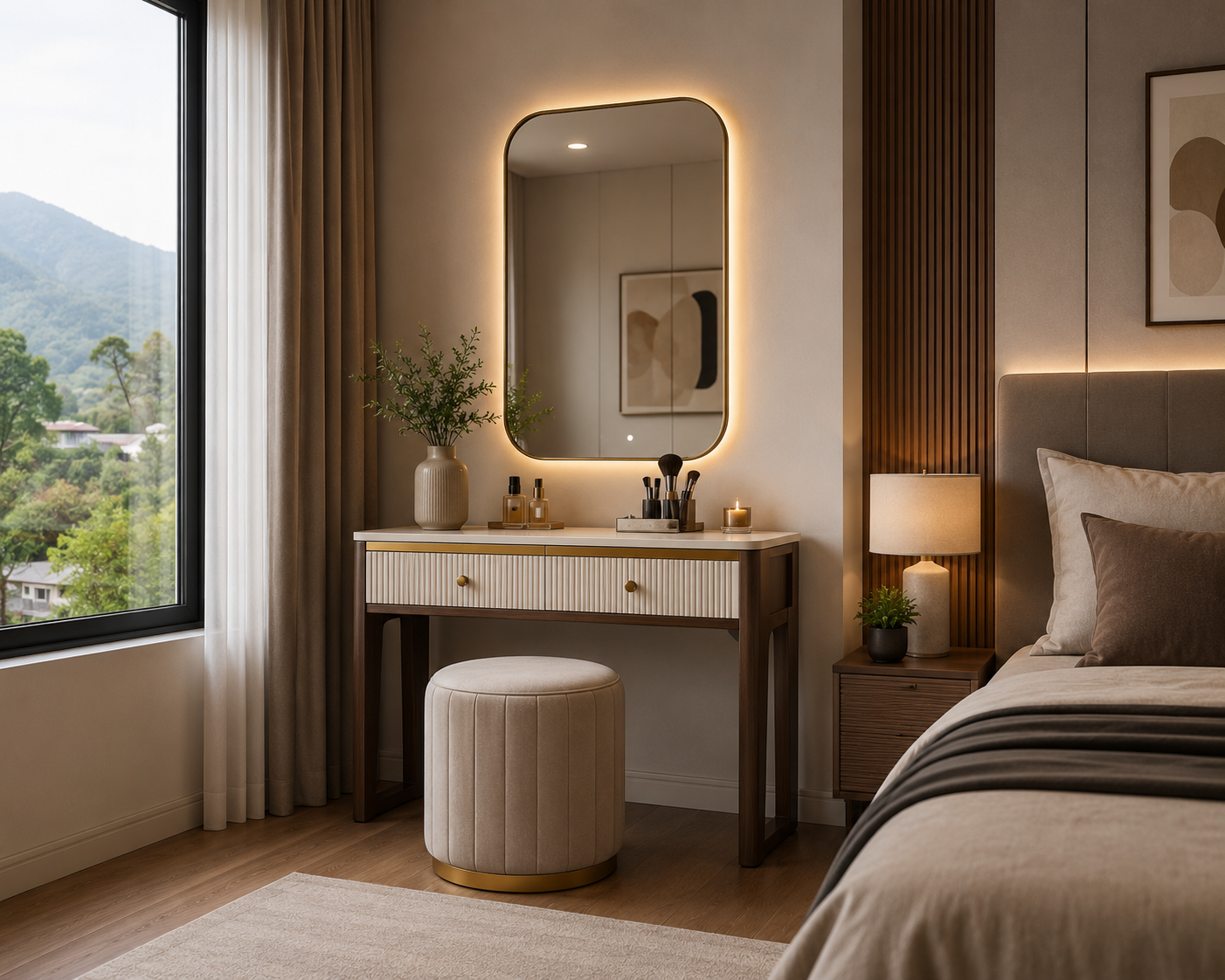
A standalone dressing table is a piece of furniture that sits on its own. It usually has a flat surface to place your cosmetics or grooming items, a mirror on top (either fixed or adjustable), and a few drawers below for storing small things like jewellery, makeup, hairpins, or creams.
How a Traditional Dressing Table Is Used
Most people place a standalone dressing table against a wall in the bedroom – sometimes near a window for natural light, sometimes beside the wardrobe. It comes in many styles: wall-mounted floating designs, classic wooden designs with full-length mirrors, modern minimalist designs with a simple frameless mirror, and vanity-style designs with side lighting.
The key thing here is flexibility. You can shift it around. You can change it without touching your wardrobe. And it works as a dedicated personal space just for getting ready.
The downside? A standalone dressing table takes up floor space on its own. In a small bedroom, that can feel like too much.
What Is a Wardrobe with Built-In Dressing Unit?
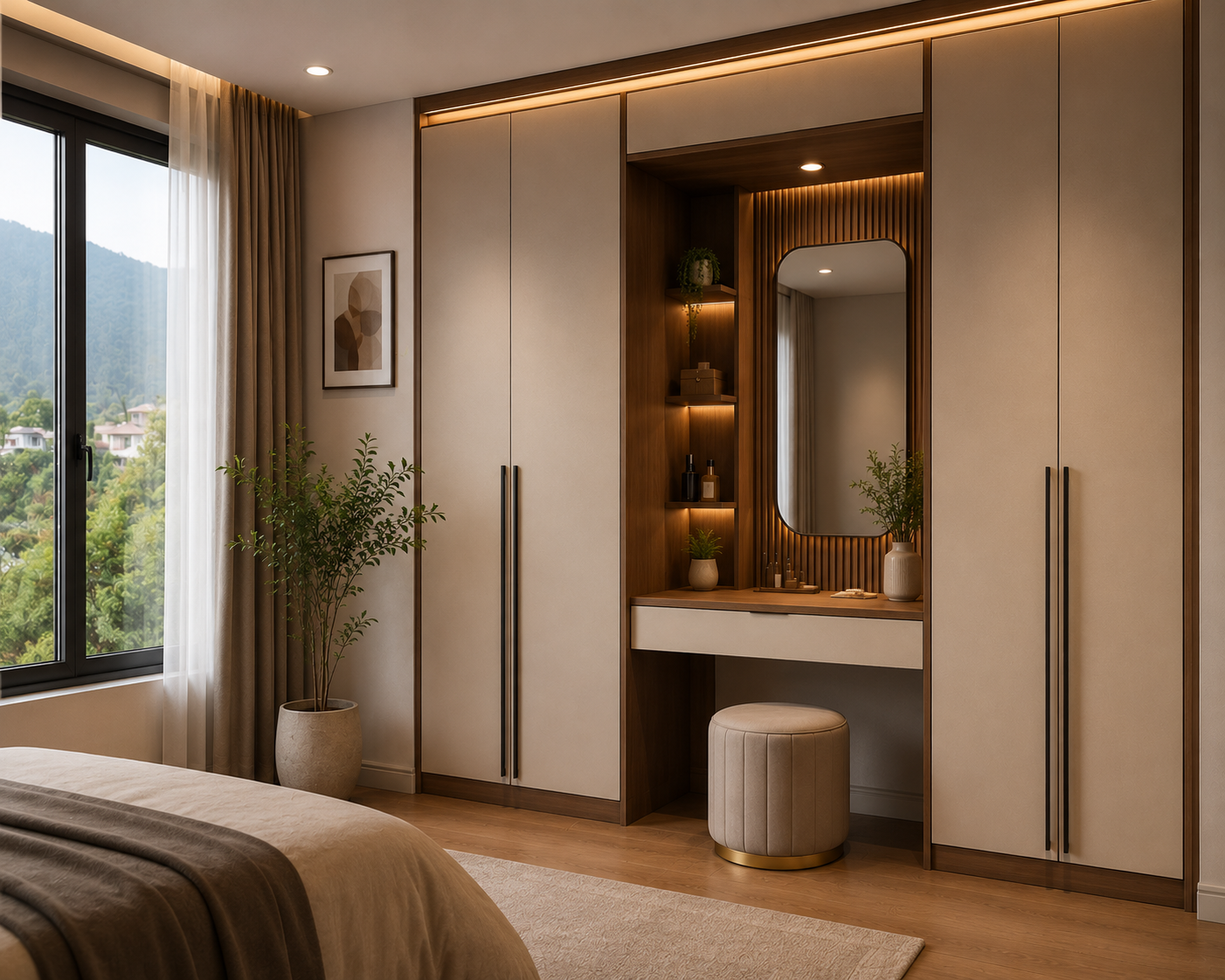
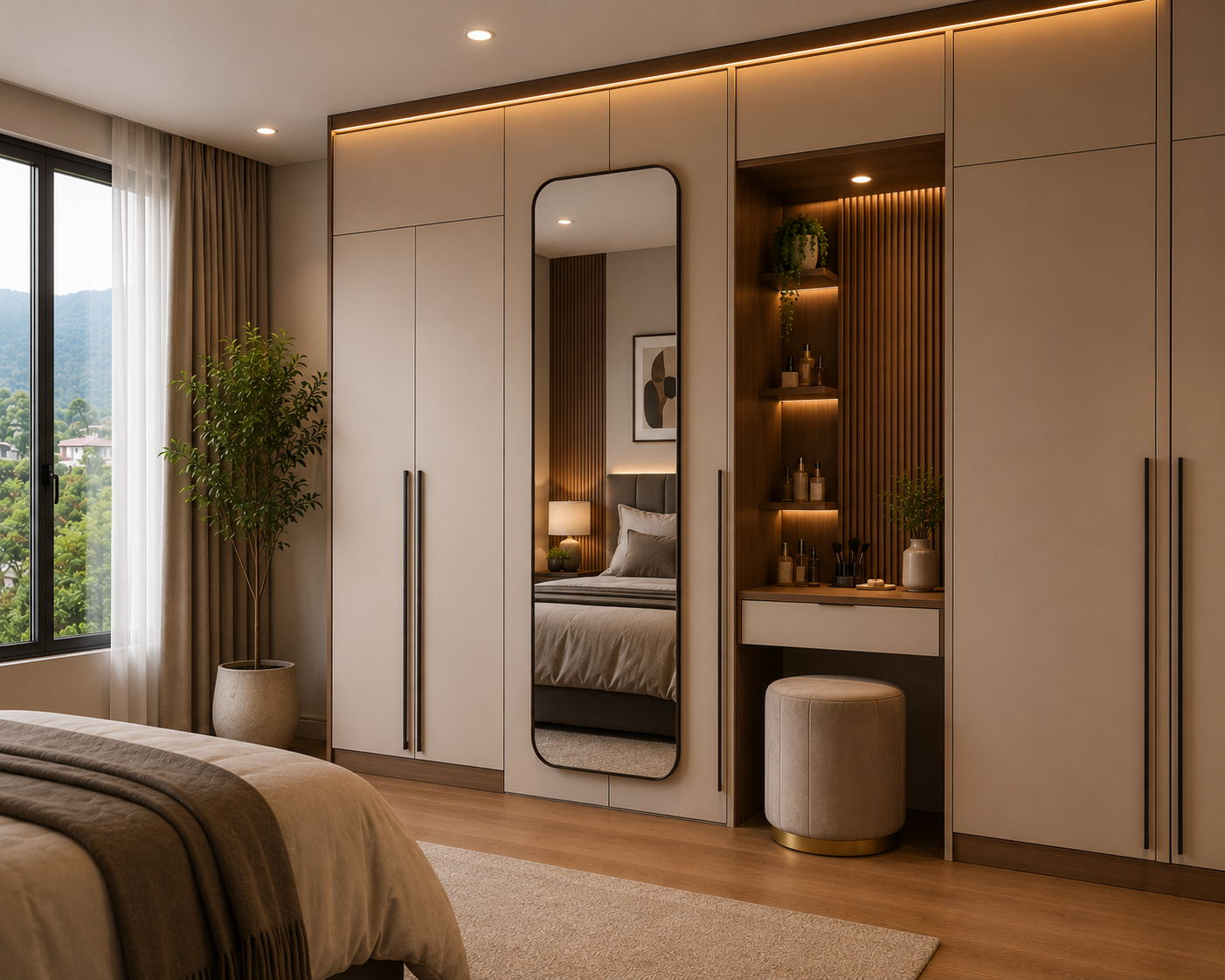
A wardrobe with a built-in dressing unit – also called a built-in dressing wardrobe or integrated dressing unit – combines your full clothing storage with a dressing area in one single structure. Instead of having two separate pieces of furniture, you have one cohesive unit that handles both.
How a Built-In Dressing Wardrobe Works
Imagine a large wardrobe that takes up one full wall. On one side, you have hanging space, shelves, and drawers for clothes. On the other side – or in the centre section – there is a fold-out mirror, a small pull-out surface or fixed shelf, and dedicated small drawers for accessories. Everything in one place.
This is exactly the kind of wardrobe design that Bhumim manufactures and installs for homes across Dehradun and nearby areas. Because everything is custom-built to your wall dimensions, nothing goes to waste.
The big advantage here is space efficiency. You are using the same wall area for both storage and dressing. No extra footprint. No extra furniture to dust.
Get started with Beautiful Homes
For expert design consultation, send us your details and we’ll schedule a call
Dressing Table vs Wardrobe Dressing Unit: A Full Comparison
Here is a clear side-by-side breakdown to help you understand the difference across every major factor.
Space Usage
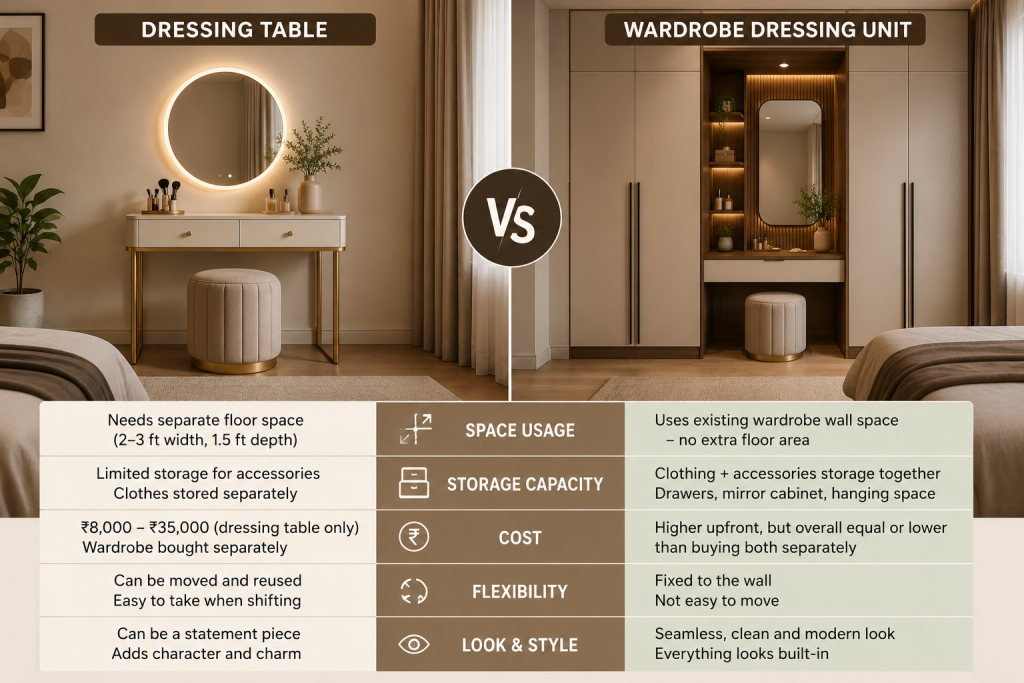
A standalone dressing table needs its own floor space – typically around 2 to 3 feet of width and 1.5 feet of depth. That might not sound like much, but in a bedroom that is already tight after placing the bed, it adds up fast.
A built-in dressing wardrobe uses the wall space you were already going to use for the wardrobe. The dressing section is simply integrated into that same footprint. So effectively, you are getting the dressing area for free from a floor space perspective.
Winner: Built-in dressing wardrobe for small to medium bedrooms.
Storage Capacity
A standalone dressing table offers very limited storage – mostly small drawers for accessories. Your clothes still go in the wardrobe separately.
A wardrobe dressing unit gives you both clothing storage AND accessory storage in one place. You can have a dedicated drawer section for jewellery, a mirror cabinet for skincare, and full hanging space – all together.
Winner: Built-in dressing wardrobe for overall storage.
Cost
A standalone dressing table can cost anywhere from ₹8,000 to ₹35,000 depending on the material and design – and you still need to buy a wardrobe separately.
A custom-built wardrobe with an integrated dressing unit costs more upfront as a single piece, but when you add up what you would spend on both a good wardrobe and a good dressing table, the combined cost of an integrated unit is usually equal or lower – and you get better quality, better fit, and a cleaner look.
Winner: Tie – depends on budget and quality level.
Flexibility and Rearranging
Standalone dressing tables can be moved. If you redecorate or shift to a new home, you take it with you.
A built-in wardrobe dressing unit is fixed to the wall. It is made for that specific room. You cannot easily move it.
Winner: Standalone dressing table for flexibility.
Look and Style
A standalone dressing table can look really beautiful as a statement piece – especially a vintage wooden design or a backlit Hollywood vanity style. It adds character to the room.
A built-in unit looks seamless and clean. No gaps, no awkward corners, no mismatched furniture styles. Everything looks like it belongs together.
Winner: Personal preference – traditional charm vs. modern seamless look.
Which One Saves More Space?
Space is usually the deciding factor – especially in Indian homes where bedroom sizes are often between 100 and 150 sq ft.
Small Bedrooms (Under 120 sq ft)
In a small bedroom, every inch matters. A standalone dressing table will eat into the walking space between the bed and the wall. You will constantly feel cramped. In this case, a wardrobe with a built-in dressing unit is clearly the smarter choice. It keeps the room open and breathing.
Medium Bedrooms (120–180 sq ft)
Here you have a bit more room to play with. A well-placed standalone dressing table beside the window is totally workable. But if you want more wardrobe storage – especially if you are a family with one shared bedroom wardrobe – then a built-in unit still makes more sense.
Large Master Bedrooms (Above 180 sq ft)
With more space, you have real options. Many people in larger homes prefer a standalone dressing table near a window or in a dedicated dressing corner – it feels like a personal retreat. Others go for a full wall wardrobe with integrated dressing area for a high-end, hotel-room feel. Both can work beautifully here.
Check out Bhumim’s guide on bedroom wardrobe storage ideas for more tips on making the most of your bedroom layout.
Mirror Placement: What Actually Works?
The mirror is one of the most important parts of a dressing area – and its placement makes a huge difference.
Mirror in a Standalone Dressing Table
Most standalone dressing tables come with a mirror that sits on the table surface. Some have a single upright mirror, others have a trifold mirror (three panels) that lets you see all angles. The mirror height is usually fixed at seated eye level, which is great for makeup but not ideal for checking your full outfit.
Mirror in a Built-In Dressing Wardrobe
A wardrobe with an integrated dressing unit can include a full-length mirror on the door – which is actually one of the most functional placements possible. You can check your complete outfit from head to toe. Many modern wardrobe designs also include a fold-out or swing-out mirror panel that stays hidden when not needed.
At Bhumim, we often recommend a combination: a large mirror on the wardrobe door for outfit checks, and a smaller focused mirror inside the dressing section for detailed grooming. This setup serves both needs without using extra floor space.
What Works Best for Dehradun Homes?
Dehradun is a unique city. The homes here range from compact apartments in the main city to spacious villas along Rajpur Road and independent houses in areas like Sahastradhara Road, Ballupur, and Dalanwala. The choices for bedroom furniture are not one-size-fits-all here.
Here is what we see working well across different types of homes in Dehradun.
Apartments in Dehradun
Most 2BHK and 3BHK apartments in areas like Jakhan, Vasant Vihar, and Dharampur have bedrooms between 100 and 130 sq ft. Floor space is precious. A built-in wardrobe with an integrated dressing unit is almost always the better call here. It keeps the room from feeling overcrowded and gives you everything in one clean wall unit.
Villas and Independent Homes on Rajpur Road
Homes in this area tend to have larger master bedrooms – often 180 sq ft or more. Here, a separate dressing table or even a dedicated dressing corner with a standalone vanity unit works very well. Some families even create a small walk-in dressing area between the bedroom and bathroom.
Homes in Sahastradhara Road and New Areas
These are often newer constructions with modern layouts. The bedrooms are well-designed but still compact. Custom-built wardrobe dressing units that use every inch of the available wall work best here.
Humidity and Weather Considerations
Dehradun’s climate includes a reasonably humid monsoon season. This matters for materials. MDF (medium-density fibreboard) without a moisture-resistant finish can swell and warp in humid conditions. At Bhumim, we use BWP-grade plywood and moisture-resistant laminates for all bedroom furniture – whether it is a standalone dressing table or a full wardrobe unit. This keeps your furniture looking good and functioning properly even through Dehradun’s wet season.
Family Storage Needs
Indian families typically have a large volume of clothes, sarees, suits, kids’ clothes, seasonal items, and bedding to store. A standalone dressing table does not help with any of this – you still need a large wardrobe alongside it. A well-planned integrated wardrobe dressing unit, on the other hand, handles clothes, accessories, and grooming all in one. That is a real practical advantage for families.
For local Dehradun customers looking at full wardrobe options, explore Bhumim’s wardrobe design ideas for Dehradun homes.
How to Plan Your Bedroom Dressing Area Step by Step
Whether you go with a standalone table or an integrated unit, planning ahead makes a big difference. Here is a simple process to follow.
Step 1: Measure Your Bedroom
Note down the length and width of the room, and the positions of doors, windows, and electrical points. Knowing exactly how much wall space you have will directly guide your decision.
Step 2: Decide on Your Primary Need
Ask yourself: do you need more clothes storage, or do you primarily need a dedicated grooming space? If storage is the bigger concern, go built-in. If you want a personal beauty corner, a standalone unit might feel more satisfying.
Step 3: Choose Your Lighting
Natural light is always best for grooming. If possible, place your dressing area – whether standalone or integrated – near a window. If that is not practical, plan for warm LED strip lighting above the mirror.
Step 4: Think About How You Use the Space
Do you share the bedroom with a partner? Do you need access to the wardrobe and dressing area at the same time every morning? If yes, an integrated unit where both sides can be opened simultaneously makes morning routines much smoother.
Step 5: Pick Your Material and Finish
For Dehradun homes, always choose moisture-resistant materials. Opt for laminate or lacquered MDF, BWP plywood, or PVC board for areas exposed to humidity. Avoid raw MDF or low-grade particle board.
Step 6: Get a Custom Design Made
Standard off-the-shelf furniture rarely fits perfectly. A custom-built unit from Bhumim is made to your exact wall dimensions, maximising every centimetre and matching your bedroom décor perfectly. Contact us to book a free design consultation.
Common Mistakes People Make
Many homeowners make avoidable mistakes when setting up their bedroom dressing area. Here are the most common ones – and how to dodge them.
Buying a dressing table without measuring the room first. It seems obvious, but many people pick a table they love online, and it arrives too big for the space. Always measure before you order.
Placing the dressing table far from natural light. Getting ready in poor light is frustrating. You end up thinking your makeup looks good at home and then stepping out into daylight and realising it does not. Light placement really matters.
Ignoring the mirror size. A small mirror on a dressing table feels restrictive. Go for a larger mirror whenever possible – at least 18 inches wide for a seated vanity mirror, or full-length if using a wardrobe door mirror.
Choosing a material that cannot handle Dehradun’s humidity. Furniture that warps, peels, or swells after one monsoon is a waste of money. Always ask about moisture resistance.
Cramming both a standalone dressing table AND a full wardrobe into a small bedroom. The room ends up feeling like a furniture showroom with no breathing space. In tight bedrooms, always consolidate.
Not planning for storage inside the dressing unit. A flat surface with no drawers or shelves gets cluttered within days. Good bedroom dressing area ideas always include dedicated compartments for makeup, jewellery, and grooming tools.
Expert Tips from the Workshop Floor
After manufacturing and installing hundreds of bedroom wardrobes and dressing units across Dehradun and surrounding regions, here is what our team at Bhumim recommends:
For small bedrooms: Always go for a built-in dressing wardrobe. Use a fold-out mirror panel inside the wardrobe so the mirror is hidden when not in use – this keeps the room feeling cleaner.
For couples: Plan two separate zones within the wardrobe – one side for each person. Even if you combine the dressing unit into one shared section, having clearly divided storage reduces daily morning friction significantly.
For those who love the vanity look: You do not have to completely give up on a standalone dressing table feel just because you have a built-in unit. A well-designed dressing section inside a wardrobe can be fitted with a backlit mirror, a padded stool, and drawer dividers that feel just as luxurious as a separate vanity table.
On material: We always recommend 18mm BWP plywood for the carcase (the main body of the wardrobe or unit) and a durable laminate or PU finish for the exterior. For the dressing shelf surface, a scratch-resistant laminate works well – it is easy to clean and holds up to daily use.
On hardware: Soft-close drawer channels and hinges are worth every extra rupee. When you are getting ready in a hurry every morning, having drawers that glide smoothly – and not slam shut – genuinely improves your day.
For a broader look at how Bhumim’s wardrobe systems work, you can also read our post on hinged vs sliding wardrobes to figure out which door type works best for your bedroom layout.
Benefits and Challenges: A Honest Look
Benefits of a Standalone Dressing Table
- Dedicated personal space purely for grooming
- Can be moved or replaced independently
- Easier to add later if you did not plan for it initially
- Great for creating a classic or vintage bedroom aesthetic
- Works well in large bedrooms where there is enough floor space
Challenges of a Standalone Dressing Table
- Takes up floor space in addition to the wardrobe
- Limited storage – mostly small drawers
- Can look cluttered if not organised regularly
- Quality standalone tables in mid-to-high range can be expensive
- Does not make use of vertical wall space efficiently
Benefits of a Built-In Dressing Wardrobe
- Space-efficient – dressing area uses the same wall footprint as the wardrobe
- More storage overall – clothes, accessories, and grooming items all in one place
- Cleaner, more seamless look in the bedroom
- Custom-built to your room dimensions – no awkward gaps
- Full-length mirror option is very practical
- Better for families with higher storage demands
Challenges of a Built-In Dressing Wardrobe
- Fixed to the wall – cannot be moved easily
- Requires upfront planning and a professional manufacturer
- Higher initial investment compared to a cheap readymade dressing table
- If the internal layout is not planned well, the dressing section can feel cramped
Frequently Asked Questions
Q1: What is the average cost of a wardrobe with a built-in dressing unit in Dehradun?
The cost depends on size, materials, and finish. A basic 6-foot wardrobe with an integrated dressing unit typically starts around ₹45,000 to ₹60,000. Premium custom designs with soft-close hardware, backlit mirrors, and premium laminates can go up to ₹1,20,000 or more. At Bhumim, we offer free consultations and 3D design previews so you know exactly what you are getting before manufacturing begins.
Q2: Can I add a dressing unit to my existing wardrobe?
In some cases, yes – if there is enough internal space inside the wardrobe. However, retrofitting a dressing section into an existing wardrobe is tricky and often ends up looking patchy. Building a new custom unit from scratch usually gives a much better result.
Q3: Which is better for small bedroom dressing area ideas - a wall-mounted dressing table or a built-in wardrobe unit?
For very small bedrooms, a wall-mounted floating dressing table can work if you already have enough wardrobe storage. It saves floor space because it mounts directly to the wall. However, for the best all-round solution in small bedrooms, a wardrobe with an integrated dressing section is more space-efficient overall.
Q4: Does a dressing unit inside a wardrobe affect the clothing storage capacity?
Yes, slightly. The dressing section takes up one portion of the wardrobe – typically one bay of 18 to 24 inches wide. You lose that portion for hanging clothes. However, since the rest of the wardrobe is still fully available, most families find the trade-off very much worth it.
Q5: What is the best material for a dressing table or wardrobe dressing unit in Dehradun's climate?
BWP-grade (boiling water-proof) plywood is the best choice for the main structure in Dehradun’s humid monsoon season. Pair it with a moisture-resistant laminate finish. Avoid raw particle board or low-grade MDF in areas with high humidity.
Q6: How long does it take Bhumim to manufacture and install a custom wardrobe with a dressing unit in Dehradun?
Typically 15 to 21 working days from design finalisation to installation. The process starts with a free home visit for measurements, followed by 3D design approval, manufacturing at our facility, and final installation at your home.
Q7: Is a dressing unit with a built-in wardrobe a good choice for a rented apartment?
Not always. Since it is fixed to the wall, you cannot take it when you move out. For renters, a high-quality standalone dressing table paired with a good free-standing wardrobe is a more practical and portable option.
Q8: What are the best dressing unit design ideas for a master bedroom in Dehradun?
Popular designs include a wardrobe with a central dressing bay featuring a backlit full-length mirror, pull-out drawers with velvet inserts for jewellery, a fold-out surface for cosmetics, and USB charging points built into the unit. All of these are available as custom options through Bhumim.
Key Takeaways
- Dressing table vs wardrobe dressing unit – the right answer depends on your bedroom size, lifestyle, and storage needs.
- For small bedrooms under 120 sq ft, a built-in wardrobe dressing unit is almost always the better choice – it saves floor space and gives you more overall storage.
- For large master bedrooms, a standalone dressing table can work beautifully – especially if you want a dedicated personal grooming corner.
- Mirror placement matters – a full-length wardrobe door mirror is more practical than a small tabletop mirror for complete outfit checks.
- Dehradun’s humid climate means you should always choose moisture-resistant materials like BWP plywood and sealed laminates.
- A custom-built unit from Bhumim fits your exact wall dimensions and avoids the wasted space and poor fit that comes with ready-made furniture.
- Family storage needs – for Indian families with large wardrobes, an integrated dressing wardrobe handles everything in one place far more efficiently.
- Common mistakes – not measuring the room, ignoring humidity, and cramming too much furniture into a small room are the biggest errors to avoid.
Conclusion
Choosing between a dressing table and a wardrobe dressing unit is not just about aesthetics – it is about making your bedroom work properly for your life every single day.
If your bedroom is compact, a built-in dressing wardrobe is one of the smartest investments you can make. If your bedroom is large and you love the idea of a dedicated vanity corner, a beautiful standalone dressing table gives you that personal space. And in many larger homes, the best solution is actually a combination – a large wardrobe for all storage with a dedicated vanity-style dressing table in a corner near the window.
At Bhumim, we do not sell standard off-the-shelf furniture. We design, manufacture, and install custom modular furniture that is made for your specific home – measuring every centimetre, every wall, every nook. Whether you need a sleek built-in wardrobe with a fully equipped dressing section, or you want a standalone vanity unit that stands out in your master bedroom, we build it from scratch to match your space, style, and budget.
We serve homeowners across Dehradun, Haridwar, Rishikesh, Roorkee, Noida, and surrounding areas – and every project starts with a free home visit and a detailed 3D design.
Ready to plan your perfect bedroom dressing area? Book a free consultation with Bhumim today.
About This Article
Published by: Bhumim India Private Limited-Modular Kitchen Manufacturer & Installer, Dehradun
GST: 05AAOCB1784F1ZM | ISO 9001:2015 Certified
Service Areas: Dehradun · Haridwar · Rishikesh · Roorkee · Noida · Ghaziabad
Contact: 08044630777 | hello@bhumim.com
Note: This article is written from Bhumim’s on-ground manufacturing and installation experience. All material recommendations are based on what we use in real kitchens across our service areas.