

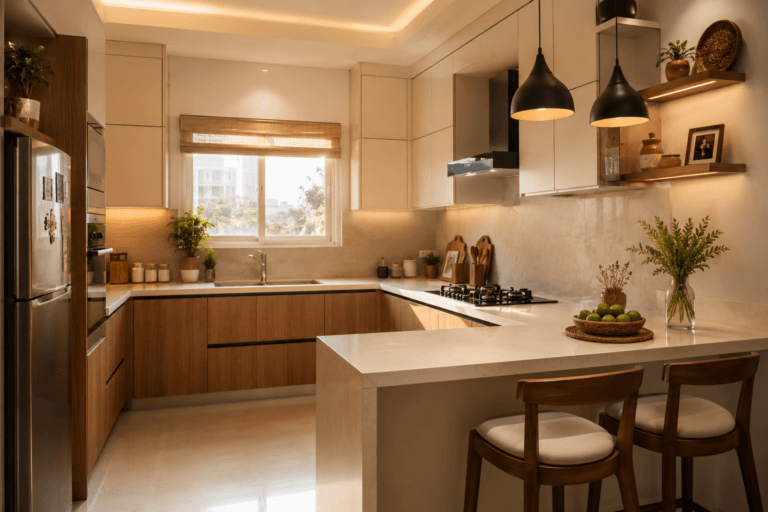
Modular Kitchen Design
Western Kitchen Design for Indian Homes | Warm & Timeless
Plan a western kitchen design that is warm, timeless, and built for real Indian cooking-layouts, materials, colors, and city-specific tips.
July 25, 2026
Picture a flat where the stove is indoors, but the best light, breeze and view are on the balcony. Many people in that spot want to brew chai outside, grow a few herbs or cook a weekend meal there. The balcony can support it, if you plan it right.
Whether you want a barbecue corner, a modular counter for morning chai, or a full herb-garden-and-cooking nook, the choice depends on your balcony width, your climate and how you cook.
Balcony kitchen ideas are practical setups that turn a home balcony into a functional cooking, dining, or food-prep space. For Indian apartments, the best approaches combine weather-resistant storage, compact cooking equipment, vertical herb gardens, and smart layouts that work in 40–80 sq ft-without permanently altering the balcony structure.
This guide covers seven ideas for Indian homes, with attention to climate, space constraints, and the specific way Indian households cook.
Indian balconies are already closer to functional utility spaces than purely decorative ones. Most apartments above a certain size in Dehradun, Noida, or Ghaziabad come with a kitchen-adjacent balcony-sometimes called a dry balcony-already built into the daily cooking rhythm. It holds the washing machine, the drying rack, or extra pantry overflow. The shift from utility zone to kitchen extension is smaller than it seems.
Furthermore, the Indian climate has one useful property: most cities enjoy several months of comfortable outdoor weather. Dehradun’s cool winters and mild summers mean the balcony is usable almost year-round. Even Noida and Ghaziabad-with harsh May–June heat-become ideal balcony cooking spots from October through March.
Before picking your setup, it helps to look at modular kitchen layouts-several of these adapt directly to compact balcony counters, because the planning logic is identical: maximize function in a defined footprint.
For expert design consultation, send us your details and we’ll schedule a call
Three factors determine whether your balcony kitchen idea succeeds long-term or turns into a maintenance headache within one monsoon season.
Standard plywood or MDF cabinetry will swell and delaminate if your balcony is semi-open or receives even occasional rain splash. For balcony counters and storage, WPC (Wood Plastic Composite) boards or marine plywood (BWP-grade, IS:710) are the right choices-both handle humidity without warping. Stainless steel shelving works well too, especially for fully open balconies.
If you plan to use a gas stove or induction cooktop on the balcony, ensure there is at least one open side for air circulation. Cooking smoke trapped between a wall and an awning builds up surprisingly fast. For full outdoor cooking setups, a compact chimney hood mounted against the wall resolves this cleanly.
Balcony load limits vary by building, so ask your builder or society for the rated load before you add base cabinets, a stone countertop and appliances. If you rent, confirm whether permanent fixtures are permitted-most of the ideas below are semi-permanent or fully removable.
The simplest and most practical balcony kitchen idea is a single-wall counter running along one side-usually 4–6 feet long and 24 inches deep. This setup fits most Indian balconies without eating into the walking area.
Place an induction cooktop at one end, a compact single-basin sink in the middle if your balcony has a water point, and a two-shelf storage unit at the other end for utensils, spices, and a cutting board rack. Keep the counter at standard kitchen height (34 inches) for a comfortable cooking posture.
The counter material matters a great deal here. WPC shutters with an 18mm BWP plywood carcass hold up through monsoon far better than standard laminates. For a polished finish without the maintenance worry, a quartz countertop resists heat, stains, and humidity equally well.
Expert Tip: Keep the induction cooktop on a pull-out platform rather than flush-mounted if space is tight. That way, it stores away when not in use and the counter doubles as a prep and serving surface.
Even a 3-foot section of balcony can hold enough fresh herbs to transform everyday cooking. This is the most popular balcony kitchen idea for Indian homes-for good reason. Fresh tulsi, pudina, dhaniya, curry patta, and green chillies growing ten feet from the stove cut both grocery runs and food waste significantly.
Set up vertical wall planters in a tiered system-three rows stacked between two and five feet height capture morning sun without blocking the balcony view. Use grow bags for tomatoes and methi at floor level. A wall-mounted drip irrigation strip connected to the kitchen tap keeps watering effort close to zero.
The garden creates a daily reason to step outside.
A question that comes up often among Indian homeowners: “My balcony only gets 3-4 hours of direct sun-can I still grow kitchen herbs?” Yes. Mint, coriander, curry leaves, and spinach do well in partial shade. Basil and tomatoes, however, need six or more hours of sun-skip those in north-facing or shaded balconies.
For those who want occasional outdoor cooking without a permanent setup, a dedicated grill corner is the practical answer. Position a compact tabletop BBQ grill or charcoal kettle grill near the balcony railing-at least 18 inches away from any wall or surface. A fold-out side table handles prep and plating.
In North Indian cities like Dehradun and Haridwar, winters from November to February are ideal for balcony barbecue evenings. The enclosed courtyard-style balconies common in Uttarakhand housing blocks retain warmth while still letting smoke escape upward through the open railing.
This setup works best when the balcony has a metal or glass railing rather than a solid parapet, since open-railing enclosures allow heat and smoke to dissipate naturally.
When this idea is NOT the right fit: If your balcony is fully enclosed with sliding glass panels-common in Noida and Ghaziabad high-rises-avoid charcoal or gas grills inside the enclosure entirely. Carbon monoxide buildup in closed spaces is a serious safety risk. For fully enclosed balconies, induction cooktops are the only safe choice.
Not every balcony kitchen idea needs to involve full-scale cooking. A chai and breakfast station-a narrow 18-inch deep counter with an electric kettle, a toaster, a compact induction plate, and sealed canisters for tea, coffee, and sugar-turns the balcony into a meaningful morning ritual space.
Pair this with a foldable bistro table and two chairs, and the balcony becomes a proper outdoor café. This setup needs no plumbing, costs far less than a full counter installation, and is completely removable-making it ideal for rented apartments where permanent fixtures are not permitted.
For the storage unit, a slim wall-mounted cabinet in WPC or powder-coated aluminium keeps everything organised. Blum soft-close hinges on cabinet doors reduce the daily wear that degrades standard balcony furniture.
Many Indian apartments have a dry balcony directly off the kitchen-a narrow 3–5 foot utility strip that typically holds the washing machine and cleaning supplies. With smart planning, this space can handle both its utility function and a small food-prep extension simultaneously.
The key is vertical zoning. Keep the washing machine and utility items at the lower level-floor to 30 inches. Add a waterproof counter at 34 inches for food prep. Use pull-out shelves above that for pantry overflow-dry ingredients, pickle jars, pressure cookers. A sliding partition between the utility zone and the prep zone keeps the two visually separate when guests are around.
A concern that surfaces regularly on Indian home forums: “If I use my dry balcony for cooking prep, won’t it smell and attract pests?” Sealed storage units, a covered drain trap, and a weekly wipe-down with diluted phenyl solution handle both problems. The rule is simple: never leave food waste or open containers on the balcony overnight.
For layouts that squeeze the most out of tight kitchen spaces, the small kitchen design guide covers several configurations that translate directly to compact balcony counters.
If your balcony is wider than 8 feet-common in ground-floor apartments, independent floor units, and most Dehradun hillside homes-a small island-style setup opens things up considerably. A central island counter roughly 4 feet by 2 feet provides a 360-degree working surface that suits family cooking, where two people can work side by side without collision.
Place the cooking appliance on one side of the island and the prep and plating area on the other. Wall-mounted storage racks around the balcony perimeter keep everything within reach without cluttering the island surface.
This layout borrows directly from island kitchen design principles; the same logic of creating a social, multi-person cooking hub applies whether the island is indoors or on an open balcony.
The most complete option is a proper modular kitchen unit designed for semi-outdoor use-built with WPC or stainless steel carcasses, weather-rated hardware (ask for stainless-steel or weather-rated fittings from an approved brand such as Hafele), and a compact chimney hood where the balcony wall permits installation.
This setup functions as a true second kitchen. It handles light Indian cooking-chaas, dals, quick stir-fries, eggs, parathas-without sending every cooking smell back into the main living area. Because the construction is modular, each unit is replaceable independently if one section gets damaged, which is a significant advantage over carpenter-built balcony counters.
Ask Bhumim which compact configurations it can build for your balcony width. The end-to-end process-design consultation, 3D visualisation, manufacturing, and installation-means the unit is built to your exact balcony dimensions rather than adapted from a standard indoor size.
If you are in Dehradun, Noida, Rishikesh, Roorkee, or Haridwar and want a proper balcony kitchen installation, book a free design consultation here.
Use this quick decision guide based on balcony width and intended use:
Balcony Type | Best Idea | Why It Works |
Narrow dry balcony (under 4 ft) | Idea 5: Dry Balcony Makeover | Vertical zoning solves the narrow-width problem |
Standard apartment balcony (4–6 ft) | Ideas 1 + 2: Counter + Herb Garden | Most flexible, highest daily-use combination |
Fully enclosed glass balcony | Idea 4: Chai Station | Safe with induction; no combustion risk |
Wide balcony or independent floor (8+ ft) | Idea 6 or 7: Island or Full Modular | Space supports true kitchen function |
Rented apartment | Ideas 3 + 4: Grill Corner or Chai Station | No permanent fixtures needed |
Material selection is where most balcony kitchen projects either last a decade or fall apart by the second monsoon. Here is what works and what doesn’t.
WPC (Wood Plastic Composite) is the standout choice for cabinet shutters and panels in any semi-open or rain-exposed balcony. It does not absorb water, does not swell, and holds colour even with regular sun exposure. It is heavier than plywood but tends to outlast it in humid conditions.
BWP-grade marine plywood (IS:710) is the right carcass material. This grade is specifically rated for boiling water resistance, meaning it holds structural integrity even with regular moisture contact. Standard commercial plywood (IS:303) will delaminate in one to two monsoon seasons in a semi-open balcony-regardless of what laminate finish covers it.
Stainless steel shelving is maintenance-free and the most durable surface for fully open balconies. Less decorative, but completely practical for a utility-forward setup.
What to avoid without exception: MDF, particle board, or HDF in any position exposed to rain or consistent moisture. These materials absorb water rapidly, expand internally, and lose structural integrity-the laminate finish does not protect the core.
For colour choices that hold up in high-light outdoor environments, the modular kitchen color combination guide has finish recommendations suited to kitchens that receive strong direct sunlight.
Yes, in most apartments, provided you use weather-resistant materials such as WPC or BWP-grade marine plywood, plan ventilation for any heat source, and stay within the balcony’s load limit. Compact modular counters, induction cooktops and vertical herb gardens are the most practical starting points. Check your society rules and ask your builder for the rated load first.
A dry balcony is a utility balcony attached to the kitchen, usually used for the washing machine, cleaning supplies and clothes drying. A kitchen balcony is any balcony converted or designed for cooking, food prep, dining or herb growing. Many homeowners turn part of a dry balcony into a prep zone and use vertical zoning to keep the two areas separate.
A gas stove is safe on a semi-open balcony with at least one open side for ventilation. It is not safe inside a fully enclosed glass balcony without a proper exhaust system, because carbon monoxide can build up in closed spaces. For fully enclosed balconies, an induction cooktop is the correct and safe choice.
WPC for cabinet shutters and BWP-grade marine plywood (IS:710) for the carcass are two reliable choices for balcony kitchen cabinetry in India. Both resist moisture better than standard board. Avoid MDF, standard commercial plywood or particle board in any outdoor or semi-outdoor position, since the laminate finish does not protect the core from water.
A single-wall balcony counter needs a minimum of about 4 feet in length and 18 to 24 inches in depth, with at least 36 inches of clear walking space in front. Most apartment balconies between 4 and 6 feet wide can take this layout. Measure the clear width after the railing and any drain before you choose a counter.
Yes. Mint, coriander, curry leaves and green chillies do well with as little as 3 to 4 hours of direct sunlight a day. Use grow bags or vertical wall planters to save floor space. Tomatoes and basil need 6 or more hours of sun, so skip them on north-facing or heavily shaded balconies.
A chai station or a grill corner suits a rented flat, because neither needs a permanent fixture. A chai station is a narrow counter with a kettle and an induction plate, and a grill corner is a tabletop grill with a fold-out side table. Confirm with your landlord whether any permanent fixture is allowed before you drill into walls.
Check two things first: your landlord, if you rent, and your society or builder rules on balcony use and load. Permanent counters, plumbing and gas lines are usually more restricted than removable setups. A removable chai station or herb garden rarely needs approval. Get any permission in writing before you order cabinets or start fitting.
Call or WhatsApp Bhumim at 08044630777, or fill in your details at bhumim.com/contact. Share your balcony width, its exposure to rain and sun, and the idea you like, and the team shows the plan in a free 3D design, typically within 3 to 7 days.
The most common mistake with balcony kitchen ideas is one of two extremes: doing too little-a portable stove on a plastic rack that collapses by the third monsoon-or overbuilding with materials that cannot handle outdoor exposure.
Start with one idea that matches your current balcony width and lifestyle. A herb garden combined with a compact counter can change how you use the space within a few weeks. If the setup works for you, it is straightforward to expand toward a fully modular balcony kitchen over time.
A small start, such as a 5-foot WPC counter with an induction plate and a wall-mounted herb garden, is often enough to change how a balcony gets used.
If you want a balcony kitchen designed and installed the right way-with proper materials, custom dimensions, and end-to-end support-speak to Bhumim’s design team for a free consultation. We work across Dehradun, Noida, Ghaziabad, Haridwar, Rishikesh, and Roorkee.
Published by: Bhumim India Private Limited-Modular Kitchen Manufacturer & Installer, Dehradun
GST: 05AAOCB1784F1ZM | ISO 9001:2015 Certified
Service Areas: Dehradun · Haridwar · Rishikesh · Roorkee · Noida · Ghaziabad
Contact: 08044630777 | hello@bhumim.com
Note: This article is written from Bhumim’s on-ground manufacturing and installation experience. All material recommendations are based on what we use in real kitchens across our service areas.
Plan a western kitchen design that is warm, timeless, and built for real Indian cooking-layouts, materials, colors, and city-specific tips.
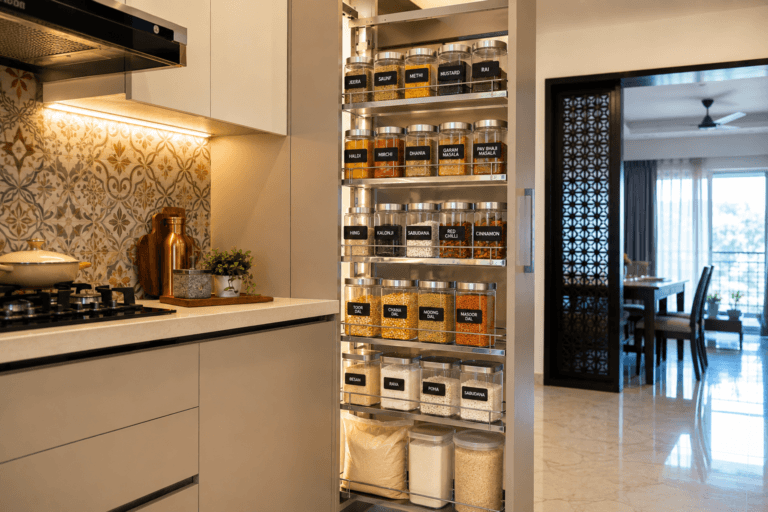
Pantry unit for modular kitchens: 5 types, sizes from 150 to 600 mm, materials and price ranges for Dehradun, Noida and Ghaziabad homes.
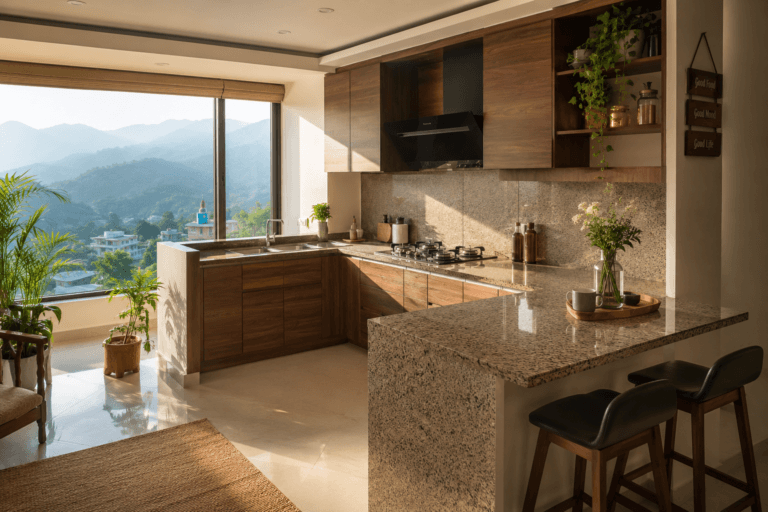
Upgrade your kitchen design with the best breakfast counter ideas for Indian homes. Layouts, dimensions, materials & costs for Dehradun.