

Kitchen Pantry Units That Save Space: The Complete Indian Homeowner's Guide
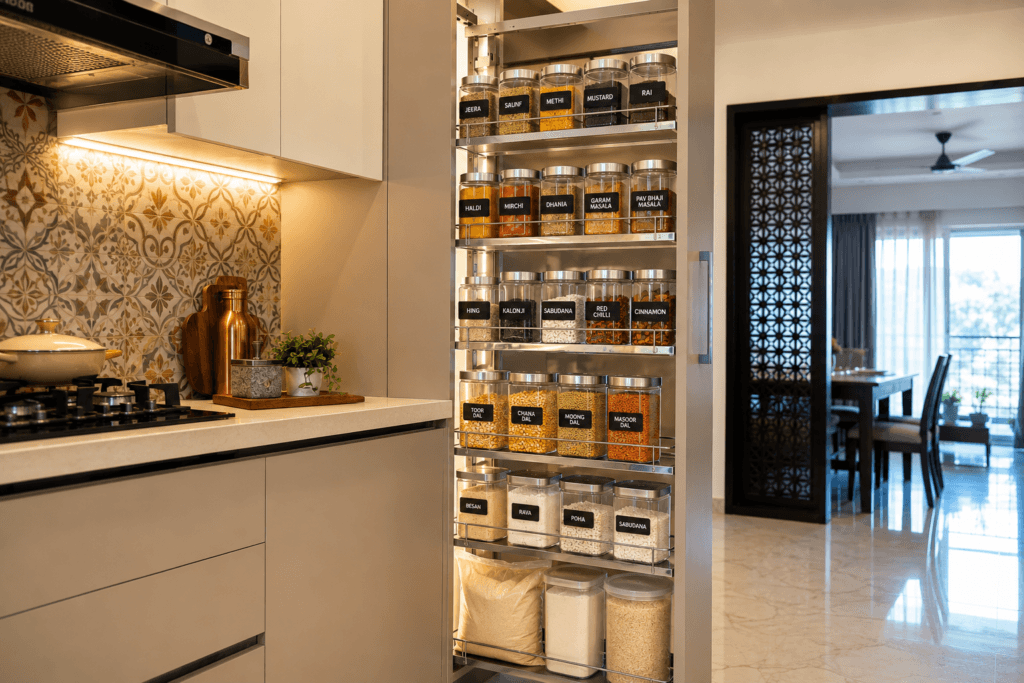
Kitchen pantry units that save space are vertical modular storage cabinets- from 150 mm to 600 mm wide- built with pull-out runners, swing racks, or tandem drawer systems to consolidate groceries, spices, oils, and dry foods into one accessible, organised zone. In a 60–100 sq ft Indian apartment kitchen, a well-chosen pantry tall unit replaces up to three horizontal under-counter cabinets while using a fraction of the floor space.
The Pantry Problem Most Indian Kitchens Never Solve
After installing modular kitchens across Dehradun, Haridwar, Noida, and Ghaziabad, the single storage question we get most consistently is this: “Where do I put the flour bags, the dal containers, the seven masala jars, the mustard oil tin, and the two spare packets of chivda-and still find everything in under ten seconds?”
The answer is almost always the same. Not a bigger kitchen. Not more cabinets. A dedicated pantry unit-designed correctly, with the right mechanism and the right material for where you live.
But here’s what most kitchen guides won’t tell you: the pantry unit that works beautifully in a western kitchen photographed for an international blog is completely wrong for a 70-sq-ft apartment kitchen in Noida Sector 78, or a hill-facing flat in Rajpur Road, Dehradun. Wrong width. Wrong mechanism. Wrong material for the climate. And no provision for the heavy-duty Indian grocery storage that comes with cooking three meals a day.
This guide fixes that. It covers every type of kitchen pantry unit that saves space-with real dimensions, actual load capacities, hardware brands with honest pricing in INR, and city-specific advice for Uttarakhand and Delhi-NCR. Whether you are designing a full modular kitchen from scratch or retrofitting a pantry into an existing layout, you will find a specific answer here, not a generic list.
Why Every Modern Indian Kitchen Needs a Dedicated Pantry Unit
The Micro-Kitchen Challenge in Indian Apartments
The average kitchen in a 2BHK or 3BHK flat in Delhi-NCR measures between 60 and 110 sq ft. In Noida’s Sector 75, 78, and 137 high-rise buildings, compact floor plans push that number further down-sometimes to 55 sq ft. In Dehradun’s newer apartment clusters along Sahastradhara Road and IT Park, kitchens land in the 65–85 sq ft range.
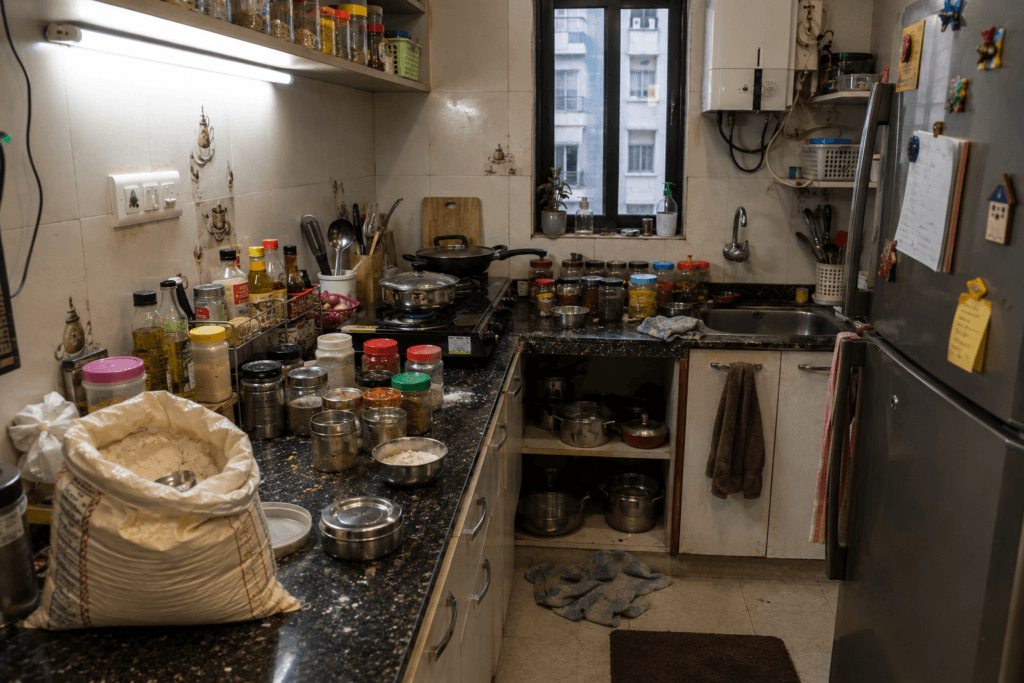
That is not a lot of room to store what an Indian household actually needs: four or five different dals, rice, atta, poha, two or three cooking oils, fifteen to twenty masalas, sugar, salt, snack boxes, pickle jars, and the seasonal additions that arrive during Diwali or Holi. Traditional under-counter cabinetry, where you reach into the back of a deep cabinet and hope for the best, was never designed for this.
The result is what most homeowners end up with: countertops that become permanent storage zones, cabinets that nobody wants to open because everything will fall out, and spice racks that breed clutter rather than control it.
A dedicated pantry unit changes that equation completely.
Vertical vs Horizontal Storage: Why Tall Units Win
Think of it this way: a standard base cabinet is 550mm deep, 600mm wide, and 720mm tall. It gives you roughly 0.24 cubic metres of usable storage-and most of that back half is a graveyard for items you forgot you owned.
A tall pantry unit, by contrast, uses the full ceiling height-typically 1950mm to 2150mm-in a footprint of just 450mm to 600mm. That single unit holds 3 to 4 times the accessible storage volume of an under-counter cabinet. In a kitchen where floor space is the scarcest resource, going vertical is not a design preference; it is a practical necessity.
According to the experts, interior designers, vertical wall-space utilisation through tall units can improve storage efficiency by up to 300% compared to traditional horizontal under-counter cabinetry in 60–100 sq ft kitchens.
What Indian Cooking Actually Puts in a Pantry
A pantry unit for Indian cooking needs to handle a very specific load profile. Consider what a typical family keeps:
- 5–10 kg flour bag (atta), 5 kg rice container, 2–3 kg sugar-these are heavy base items
- 15–20 masala tins or jars, tea, coffee, sugar packets-these are daily-reach items at eye level
- Mustard oil tin (15L or 5L), extra cooking oil-these are bulky and slippery
- 3–4 different dals in large containers-medium weight, medium frequency
- Snack packets, biscuits, dry fruits, instant noodles-light, frequently changing
A pull-out pantry that treats all these the same-one wire basket per tier, all at the same depth-will fail. A well-designed pantry zones them: heavy items at the bottom, daily items at eye level, occasional bulk at the top or the back. This guide walks through exactly how to do that in Section 6.
Get started with Beautiful Homes
For expert design consultation, send us your details and we’ll schedule a call
Five Types of Space-Saving Kitchen Pantry Units (With Dimensions)
Not all pantry units are the same. The mechanism, width, and configuration determine whether a unit fits your kitchen layout, your budget, and your actual cooking patterns. Here are the five types you will encounter, with honest pros and cons for each.
Type 1: Slim Pull-Out Pantry (150mm to 300mm Wide)
This is the pantry unit most people forget to plan for-and then kick themselves for missing.
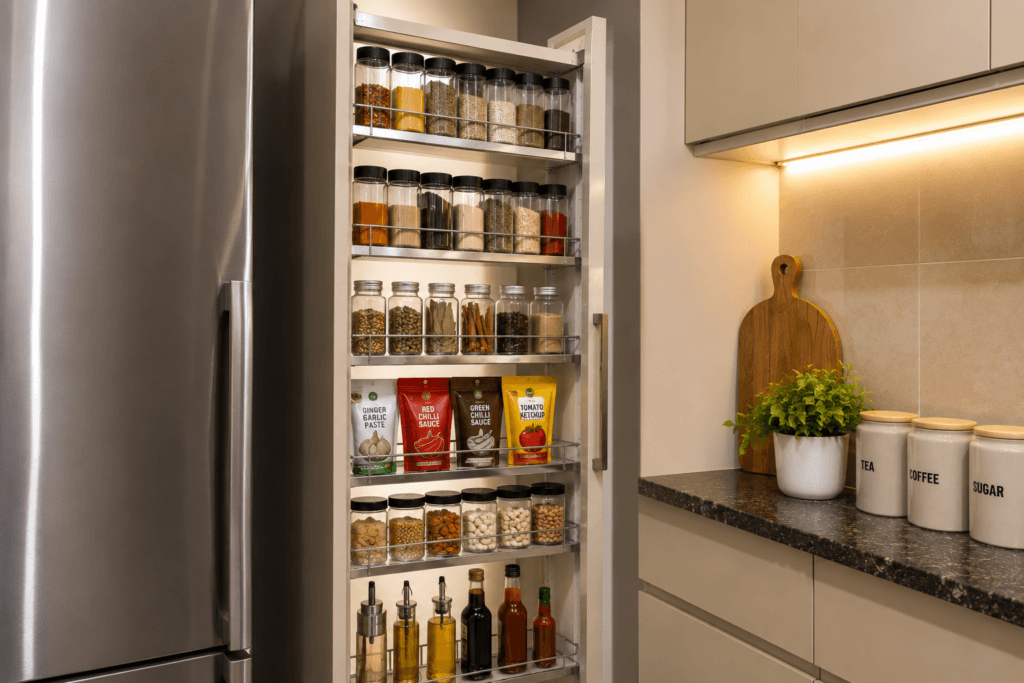
A slim pull-out pantry fits into the narrow dead spaces between a refrigerator and a wall, between a hob cabinet and a door frame, or beside a tall chimney column. These 150mm to 300mm gaps are common in modular kitchen design and usually go to waste.
Inside this unit, a full-extension runner system pulls the internal frame outward, bringing every shelf to you rather than asking you to reach in. Typical configurations hold 6 to 12 tiers of shelves, each 150–300mm wide, making them ideal for spice bottles, sauce packets, oil dispensers, rolled atta bags, and small tins.
Load capacity: 15 kg to 30 kg total, depending on runner grade
Ideal for: Micro-kitchens under 70 sq ft, parallel kitchen corridors, any kitchen with a narrow gap between two units
Hardware cost (branded): ₹3,500 to ₹9,000 for the pull-out mechanism
Pro Tip (from Bhumim installations): The most common mistake with slim pull-outs is ordering them too shallow. The internal frame needs at least 130mm of clear depth inside the carcass. If you are retrofitting into an existing gap, measure the clear internal depth before ordering-not the external gap width.
When a slim pull-out is NOT the right choice: If you need to store large atta bags, 15-litre oil tins, or pressure cookers, this unit is the wrong tool. Move up to a full tall unit or a tandem drawer pantry for heavy, bulky items.
Type 2: Full Tall Swing Larder Unit / Pantry Swing Unit (450mm to 600mm Wide)
This is the star of modular kitchen pantry design-and for good reason.
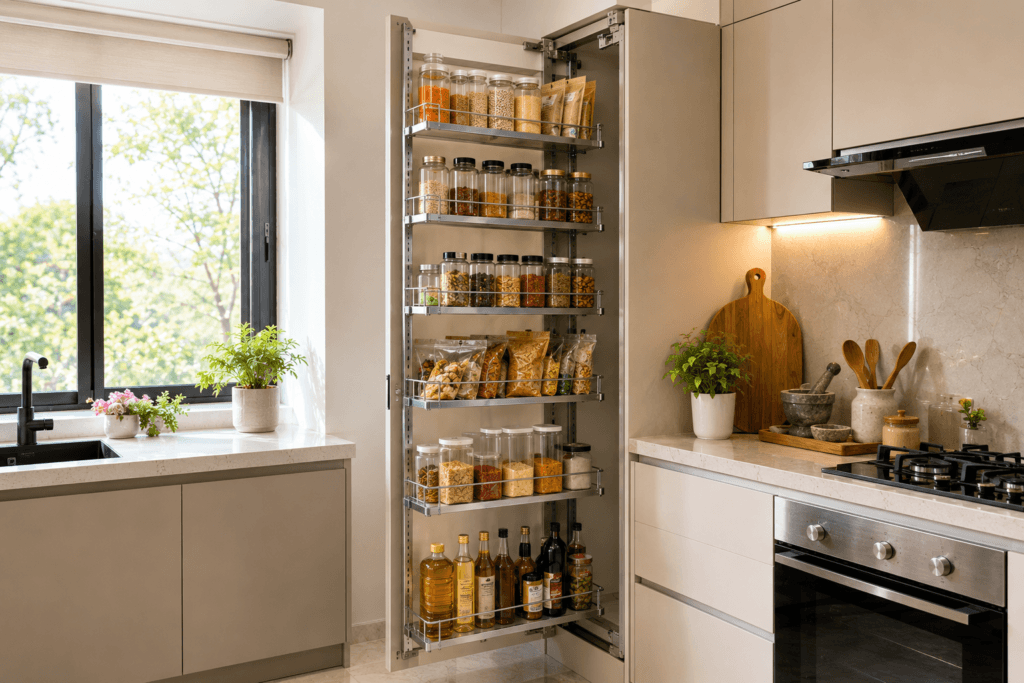
A tall swing larder unit (also called a pantry swing or larder unit) sits inside a full-height cabinet, typically 1850mm to 2150mm tall. When you open the door, the entire internal frame swings outward in a single movement, bringing all shelves-including those at the very back-within easy reach. Nothing stays hidden. Everything presents itself to you.
The mechanism works on a gas spring or rack-and-pinion swing system. On a well-made unit from Hafele (Dispensa series), the swing is smooth, silent, and controlled. On an unbranded local unit, the same action can feel jerky, noisy, and prone to misalignment within 12–18 months.
Dimensions:
- Cabinet width: 450mm or 600mm (match to your module plan)
- Internal depth: 500mm to 550mm (standard to align with base cabinets)
- Height: 1850mm to 2150mm standard; can extend to ceiling with an upper loft unit
Load capacity: 70 kg to 120 kg total for a branded mechanism (Hafele). Generic local mechanisms begin to sag under loads exceeding 25–35 kg.
According to Hafele India’s technical specification manual (2024–2025), the Hafele Dispensa pantry swing mechanism is engineered for a dynamic load of up to 100 kg and rated for more than 50,000 open-close cycles-that is over 13 years of daily use.
Ideal for: Medium to large kitchens (80 sq ft and above), families that bulk-purchase groceries, any kitchen where maximum visibility is the priority. Hardware cost (branded): ₹25,000 to ₹75,000 for the mechanism; total unit with carcass and shutter is ₹45,000 to ₹1,00,000+
The honest trade-off: A full swing larder unit opens outward-which means it needs clear floor space in front of it to swing fully. In a very narrow parallel kitchen corridor (under 1100mm between the two counters), this swing clearance is sometimes impossible. In that case, an inner tandem drawer pantry behind a single shutter is the better answer.
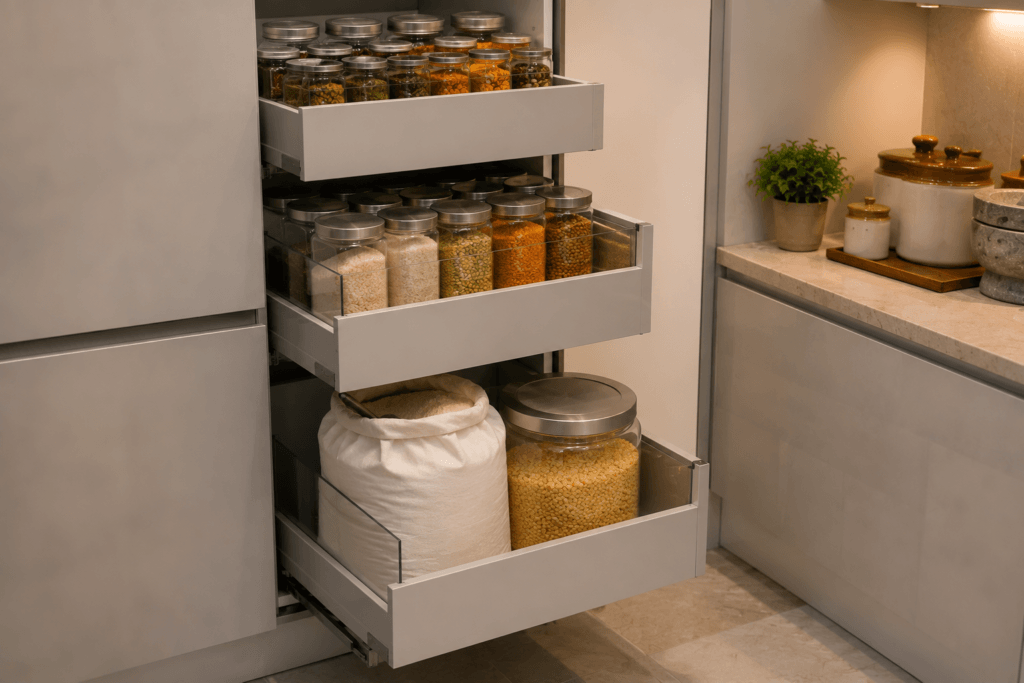
Type 3: Inner Tandem Drawer Pantry (Behind a Single Shutter)
Where the swing larder unit gives you everything at once, an inner tandem drawer pantry gives you control. Behind a single hinged or push-to-open shutter, you get three to four independent tandem drawers-each one pulling out separately on its own full-extension runner.
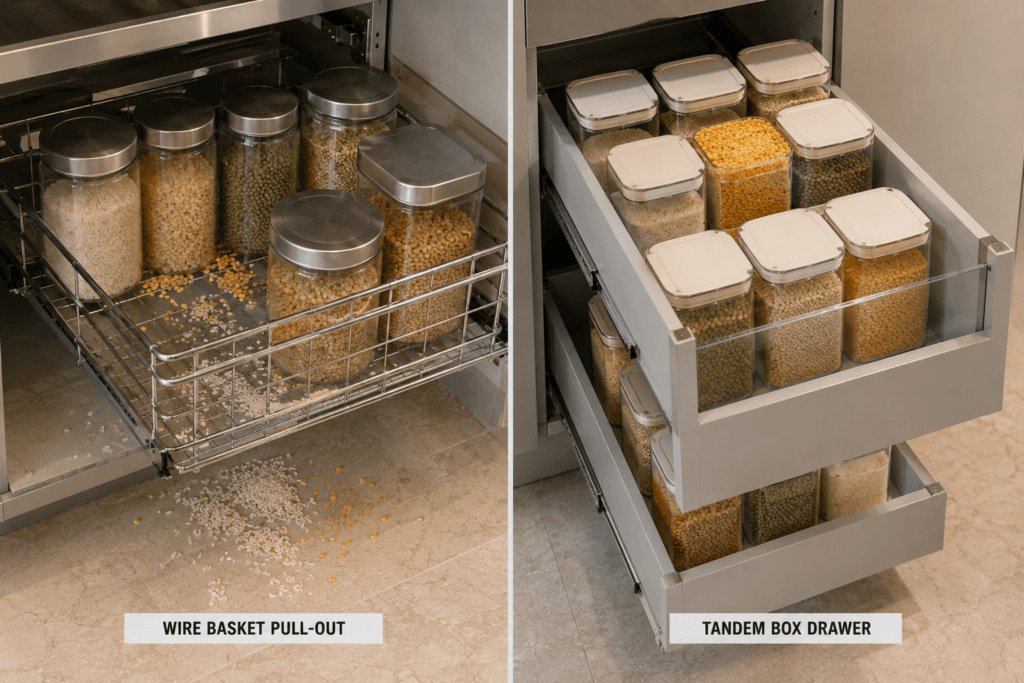
You pull open only the drawer you need. This reduces wear on the mechanism and keeps the rest of your storage undisturbed. Tandem box drawers (solid metal or acrylic-sided, not wire-grid) are also the easiest pantry storage to clean: a spilled lentil or turmeric drip stays in the box and wipes out with a cloth.
This is the option that community users and kitchen renovation forums consistently recommend after they have tried wire-basket pull-outs and had to deal with the cleanup. As one community user described: small grains like rice, moong dal, and cumin fall through the wire grid of a basket pull-out and collect at the bottom of the cabinet, creating a cleaning problem that wire pull-outs were supposed to prevent.
Load capacity: 30 kg to 50 kg per individual drawer, on a Hafele tandem runner. Bottom drawers on heavy-duty runners (Blum Tandembox Antaro) carry even more. Ideal for: Compact and medium kitchens (70–120 sq ft), households that store heavy dry goods (large atta bags, dal containers, jaggery blocks), anyone who prioritises easy daily cleaning. Hardware cost: ₹12,000 to ₹35,000 for a 3-drawer inner tandem set
Common Mistake Alert: Buyers often confuse a “tandem box” with a standard “channel drawer.” A tandem box is a full-wrap drawer with solid sides, a solid base, and a synchronised soft-close runner system on both sides. A standard channel drawer uses a single underside runner. For pantry use with heavy loads, always specify tandem box-not standard channel.
Type 4: Wicker Basket Pantry (Dry Vegetable and Breathable Storage)
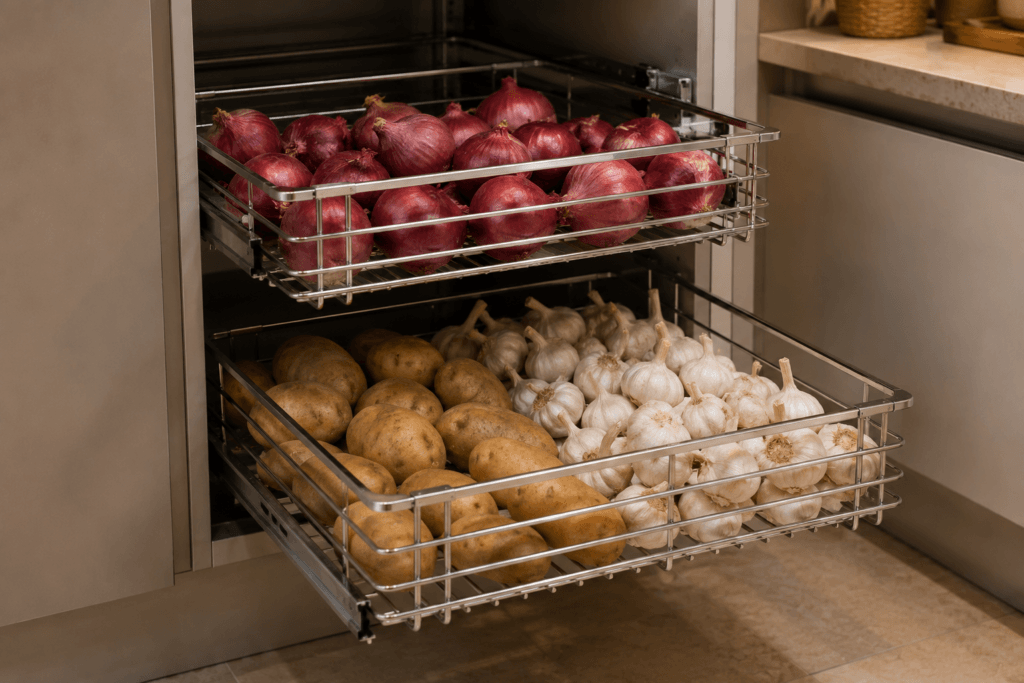
Wire wicker baskets-open-grid frames in stainless steel or chrome-are not ideal for storing grains or loose spices. But they are excellent for one specific job: storing breathable dry vegetables like onions, potatoes, garlic, and sweet potatoes.
These vegetables need airflow. Sealed containers cause them to rot faster. A lower-section pull-out pantry with three or four open-grid wire baskets is the right choice for this job-positioned away from the sink and hob to keep them dry and cool.
For kitchens in Haridwar and Roorkee, where large joint-family households buy onions and potatoes in 10–25 kg quantities, a dedicated 3-basket wicker pantry in the lower section of a tall unit makes a real practical difference.
Important: Use SS304 (stainless steel grade 304) wire baskets, not chrome-plated iron wire. Chrome-plated iron baskets rust within 2–3 years when exposed to kitchen moisture and occasional liquid splashes. SS304 is rust-proof and handles Uttarakhand’s monsoon humidity without corrosion. This distinction is almost never mentioned in kitchen showroom conversations but matters enormously over a 5-year lifespan.
Load capacity: 20 kg to 40 kg per basket, depending on basket size and runner grade
Ideal for: Lower section of tall units; households with large dry vegetable storage needs; Haridwar, Roorkee, and Rishikesh homes where ventilated storage matters
Hardware cost: ₹2,500 to ₹8,000 per basket unit
Type 5: Magic Corner / LeMans Blind Corner Pantry Unit
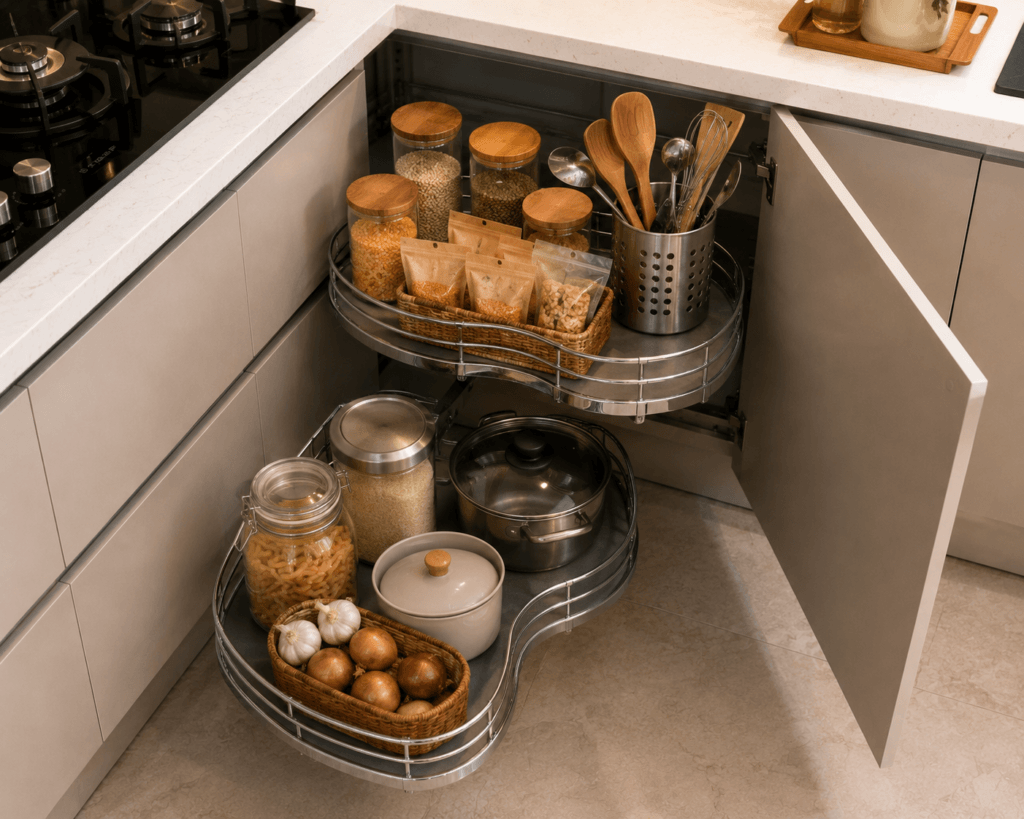
The blind corner-that awkward L-shaped dead zone where two runs of cabinetry meet-is one of the most wasted spaces in Indian kitchen design. A Magic Corner or LeMans carousel unit converts this dead zone into usable storage through a linked tray system that pulls outward and swings to the side as you open the door.
This is not the same as a rotating carousel (lazy susan), which requires a circular cutout inside a round cabinet and still leaves the back quadrant difficult to reach. A LeMans system uses a linked kidney-shaped tray set that travels on an arc, so everything at the back comes forward to you as you pull.
Dimensions: Designed for L-shaped corner cabinets with a minimum internal clear dimension of 800mm × 800mm
Load capacity: 25 kg to 45 kg total on a branded LeMans unit
Ideal for: L-shaped and U-shaped kitchen layouts in medium to large homes; any kitchen with a dead corner that currently stores items you have not touched in six months.
Hardware cost: ₹18,000 to ₹45,000 for a branded LeMans or Magic Corner mechanism
Pantry Hardware Comparison: Which Type Is Right for You?
Feature / Metric | Slim Pull-Out (150–300mm) | Tall Larder Swing Unit (450–600mm) | Inner Tandem Drawer Pantry | Wire Basket Pull-Out | Magic Corner / LeMans |
Best used for | Spices, sauces, small oil bottles | Full grocery packages, bulk goods, snacks | Heavy flour bags, dals, large utensils | Dry vegetables (onions, potatoes, garlic) | Dead L-shaped corner spaces |
Typical load capacity | 15–30 kg | 70–120 kg (branded) | 30–50 kg per drawer | 20–40 kg per basket | 25–45 kg total |
Ideal kitchen size | Micro-kitchens (< 70 sq ft) | Medium to large (80 sq ft+) | Compact & medium (70–120 sq ft) | Any size (lower section) | L-shaped, U-shaped layouts |
Est. hardware cost (INR) | ₹3,500–₹9,000 | ₹25,000–₹75,000 | ₹12,000–₹35,000 | ₹2,500–₹8,000 per unit | ₹18,000–₹45,000 |
Cleaning ease | Moderate (narrow space) | Easy (full pull-out access) | Very easy (removable bins) | Moderate (grid catches spills) | Moderate (curved tracks) |
Swing clearance needed | None | Yes-500–600mm in front | None | None | Partial-corner space only |
Material Guide for North Indian Climate: What Actually Lasts
This is the section most kitchen guides skip entirely-and it is the one that determines whether your pantry unit is still performing at year 5 or falling apart at year 2.
North India is not a single climate. Dehradun and Rishikesh receive heavy monsoon rainfall from June through September, with humidity levels that can exceed 90% on consecutive days. Noida and Ghaziabad are drier, but face a different challenge: fine urban dust that infiltrates every gap in a poorly sealed cabinet.
These differences change the material decision entirely.
Carcass Material: What Your Pantry Box Is Made From
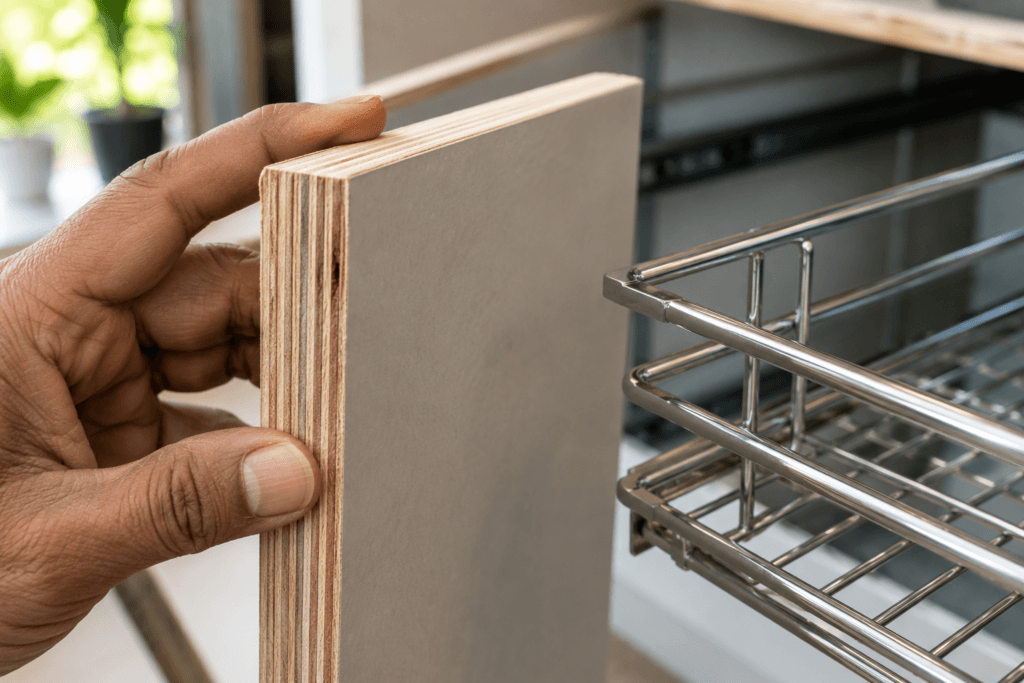
BWR/BWP Marine Grade Plywood (IS:710 Certified)-Best for Uttarakhand Homes
Boiling Water Resistant (BWR) and Boiling Water Proof (BWP) Marine Plywood is made with a cross-laminated phenolic resin bonding process that allows it to withstand up to 72 hours of boiling water immersion without delaminating, as per Bureau of Indian Standards specification IS:710.
In plain terms: this material does not swell, warp, or delaminate when it gets wet repeatedly. For pantry carcasses in Dehradun, Rishikesh, Haridwar, and other Uttarakhand homes that face four months of high monsoon humidity every year, BWR/BWP-grade plywood is the only board-type material we recommend for base and tall cabinet carcasses.
The trade-off: BWR/BWP plywood is the most expensive board material-typically 30–50% more per sheet than HDHMR. However, for a pantry unit that will hold 80–100 kg of groceries in a high-humidity zone, replacing cheap board after 2–3 years costs far more than the plywood premium upfront.
HDHMR (High-Density Moisture-Resistant Board)-Best for Delhi-NCR Homes
HDHMR-High-Density Moisture-Resistant board-is a step up from standard HMR/MDF in density, screw-holding strength, and moisture resistance. It does not reach the wet-zone tolerance of IS:710 plywood, but for kitchens in Noida and Ghaziabad-where the main challenges are urban dust and occasional condensation rather than sustained monsoon dampness-it performs very well and costs less than plywood.
HDHMR cabinets also hold hinges and runners more securely than standard MDF, which matters for a pantry unit that gets opened and closed heavily every day.
Standard MDF-Avoid for Pantry Carcasses
Standard MDF is fine for dry-area shutters and painted-finish panels. It is not appropriate for pantry carcasses-especially near sink zones or in any kitchen that sees real humidity variation. MDF swells from the edges first, and once swelling starts, it does not reverse. In Dehradun’s monsoon-season humidity, a standard MDF pantry carcass can visibly deform within two rainy seasons.
Hardware Coating: What Your Pull-Out Mechanism Is Made From
SS304 Stainless Steel Wire-Always, for Uttarakhand Homes
SS304 (Grade 304 stainless steel) is the rust-proof standard for kitchen hardware in high-humidity environments. It does not corrode when exposed to cooking moisture, cleaning liquids, or the sustained humidity of a North Indian monsoon. For wire baskets and pull-out frames in Dehradun, Rishikesh, and Haridwar kitchens, SS304 wire is non-negotiable.
Chrome-plated iron wire is cheaper-and it will chip, pit, and rust within 2–3 years in a humid kitchen. The visual difference at purchase is minimal. The difference at year 3 is obvious.
Powder-Coated or Galvanised Steel Runners-Acceptable for Delhi-NCR
For Noida and Ghaziabad kitchens, where humidity is lower and the main wear comes from daily mechanical use rather than moisture, good-quality powder-coated or galvanised steel runners (Blum) perform reliably without the SS304 premium.
Regional Material Selection Matrix
|
Region / City |
Primary Challenge |
Recommended Carcass |
Recommended Hardware Coating |
|
Dehradun & Rishikesh |
High monsoon humidity, termite risk |
IS:710 BWR/BWP Marine Plywood |
SS304 stainless steel wire |
|
Haridwar & Roorkee |
Seasonal temperature swings, high grocery load |
HDHMR or BWR Plywood for base units |
Heavy-duty galvanised zinc runners |
|
Noida & Ghaziabad |
Urban dust, compact floor plans, high daily use |
HDHMR with sealed edge-banding |
Soft-close dust-sealed full-extension runners |
City-by-City Buying Guide: Uttarakhand
Dehradun: Design for the Monsoon, Not Just the Blueprint
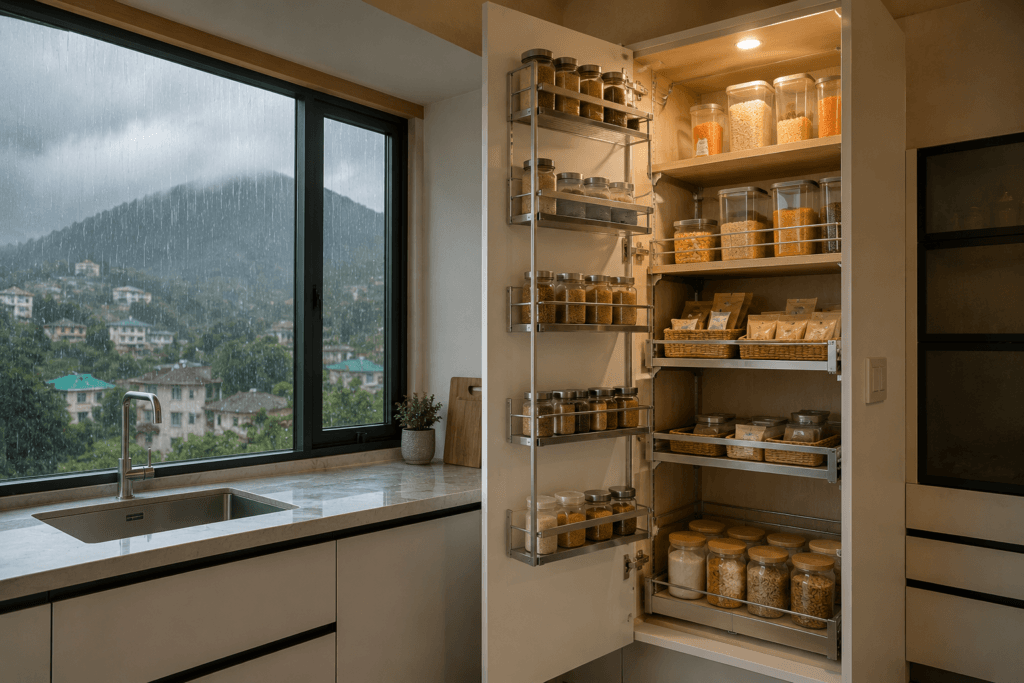
Dehradun’s kitchen storage problem is not just about space-it is about what the monsoon does to storage. From late June through September, relative humidity in hillside apartment clusters along Rajpur Road and Sahastradhara Road regularly stays above 80%. An improperly sealed pantry unit in this environment becomes a breeding ground for mold and weevils inside stored flour and spice containers.
What to specify for Dehradun pantry units:
- IS:710 BWR/BWP plywood carcass-not HDHMR or MDF
- Full-perimeter edge-banding on all exposed carcass edges (prevents moisture ingress through the board edges)
- SS304 wire baskets-not chrome-plated iron
- PVC or stainless steel adjustable legs under the unit base (keeps the base 80–100mm off the floor, allowing airflow and preventing base moisture contact)
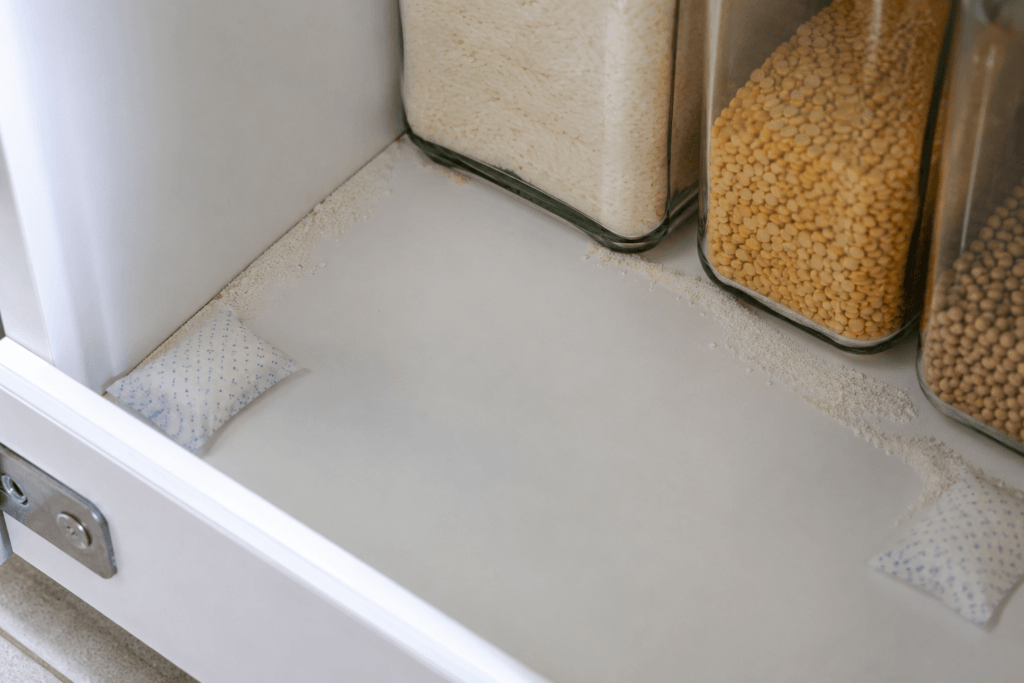
- Activated silica gel sachets inside the pantry-placed in the back corners, replaced quarterly
- Ventilated louvres on the shutter design if possible-improves internal air circulation
Termite note: Dehradun homes near older tree-lined areas (Civil Lines, Jakhan, Race Course) have a documented termite risk. If you choose plywood for your pantry carcass, apply a borate-based anti-termite treatment to all cut edges before assembly. Ask your installer specifically about this-it is a 10-minute process that adds years to the unit’s life.
Haridwar: High-Load Pantry for Large Families
Haridwar kitchens often supply large joint households-sometimes 6 to 10 people-which means the grocery storage requirement is substantially higher than a nuclear family’s 2BHK in Noida.
The practical implication: a pantry unit for a Haridwar home must be spec’d for heavy loads from the start. A standard pantry mechanism rated for 60 kg that sounds adequate for a nuclear family will be chronically overloaded in a large joint household within months.
What to specify:
- Hafele Dispensa with 80–100 kg rated capacity
- Tandem box drawers in the base section (rated 50 kg each) for large flour, dal, and oil containers
- Deep pantry baskets (minimum 500mm depth) to accommodate 10–15 kg wheat flour bags lying flat
Strong carcass-18mm BWR plywood or HDHMR throughout
Rishikesh: Compact and Clean for Homestays and Compact Homes
Rishikesh has a growing market for compact, well-designed kitchens in boutique homestays, yoga retreat residences, and compact modern apartments near Tapovan and Pashulok. The storage challenge here is different: the riverside location adds ambient humidity to the equation, and most compact kitchens need to look clean and uncluttered for guest presentation.
What works well:
- Glass-front or acrylic-finish shutter on the pantry unit (clean, visible, easy to maintain)
- Slim pull-out pantry (200–300mm) for one dead-space slot; full-swing larder unit for the main pantry position
- HDHMR carcass with moisture-resistant edge-banding-BWR plywood if the kitchen faces riverside humidity
Motion-sensor LED strip lights inside the pantry (turns on automatically when the door opens-practical and visually appealing for guest-facing kitchens)
Noida: Vertical Storage for High-Rise Compact Kitchens
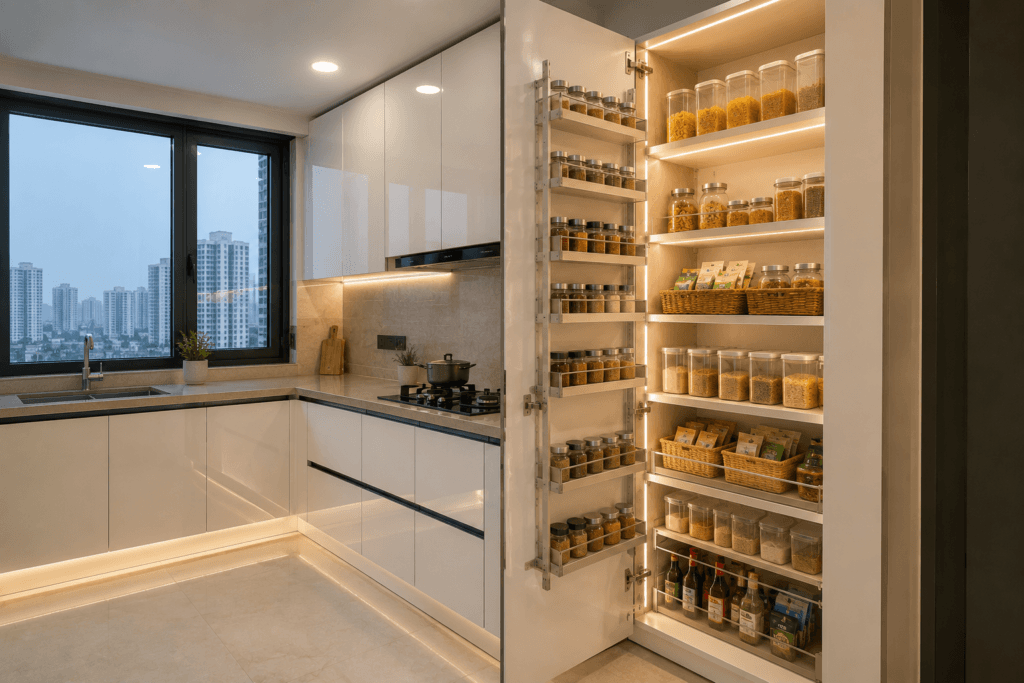
Noida’s dense high-rise clusters-Sectors 75, 78, 121, 137, 150, and Noida Extension-pack 2BHK and 3BHK apartments into increasingly compact floor plans. Many builder-floor kitchens in Sectors 75 and 78 come in at 60–75 sq ft, with a ceiling height of 9 to 10 feet.
This ceiling height is the opportunity. A floor-to-ceiling tall pantry unit-from the base cabinet level at 900mm all the way to 2400–2700mm-uses every centimetre of that vertical space. In a kitchen with a 10-foot ceiling, a full-height pantry with a loft unit above it can store enough grocery inventory for two to three weeks without touching a single countertop.
What to specify for Noida:
- HDHMR carcass with sealed edge-banding (dust infiltration, not monsoon humidity, is the primary material threat)
- Soft-close mechanisms with dust-sealed runners-prevents fine Delhi-NCR dust from accumulating in the slide channel
- Acrylic or lacquered glass shutter-easy to wipe clean after oily cooking vapours
- Motion-sensor LED strip inside the pantry (a 9-foot-deep pantry is dark without interior lighting)
- Narrow slim pull-out (150–200mm) in any gap beside the refrigerator or beside a tall chimney column
For a small kitchen design in a compact Noida 2BHK, a tall pantry unit paired with a slim pull-out in a dead gap can effectively double usable storage without expanding the kitchen footprint.
Ghaziabad: Solve the "Lost-at-the-Back" Problem
In Ghaziabad’s builder-floor homes across Indirapuram, Vaishali, and Vasundhara, one of the most common kitchen complaints is about deep under-counter cabinets where items at the back are never retrieved. The oil tin bought three months ago is lost behind the pressure cooker. The new packet of poha is somewhere behind the old ones.
The right pantry unit for Ghaziabad homes is one that eliminates this problem entirely: a full-swing larder unit or an inner tandem drawer pantry, where nothing is ever pushed to the back and forgotten.
What to specify:
- Full-extension runners on every pull-out-must extend 100% of their depth, not 75%
- Inner tandem drawer pantry (3-drawer configuration) for base-level storage
- Tall swing larder unit for the main pantry position
- HDHMR carcass with sealed edges
How to Organise Your Pantry Unit for Heavy Indian Cooking
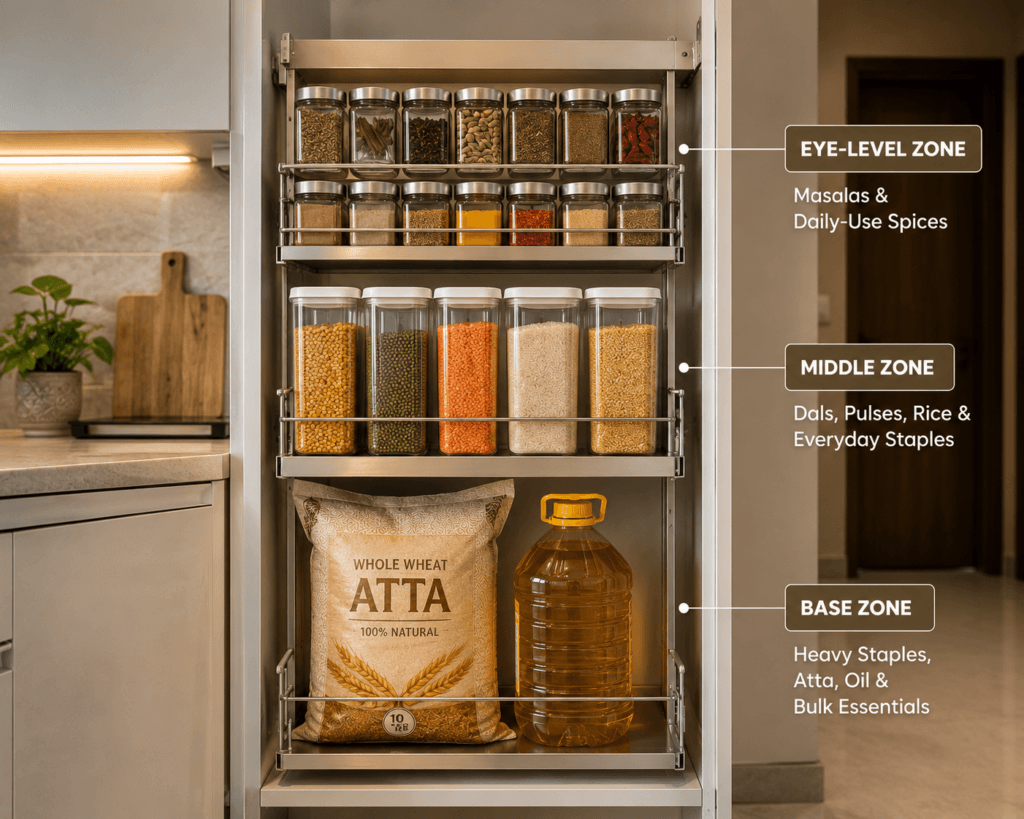
A well-specified pantry unit with the wrong organisation system still creates daily frustration. The three-zone organisation method, based on how frequently different items are used and how heavy they are, works across every pantry unit type.
Zone 1-Eye Level (900mm to 1500mm from floor): Daily Reach Items
This is the most accessible zone, reached without bending or stretching. It should hold everything used daily: cooking masalas, tea, coffee, everyday cooking oils in small dispensers, sugar, salt, and the spice tins that go onto the hob every morning. Keep 12–20 items here maximum-more than that creates visual clutter and slows down morning cooking.
Storage tip: Use matching airtight glass or food-grade acrylic containers for masalas. They look clean, keep moisture out (critical in Uttarakhand kitchens), and prevent turmeric and chilli powder from staining the basket. A 500ml square airtight container for each masala, labelled, makes a pantry genuinely faster to use than loose packets.
Zone 2-Middle Section (Lower-reach, 500mm to 900mm): Medium-Frequency Groceries
Dals, rice, poha, semolina (rava), extra cooking oil bottles, larger sugar and salt containers-items used 2–4 times per week rather than every day-belong here. This section is easily reached by bending slightly but is not the first thing you see when you open the pantry.
Use deep tandem box drawers in this zone for heavy items like dal containers and 5-kg rice boxes. Solid-base drawers prevent the grain-spill-through problem that plagues wire baskets.
Zone 3-Top and Base Sections (Above 1500mm and Below 500mm): Occasional and Heavy Items
The top of the pantry (above comfortable arm reach) is for items bought in bulk but used infrequently: extra oil tins, 10–25 kg flour bags, festive food items bought once a month, and backup grocery inventory.
The very base of the pantry-below 500mm from the floor-handles the heaviest loads: large flour bags, bulk dal containers, heavy cooking oil tins. Tandem box drawers at the base, on heavy-duty runners rated for 50 kg+, are the right mechanism here. This keeps heavy items stable, low, and accessible without asking you to lift them to shoulder height.
Essential Pantry Accessories That Actually Help
Anti-slip acrylic tray mats: Placed in every basket or tandem box, these prevent containers from sliding forward when the unit pulls out. They also contain small spills-a turmeric drip, a sticky oil splash-that would otherwise stain the drawer base.
Door-mounted shallow racks: Many full swing larder units include shallow racks mounted to the shutter itself. These work well for small spice bottles, sachets, and flat items like ready-masala packets. Do not overload them-the shutter-mounted load adds to the total swing mechanism load.
Motion-sensor LED strip lights: Available in warm white or cool white aluminium profile strips with a door-sensor switch. They turn on automatically when the pantry door opens and turn off when it closes. In a deep tall pantry in a compact kitchen, this is not just aesthetic-it is genuinely practical.
Airtight container sizing for Indian pantries: Standard 500ml containers fit comfortably on shelves 150–200mm deep. For dal and rice storage, 1-litre to 3-litre BPA-free food-grade containers with airtight lids prevent moisture, pests, and grain contamination. Standardise your container sizes-it makes the pantry reorganise-able without measuring every time.
How to Protect Your Pantry Unit from Ants and Monsoon Damage
This is one of the most frequently asked questions from North Indian homeowners-and one that almost no kitchen blog addresses directly. If you have lived with a disorganized pantry through one Indian monsoon, you know the combination of humidity, stored flour, and poorly sealed cabinet joints is a recipe for ants, weevils, and mold.
For ant prevention:
- Store all grain, flour, sugar, and dry food in sealed food-grade containers-never in the original paper packaging inside the pantry. Paper packets are not pest barriers.
- Apply food-safe silicone sealant to all cabinet door gaps and base gaps. Ants enter through gaps as small as 0.5mm.
- Place food-grade diatomaceous earth (available at organic stores) along the base interior of the pantry. It is safe for food-storage environments and lethal to crawling insects.
- Keep the pantry interior dry. A weekly wipe-down with a cloth dampened in diluted white vinegar (1:5 ratio) cleans and deters ants without chemical residue.
For monsoon mold prevention in Uttarakhand:
- Install small silica gel sachets in the back corners of each pantry shelf section. Replace them every 90 days during monsoon season.
- Never put wet jars, damp packaging, or condensation-covered bottles directly into the pantry. The moisture transfers to the board and creates mold conditions.
- Wipe the inside of the pantry with diluted vinegar once a month during the June–September monsoon period.
- If you notice a musty smell inside a closed pantry, empty the unit, air it out for 48 hours, clean with vinegar solution, allow to dry completely, and place fresh silica sachets before restocking.
Common Mistakes to Avoid When Buying a Kitchen Pantry Unit
Mistake 1: Buying by Price Without Checking Load Ratings
The most expensive mistake is the cheap one. An unbranded wire pull-out pantry purchased from a local hardware market in Noida or Dehradun for ₹4,000 to ₹6,000 has no published load rating for a reason-it does not have one. These units begin sagging under loads of 25–30 kg, which is less than two full dal containers plus a flour bag.
After six to twelve months of regular use, the baskets tilt forward, the runners bind, and the door no longer closes properly. Replacing the mechanism after installation requires removing the shutter and the basket frame-a carpentry job that can cost ₹3,000 to ₹5,000, on top of the replacement hardware cost.
Mistake 2: Choosing Wire Baskets for Grain and Spice Storage
Wire baskets are designed for breathable, chunky items-not for lentils, cumin, coriander powder, or any small-grain or powdered spice. The grid openings allow small items to pass through onto the basket below, creating a layered mess that requires full emptying to clean.
Specify solid-base tandem box drawers for any section of the pantry that will hold loose-grain containers, spice jars, or powdered ingredients. Use wire baskets only for the designated dry-vegetable section.
Mistake 3: Not Leaving Swing Clearance for a Larder Unit
A full swing larder unit requires 500–600mm of clear floor space in front of it to open fully. In a parallel kitchen layout where the two counters are 900–1100mm apart, this clearance is sometimes insufficient. Measure the swing radius before committing to a larder unit in a narrow layout.
If clearance is an issue, choose an inner tandem drawer pantry instead-it opens straight outward, requiring only the drawer extension depth as clearance, not a side swing.
Mistake 4: Ignoring the Soft-Close Buffer Quality
Soft-close hinges and drawer buffers are the mechanical components that take the most punishment in a daily-use pantry. A pantry that is opened and closed 6–10 times a day across a household sees more than 2,000 open-close cycles per year. At that rate, a low-quality soft-close buffer wears out in 18–24 months and starts letting doors bang or slam.
Some branded hinges are rated for 80,000–100,000 cycles under their published specifications. Generic soft-close hinges from local markets typically carry no published cycle rating.
Mistake 5: No Provision for Future Hardware Tuning Access
Every pull-out pantry mechanism has 3D adjustment screws on the front mounting brackets-allowing height, depth, and tilt alignment to be corrected after installation. But only if there is access to those screws once the shutter is in place.
Ask your installer to leave a minimum 50mm clearance gap between the top of the shutter and the underside of the upper cabinet-or to use a soft-close hinge design that allows the door to be removed and re-hung without tools. If this is not planned upfront, any future adjustment requires dismantling the unit entirely.
Should You Get a Pull-Out Pantry or a Carpenter-Built Storage Shelf?
This is a fair question-and the honest answer is: it depends on your budget timeline, not just your budget.
A carpenter-built open shelf unit inside an existing cabinet can cost ₹3,000 to ₹8,000 and provides basic storage organisation. If you are renting an apartment for 18–24 months, this is often the sensible answer. The hardware investment cannot travel with you.
For a home you will occupy for 5+ years, a modular pantry unit-with a proper carcass, branded mechanism, and appropriate material for your local climate-almost always works out more economical. The reason is not just durability, but replaceability. If the mechanism fails at year 7, you replace only the mechanism-not the entire unit. A carpenter-built shelf unit that warps from monsoon humidity typically requires a full rebuild.
Additionally, a well-made modular kitchen design with a properly specified pantry unit adds measurable value to a resale property in North India, where buyers increasingly compare kitchen quality. A carpenter-built shelf does not.
Frequently Asked Questions
The minimum width for a functional slim pull-out pantry is 150mm (6 inches). At this width, you can store spice bottles, sauce dispensers, and small oil bottles in a single row. For a full-height swing larder unit with multi-tiered storage, the minimum practical width is 450mm, and 600mm is more common for accommodating packaged grocery items side by side.
Both work well for different needs. A pull-out pantry (larder swing unit) gives you a full view of everything in one swing-ideal if visibility is the priority. An inner tandem drawer pantry allows you to open individual drawers independently-better for heavy grocery loads, easier to clean, and more suitable for a narrow kitchen where swing clearance is limited. For most Indian households, the inner tandem drawer pantry is the higher-utility day-to-day choice; the full swing larder unit is the more impressive visual choice.
It depends entirely on the mechanism. Standard premium soft-close pantry pull-out mechanisms from Hafele carry 70 kg to 120 kg of dynamic load. Budget mechanisms from unbranded local suppliers typically handle 25–35 kg before the runners begin to bind. Always ask for the published load rating before purchasing.
IS:710-certified BWR (Boiling Water Resistant) or BWP (Boiling Water Proof) marine plywood is the most reliable board-type material for cabinet carcasses in high-humidity environments. It resists swelling, warping, and delamination even during prolonged exposure to moisture. Pair it with SS304 stainless steel wire baskets rather than chrome-plated iron for better durability and corrosion resistance.
Yes, in most cases. If your existing kitchen has a vertical gap of 150mm or more between any two units-beside the refrigerator, beside a chimney column, or between wall cabinets-a carpenter can retrofit a slim pull-out pantry into that slot without touching the countertop or other cabinets. For a full tall unit addition, you need a clear floor-to-ceiling space of at least 450mm wide, which is less common in an existing kitchen but not unusual in L-shaped and parallel layouts.
Store all dry goods in sealed food-grade containers-never in paper packets inside the pantry. Apply food-safe silicone to all cabinet gaps. Place food-safe diatomaceous earth along the pantry base interior. Clean the inside monthly with diluted white vinegar (1:5 ratio with water). In Uttarakhand monsoon periods, add silica gel sachets to absorb ambient moisture.
For a basic pantry tall unit with standard hardware and an HDHMR carcass, expect ₹18,000–₹30,000 all-in, including hardware, carcass, shutter, and installation. A mid-range unit with premium hardware, a BWR plywood carcass, and a laminate shutter typically costs ₹45,000–₹65,000. A fully featured pantry unit with advanced pull-out mechanisms, an acrylic shutter, and a BWP plywood carcass can cost ₹90,000–₹1,20,000+.
Yes-and it is actually the best use of open-grid wire baskets. Onions, potatoes, garlic, and dry ginger need airflow, which solid tandem boxes do not provide. Specify 3–4 open wire baskets in the lower pantry section, on full-extension runners, away from the sink moisture zone. Use SS304 wire-not chrome-plated iron-for long-term durability in North Indian kitchens.
Three common causes: overloading beyond the mechanism’s rated capacity (weigh what you store); food debris or dust in the lower slide track (vacuum and wipe the track monthly); or runner misalignment from a dropped heavy item (an installer can realign using the 3D adjustment screws on the front mounting brackets). Do not lubricate the track with cooking oil-it attracts more debris. Use only silicone-based lubricant spray if the manufacturer recommends lubricating the track at all.
It depends on priorities. A glass-front shutter lets you see pantry contents without opening the door-useful for quick visual inventory checks. It is also easier to wipe clean of cooking grease. The trade-off: toughened glass shutters cost more than laminate (add ₹5,000–₹15,000 per shutter depending on size), and glass can break during aggressive handling or an earthquake in hill regions. Laminate is more scratch-resistant and significantly cheaper. Both are acceptable choices-choose based on your cooking habits and budget rather than aesthetics alone.
In a parallel kitchen design with a corridor width of 900–1200mm, a full swing larder unit (requiring 500–600mm swing clearance) may conflict with the opposite counter if the pantry is positioned mid-run. Position the larder unit at the end of the run-at the open end of the corridor-where swing clearance is available. Alternatively, choose an inner tandem drawer pantry in the mid-run position, where it opens straight outward and requires only 550–600mm of clearance depth.
Use aluminium profile LED strip channels mounted vertically on the internal sides of the carcass, or horizontally under each shelf. Specify warm white (2700K–3000K) for a natural food-storage visual rather than cool blue-white. A door-sensor microswitch turns the light on when the door opens and off when it closes. The entire lighting setup adds ₹2,500–₹6,000 to the pantry unit cost depending on the number of strips and the switch type-a worthwhile addition for any pantry deeper than 450mm.
Key Takeaways: Choosing the Right Pantry Unit for Your Kitchen
If there is one principle that runs through every pantry installation-across Dehradun hill-side flats, compact Noida sector apartments, and large Haridwar joint-family homes-it is this: the right pantry unit is the one spec’d for your actual kitchen, your actual grocery load, and your actual climate. Not the one that looks impressive in a showroom photo.
To make the right choice:
- Match the mechanism type to your kitchen size and swing clearance availability
- Match the material to your city’s climate-BWR plywood for Uttarakhand, HDHMR for Delhi-NCR
- Specify SS304 wire for any exposed metal in Dehradun, Rishikesh, and Haridwar kitchens
- Choose branded hardware (Hafele)-the load capacity difference over an unbranded mechanism is not marginal, it is the difference between 3 years and 15 years of useful life
- Zone the pantry for Indian cooking: heavy items at the base, daily items at eye level, occasional bulk at the top
- Seal food in proper containers-no open paper packets inside the pantry, ever
The kitchen you plan now is the kitchen you will cook in every morning for the next decade. A pantry unit that works correctly makes that daily experience measurably easier. One that fails under load, swells from monsoon humidity, or collapses its wire baskets after 18 months makes it measurably worse.
If you are in the planning stage for a full modular kitchen design-including pantry units, base cabinets, wall units, and all the hardware choices that connect them-Bhumim designs, manufactures, and installs complete modular kitchens across Dehradun, Haridwar, Rishikesh, Roorkee, Noida, and Ghaziabad. Every kitchen we install is planned on the specific dimensions and climate context of your home-not a generic catalogue spec.
About This Article
Published by: Bhumim India Private Limited-Modular Kitchen Manufacturer & Installer, Dehradun
GST: 05AAOCB1784F1ZM | ISO 9001:2015 Certified
Service Areas: Dehradun · Haridwar · Rishikesh · Roorkee · Noida · Ghaziabad
Contact: 08044630777 | hello@bhumim.com
Note: This article is written from Bhumim’s on-ground manufacturing and installation experience. All material recommendations are based on what we use in real kitchens across our service areas.