

Types of Aluminium Kitchen Cabinets: Style And Durability
Aluminium kitchen cabinet design covers several distinct construction types-including solid extruded panel cabinets, aluminium frame with glass or ACP shutters, powder-coated colour systems, and wood grain sublimated profiles-each suited to different budgets, aesthetic goals, and climate conditions. All types share zero termite risk, complete waterproofing, and structural lifespans that regularly exceed 20 years in Indian homes.
Aluminium as a kitchen cabinet material is not new. What is new in 2026 is how far the design range has expanded-from antiseptic-looking metal boxes to handleless matte-black shutters that pass as Italian cabinetry at a glance. If you are trying to understand which type fits your home, your climate, and your budget, this guide covers the full picture: construction types, finish technologies, performance under Indian conditions, and what to check before you sign off on a quote.
Why So Many Homeowners Are Switching to Aluminium Kitchen Cabinets
You have probably seen it in someone else’s kitchen first. A section of lower cabinets near the sink has started to warp-the door won’t close flush anymore, the bottom edge is lifting at the corner, and there’s a faint smell that appeared after the last monsoon. That pattern shows up in plywood and MDF kitchens across Dehradun’s hill-facing apartments, Ghaziabad’s older residential blocks, and Noida’s high-rise units with poor cross-ventilation. After installing modular kitchens across these cities, we see this outcome more often than most kitchen companies will admit publicly.
Aluminium doesn’t do any of that. The material is inorganic-it absorbs no moisture, offers nothing for termites to consume, and its frame dimensions on day one are the same in year fifteen. That structural consistency is the real reason aluminium is growing inside the Indian modular kitchen market, which is projected to expand at a CAGR of over 12% through 2028, with non-wood materials driving a significant share of that growth.
The modular kitchen design options in aluminium today cover everything from budget ACP shutters to anodized glass-profile systems that would not look out of place in a European showroom. Which one is right depends on how you cook, what your kitchen faces (humidity, direct sun, cooking fumes), and what you want the space to feel like. Let’s work through that properly.
What Is an Aluminium Modular Kitchen Cabinet, Exactly?
An aluminium modular kitchen cabinet is a storage unit-base cabinet, wall cabinet, or tall column-in which the structural frame, shutters, or both are manufactured from aluminium alloy profiles and panels, assembled off-site in a factory, and installed as complete units in the kitchen.
That “off-site factory manufacture” detail is what separates a modular aluminium kitchen from a site-fabricated aluminium kitchen. Site fabrication (what a local welder builds in your kitchen with angle sections and sheet metal) uses lower-grade material, relies on on-site cutting and joining, and typically lacks the soft-close hardware compatibility and finish precision of a factory-built modular system. The two are not the same product, even though both are described as “aluminium kitchens.”
In a factory-manufactured system, the most common alloy used for structural extrusions is 6063-T5-a medium-strength, highly extrudable alloy that offers excellent surface finish quality for powder coating and anodizing. Frame wall thickness in quality systems runs 1.2mm to 2.0mm, with 1.5mm being the practical minimum for base cabinet carcasses carrying daily load.
Expert Tip: When getting quotes, ask fabricators to state the alloy grade and profile wall thickness in writing. A quote that only says “aluminium frame” could mean anything from 0.8mm decorative sheet to a proper 1.5mm 6063-T5 structural extrusion-and you cannot tell the difference by looking at it.
Get started with Beautiful Homes
For expert design consultation, send us your details and we’ll schedule a call
Comprehensive Types of Aluminium Kitchen Cabinets by Material and Construction
1. Solid Extruded Aluminium Panel Cabinets (Double-Walled)
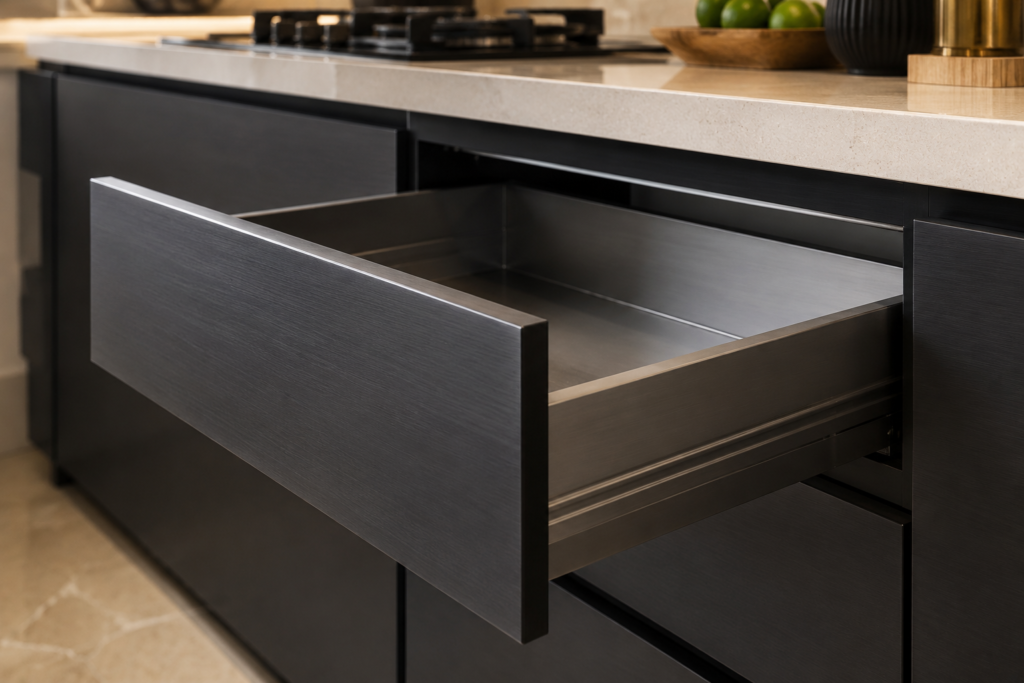
This is the most structurally robust construction type in the aluminium kitchen category. Both the frame and the shutter face are made from extruded aluminium alloy-typically a double-skin design where two aluminium surfaces sandwich a cavity or a rigid infill, creating a panel that is simultaneously lightweight and very stiff.
Double-walled extruded panels solve two problems that single-skin aluminium shutters struggle with: acoustic resonance (the hollow “clang” you hear when metal doors bang) and thermal expansion variation (single-skin panels can develop minor bowing in zones with significant temperature swings, such as Roorkee’s summer-to-winter range). The double-walled construction eliminates both.
These cabinets are typically the choice for heavy-use family kitchens-base cabinets, pantry tall units, and undersink storage where maximum load capacity and moisture resistance are more important than cost per square foot. A 1.5mm reinforced aluminium modular shelf in this category can support 30–50 kg per linear foot without sagging.
Best for: Families who cook daily, kitchens near water sources, heavy utensil storage.
Cost range (estimated, 2026): ₹650–₹950 per sq ft for the shutter/panel component.
2. Aluminium Frame with Glass-Front Shutters (Profile Systems)
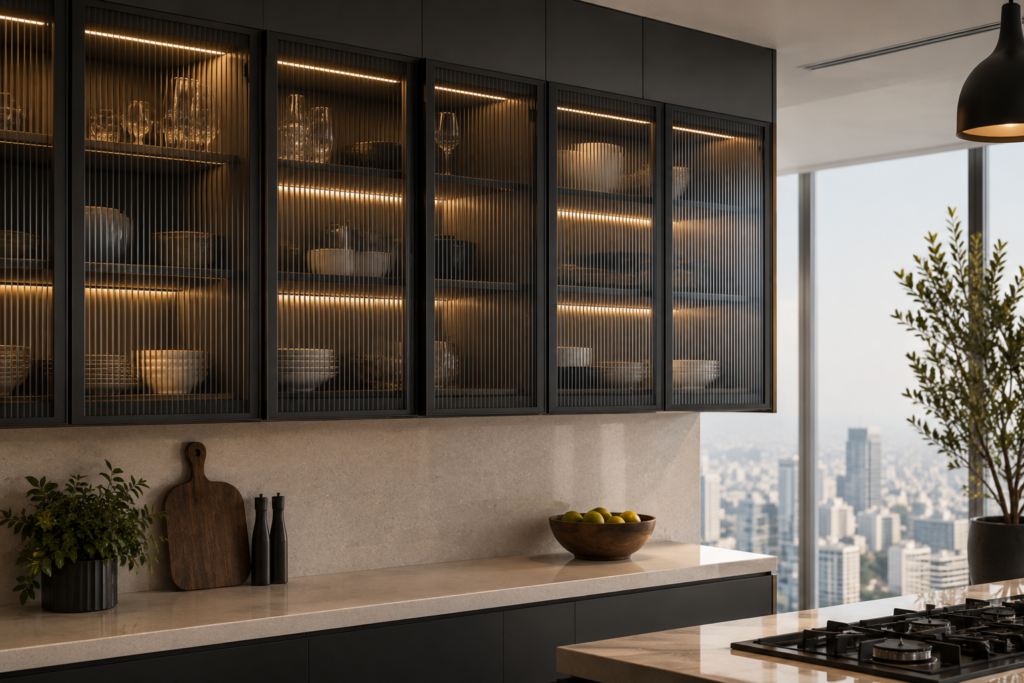
This is the design type that has done the most to shift public perception of aluminium kitchens from “industrial” to “aspirational.” Ultra-slim aluminium profile borders-sometimes just 12–18mm wide-surround toughened glass panels to create shutters that are simultaneously lightweight, strong, and visually striking.
The glass itself varies across four main options:
- Clear toughened glass: Fully transparent, best for display sections-crockery, glassware, decorative items.
- Frosted toughened glass: Semi-opaque, softens the interior while maintaining a contemporary feel.
- Fluted/ribbed glass: A 2024–2026 design trend that is gaining ground rapidly in Noida and Ghaziabad apartments-the vertical ribbing creates texture and partially obscures the interior without fully hiding it.
- Tinted glass (bronze, grey, black): Adds depth and drama to the kitchen facade, particularly effective against white or off-white wall tiles.
The aluminium profile itself can be powder-coated, anodized, or brushed to match other kitchen finishes. Corners are joined using heavy-duty die-cast zinc or aluminium cleats, which is worth checking on any profile system you’re evaluating-a corner held with thin sheet tabs is a sign of low-grade construction.
One honest limitation to state clearly: glass-front shutters are not right for every section of an Indian kitchen. Near the hob-especially with Indian cooking that involves heavy oil and masala splatter-glass interiors need more frequent cleaning than solid shutters. Most homeowners use glass fronts selectively: on wall cabinets above the counter, not on every cabinet in the kitchen.
Best for: Living-facing open kitchens, display sections in Noida apartment towers, homeowners who prefer a lighter, more open kitchen aesthetic.
Cost range (estimated, 2026): ₹950–₹1,600+ per sq ft for slim-profile fluted or tinted glass systems.
3. Aluminium Composite Panel (ACP) Cabinets
ACP is a construction where two thin aluminium sheets (typically 0.3–0.5mm each) sandwich a polyethylene or mineral-filled core. The resulting panel is lightweight, flat, and available in a wide range of colours and finishes including gloss, matte, metallic, and woodgrain.
ACP cabinets are the entry-level option in the aluminium kitchen category, and that is not a criticism-for rental properties, utility kitchens, and budgets under ₹500 per sq ft, ACP delivers better moisture resistance than commercial plywood at a comparable or lower cost.
A few things to understand about ACP before specifying it:
First, ACP is a shutter and panel material, not a structural frame material. ACP shutters on an aluminium extrusion frame is a legitimate, durable combination. ACP shutters on a plywood or MDF carcass partially negates the waterproofing benefit, since the underlying frame is still moisture-sensitive.
Second, ACP panels are susceptible to denting under sharp impact-more so than a solid extruded aluminium panel or a thick laminate on ply. For a kitchen with young children or heavy daily cooking activity, this is worth factoring into the decision.
Third, the fire safety question comes up with ACP near hobs: standard ACP with a polyethylene core has a fire-safety limitation at very high temperatures. For backsplash applications directly behind a gas hob, ACP is not recommended. As a cabinet shutter material at counter height and above, it is safe under normal kitchen operating conditions.
Best for: Budget-conscious buyers, rental property kitchens, utility or service kitchen areas, homeowners in Ghaziabad and Roorkee looking for long-term moisture resistance at entry-level pricing.
Cost range (estimated, 2026): ₹350–₹550 per sq ft for basic ACP shutter systems.
4. Wood Grain Sublimated Aluminium Cabinets
This is the construction type that addresses the single most common objection to aluminium kitchens in Indian homes: “I want the look of wood.”
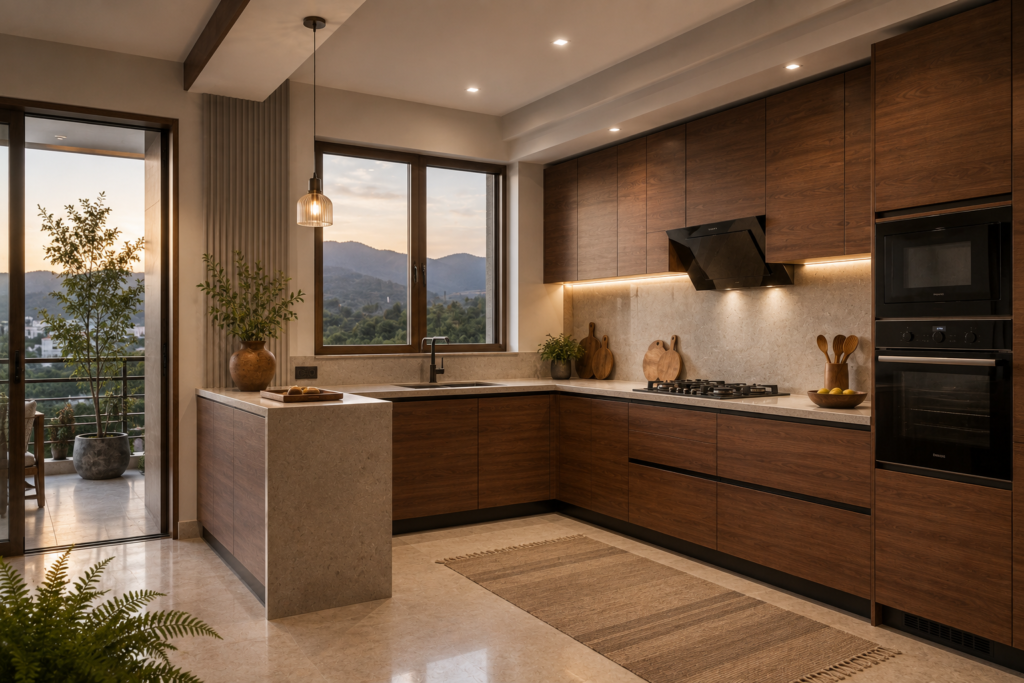
Wood grain sublimation is a printing and heat-transfer process. A base powder coat is applied to the aluminium profile, then a photographic film printed with a real wood grain pattern-teak, walnut, oak, wenge, and similar-is wrapped around the profile and vacuum-sealed. The assembly is then baked at approximately 200°C. At that temperature, the ink in the film sublimes (converts directly from solid to vapour) and bonds permanently into the powder coat surface.
The result is an aluminium profile that has a wood grain texture visible to the eye and perceptible to the touch-not a flat printed sticker, but a finish that sits in the coating itself. Combined with the structural performance of an aluminium frame, this gives you the warmth of natural wood aesthetics without the moisture absorption, termite vulnerability, or refinishing cycles that come with actual wood.
Since 2023, wood grain sublimated aluminium has become one of the fastest-growing options in Dehradun’s modular kitchen segment, particularly in independent bungalows and villas where homeowners want a warmer kitchen feel than pure metal offers.
Best for: Homeowners who prefer traditional or warm aesthetics but need monsoon-proof performance; independent houses and villas in Dehradun, Haridwar, and Rishikesh.
Cost range (estimated, 2026): ₹800–₹1,200 per sq ft for sublimated wood-finish profile systems.
5. Hybrid Aluminium–Plywood Systems
Not every kitchen has to be a single-material decision. A hybrid system uses aluminium for the components where waterproofing matters most-the carcass frame, the base cabinet bodies, and the undersink unit-while using BWP-grade plywood or HDHMR for shutters, wall cabinets in dry zones, or counter sections where wood-based materials offer a superior finish or tactile feel.
This approach makes financial sense in kitchens where the client has a clear budget ceiling but wants the durability benefit of aluminium in the specific zones most exposed to water. An aluminium carcass with an HDHMR shutter, for example, gives you a waterproof structural box with a smooth paintable or laminate-finish door surface-something aluminium extrusions alone cannot achieve as easily.
The important caveat: hybrid systems require clear specification at the quoting stage. Know which sections are aluminium, which are wood-based, and what warranty applies to each independently. A quote that lumps them together makes accountability harder when something goes wrong.
Best for: Mid-range budgets, mixed-use kitchens, clients who want wood finishes on visible upper cabinets but full aluminium performance at sink and hob base level.
For a full material comparison including HDHMR and BWP plywood performance in Dehradun’s humidity conditions, see our best modular kitchen guide for Dehradun.
Aesthetic Finishes: What Determines How Your Aluminium Kitchen Actually Looks
The construction type determines structural performance. The finish determines what you see, touch, and react to every day. These are four different technologies-each with a distinct look, durability profile, and maintenance requirement.
Powder-Coated Finishes (Matte, Satin, and Gloss)
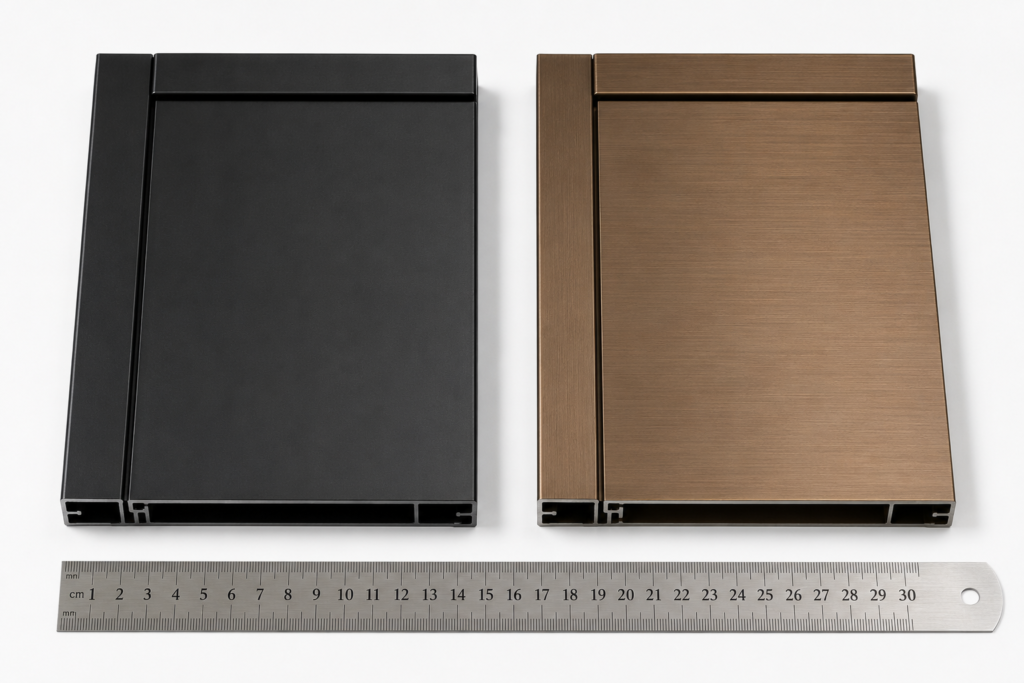
Powder coating is the most widely used surface treatment for aluminium kitchen profiles in India. A dry pigment powder is electrostatically applied to the aluminium and then cured in an oven at approximately 180–200°C, creating a finish that adheres molecularly to the surface rather than sitting on top of it as paint does.
The result is a finish that resists chipping, scratching, and most kitchen chemicals-oil, cleaning agents, and hard water-far better than conventional paint. Quality powder coatings run 60–80 microns in thickness, which is the standard range for kitchen-grade applications.
Colour range is genuinely wide: over 200 RAL shades are available for custom orders, which means the “aluminium kitchens only come in grey or silver” assumption is simply wrong. Matte black, olive green, terracotta, off-white, and warm beige are all achievable.
One watch-point: anti-fingerprint powder coating formulations are worth specifying for gloss or satin finishes. On high-touch areas like door edges and lower cabinet fronts, standard gloss powder coating shows fingerprints and smudges noticeably. Anti-fingerprint coating solves this at a marginal cost increase.
Anodized Metallic Finishes (Brushed Bronze, Champagne Gold, Matte Black)
Anodizing is an electrochemical process that grows a protective oxide layer on the aluminium surface itself, typically 15–25 microns thick when conforming to Bureau of Indian Standards IS 1868. Unlike powder coating, anodizing is not a coating applied on top of the metal-it is the metal’s own surface, transformed. This is why anodized finishes are considered more scratch-resistant than powder coating in direct surface comparison tests.
The colour range for anodizing is narrower than powder coating-the process produces a range of metallic tones naturally: natural silver, champagne gold, bronze, and dark grey/black are the most common. For homeowners who want a genuinely metallic-looking kitchen-not metallic-effect paint but actual metal-anodized profiles deliver that in a way powder coating cannot fully replicate.
Anodized finishes also perform well in environments where cleaning frequency is high, including hard water zones in NCR cities where regular wiping is unavoidable. The anodized surface tolerates mild abrasives that would damage a powder-coated finish.
PU Painted and UV-Lacquered Surfaces
PU (polyurethane) paint and UV lacquer are applied to aluminium kitchen shutters-most commonly on ACP or extruded panel surfaces-to achieve a furniture-grade level of finish smoothness that powder coating’s texture cannot always match. These finishes are popular for handleless kitchen designs where the door surface needs to look and feel like a high-end lacquered piece of furniture.
UV lacquer, specifically, is applied in a liquid state and cured under ultraviolet light in seconds, which produces a harder, more uniform film than conventional PU paint. On matte or semi-gloss surfaces, UV lacquer closely resembles membrane-finish MDF shutters-but on aluminium, it retains the underlying material’s complete moisture resistance.
The trade-off: UV and PU surfaces are more susceptible to deep scratches than anodized finishes, and re-coating in the field (after installation) is not as straightforward as touching up a powder-coated surface.
Aluminium vs. Plywood vs. Stainless Steel: Which Material Should You Actually Choose?
Feature | Aluminium | BWP Plywood | MDF/HDHMR | Stainless Steel |
Termite resistance | Complete-zero cellulose | Treated: good; untreated: vulnerable | No resistance | Complete |
Waterproofing | 100%-non-porous metal | Good (BWP) / Moderate (HDHMR) | Moderate; swells at edges | 100% |
Monsoon performance | No impact-does not absorb moisture | BWP holds; MDF swells | HDHMR resists, MDF swells | No impact |
Fire resistance | Non-combustible | Burns | Burns | Non-combustible |
VOC emissions | Zero (post-cure) | Low (BWP); low (HDHMR) | Low-moderate | Zero |
Design flexibility | High (200+ RAL colours, glass fronts, wood grain) | High (all laminate/veneer options) | High (CNC routable) | Limited (industrial look) |
Dent resistance | Good (solid panels); ACP: dents under sharp impact | Good | Good | Excellent |
Repairability | Section replacement; surface dents harder to repair | Edge banding and surface repair possible | Section replacement | Very difficult; dents permanent |
Initial cost | 15–30% higher than plywood for same spec | Mid-range | Lower | Highest |
25-year TCO | Lower-near-zero maintenance | Moderate-refinishing cycles | Low–moderate | Lowest (if budget allows initial cost) |
Best zone | Wet areas, all zones in humid climates | Visible zones, dry upper cabinets | Dry-area shutters, painted finishes | Heavy-use utility / professional kitchens |
The key point this table doesn’t make obvious: the decision is not always either/or. Many Bhumim installations in Dehradun and Noida use aluminium for base cabinets and undersink units (highest moisture exposure) and HDHMR or BWP plywood for upper wall cabinets (lower exposure, more design flexibility). That hybrid approach hits the best performance-to-cost ratio for most Indian homes.
Why Climate Determines the Right Choice in Dehradun, Haridwar, Noida, and NCR
This is the section most competing kitchen guides miss entirely-and it matters more than most homeowners realize before their first monsoon in a new kitchen.
Dehradun and Rishikesh: High Humidity, Mountain Seepage
Dehradun’s average monsoon relative humidity regularly exceeds 85%, and homes at lower elevations or facing hillsides deal with persistent seepage through walls-including kitchen walls. In these conditions, wood-based materials at the base cabinet level absorb moisture through the back panels and flooring contact points even when the front face is well-sealed.
Aluminium’s complete non-hydroscopic nature-it simply does not absorb water, period-means base cabinets stay dimensionally stable regardless of how much moisture the surrounding environment holds. For small kitchen designs in compact Dehradun apartments where ventilation is limited, this is not a premium consideration; it is a practical one.
Haridwar and Rishikesh: Riverbank Proximity and Corrosion Risk
Proximity to the Ganga significantly raises ambient humidity year-round in Haridwar and Rishikesh-not just during monsoon months. This affects not just wood-based carcasses but also ferrous metals (steel screws, hinges, and brackets without adequate treatment). Quality aluminium kitchen systems address this by specifying stainless steel fasteners at joint points rather than zinc-plated mild steel, which prevents bimetallic galvanic corrosion at connection zones.
Anodized aluminium profiles, in particular, perform well in this environment because the anodized layer (conforming to IS 1868 at 15–25 microns) creates a chemically stable surface that resists the combination of moisture and atmospheric contaminants near river environments.
Noida and Ghaziabad: High-Rise Apartments and Urban Cooking Intensity
The challenge in Noida and Ghaziabad is different. Humidity is seasonal rather than constant, but cooking intensity in Indian family kitchens is year-round and significant. Pressure cooking, deep frying, and tawa cooking produce hot oil vapour and steam that settle on every cabinet surface in the kitchen multiple times daily.
On wood-based materials, repeated steam contact at joints, edges, and hinge points eventually causes micro-delamination and swelling-visible as bubbling at laminate edges or stiffening at hinge zones. On aluminium, the same daily cooking load produces no structural degradation. A wipe with a damp microfibre cloth is all the maintenance required.
For L-shaped kitchen designs in Noida apartments-where the hob-side run of cabinets sits directly adjacent to the dining zone and aesthetics matter more than in a closed kitchen-the ability to maintain an aluminium kitchen’s appearance with minimal effort is also a practical day-to-day benefit.
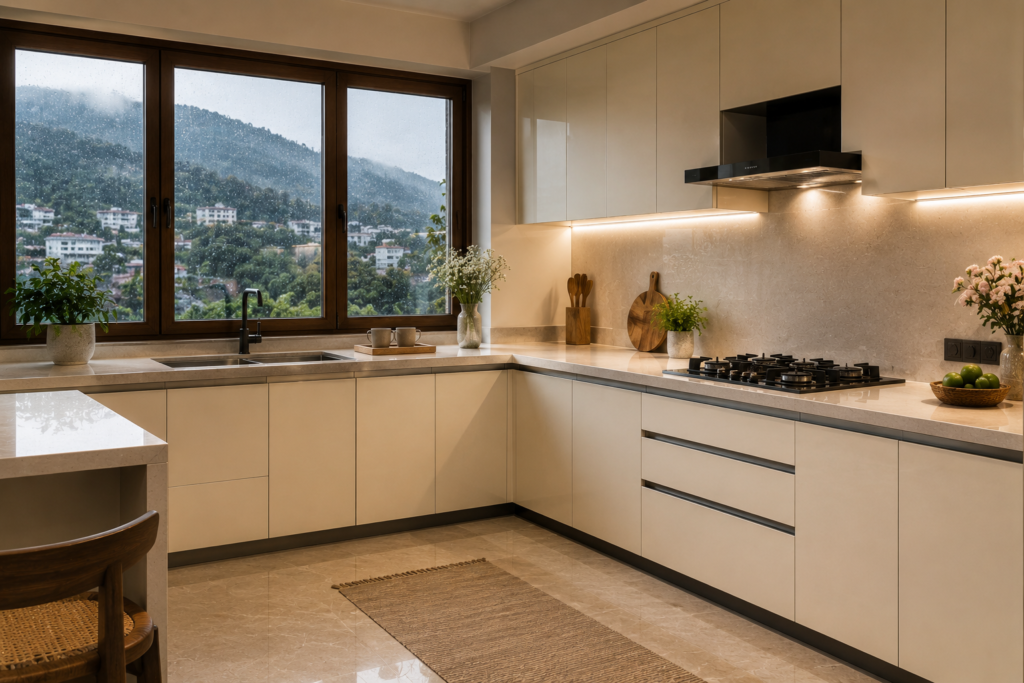
Estimated Cost Per Square Foot: Aluminium Kitchen Cabinets in North India (2026)
These are planning ranges based on market data and typical project specifications. Final pricing depends on site measurement, hardware specification, finish grade, GST, and installation complexity. Always get a detailed line-item quote before committing.
Cabinet / Shutter Type | Est. Cost Range (₹/sq ft) | Best Suited For | Key Advantage |
Basic ACP Shutters on Aluminium Frame | ₹350–₹550 | Budget rentals, utility kitchens | Low cost, light weight, waterproof shutters |
Powder-Coated Solid Aluminium Panels | ₹650–₹950 | Heavy-use family kitchens | Indestructible, high load, zero maintenance |
Wood Grain Sublimated Aluminium | ₹800–₹1,200 | Traditional / warm aesthetics in Dehradun villas | Natural wood look with metal durability |
Slim Profile with Fluted / Tinted Glass | ₹950–₹1,600+ | Noida / Ghaziabad apartment display kitchens | High-end visual, scratch-resistant glass |
Anodized Metallic Profile Systems | ₹1,000–₹1,500 | Contemporary, metallic-finish preference | Superior scratch resistance, real metal look |
Hybrid Aluminium Frame + HDHMR/BWP Shutters | ₹550–₹900 | Mid-range budget with waterproof base cabinets | Waterproof structure with wood-surface options |
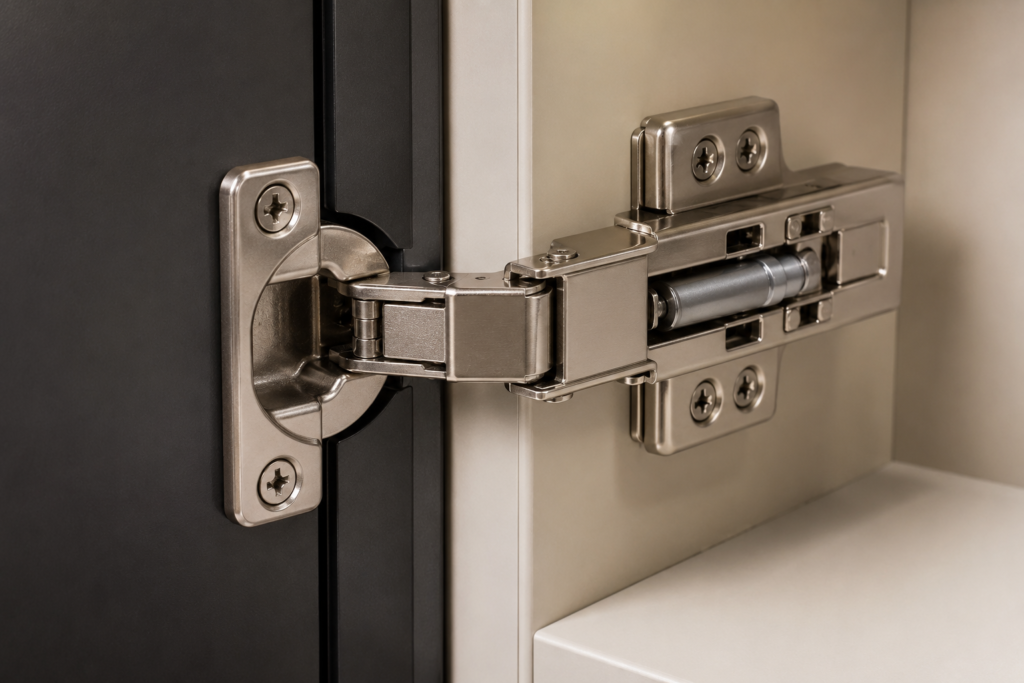
Hardware adds a separate layer of cost that is often underquoted. Soft-close hinges from Hettich, Ebco, or Blum-the brands whose hardware compatibility is specifically designed for aluminium profile systems-typically add ₹15,000–₹40,000 per kitchen depending on the door and drawer count. That is not optional spending if you want a kitchen that doesn’t develop rattles and alignment issues within two years.
How to Eliminate the "Clanging Metal Kitchen" Problem
One of the most repeated concerns in homeowner forums is noise. “Won’t aluminium doors clang every time I close them?” This is a real problem-in cheaply fabricated aluminium kitchens. In a properly specified system, it is fully solvable.
Three elements work together to eliminate metallic noise:
- Soft-close hydraulic hinges. Soft-close hinges designed for aluminium profile doors use a built-in hydraulic damper to absorb the last 15–20° of door movement. This prevents the door from striking the frame, eliminating impact noise. The result is a smooth, quiet close with no clang or slam.
- Rubber gasket strips. Quality aluminium door systems include a rubber or silicone gasket around the door perimeter. This gasket compresses on contact with the frame, cushioning the final closure point and also acting as a secondary seal against kitchen moisture and odours.
- Double-walled panel construction. A solid double-skin aluminium shutter has much lower acoustic resonance than a single-skin ACP panel. If noise is a concern, specifying double-walled solid panels over ACP shutters-at least for the most frequently used lower cabinets-addresses it at the structural level.
A kitchen that bangs and rattles is not an “aluminium kitchen problem”-it is an underfunded hardware problem. The material specification determines the fix, not the material category.
What Aluminium Kitchen Cabinets Are NOT Right For
We think every aluminium kitchen guide should include this section. Most don’t.
If you already have a structurally sound kitchen frame: Replacing only the shutters with aluminium profile doors is possible-but the carcass material still determines the moisture risk at the base. A new aluminium shutter on an old swollen plywood carcass does not fix the underlying problem; it covers it.
If your kitchen receives very heavy impact: Aluminium solid panels resist most impact, but a sharp corner-on impact (falling heavy utensil, edge of a pressure cooker) can produce a dent that is difficult to repair invisibly. On plywood with a hard laminate surface, a similar impact is more likely to crack the laminate but leave a repairable surface. If your cooking style involves a lot of heavy-object traffic near cabinet fronts, plan accordingly.
If your budget is truly limited: Below ₹300 per sq ft for shutters, the aluminium products available in the market tend to be very thin-gauge ACP or single-skin extrusions with no-name hardware. A well-made HDHMR plywood kitchen at a similar price will often deliver better real-world durability than a very cheap aluminium system. Aluminium’s advantage is in mid-to-upper range systems where the material and hardware quality actually match its performance potential.
Expert Buying Checklist: What to Inspect Before You Finalise Any Aluminium Kitchen Quote
Before signing off on a fabricator’s quote, run through these points. Ask for answers in writing.
- Frame gauge thickness: Request the profile wall thickness in millimetres. Minimum acceptable for base cabinet structural members is 1.2mm; 1.5mm or above is preferable. Thin-wall profiles flex under load and can distort at hinge mounting points.
- Alloy specification: Ask whether profiles are 6063-T5 or equivalent architectural-grade extrusion alloy. Avoid unspecified “aluminium” claims.
- Hinge and hardware brand: Confirm Hettich, Ebco, Blum, or equivalent named-brand soft-close hinges. Unbranded hinges frequently lose soft-close function within 12–18 months of daily use.
- Glass specification (if applicable): Toughened safety glass, minimum 4mm. Non-toughened glass in a kitchen shutter is a safety risk.
- Corner joint construction: Heavy-duty die-cast metal corner cleats or structural bracket screws. Avoid systems where corners are joined by thin bent sheet tabs-these loosen over time.
- Anodizing or powder coat thickness: Request certification or data sheet. Powder coat should be 60–80 microns; anodizing should comply with IS 1868 (15–25 microns).
- Structural warranty: Who warrants what, for how long, and in writing? Warranty on hardware (typically 1–5 years) is different from warranty on the structural frame (should be 10+ years for quality systems). Confirm both.
- Site measurement vs. fixed templates: A quality modular kitchen system is measured to your specific wall dimensions and manufactured accordingly. Kitchens installed from off-the-shelf fixed-size modules without site measurement adjustment will have gaps, filler strips, and alignment issues.
For Bhumim’s modular kitchen manufacturing and installation process in Dehradun-including site measurement, 3D visualization, and material selection-a free consultation covers all of these points before any commitment.
Frequently Asked Questions
Solid aluminium cabinets use fully extruded aluminium alloy panels for both the frame and the shutter face, giving maximum structural rigidity, load capacity, and acoustic mass. ACP (Aluminium Composite Panel) cabinets use a polyethylene or mineral core sandwiched between thin aluminium sheets-lightweight and cost-effective, but with lower impact resistance and dent resistance than solid extrusions. For heavy-use kitchens, solid panels are the stronger long-term choice; for budget installations or light-use areas, ACP is a practical option.
Yes-completely. Aluminium is an inorganic metal that offers no cellulose for termites to consume and absorbs zero moisture. Unlike treated plywood, where the anti-termite chemical can lose efficacy over time, aluminium’s termite and water resistance is inherent to the material and does not degrade. This makes aluminium kitchen cabinets particularly reliable in North Indian cities where termite activity is high and monsoon humidity is a recurring challenge.
For scratch resistance, anodized finishes generally outperform powder-coated ones because the oxide layer is part of the aluminium surface itself, not a separate coating. For colour range and aesthetic variety, powder coating wins significantly-over 200 RAL shades versus the metallic palette that anodizing naturally produces. In practical kitchen conditions, both perform well; the choice comes down to whether scratch resistance or colour flexibility is the higher priority.
In poorly fabricated systems, yes. In a properly specified modular aluminium kitchen with soft-close hydraulic hinges, rubber door gaskets, and double-walled panel construction, there is no metallic noise. The noise problem is a hardware and panel-quality problem, not an inherent property of aluminium. Always ask fabricators what hinge brand they specify before assuming the noise issue applies.
For base cabinets and areas near the sink-yes, aluminium is the most reliable material in humid climates. It does not absorb moisture, does not swell, and does not provide conditions for mould or fungal growth. BWP-grade plywood with proper edge banding is also a viable option for homeowners who prefer wood-based materials, but it requires more careful maintenance and does not perform as consistently over 15+ years in consistently high-humidity environments like Dehradun’s monsoon season.
Yes-fabricators can manufacture custom aluminium profile shutters sized to fit existing cabinet frames, and retrofit-compatible hinges are available for most standard plywood cabinet frame dimensions. However, this only addresses the shutter. If the existing plywood carcass is already swollen, has termite damage, or has compromised structural integrity, retrofitting shutters alone does not solve the underlying problem. Replacing only shutters makes sense when the carcass is structurally sound and the issue is aesthetic or shutter-specific.
Wood grain sublimation is a heat-transfer process where a photographic wood grain film is vacuum-baked at approximately 200°C onto a powder-coated aluminium surface. The ink sublimes directly into the coating, producing a finish that is visually and texturally similar to natural wood. Because the pattern is embedded in the coating rather than printed on top, it does not peel, chip, or fade under normal kitchen conditions. The sublimated aluminium cabinet delivers natural wood aesthetics with aluminium’s full structural and moisture performance.
In Noida and Ghaziabad, basic ACP aluminium shutters typically start around ₹350–₹550 per sq ft. Mid-range solid powder-coated systems run ₹650–₹950 per sq ft. Glass-profile and wood grain sublimated systems range from ₹800–₹1,600+ per sq ft depending on the glass type and profile specification. Hardware (soft-close hinges, tandem drawers) adds separately and should be budgeted as 15–25% of the total cabinet cost. These are 2026 market estimates; confirm current pricing with local fabricators after site measurement.
It depends on two things: your local climate and your budget tolerance for upfront cost versus long-term maintenance. In humid cities like Dehradun, Rishikesh, and Haridwar-or any apartment with poor kitchen ventilation-aluminium base cabinets pay for their higher upfront cost within 5–7 years through avoided replacement and repair. In drier, lower-humidity conditions where termite pressure is also lower, BWP plywood is a solid choice at a lower initial cost. A hybrid approach-aluminium for the wet zone, HDHMR for upper wall cabinets-often gives the best balance. No single answer fits every kitchen.
For base cabinet structural frames, insist on a minimum wall thickness of 1.2mm, with 1.5mm being the preferred specification for load-bearing members. Bring a digital calliper to the showroom or request a physical profile sample to measure yourself. Very few fabricators will object to a legitimate quality check, and the ones who do are revealing something important about how they operate. Above 1.8mm wall thickness, you are typically in the zone of high-specification commercial installations that exceed residential requirements.
Key Takeaways
- Aluminium kitchen cabinets come in five main construction types: solid extruded double-wall panels, aluminium frame with glass shutters, ACP (Aluminium Composite Panel), wood grain sublimated aluminium, and hybrid aluminium-plywood systems.
- All construction types share the core aluminium benefits: zero termite risk, complete waterproofing, no swelling, and zero formaldehyde emission.
- Finishes determine the look: powder coating offers 200+ RAL colour options; anodizing delivers superior scratch resistance with a genuine metallic appearance; wood grain sublimation reproduces real wood patterns on metal.
- For North Indian climates-Dehradun’s monsoon humidity, Rishikesh’s riverbank moisture, Noida’s cooking-intensive apartments-aluminium base cabinets are the most structurally reliable long-term choice.
- The “clanging metal” noise problem is a hardware and panel-quality issue, not an aluminium problem. Soft-close hinges, rubber gaskets, and double-walled panels eliminate it.
- Cost ranges from ₹350/sq ft (basic ACP) to ₹1,600+/sq ft (premium glass-profile systems); hardware specification adds 15–25% on top of cabinet cost.
- Always verify frame gauge thickness (minimum 1.2mm), alloy grade (6063-T5 is the architectural standard), hinge brand, and warranty coverage in writing before committing.
Aluminium is NOT always the right choice: for very tight budgets (below ₹300/sq ft), a well-made HDHMR kitchen often outperforms cheap aluminium. For dry climates and non-wet zones, BWP plywood remains a strong alternative.
Conclusion: The Kitchen That Stays the Same After Every Monsoon
Here is something we’ve observed across hundreds of kitchen installations in Dehradun, Haridwar, Noida, and Ghaziabad: the homeowners who are most satisfied five years after installation are not always the ones with the most expensive kitchen. They are the ones who matched their material specification to what their kitchen actually goes through every day.
If your kitchen faces a monsoon-season humidity swing, sits near a water source, deals with daily high-heat Indian cooking, or is in a building with any seepage history-aluminium is the right structural choice for your base cabinets. The design range in 2026 means you do not have to compromise on aesthetics to get that performance. Wood grain sublimation, fluted glass profiles, and anodized metallic finishes give you a kitchen that looks considered, not industrial.
The choice of type-ACP, solid extruded, glass-profile, wood grain, or hybrid-depends on where you sit in the budget range and what the kitchen needs to look like. Every type in this guide is a legitimate option for the right application. None of them is universally right or wrong.
If you are at the point of evaluating options for a kitchen in Dehradun, Noida, Haridwar, or anywhere in between, book a free 3D design consultation with Bhumim-we can walk you through material selection, layout planning, and a transparent per-square-foot quote based on your actual space.
About This Article
Published by: Bhumim India Private Limited-Modular Kitchen Manufacturer & Installer, Dehradun
GST: 05AAOCB1784F1ZM | ISO 9001:2015 Certified
Service Areas: Dehradun · Haridwar · Rishikesh · Roorkee · Noida · Ghaziabad
Contact: 08044630777 | hello@bhumim.com
Note: This article is written from Bhumim’s on-ground manufacturing and installation experience. All material recommendations are based on what we use in real kitchens across our service areas.