


Modular Kitchen Design
Benefits of German Modular Kitchen
Benefits of German modular kitchen: PUR edge banding, hardware ratings and pricing in Dehradun, Noida & Ghaziabad.
August 19, 2026
Kitchen drawer design works well when base units use deep drawers on full-extension, soft-close runners rated for the load. Bhumim plans widths of 300, 450, 600 or 900 mm, and a runner class written in kg on the quote. Keep shutters with roll-outs for the heaviest cast iron.
Below, a size table, a pots depth plan, a runner checklist and a cutlery fit guide follow, and a quote checklist closes the page.
On a Houzz thread, a homeowner asked whether lower drawers beat lower cabinets. The featured answer was drawers, since you reach the back without crouching. It warned to keep a few deep ones for pots and Dutch ovens. The thread is seven years old and from the US, so it is opinion, not a test.
Bhumim’s trolley guide quotes the same idea: a drawer needs one movement, while a roll-out behind a door needs two or three. It also notes that, in a US Houzz example, the roll-out base cost about $140 more than the drawer base.
There is one exception. A kitchen designer in the thread said a customer with heavy cast iron cookware got a full-height door cabinet with four roll-out trays. Another poster keeps plates in wall cabinets, because drawers move and breakables sit better on a fixed shelf.
On the other hand, we think drawers win for pots, cutlery and spices, and shutters still suit the sink base and very heavy items. Which of your daily items need a drawer?
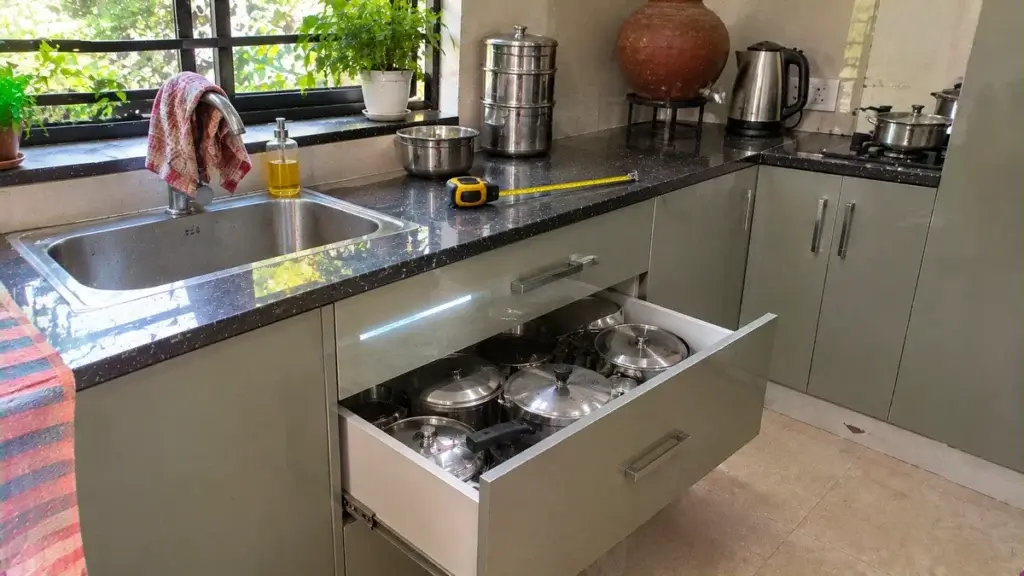
Standard cabinet widths in Bhumim’s trolley guide are 300, 450, 600 and 900 mm, with custom widths adding 15 to 25 percent. A base cabinet is 24 inches (61 cm) deep in the platform height guide. The inside space is smaller, because the sides, the back and the runner all take room. Kitchen drawer design size follows from what each drawer holds.
Item | Planning figure | In feet or inches | Source |
Drawer widths | 300, 450, 600, 900 mm | 1.0 to 3.0 ft | Bhumim trolley guide |
Base cabinet depth | 610 mm | 24 in | Bhumim platform guide |
Custom width | Adds 15 to 25 percent | n/a | Bhumim trolley guide |
Poster’s drawer fronts (US) | 127 to 152, 203 and 330 mm | 5 to 6, 8 and 13 in | Houzz pots and pans thread |
One Houzz poster planned three drawers for pots and pans. The fronts were 5 to 6, 8 and 13 inches beside a stack for small appliances. That adds up to about 26.5 inches, or 673 mm, before gaps. In our arithmetic, the rest of the base height goes to the plinth, the top and the countertop.
Measure the inside width after the side panels, not the outside size. Have you listed what each drawer will hold before you fix its height?

For expert design consultation, send us your details and we’ll schedule a call
A Houzz designer in the lower-drawer thread says to know the heights of what goes into each drawer. Use quality glides too, because a crock pot and large pots make a heavy load. A pots and pans drawer therefore needs the deepest front you can plan.
Weigh your set before you pick a runner. As an assumption, five steel pots at 2 kg each is 10 kg. Add a pressure cooker at 4 kg and three lids at 0.5 kg each, and the total is 15.5 kg. A drawer that takes that load daily needs a runner class well above it.
Bhumim’s trolley guide gives a heavier example: a pressure cooker with a stack of steel pans could reach 25 kg. That is close to the limit of a 30 kg class, so the guide would choose 40 kg or more.
Pots drawer step | What to do | Why |
List the cookware | Write each pot with its height | The tallest pot sets the front height |
Add the weight | Total kg, including food and lids | This sets the runner class |
Pick the depth | Use the full inside depth | Short drawers waste the back |
Check the front | Allow for the lid knob | Tall lids catch the drawer above |
We suggest a deep drawer on the lowest tier for pots and a shallow one above for lids and trays. Heavy cast iron may still suit a door with roll-out trays, so which is your heaviest pot?
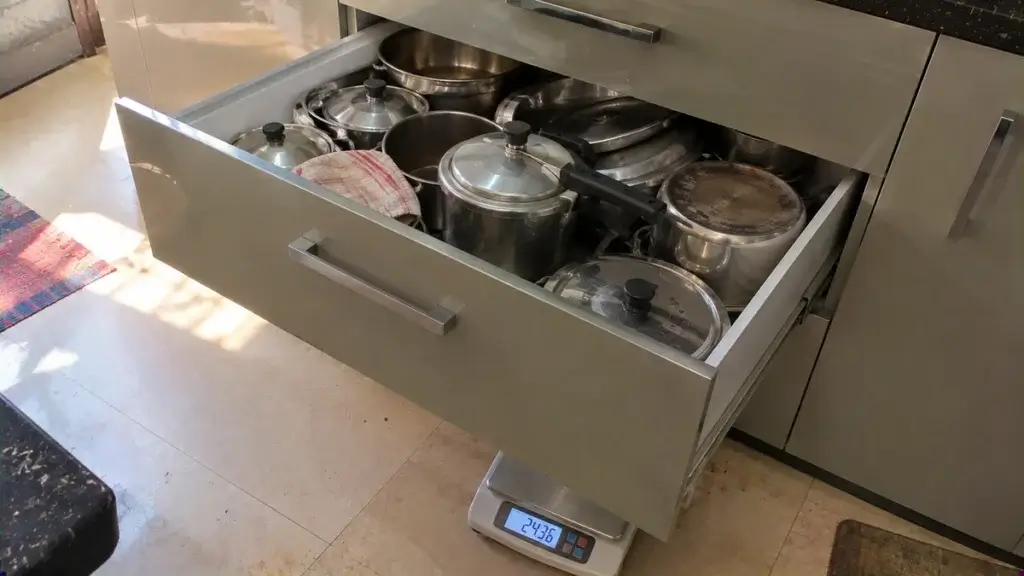
Bhumim’s trolley guide says to ask for the runner class in kg, written on the quote. It calls full extension worth having on every unit you reach into from above. Blum’s TANDEMBOX page lists 30 kg and 65 kg load classes, a load capacity of up to 65 kg, and a soft-close option.
Check | What to ask | Why it matters |
Load class | Runner class in kg, on the quote | A drawer sags when overloaded |
Extension | Full or partial | Full shows the whole drawer |
Soft-close | Built in or add-on | Consistency over years, not day one |
Brand | Named on the quote | You can trace the warranty |
Bhumim’s accessories guide lists load rating and soft-close consistency over repeated use as what to compare. That means a demo on day one tells you little. We suggest asking how the soft-close feels after a full year of daily use.
However, a soft-close drawer can feel stiff under a heavy load. Test it with a full set of pots in your hands. Does your quote name the brand and the class?

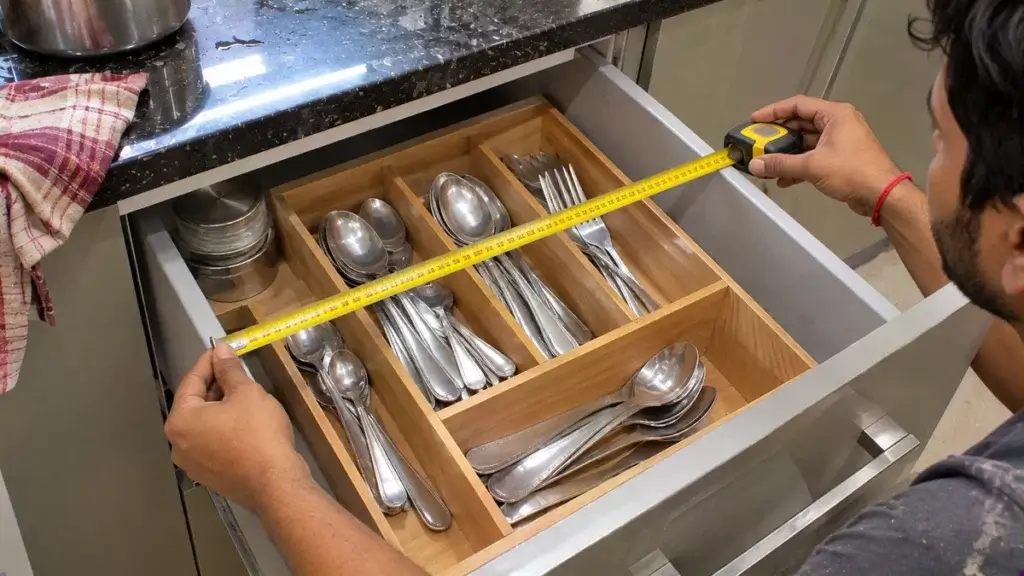
Bhumim’s accessories guide says cutlery trays sit inside drawers and split the space for spoons, knives and serving ware. It adds that loose trays shift and rattle, so the tray must match the drawer size.
Measure the inside width and depth after the sides and the runner are in. Then pick a tray that fits that opening, or one you can cut down. Kitchen drawer design inside the box matters too: liners, trays and dividers.
One Houzz poster, who has all lower drawers, uses non-skid liners and a few movable dividers. The poster says rearranging them a month later was no fuss. The poster adds that built-in dividers would have locked the layout.
Zone | Drawer contents | Poster’s rule |
Near the hob | Pots, spices, utensils | Keep items near the point of use |
Prep area | Knives, boards, colanders | Same rule, from the thread |
Near the dishwasher or sink | Plates, bowls, cutlery | Unload with the least distance |
Do you want fixed dividers or movable ones? We think movable ones suit a family whose cooking changes, though a fixed tray looks tidier. A small kitchen drawer design should keep the cutlery drawer close to the sink and the hob.
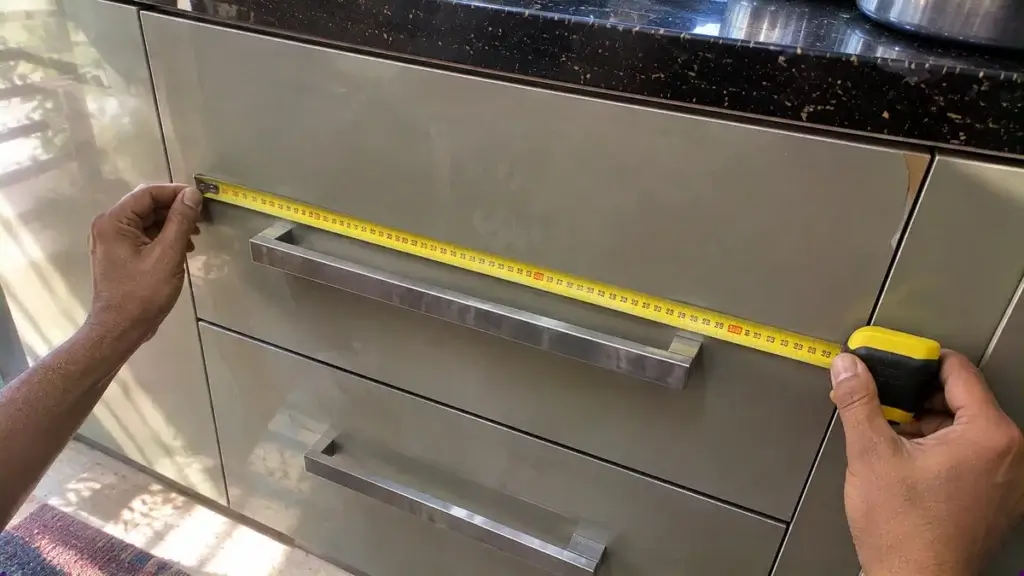
Handles decide how a drawer feels, and Bhumim’s handles guide says to use two pulls on any drawer 46 cm (18 inches) or wider. Keep a bar pull to two-thirds or three-quarters of the drawer width. It also says to buy by hole centres, because the shutter is drilled for one spacing.
The same guide says pulls on the top rail make lower drawers easier to open, especially for taller users. A brushed or lightly textured steel face hides marks far better than a polished one.
For kitchen drawer design without handle, the guide treats handleless as a separate route. Those systems are built into the cabinets, so they are hard to add later, so decide before the carcass is made.
A modern kitchen drawer design often uses plain, flush fronts with one long pull, which also keeps the front easy to wipe. Do you want pulls or a handleless edge?
A modular kitchen drawer design starts from the work zones, which the modular kitchen designs pages show for each layout. Put pots and spices near the hob, knives and boards in the prep area, and plates near the dishwasher or sink.
Bhumim’s trolley guide adds a rule for the aisle. Keep it at least 90 cm so a fully open drawer still leaves room to stand. In a small kitchen that rule can decide whether you use a 600 mm or a 450 mm drawer beside the hob.
The trolley guide cites Bhumim’s small kitchen guide for a masala pull-out beside the hob that holds 20 to 30 jars. On the other hand, it notes that a 900 mm drawer is harder to pull when it is full of cookware.
A Houzz poster has drawers 9 to 24 inches wide but only 12 inches deep on the back of an island. They hold measuring cups, pie plates and food storage. Shallow drawers have a place too.
For kitchen drawer design ideas, count your items first. Then the number of drawers follows, not the other way round. How many drawers does your cooking need?

Dehradun’s monsoon is humid, and the India Meteorological Department’s Climate of Dehra Dun report puts daily maximum humidity near 90 percent by late July. Those are 1971 to 2010 normals. In our reading, runners and drawer bottoms take that damp daily, so ask what the carcass and the runner finish are.
For a 1 to 3 BHK flat in Noida or Ghaziabad, the aisle is often the limit. A narrow kitchen may suit 450 mm drawers with a full pull-out, not a 900 mm one that blocks the walk.
Bhumim’s team typically takes 3 to 7 days for the design and 3D preview. That is the window to check each drawer height against your pots, such as a tall pressure cooker. An Indian kitchen drawer design also needs room for it. Is your aisle at least 90 cm?

Drawers are hard to change once the carcass is made, so these are the slips worth catching on paper.
Most of these cost nothing to avoid, so which one could catch you out?
Want the drawers planned against your kitchen? Share your platform length and a list of what you store, and review each drawer in a free 3D design. Call or WhatsApp 08044630777 or fill in your details at bhumim.com.
With the sizes, the runner class and the layout fixed, you can compare quotes on the same terms.
Mostly yes. The featured Houzz answer says drawers are easier to use and reach the back corner, but keep a few deep ones for pots. Another poster keeps plates in wall cabinets, and a designer used roll-out trays for heavy cast iron. Choose drawers for daily items and shutters for the sink base.
In Bhumim’s trolley guide, standard cabinet widths are 300, 450, 600 and 900 mm, and a base cabinet is 24 inches (61 cm) deep in the platform guide. Heights vary by use. A Houzz poster planned fronts of 5 to 6, 8 and 13 inches. Measure inside the sides and runner.
Use the full inside depth of the base cabinet, and a front tall enough for your tallest pot with its lid. A Houzz designer says to know the height of what goes in each drawer. List your cookware first, then set the front height, not the other way round.
It depends on the runner. Blum’s TANDEMBOX page lists 30 kg and 65 kg load classes. Bhumim’s trolley guide says to ask the seller for the runner class in kg, written on the quote. Add up your pots and lids first, then choose a class well above that total.
Soft-close is a comfort, and it matters most on heavy drawers that slam. Bhumim’s accessories guide says to compare load rating and soft-close consistency over repeated use, not just on day one. Ask for the brand and the class on the quote, and test it with a full load.
Store things near where you use them. A Houzz poster puts knives, boards and colanders in the prep area, pots and spices near the stove, and dishes near the dishwasher. Movable dividers let you rearrange later, while built-in ones lock the layout, so choose by how often your cooking changes.
Count your items first, then stack tiers by height. One Houzz poster planned fronts of 5 to 6, 8 and 13 inches for pots and pans. The sink base usually stays a shutter. In a small kitchen, a 450 mm drawer beside the hob can do more than a 900 mm one that blocks a 90 cm aisle.
Yes, but decide early. Bhumim’s handles guide treats handleless as a separate route, built into the cabinets and hard to add later. If you want pulls, buy by hole centres, and use two pulls on any drawer 46 cm or wider. Ask your maker which edge profile they use.
Call or WhatsApp Bhumim at 08044630777, or fill in your details at bhumim.com/contact. Share your platform length and a list of what you store, and the team shows each drawer in a free 3D design, typically within 3 to 7 days.
A drawer works when its size, its runner and its place in the layout are chosen for what it holds. Decide those first, then pick the front and the pull.
If you are planning a kitchen in Dehradun, Haridwar, Noida or nearby, call or WhatsApp Bhumim at 08044630777 or reach out through bhumim.com/contact for a free 3D design, and ask how your drawers should be planned.
Published by: Bhumim India Private Limited-Modular Kitchen Manufacturer & Installer, Dehradun
GST: 05AAOCB1784F1ZM | ISO 9001:2015 Certified
Service Areas: Dehradun · Haridwar · Rishikesh · Roorkee · Noida · Ghaziabad
Contact: 08044630777 | hello@bhumim.com
Note: This article is written from Bhumim’s on-ground manufacturing and installation experience. All material recommendations are based on what we use in real kitchens across our service areas.
Benefits of German modular kitchen: PUR edge banding, hardware ratings and pricing in Dehradun, Noida & Ghaziabad.
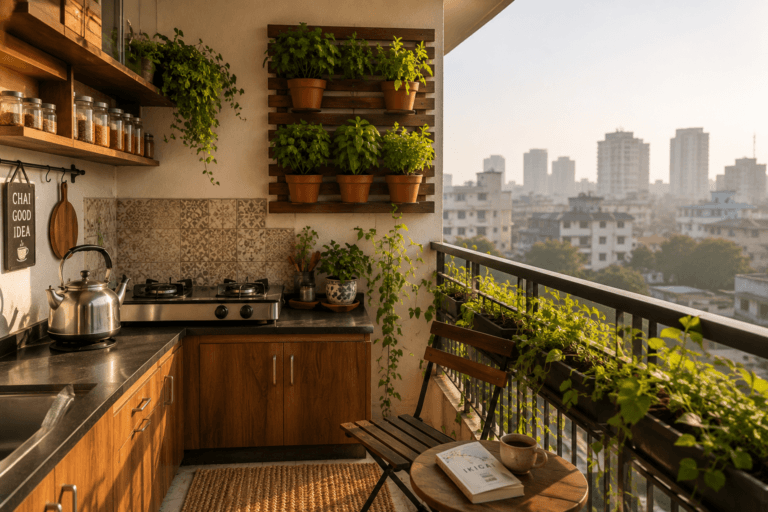
Seven balcony kitchen ideas for Indian apartments: counter, herb garden, grill and chai station layouts, plus WPC vs plywood for monsoon.

Planning a modular kitchen upgrade before Diwali? Here's a realistic 10-day installation plan, material choices, and site prep checklist.