


Modular Kitchen Design
Arch Kitchen Design Ideas to Enhance Your Home Décor
Arch kitchen design ideas for Indian homes – POP, wood, and glass options, local cost in Dehradun & NCR, smoke tips, and modular integration.
July 29, 2026
Kitchen corner cabinet solutions fit three jobs. A magic corner suits heavy items in an 800 by 800 mm corner. A carousel suits light items in a tight one, and drawers suit wide cabinets. Order the mechanism with the carcass, because Bhumim’s guides say it is hard to add later.
Below, a comparison table, sizes in mm, a two-corner cost example and a quote checklist follow, so you can pick before the carcass is made.
A blind kitchen corner cabinet is a base unit where two walls meet and part of the interior hides behind the next cabinet. Bhumim’s accessories guide says up to half of a corner unit’s volume is unreachable without a magic corner or a carousel. It adds that a poorly planned corner can waste close to two cubic feet in a compact kitchen.
In our arithmetic, two cubic feet is about 57 litres, space you cannot reach. That is the cost of a plain shelf in the corner.
The L-shaped kitchen guide calls the corner the most difficult and most underused space in any kitchen. It warns that a standard shelf corner cabinet leaves the back inaccessible for years, so the corner is a design choice, not a leftover.
We think the choice comes down to three things: the size of your corner, the weight of what you store, and your budget. Which of those three limits your own kitchen the most?
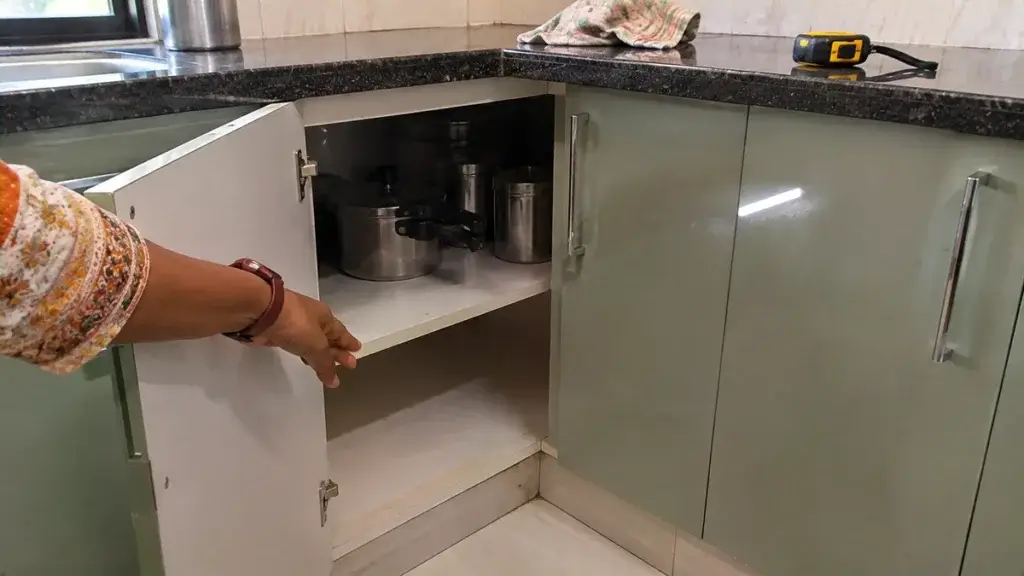
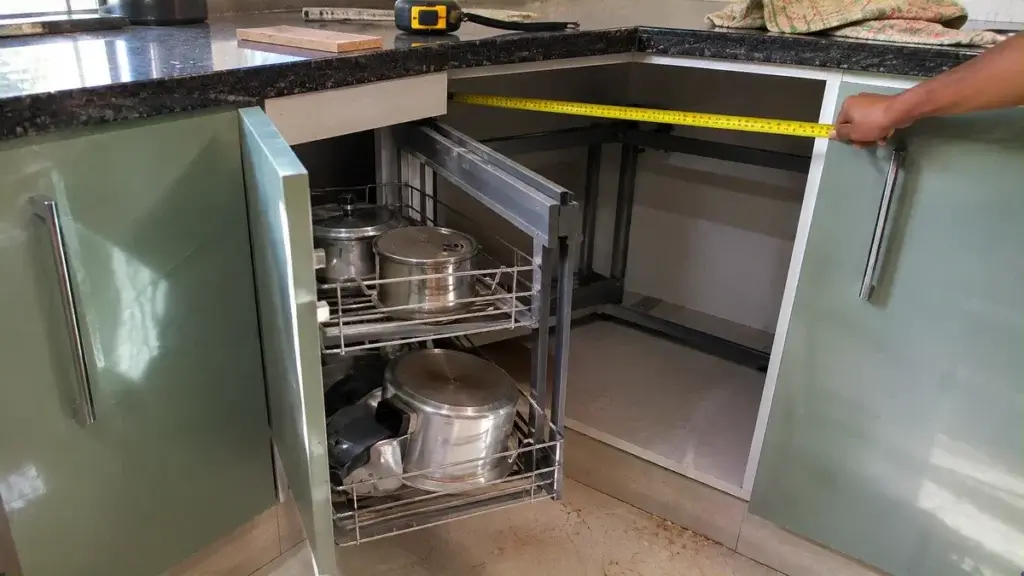
Bhumim’s pantry guide describes the magic corner and LeMans type as a linked tray set. It is designed for L-shaped corner cabinets with a minimum internal clear size of 800 by 800 mm. It pulls out and swings aside. A branded unit carries 25 to 45 kg in total, and the hardware costs Rs 18,000 to 45,000.
The accessories guide adds that magic corners hold more weight and suit larger corner cabinets. The L-shaped guide says a magic corner costs more than a carousel but gives full visibility of every item.
Blum hardware, according to the L-shaped guide, is used in several Bhumim projects. The U-shaped guide goes further, because it says a Blum magic corner saves more daily frustration over five years than an upgraded acrylic finish. That is Bhumim’s own view, so read it as advice on where to spend, not as a test result.
Here the trade-off is size. If your corner is smaller than 800 mm each way, a magic corner will not fit. A carousel or a diagonal door is the better route. Have you measured the clear inside of your corner?
For expert design consultation, send us your details and we’ll schedule a call
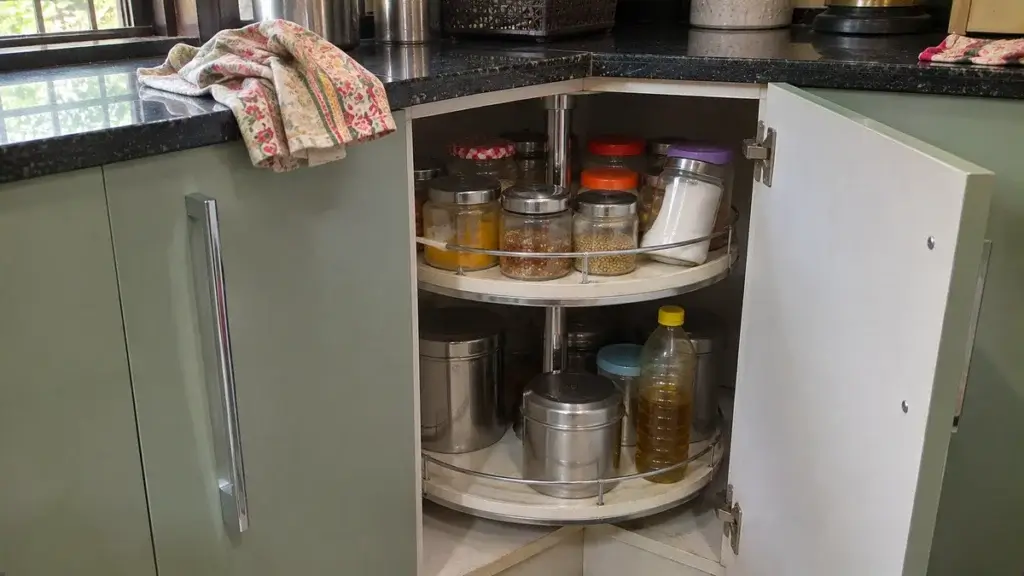
A carousel is a rotating circular shelf in the corner cabinet. The U-shaped kitchen guide says it suits light items such as spice jars, small containers and condiments. The L-shaped guide warns that carousel units are not ideal for heavy cookware, because the spinning mechanism has weight limits.
Bhumim’s pantry guide adds that a carousel needs a circular cutout and still leaves the back quadrant hard to reach. The accessories guide says carousels work well in tighter spaces, which is why they are the usual pick for a small kitchen corner cabinet.
One Houzz poster described a two-level kidney-shaped susan. It holds a large crock pot, a small one, a blender and a stack of big steel bowls. Another owner dislikes a susan with a hinged door. Both are opinion, from a 14 year old US thread.
However, a carousel is a weak choice for heavy cookware but suits light, often-used items, so what will you keep in yours?
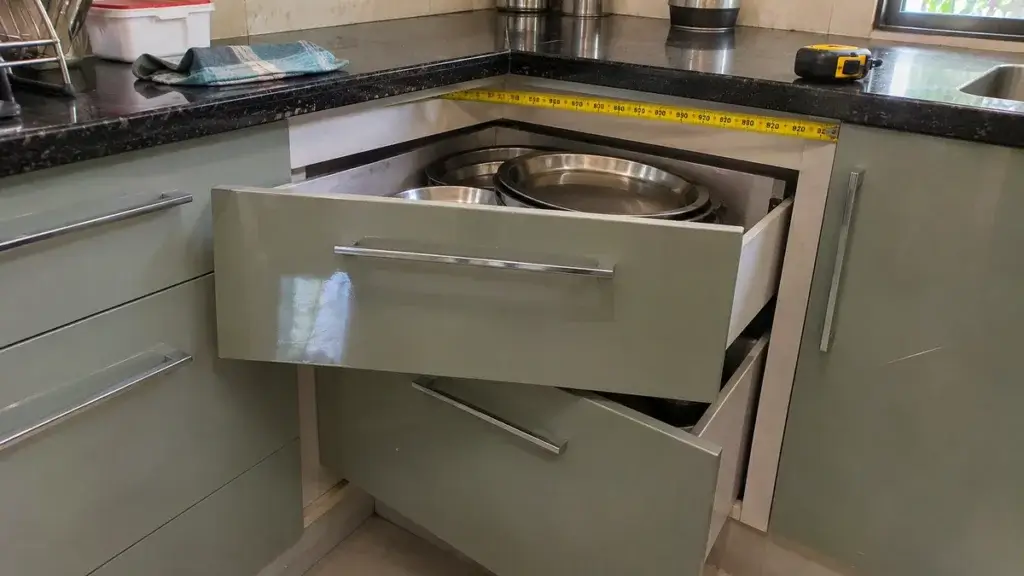
Blum’s SPACE CORNER page describes corner drawers or pull-outs that use standard fronts, hold up to 65 kg and close softly. Its recommended cabinet width is 900 to 1,200 mm, or about 2.95 to 3.94 feet in our conversion. The fronts swing inwards, so they do not catch the neighbouring cabinet.
A Houzz owner who has corner drawers did the maths in a 14 year old thread. In a 36 inch (914 mm) square cabinet, one pie-cut susan tray and one corner drawer hold about the same, within roughly 2 percent. Most people fit two susan trays against three or four drawers, so drawers win on surface area.
The U-shaped guide also lists a diagonal corner cabinet with a door angled at 45 degrees. It is a lower-cost option for moderate use, with no mechanical unit. The L-shaped guide mentions an L-shaped drawer set for small kitchens.
On the other hand, drawers need width, so in a small corner they lose to a carousel. Do you have 900 mm or more along the run?
Cabinet material also matters here; our guide to aluminium kitchen cabinets explains the styles and durability.
This table puts the options side by side. The figures are from Bhumim’s guides and Blum’s India page, and the last column is our judgement.
Option | Corner needed | Load | Trade-off |
Plain blind shelf | Any size | n/a | Half the volume unreachable |
Carousel | Tight corner works | Weight limits, light items | Back quadrant stays hard to reach |
Magic corner or LeMans | At least 800 x 800 mm inside | 25 to 45 kg, branded | Hardware Rs 18,000 to 45,000 |
Corner drawers | 900 to 1,200 mm wide | Up to 65 kg (Blum) | Needs width along the run |
Diagonal door | Moderate corner | Moderate use | Smaller door opening |
A modern kitchen corner cabinet often uses plain flush fronts, so the door gaps and handle positions in the corner need a drawing. In an L-shaped plan, check that the corner door can open past the adjacent drawer. In a U-shaped plan, repeat that check at both corners, because a clash at one corner is easy to repeat at the other.
The kitchen corner cabinet design that suits you is the one that matches your corner and your load. A modular kitchen corner cabinet also needs the plan to show which way each door swings. Which row looks like your kitchen?

In an L, the two arms meet at the corner. The L-shaped kitchen guide warns that base cabinet doors in the corner area sometimes swing into each other if not planned. That is one reason it recommends pull-outs and carousels over standard hinged-door corner cabinets.
See how the arms are laid out in Bhumim’s L-shaped kitchen designs. The same guide says the refrigerator belongs at the end of one arm, not in the corner. A corner fridge blocks movement and makes the door swing awkward.
Ask your maker for a plan view that shows every door and drawer front swinging open at once. A drawer front hitting a door handle is easy to spot on paper and costly to fix later.
We suggest you also check the hob and sink, since a corner cabinet beside them gets splashes and heat. Does your plan show every door open at once?
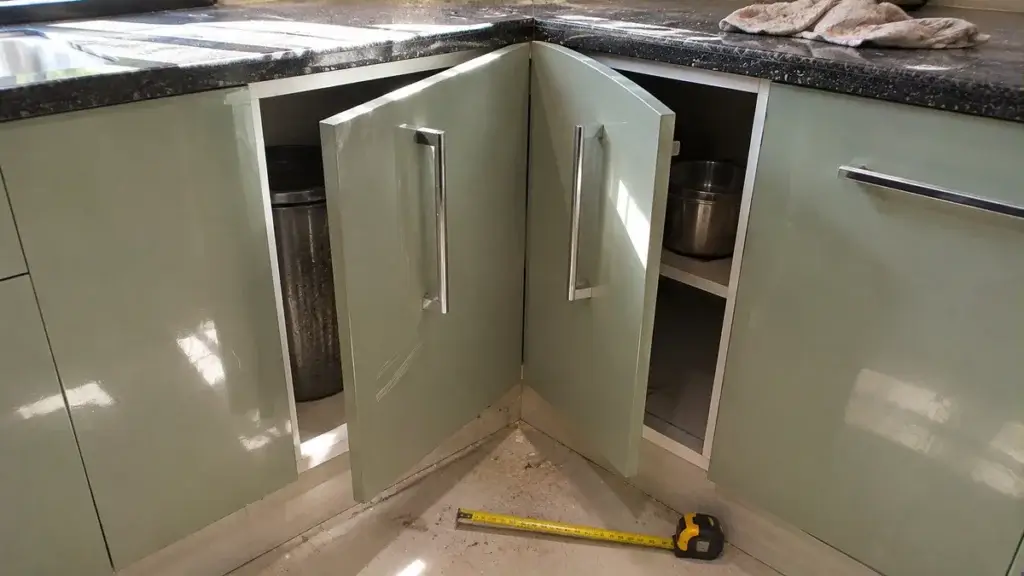
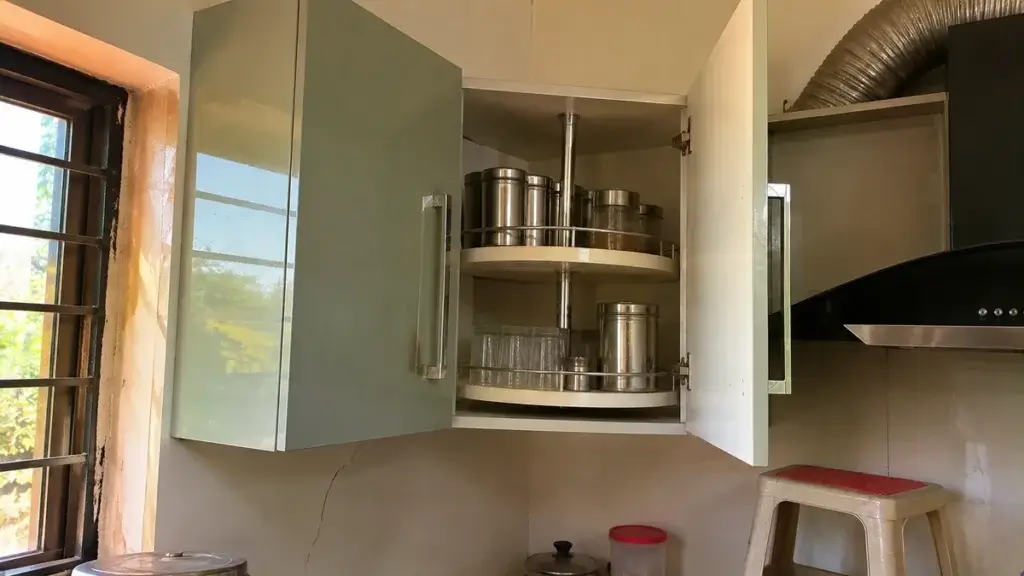
Wall cabinets create a dead zone in the corner as well. The L-shaped guide suggests using the upper corner for a chimney or a decorative element. In a U-shaped layout, two upper corners are in play, so the same choice repeats.
A kitchen corner cabinet shelf in the upper corner can be a corner wall unit with a carousel or a simple open shelf. One Houzz poster says a lazy susan helps most in an upper corner, which they call lost space without one.
Keep the weight low, because an upper carousel hangs on the wall and your reach is above the shoulder. We think upper corners suit light items such as masalas, tea and rarely used glasses. Which items in your kitchen do you reach for every single day?
In a small flat, a small kitchen corner cabinet should be a carousel or a diagonal door, since magic corners need 800 mm each way. The U-shaped guide says deep corner cabinets can waste up to 30 percent of their usable depth. It puts a tall pantry beside the corner, not in it. See the accessories guide on matching hardware.
Plan | Hardware per corner | Cost (our arithmetic) |
One corner (L-shaped) | Rs 18,000 to 45,000 | Rs 18,000 to 45,000 |
Two corners (U-shaped) | Rs 18,000 to 45,000 each | Rs 36,000 to 90,000 |
The U-shaped guide says corner accessories must be ordered with the kitchen modules and cannot be added easily afterwards. It also advises buying hardware from Blum or Hafele for smooth years of use.
The accessories guide warns that a magic corner, a larder and several pull-outs in a compact kitchen can eat usable volume. Pick one or two, not all. Is your kitchen an L or a U, and how many corners does it have?
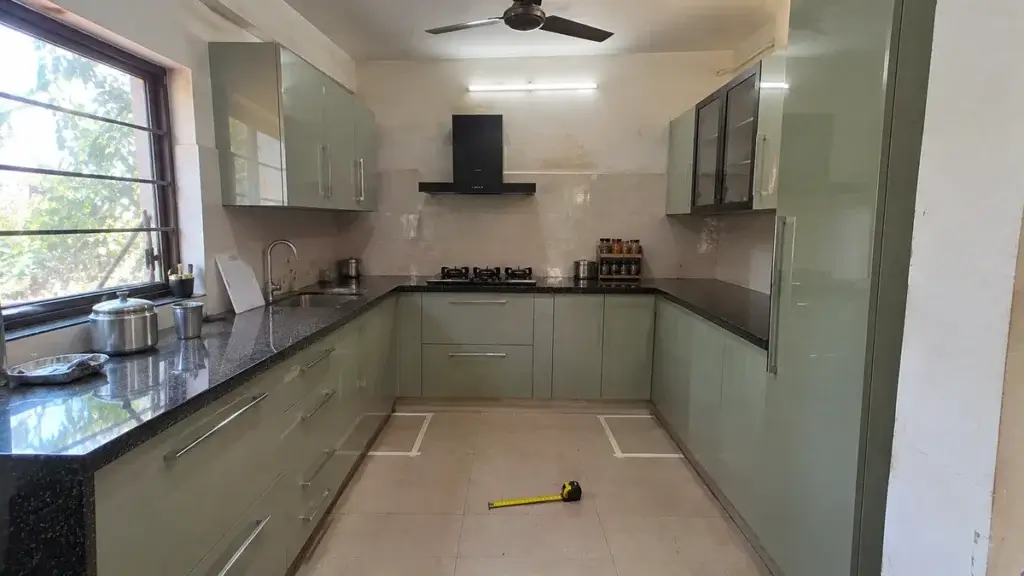
Dehradun’s monsoon is humid. The India Meteorological Department’s Climate of Dehra Dun report puts daily maximum humidity near 90 percent by late July. Those are 1971 to 2010 normals. In our reading, a corner mechanism sits in a closed box at the sink or hob end. Ask about the finish of the runners and the baskets.
Independent homes on Rajpur Road and GMS Road in Dehradun have more generous ceilings than compact flats, says the U-shaped guide. That suits a tall pantry beside the corner wall, because it adds vertical storage while the corner itself stays simple.
In a 1 to 3 BHK flat in Noida or Ghaziabad, the corner is often small. A carousel or a diagonal door is more realistic than a magic corner. A larger Haridwar or Dehradun home may take a magic corner at each end of a U.
Bhumim’s team typically takes 3 to 7 days for the design and 3D preview. That is the time to check the clear size of your corner and every door swing. Is your corner at least 800 mm each way?
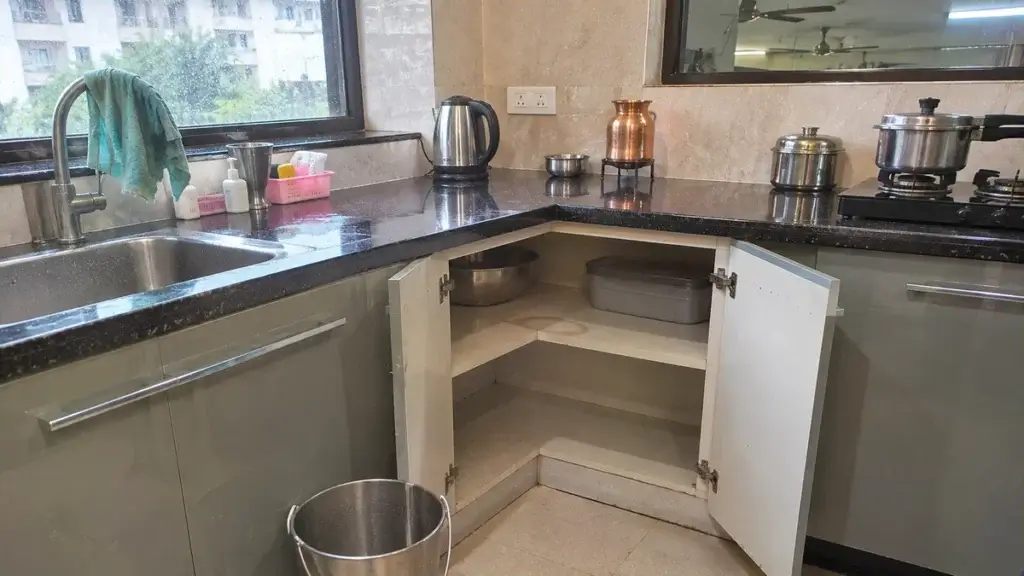
A corner is tied to the carcass, so these are the slips worth catching on paper.
Most of these cost nothing to avoid on paper, so which one could catch you out?
Want your corner planned against the real layout? Share your corner size and the items you store, and review the mechanism in a free 3D design. Call or WhatsApp 08044630777 or fill in your details at bhumim.com.
With the corner size, the load and the door plan fixed, you can compare quotes on the same terms.
It depends on the corner size and load. Bhumim’s guides suit a magic corner to a larger corner of at least 800 by 800 mm inside, and a carousel to a tighter one with light items. Corner drawers need 900 to 1,200 mm of width. Match the choice to your corner, not to a photo.
It is a base cabinet where two runs meet and part of the inside sits behind the neighbouring cabinet. Bhumim’s accessories guide says up to half of a corner unit’s volume is unreachable without a magic corner or a carousel. A plain shelf there wastes the most space.
Bhumim’s pantry guide gives a minimum internal clear size of 800 by 800 mm for a magic corner or LeMans unit in an L-shaped corner. Measure after the side panels, both ways. If your corner is smaller, a carousel or a diagonal door is the realistic choice.
Opinions differ. A Houzz owner with corner drawers found a single pie-cut susan tray and a drawer hold within about 2 percent of each other, while drawers win on surface area when stacked. Another poster prefers a magic corner. Choose by what you store and how wide your run is.
In the same Houzz thread, one owner hates the hinged door on a three-quarter susan and keeps it open while baking. Doors that open into the room can also clash with the next unit. Ask your maker about a door attached to the tray, and test the swing on the plan.
It varies by type. Bhumim’s pantry guide lists 25 to 45 kg in total for a branded LeMans or magic corner, and Blum’s SPACE CORNER page says up to 65 kg. Carousels have weight limits and suit light items. Ask for the load rating in kg on the quote.
Bhumim’s pantry guide puts a branded magic corner or LeMans mechanism at Rs 18,000 to 45,000 for the hardware. For a U-shaped kitchen with two corners, that is Rs 36,000 to 90,000 by our arithmetic. The carcass, the doors, installation and GST are extra, so ask the quote to list each one separately.
Match the items to the mechanism. Bhumim’s U-shaped guide says a carousel suits spice jars, small containers and condiments, and a magic corner suits heavier items. Keep what you use daily nearest the opening, and keep heavy pots on a base that is rated for them.
It is hard. Bhumim’s accessories guide says a corner accessory is tied to the carcass structure, and the U-shaped guide says corner accessories must be ordered with the kitchen modules. Decide the mechanism at the design stage, and ask for it on the first quote.
Call or WhatsApp Bhumim at 08044630777, or fill in your details at bhumim.com/contact. Share your corner size in mm, what you store and a photo of the wall, and the team shows the mechanism in a free 3D design, typically within 3 to 7 days. You can also ask for a plan view that shows every door swing.
A corner works when the mechanism, the corner size and the door plan are chosen together. Measure first, then pick the type, and put the load rating on the quote.
If you are planning a kitchen in Dehradun, Haridwar, Noida or nearby, call or WhatsApp Bhumim at 08044630777 or reach out through bhumim.com/contact for a free 3D design, and ask how your corner should be planned.
Published by: Bhumim India Private Limited-Modular Kitchen Manufacturer & Installer, Dehradun
GST: 05AAOCB1784F1ZM | ISO 9001:2015 Certified
Service Areas: Dehradun · Haridwar · Rishikesh · Roorkee · Noida · Ghaziabad
Contact: 08044630777 | hello@bhumim.com
Note: This article is written from Bhumim’s on-ground manufacturing and installation experience. All material recommendations are based on what we use in real kitchens across our service areas.
Arch kitchen design ideas for Indian homes – POP, wood, and glass options, local cost in Dehradun & NCR, smoke tips, and modular integration.

Types of aluminium kitchen cabinet design: powder-coated, glass-profile, wood-grain & ACP. 2026 price guide for Dehradun.
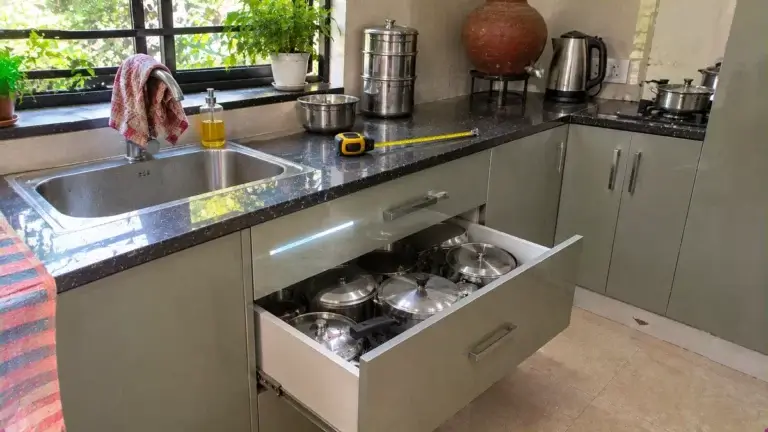
Planning kitchen drawer design? See base-drawer sizes in mm, soft-close runner checks, pots and pans depth and cutlery tray fit.