

Blue Kitchen Cabinets: Design, Shade, and Material for Indian Homes (2026)
Blue kitchen cabinets work beautifully in Indian homes when you match the shade to your kitchen’s size and light-deep navy for spacious layouts with natural light, teal or dusty blue for compact apartments-and finish the carcass in HDHMR or BWP-grade plywood to handle monsoon humidity, turmeric splashes, and the daily reality of Indian cooking. Pair the cabinets with white quartz countertops or light granite, add brushed brass handles, and install warm LED profile lighting under wall units to keep the space bright and inviting.
Why Blue Kitchen Cabinets Are Having a Moment in Indian Homes-and Why That's Not a Coincidence
After installing modular kitchens across Dehradun, Haridwar, Noida, and Ghaziabad, we notice the same shift again and again. Homeowners who once defaulted to warm wood or off-white finishes are walking into the showroom asking specifically for blue. Not “something different.” Blue.
Blue carries a psychological weight that makes a kitchen feel grounded and deliberate rather than temporary. Colour psychology research consistently links blue tones to calm, focus, and a sense of controlled space-qualities that matter when you’re spending 60–90 minutes in a kitchen every morning cooking for a family.
In 2026, navy blue modular kitchens are among the most requested cabinet colours across India, based on design trend data from the Indian modular kitchen industry. The shift is especially visible in Tier 2 cities like Dehradun, where villa renovations along Rajpur Road and Sahastradhara Road increasingly feature dark-tone kitchens that would have felt risky just a few years ago. Across Noida and Ghaziabad, compact L-shaped kitchen designs in muted teal and dusty blue are replacing the builder-flat laminate beige that once dominated high-rise apartments.
There’s one important thing to settle early: blue cabinets are not a passing trend the way chevron backsplashes or open shelving crazes were. After white, blue is consistently the second most popular colour for kitchen cabinetry globally, and it has held that position for over a decade. The shade families cycle-navy was dominant, then cobalt, now muted blue-grey and teal are leading-but blue itself doesn’t go anywhere.
That said, getting it right requires more thought than choosing a colour from a swatch. The right shade, material, and pairing differ significantly between a hilltop villa in Dehradun, a compact flat in Noida Sector 62, and a holiday home near the Rishikesh riverfront. This guide covers all of it.
Get started with Beautiful Homes
For expert design consultation, send us your details and we’ll schedule a call
What Shade of Blue Actually Works for Your Kitchen?
The most common mistake with blue kitchens isn’t choosing the wrong shade-it’s choosing the right shade for the wrong space. A colour that looks stunning on a large Instagram kitchen can feel oppressive in a 90 sq ft apartment kitchen with one small window. Here’s how to match the shade to your specific conditions.
Navy Blue and Royal Blue: For Spacious Kitchens With Strong Natural Light
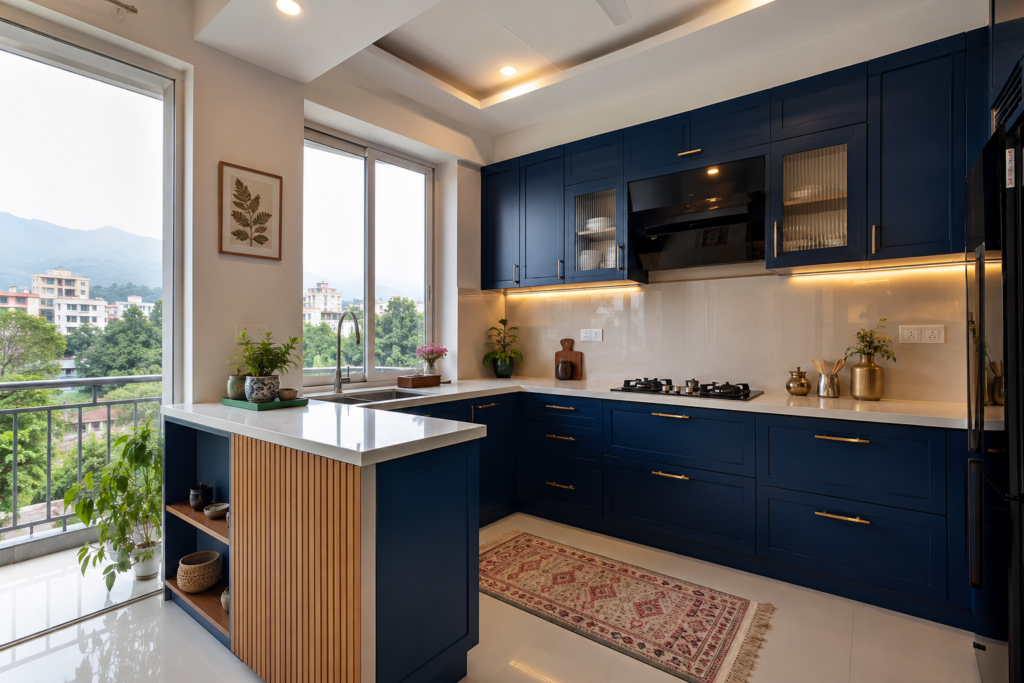
Navy blue is a deep, anchoring tone that reads as regal rather than heavy-but only when there’s enough natural light to let it breathe. Think independent houses along Dehradun’s Vasant Vihar, Noida villas with floor-to-ceiling windows, or any kitchen that gets at least 4–5 hours of direct sunlight.
Paired with white quartz countertops, brushed gold or brass handles from brands like Hafele, and glass-front upper cabinets, navy blue lower units create a two-level contrast that adds depth without closing the room in. One practical tip: if the kitchen has only one window or relies heavily on artificial light, go with the next shade lighter. Navy in a dark kitchen is the design choice most likely to trigger the “it felt smaller than I expected” regret we hear from homeowners.
Teal and Dusty Blue: The Smart Choice for Compact Urban Kitchens
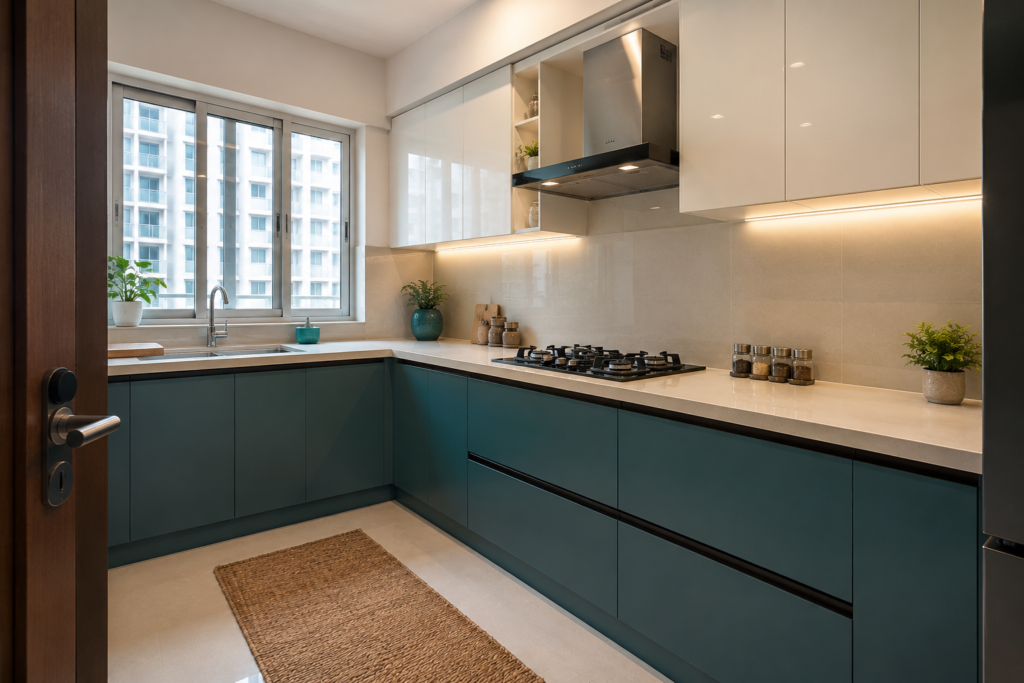
Teal (a blue-green that sits between sea blue and jade) and muted dusty blue shades are having their moment in 2026 because they carry enough colour to make a statement while reflecting significantly more light than deep navy. For parallel kitchen designs in Noida high-rises, L-shaped kitchens in Ghaziabad apartments, or riverfront holiday homes in Rishikesh, teal reads as fresh and intentional without shrinking the perceived space.
Teal also pairs naturally with the warm wood tones and natural stone textures that are increasingly popular in Uttarakhand homes. A teal base cabinet against a teakwood-finish open shelf unit and terracotta backsplash tiles creates a palette that feels rooted in the local context rather than imported wholesale from European design trends.
Two-Tone Blue and White: The Safest, Most Practical Approach
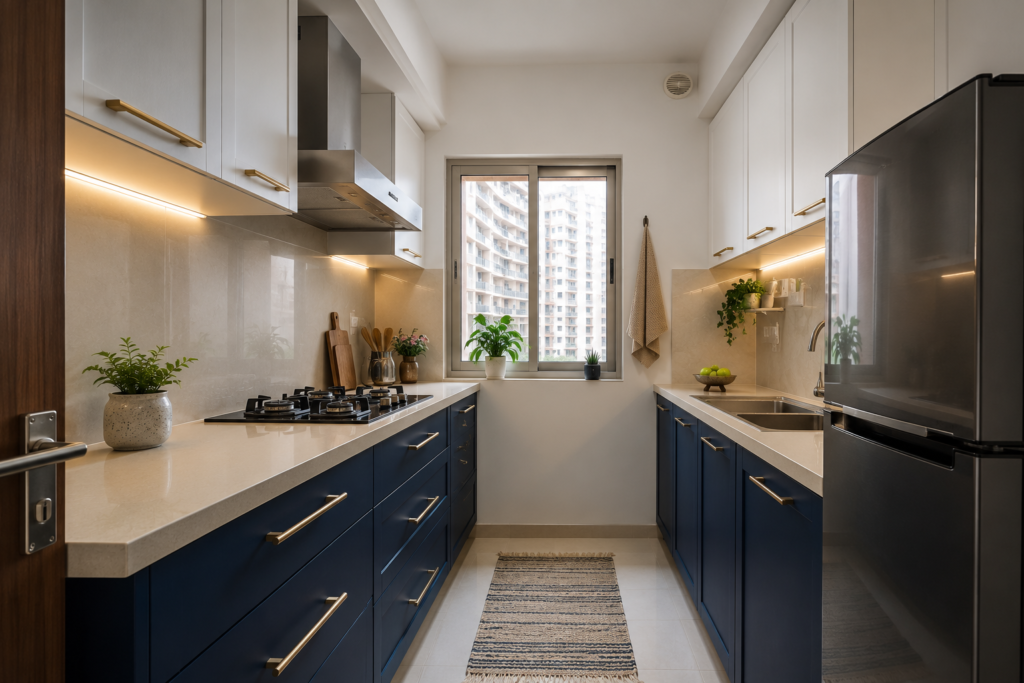
For anyone with a compact kitchen who loves the idea of blue but worries about the space feeling closed in, the two-tone approach is not a compromise-it’s actually the most effective design choice available. Dark blue lower cabinets with white or off-white upper cabinets (or vice versa) does three things simultaneously: keeps the upper visual field light and open, grounds the lower half with colour and depth, and makes the ceiling feel higher than it is.
This is particularly useful in the parallel kitchen layouts common across Noida Sector 137 and Indirapuram, where 7–8 feet of cooking space between two walls already feels corridor-like. A two-tone finish opens those spaces up considerably-and from a maintenance perspective, the upper cabinets in any kitchen get less grease exposure, so white uppers stay cleaner with less effort than a full-blue kitchen would.
Which Cabinet Material and Finish Should You Choose for Blue Kitchen Cabinets?
This is the section most competing articles skip or keep vague. Choosing the wrong material isn’t just a durability problem-it affects how your blue colour looks three years from now and whether it holds up through Dehradun’s monsoons or Noida’s construction-phase dust.
The Carcass: HDHMR vs BWP Plywood vs MDF
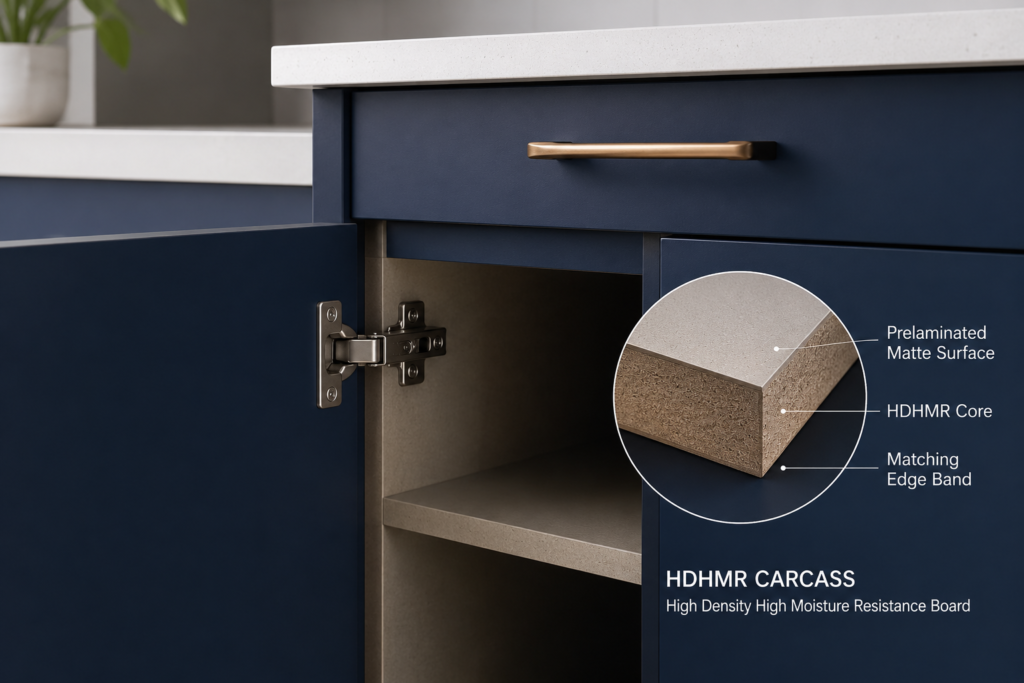
The cabinet carcass is the inner skeleton-the box the shutter door attaches to. In Indian kitchens, especially in humid zones, the carcass material matters more than the shutter finish for long-term durability.
HDHMR (High-Density Moisture Resistant board) is our standard recommendation for most Dehradun and Uttarakhand kitchens. It’s engineered to handle the humidity swing that comes with hill-region monsoons, resists swelling near sink zones better than standard MDF, and comes in at a lower cost than BWP-grade plywood while delivering near-equivalent durability. For kitchens that don’t sit directly in a flood-risk zone or have extreme water exposure, HDHMR hits the best balance of performance and price.
BWP-grade plywood (IS:710 Marine Grade) is the standard for base cabinets, sink units, and anywhere the carcass has regular water contact. The Bureau of Indian Standards IS:710 specification requires BWP marine plywood to withstand 72 hours of continuous boiling without delaminating-that’s the level of moisture resistance you want under a kitchen sink in Rishikesh or Haridwar, where seasonal flooding and persistent dampness are real conditions. It costs more than HDHMR, but for those specific positions, the extra spend is not optional.
MDF (Medium-Density Fibreboard) is not inherently bad. It’s smooth, CNC-machinable to precise profiles, and takes painted or lacquered finishes cleanly. However, standard MDF is not recommended within splash range of a sink or hob in any humid Indian zone. It swells, and once swollen, it doesn’t recover. Use MDF for dry-area upper cabinets, painted shutters in low-humidity spaces, or decorative features-not as the carcass material in a wet zone.
Material | Best Application | Trade-off |
BWP Plywood (IS:710) | Base cabinets, sink units, heavy-load shelves | Most durable; also the most expensive carcass option |
HDHMR | Kitchen carcasses in humid zones (Dehradun, Rishikesh) | Near-plywood moisture resistance at lower cost; slightly heavier than MDF |
MDF | Dry-area upper cabinets, painted shutters | Budget-friendly, smooth finish; swells in wet zones |
The Shutter Finish: Acrylic, PU Polish, or Laminate?
The shutter is the visible door-and for blue kitchen cabinets specifically, the finish choice affects both the visual impact and how the colour holds up over time.
High-gloss acrylic gives blue the most vivid, almost lacquered appearance. The colour depth on a high-gloss acrylic navy door is noticeably richer than on a matte equivalent, and the surface cleans easily with a damp cloth. The trade-off: gloss acrylic shows fingerprints on darker shades. For Noida and Ghaziabad homes with construction-adjacent dust, you’ll find yourself wiping the doors more often than with a matte finish. Anti-fingerprint acrylic sheeting (available from several Indian manufacturers) reduces this problem significantly and is worth specifying.
Matte PU (Polyurethane) lacquer is the finish choice that most experienced kitchen designers in Dehradun and Noida now recommend for dark colours including navy and teal. Applied by spraying polyurethane directly onto the shutter in a controlled environment, it creates a seamless, velvety surface that hides minor fingerprints, resists oil drops better than plain high-gloss cabinets, and handles the thermal cycling of an Indian kitchen (the temperature difference between a hob running at full blast and a cool monsoon-season evening). The downside is cost-PU lacquer requires skilled spray-finishing and typically adds 30–40% to shutter costs compared to laminate at the same grade. It’s also worth confirming your installer has a proper spray booth, not an outdoor setup.
High-pressure laminates (HPL) are the most practical choice for homeowners who want blue cabinets on a controlled budget without sacrificing durability. Available in matte, textured, and suede-effect finishes across blue shade families, a quality HPL finish from brands like Greenlam or Merino is scratch-resistant, oil-wipe-clean, and holds colour well. The limitation: unlike acrylic or PU, laminates have visible joins and can’t achieve the completely seamless edge-to-edge look of sprayed finishes. For a budget kitchen or a home where practicality outweighs aesthetics, HPL is the right call.
Finish | Visual Result | Maintenance | Cost Range (per sq ft, approx) |
High-Gloss Acrylic | Deep, vivid colour | Shows fingerprints; wipe daily | ₹1,800–₹2,400 |
Anti-Fingerprint Acrylic | Rich colour, fingerprint-resistant | Low maintenance | ₹2,000–₹2,600 |
Matte PU Lacquer | Seamless, velvety, luxury feel | Very low maintenance | ₹2,800–₹4,000+ |
High-Pressure Laminate | Clean, textured, practical | Scratch-resistant; very easy to wipe | ₹1,200–₹1,600 |
Pricing ranges are indicative for 2026 in Dehradun and NCR markets; actual quotes depend on scope, hardware, and installation complexity.
How to Handle Turmeric Stains, Oil Residue, and Dust on Blue Cabinets
In every Dehradun showroom visit: “Blue sounds beautiful, but how do I clean turmeric off it?” It’s a fair concern, and the honest answer is that the finish matters far more than the colour.
Turmeric (haldi) stains on cabinet surfaces are primarily a problem with porous finishes-rough laminates, painted MDF without a proper topcoat, or older PU finishes that have micro-cracked from age. On a well-applied PU lacquer or anti-fingerprint acrylic blue door, a haldi splatter wipes off with a damp cloth and a drop of dish soap within the first hour. The caution: if you leave it and it dries, the curcumin pigment can leave a faint ghost stain on lighter blue shades (think powder blue or pale teal). On navy or cobalt, the colour contrast makes staining far less visible.
For day-to-day oil residue-the grease mist that builds around the hob over time-the single most effective protection is a properly sized chimney running during every cooking session. A chimney that pulls 1,000 m³/hr of air is not the same as one pulling 600 m³/hr when your kitchen is 8 feet from hob to opposite wall. Underpowered chimneys let oil mist settle on cabinet surfaces faster than any finish can repel it. This isn’t a material question-it’s a ventilation question that most cabinet articles ignore.
For dust accumulation in NCR cities: matte finishes in general accumulate visible dust faster than high-gloss surfaces, because the texture gives dust more surface area to cling to. If your kitchen faces a construction site or is on a lower floor in a dusty Noida sector, anti-fingerprint acrylic (which has a smooth surface despite the matte appearance) is the better choice over a textured laminate.
Countertops, Backsplash, and Hardware That Pair With Blue Cabinets
Getting the pairings right is what separates a blue kitchen that looks considered from one that looks like three separate decisions made at three separate stores.
Countertops
White quartz with light grey veining is the most consistently successful pairing for navy and deep blue cabinets. The white reflects light back into the kitchen (helping counter the light-absorbing effect of dark cabinets-dark cabinet colours can absorb up to 80% of ambient light, per Architectural Lighting Society guidelines), and the grey veining provides enough visual interest without fighting the blue. Good-quality quartz slabs-from Indian fabricators or imported options-are available in 20–25 mm thicknesses suited to standard Indian kitchen counters.
Jet Black Indian Granite works with navy blue for a dramatic, high-contrast kitchen-the kind of look that photographs well and holds its own in a spacious villa kitchen. The trade-off: both surfaces absorb light, so you need significantly more task lighting (target 300–400 lux under cabinets in a kitchen with dark countertops and dark cabinet doors).
White marble looks exceptional with deep blue but is the highest-maintenance option. Indian white marble (Makrana or equivalent) stains from acidic liquids-even lime juice left on the surface for 20 minutes can etch the stone. If you want the marble look without the maintenance, a marble-look quartz gives you 90% of the aesthetic at one-third the upkeep.
Natural wood countertop sections work beautifully with lighter blue shades like teal or dusty blue. A slim wooden breakfast ledge running along one end of a teal kitchen adds warmth that prevents the space from feeling cold or clinical.
Hardware
Brushed brass or gold-tone handles are the most requested hardware pairing for navy blue in Dehradun showrooms right now, and the visual logic is clear: the warmth of brass softens the coolness of dark blue, creating a contrast that reads as deliberate rather than accidental. Brands like Hafele, and Blum all offer brushed brass options with soft-close mechanisms.
Matte black hardware is the alternative if you want a more contemporary, industrial kitchen rather than a warm-luxury one. Black handles on cobalt or royal blue create a sharper, more graphic contrast that works well in open-plan city apartments.
Avoid bright chrome on dark blue-the cold silver against cool blue tends to flatten the design rather than lift it.
Backsplash
A full-height stone slab backsplash in white or light grey quartz is the most seamless option-it reads as one continuous surface from countertop to upper cabinet, which makes the kitchen feel taller. Alternatively, subway tiles in off-white or ivory, or patterned encaustic tiles above the hob, add texture without competing with the cabinet colour. One tile combination to avoid: dark grout with white tiles behind dark blue cabinets-the busy contrast competes with the cabinetry rather than supporting it.
Lighting Blue Kitchens: A Step Most Homeowners Skip
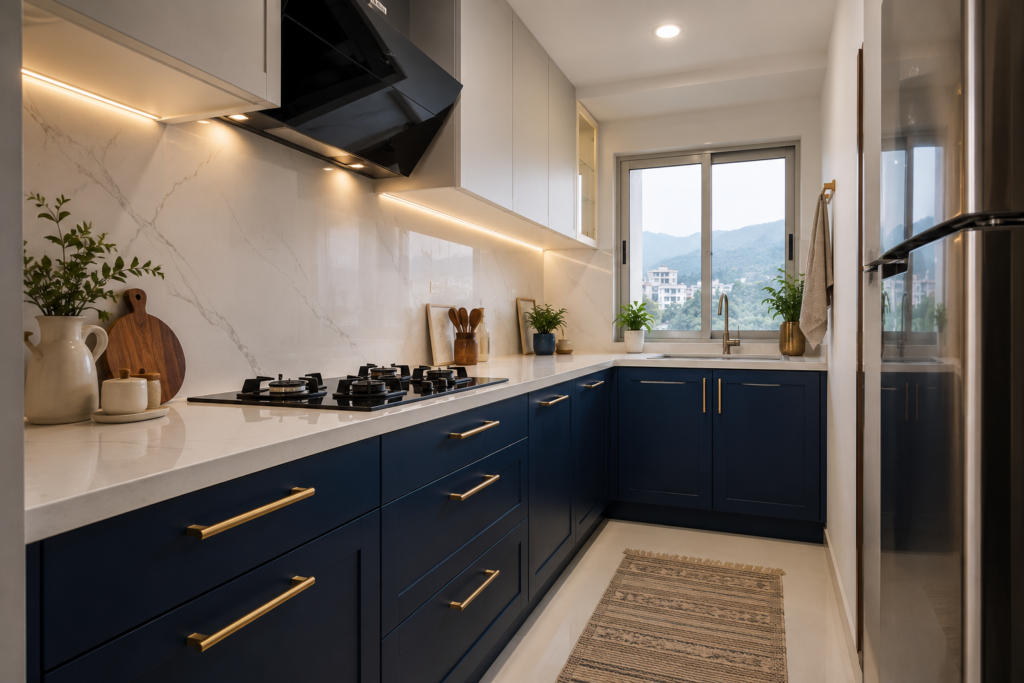
Dark blue cabinets absorb ambient light. That’s not a problem if you plan the lighting properly-but it becomes a real problem if you treat lighting as an afterthought.
The Architectural Lighting Society recommends 300–400 lux of warm task lighting for kitchens with dark cabinet colours. In practical terms, this means:
- LED profile lights under wall cabinets, facing the countertop workspace. These are the most important fixtures in any dark-cabinet kitchen. A 2700K warm white colour temperature makes the space feel inviting; a cooler 4000K temperature makes it feel clinical and exaggerates the coolness of the blue.
- Warm ceiling downlights (not cool white) above the main work zones-sink, hob, and prep area.
- Avoid single-source overhead lighting in a dark kitchen. One central ceiling fitting will leave corners shadowed and make the space feel smaller than it is.
For island kitchens in larger homes (Dehradun villas, Noida duplexes), pendant lights above the island or breakfast counter add both task illumination and visual height-particularly useful if the island itself is in a deep blue finish.
City-by-City Guide: What Works for Your Location
Dehradun
Dehradun’s climate makes material choice non-negotiable before anything else. The monsoon season brings sustained humidity that causes non-moisture-resistant boards to swell within the first two years. For any modular kitchen in Dehradun, HDHMR or BWP-grade IS:710 plywood is the mandatory starting point for carcasses. Aesthetically, Rajpur Road and Sahastradhara Road projects tend toward darker, more refined finishes-deep navy with brass hardware, white quartz, and warm LED profile lighting reads well in the larger independent house kitchens common in this area. Browse Bhumim’s full modular kitchen design range to see layouts suited to Dehradun homes.
For compact Dehradun apartments in the city centre, a two-tone approach (teal or dusty blue lowers, white uppers) with anti-fingerprint acrylic shutters handles both the aesthetic goals and the maintenance reality of daily Indian cooking.
Haridwar and Rishikesh
Kitchens near the river corridor in Rishikesh-particularly Tapovan and Ganga Nagar-see design briefs that lean toward calming, natural palettes. Teal and sea blue shades work particularly well in this context, pairing naturally with natural stone countertops or wooden elements that reference the surrounding landscape. Haridwar, with its traditional family home renovation market, tends toward slightly more conservative applications-blue as an accent on lower cabinets or an island, rather than a full blue kitchen. Contact Bhumim’s Haridwar team for location-specific recommendations.
Importantly: both Haridwar and Rishikesh share Dehradun’s humidity profile. BWP plywood for base and sink cabinets is not optional in either location.
Noida and Ghaziabad
High-density apartment blocks in Noida Sector 62, 137, and Indirapuram, and across Raj Nagar Extension in Ghaziabad, typically work with compact kitchen footprints-parallel layouts or tight L-shaped configurations in 70–100 sq ft. In these spaces, the full blue kitchen is usually too much. The approach that works: anti-fingerprint matte acrylic in dusty blue or slate blue for lower cabinets, white or light-wood uppers, and strong under-cabinet LED lighting to compensate for limited natural light in inner-facing kitchens.
Dust accumulation from ongoing construction in NCR growth zones is a real factor. Smooth matte acrylic is easier to maintain than textured laminate in these conditions. The Bhumim Noida team handles these layouts regularly and can advise on compact kitchen optimisation.
How Much Does a Blue Modular Kitchen Cost in Dehradun and NCR?
The colour itself doesn’t add cost-blue acrylic or blue laminate costs the same as any other colour in the same material range. What affects price is the finish category, layout complexity, and hardware grade.
For blue kitchen cabinets specifically in Dehradun and NCR, 2026 price ranges by finish tier:
- Laminate finish (HPL in blue shades): ₹1,200–₹1,600 per sq ft of cabinetry. Practical and durable; suitable for budget-conscious builds.
- High-gloss or anti-fingerprint acrylic: ₹1,800–₹2,600 per sq ft. The most popular mid-range finish for blue cabinets, given the colour depth and cleanability.
- Matte PU lacquer: ₹2,800–₹4,000+ per sq ft. The choice for a seamless, high-end look on navy or royal blue.
A standard L-shaped kitchen of 30–35 sq ft of cabinetry at the acrylic price point typically runs ₹60,000–₹90,000 in cabinet shutters alone-add the carcass (HDHMR or BWP plywood), countertop, hardware, chimney, and installation, and a complete mid-range modular kitchen in this range typically lands between ₹1.8 lakh and ₹3.5 lakh in Dehradun, and ₹1.5 lakh–₹3 lakh in Noida/Ghaziabad (where labour costs differ slightly).
These are 2026 indicative ranges. Actual quotes depend on kitchen dimensions, layout, countertop material, hardware brand, and site conditions. Get a site-measured quote before finalising any budget.
Two Myths About Blue Kitchen Cabinets-Addressed Directly
Myth 1: Dark blue cabinets will make a small kitchen look like a cave.
This is only true if you ignore the other design elements. Navy blue lower cabinets with white uppers, a reflective quartz countertop, and warm under-cabinet LED profile lights create a kitchen that feels anchored and considered-not dark. The blue grounds the lower half while the white upper half keeps the visual ceiling high. Hundreds of compact Indian kitchens in this configuration prove it works.
Myth 2: Blue cabinets are impossible to keep clean in an Indian kitchen.
This comes from experience with plain gloss white cabinets, where every mark shows. Anti-fingerprint matte PU and quality acrylic finishes actually repel oil drops and cooking residue better than standard high-gloss white. The surface tension of a properly cured PU or anti-fingerprint acrylic coating means oil beads rather than spreading. The daily wipe that a white kitchen needs exists for blue kitchens too-but the marks are simply less visible on a dark or muted surface.
Key Takeaways
- Blue kitchen cabinets work across all Indian home types when the shade is matched to the kitchen’s size, light availability, and layout.
- Navy and royal blue suit large kitchens with ample natural light; teal and dusty blue work better for compact urban apartments.
- Two-tone (dark lower cabinets + white upper cabinets) is the safest and most practical approach for small or low-light kitchens.
- HDHMR or BWP-grade IS:710 plywood is the non-negotiable carcass material for Dehradun, Rishikesh, and Haridwar-the monsoon humidity will degrade standard MDF within 1–2 years near water sources.
- Anti-fingerprint matte acrylic and PU lacquer are the best shutter finishes for blue, balancing colour depth with low maintenance.
- Brushed brass/gold hardware warms dark blue; matte black hardware sharpens it for a contemporary look.
- White quartz with grey veining is the most versatile countertop pairing for blue cabinets across budget levels.
- Install warm 2700K LED profile lights under wall cabinets-dark cabinets absorb ambient light and the kitchen will feel dim without dedicated task lighting.
- Blue cabinet colour does not increase cost over other colours at the same material and finish tier.
Frequently Asked Questions
Blue is consistently the second most popular kitchen cabinet colour after white, and has held that position for over a decade globally. The shade families within blue cycle (navy, then cobalt, now blue-grey and teal), but blue cabinetry itself is not a trend-it’s an established design choice with staying power. A well-executed navy or teal modular kitchen will look intentional and current in 10 years, unlike purely seasonal colour trends.
Not if you design for it. Navy lower cabinets paired with white upper cabinets, a white or light quartz countertop, and warm LED under-cabinet lighting keep the upper visual field open and the lower half grounded-the result reads as deliberate rather than cramped. Avoid all-dark cabinets in a kitchen smaller than 80 sq ft without a lighting plan to compensate.
For most Indian homes, anti-fingerprint acrylic is the best balance: it gives blue cabinets deep, vivid colour, resists oil and turmeric splashes, and sits in the middle of the price range. PU lacquer is better for a seamless, high-end finish on navy or royal blue, but costs 30–40% more than acrylic. Laminate is the practical, durable option for budget builds-the colour range in quality HPL is now wide enough to include most blue shade families.
For base cabinets and sink units, yes-it is not optional in hill-region humid zones. The Bureau of Indian Standards IS:710 specification requires BWP marine plywood to withstand 72 hours of boiling without delaminating. In Dehradun and Rishikesh, where monsoon season brings sustained high humidity and occasional dampness through wall seepage, standard plywood or MDF in these positions will swell and fail. HDHMR is an acceptable alternative for carcass areas that don’t have direct water contact.
White quartz with soft grey veining is the most versatile and widely used pairing-it reflects light back into the kitchen, contrasts cleanly with dark blue without fighting it, and works across all shade families from navy to teal. Jet black granite creates a dramatic high-contrast look but requires significantly more task lighting. Light wood or butcher-block sections add warmth that works particularly well with lighter blues like teal or dusty blue.
Blue is generally considered Vastu-compatible for kitchens that face north or east, as it is associated with water elements. For south or south-east facing kitchens (which Vastu traditionally associates with fire), some practitioners recommend pairing blue with warm accents like wood or brass to balance the colour’s elemental properties. If Vastu compliance is a priority, discuss the kitchen’s orientation with your designer before committing to a shade.
On anti-fingerprint acrylic or PU lacquer surfaces, a fresh turmeric splatter wipes off easily with a damp cloth and mild dish soap within the first 30–60 minutes. If it dries, apply a small amount of diluted dish soap on a soft microfibre cloth and wipe gently-don’t scrub, as abrasives scratch the finish. Lighter blue shades may show a faint ghost stain after a prolonged dried stain; on navy or cobalt, the contrast makes any residual mark virtually invisible.
For most Indian kitchens under 100 sq ft, colour just the lower cabinets and keep uppers white or light-this is the two-tone approach that maximises visual space. For kitchens above 120 sq ft with good natural light, a full blue kitchen (both upper and lower) works well, especially in navy or teal. If you want the full blue look in a compact space, use a lighter shade on the uppers and reserve the darker tone for lowers.
A complete mid-range blue modular kitchen in Noida (anti-fingerprint acrylic shutters, HDHMR carcass, quartz countertop, soft-close hardware) in a standard L-shaped or parallel layout typically runs ₹1.5 lakh–₹3 lakh for a 25–35 sq ft kitchen in 2026. Laminate-finish builds are less expensive; PU lacquer or island layouts will sit above this range. Get a site-measured quote from Bhumim Noida for an accurate project estimate.
Yes. Bhumim manufactures modular kitchen units at our Dehradun facility and installs across Haridwar, Rishikesh, Roorkee, Noida, and Ghaziabad. Delivery and installation timelines from confirmed design sign-off are typically 7–12 working days for standard L-shaped or parallel layouts, slightly longer for U-shaped or island configurations with custom hardware.
Conclusion
When someone walks into a kitchen finished in well-chosen navy blue cabinets-with brushed brass handles, white quartz countertops, and warm profile lighting glowing under the wall units-the first thing they notice isn’t the colour. It’s that the room feels finished. Considered. Like someone made a real decision instead of defaulting to beige.
That’s what blue kitchen cabinets do when they’re done well. And “done well” in the Indian context means matching the shade to your specific kitchen’s light and space, choosing HDHMR or BWP plywood for the carcass in humid climates, selecting the right finish for your maintenance tolerance, and getting the pairing right so the blue works with everything around it-not against it.
If you’re planning a blue modular kitchen in Dehradun, Noida, Haridwar, Rishikesh, Roorkee, or Ghaziabad, the most useful next step is a 3D design preview with your actual kitchen dimensions. You’ll see whether navy or teal suits the space before any material is cut.
Book a free 3D design consultation with Bhumim-WhatsApp us at 08044630777 or get a free estimate for a blue modular kitchen in your city.