

Wardrobe Loft Design: Do You Really Need One?
Wardrobe loft design adds a closed storage tier above the main wardrobe, usually from about 7 feet up. It holds luggage, bedding and festive clothes you touch a few times a year. You need one when your ceiling is 9 feet or higher and daily storage is already full. Below 9 feet, skip it.
A loft is a numbers question, not a style question, and ceiling height, false-ceiling drop and what you plan to store decide it.
Why the Loft Question Always Comes Up Too Late
You have finalised the layout, the shutter colour and the handles. Then someone asks, “Do you want a loft?” and expects an answer within a minute. Most people say yes, because empty wall space feels like waste, and six months later some love it while others regret it.
The difference is rarely taste, since it comes down to ceiling height and what goes up there. This guide gives you the numbers before the question arrives, and it sits inside our wider wardrobe design guide.
What Is a Wardrobe Loft, and Where Does It Start?
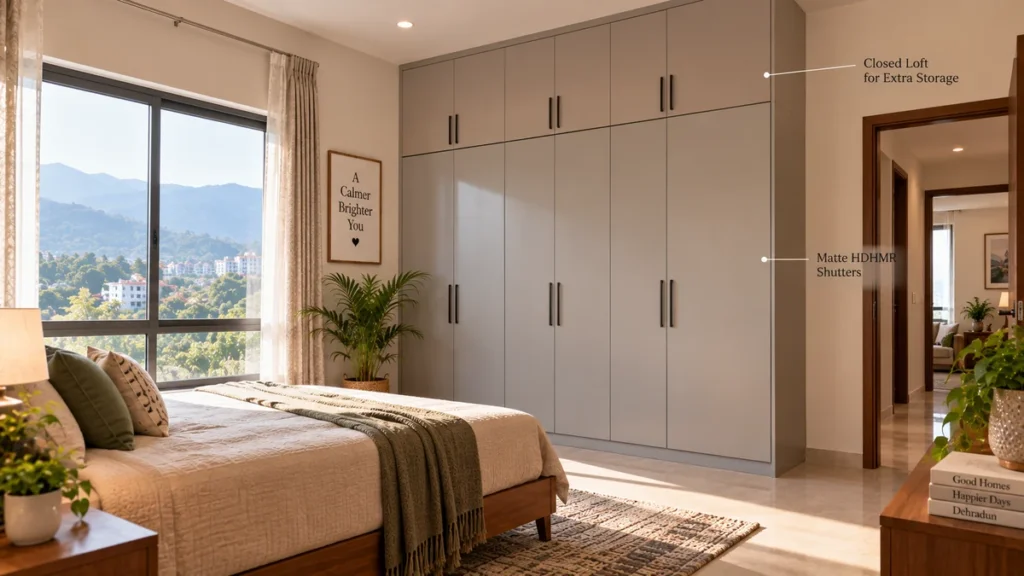
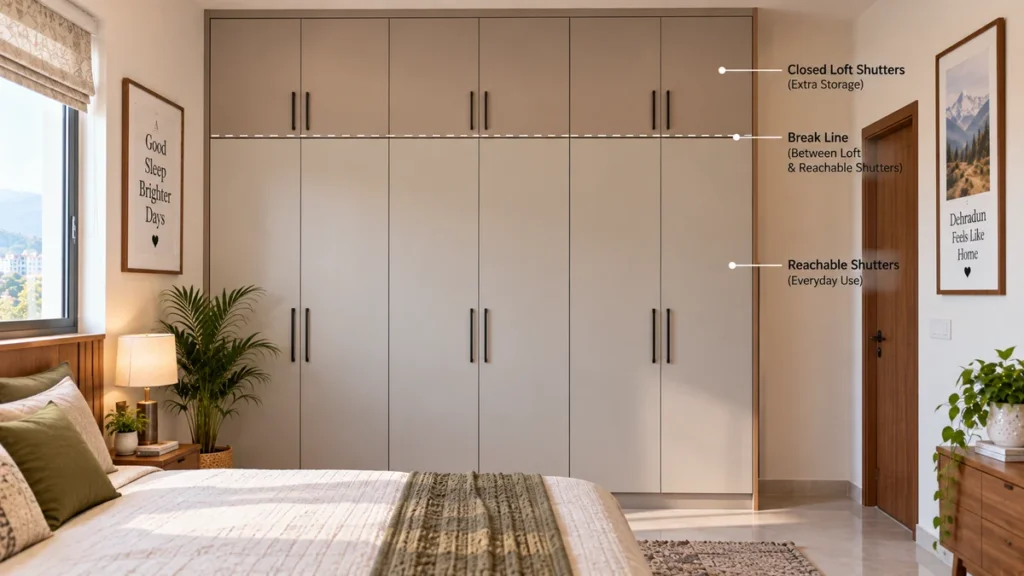
A wardrobe loft is a storage tier above the main wardrobe, closed with its own shutters. It uses wall height that would otherwise stay empty.
Floor-to-ceiling wardrobes run their doors the full height, while a loft has a visible break line, usually where your reach ends. In Indian homes that break commonly sits near 7 feet, close to lintel level.
Get started with Beautiful Homes
For expert design consultation, send us your details and we’ll schedule a call
What Is the Standard Wardrobe Loft Height, and How Much Ceiling Do You Need?
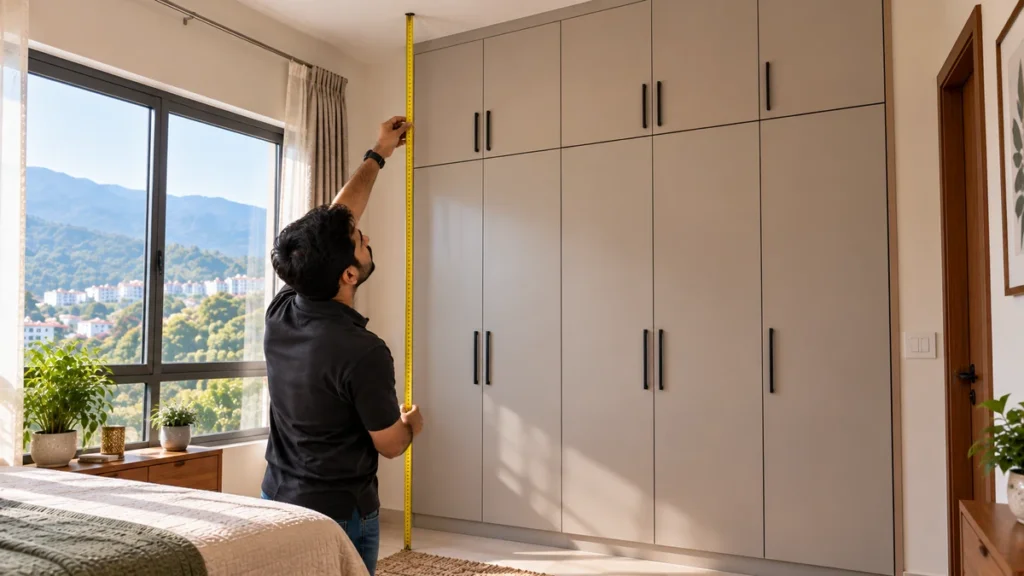
The loft gets whatever height is left once the wardrobe and the ceiling take their share, so start with three numbers.
- Wardrobe height: 7 to 8 feet is standard, with about 2 feet of depth.
- Ceiling height: 9 to 10 feet is typical. The National Building Code sets a 2.75 m minimum (about 9 feet) for habitable rooms.
- False ceiling: it takes roughly 4 to 8 inches off your usable height.
Here is the arithmetic on two common cases. Take a 9 foot ceiling with a 4 inch false-ceiling drop and a 7 foot wardrobe. That leaves about 20 inches for the loft, before shutter thickness and gaps. On a 10 foot ceiling with an 8 inch drop, you get roughly 28 inches.
Now the low case. An 8 foot ceiling leaves about 12 inches above a 7 foot wardrobe, which is a shelf rather than a loft. A full-height wardrobe usually serves you better here. Whatever your number is, compare it with the tallest item you plan to store.
What Should You Actually Store in a Wardrobe Loft?
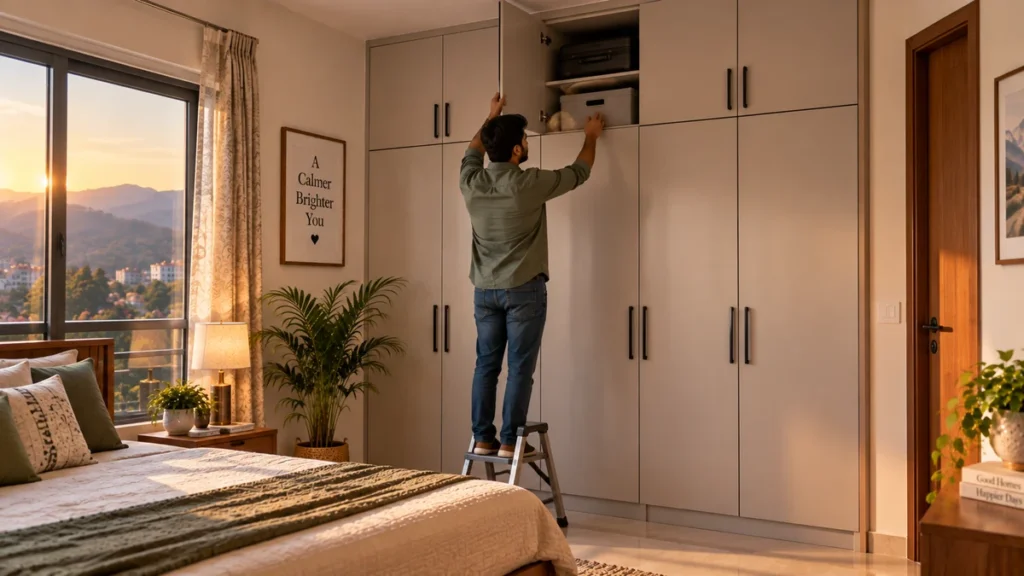
Store things you need only a few times a year, because reaching the loft usually means a stool and daily items belong lower down.
- Good fits: suitcases and travel bags, spare quilts and bedding, out-of-season and festive clothes.
- Poor fits: anything you wear weekly, and anything heavy that you would struggle to lift down at arm’s length.
One layout habit matters more than the loft itself. Do not build it as one long open shelf, because it turns into a pile. Compartments with sliding trays or covered boxes keep it usable, as our bedroom wardrobe storage guide also points out.
Wardrobe Loft Pros and Cons: The Honest Version
A loft solves one problem well and creates three small ones.
What a loft does well
- Adds storage without using any floor space, and moves rarely used items out of the way so the main wardrobe holds only daily clothes.
- Gives the wall a cleaner, finished look than stacked boxes on top.
What a loft costs you
- A stool for every visit, which is fine for luggage and tiresome for daily items.
- Dust, since lofts get cleaned rarely. Plan a wipe-down before each season.
- A heavier look. Extra shutters overhead can make a modest room feel lower.
- A higher quote, since it adds panels, shutters and hardware.
When a Loft Is Not Worth It
We would skip the loft in three cases. Your ceiling is under 9 feet. You cannot name what you would store up there. Or you would rather spend the same budget on deeper drawers and better internal fittings, which you use every day.
Which Loft Doors and Materials Suit Dehradun’s Humidity?
Overhead boxes handle humid air better than ground-level units. In monsoon humidity of 80 to 90 percent, HDHMR board (a moisture-resistant fibre board) performs acceptably overhead when every cut edge is sealed. Units near damp walls or the floor need BWP-grade IS:710 plywood (water-resistant plywood). Our HDHMR vs BWP plywood guide has the detail.
Door type is a separate choice. Loft shutters can be hinged, lift-up or sliding. Ask which hardware carries the weight. A loft shutter opens less often, so a sagging hinge goes unnoticed for a year. Bhumim works with Blum, Grass, Hafele and Raumplus for this.
Not sure whether your ceiling can carry a loft? Send us your room height and we will check the numbers and show the loft in a free 3D design before you commit. Call or WhatsApp 08044630777 or fill in your details at bhumim.com.
Loft or Floor-to-Ceiling Wardrobe: Which Fits Your Room?
A floor-to-ceiling wardrobe uses the full height and removes the dust-collecting gap above standard units, as we cover in the hinged vs sliding wardrobe guide. A loft keeps the same height but splits it, so the top part is reached by stool.
Choose the loft when you want one tidy break between daily and seasonal storage. Choose the full-height wardrobe when you want simple, continuous doors.
If you have a spare 5 by 5 feet, a dedicated dressing room may serve you better than either. See the walk-in wardrobe design guide for sizes and layouts.
A Five-Minute Check Before You Say Yes to a Loft
- Measure floor to finished ceiling, and note the false-ceiling drop separately.
- Subtract the wardrobe height (7 to 8 feet) to get your loft height.
- List what you would store and check the tallest item fits with a few inches spare.
- Be honest about the stool. Will you actually use it?
- Ask for the loft priced as its own line, so you can compare with and without.
Frequently Asked Questions
There is no fixed standard. The loft gets the height left after a 7 to 8 foot wardrobe. On a 9 foot ceiling with a 4 inch false ceiling, that is about 20 inches. On a 10 foot ceiling with an 8 inch drop, it is about 28 inches.
Aim for at least 9 feet. The National Building Code sets a 2.75 m minimum for habitable rooms, which is about 9 feet. On an 8 foot ceiling, a 7 foot wardrobe leaves only about 12 inches, which works as a shelf, not a loft.
It is worth it for suitcases, bedding and festive clothes, especially when your ceiling is 9 feet or more. It is not worth it for daily items, since you need a stool. If you cannot name what you would store there, skip it.
It depends on the room. A neat loft in matching shutters tidies the wall and hides clutter. However, in a small or low-ceilinged bedroom, extra shutters overhead can make the room feel lower and fuller. Matching the loft shutters to the wardrobe colour helps.
Yes, because most people clean them rarely. Covered boxes or closed compartments keep stored items clean. Wipe the loft shelves before each season, using a stool and a microfibre cloth, and avoid one long open shelf where everything sits exposed.
HDHMR board works well overhead in monsoon humidity when every cut edge is sealed. Units near the floor or damp walls need BWP-grade IS:710 plywood instead. Ask your manufacturer how the loft edges are sealed, since unsealed edges are where swelling starts.
Choose a loft for a clear split between daily and seasonal storage. Choose floor-to-ceiling for continuous doors and no dust gap. Both use the same height. The loft is reached by stool, while a full-height wardrobe keeps the same doors from floor to ceiling.
Call or WhatsApp Bhumim at 08044630777, or fill in your details at bhumim.com/contact. Share your room height and a photo of the wall. A team member checks the loft numbers and schedules a free 3D design session, typically within 3 to 5 working days.
Key Takeaways
- A loft is decided by numbers: ceiling height, false-ceiling drop and what you plan to store.
- With a 7 foot wardrobe, a 9 foot ceiling leaves about 20 inches and a 10 foot ceiling about 28 inches, before false ceiling.
- Under a 9 foot ceiling, a full-height wardrobe usually beats a loft.
- Use the loft for luggage, bedding and festive clothes, and keep daily items lower down.
- Sealed HDHMR works overhead in Dehradun humidity; use BWP-grade plywood near damp walls or the floor.
Conclusion
That last-minute question about a loft has a calm answer if you do the sums first. Measure, subtract, list. If the height is near 20 inches or more and your list is luggage and bedding, say yes. If not, put the budget into drawers you will open every day.
If you are planning a wardrobe in Dehradun, Rishikesh or Haridwar, call or WhatsApp Bhumim at 08044630777 or reach out through bhumim.com/contact and we will check your ceiling numbers in a free 3D design before you decide.
About This Article
Published by: Bhumim India Private Limited-Modular Kitchen Manufacturer & Installer, Dehradun
GST: 05AAOCB1784F1ZM | ISO 9001:2015 Certified
Service Areas: Dehradun · Haridwar · Rishikesh · Roorkee · Noida · Ghaziabad
Contact: 08044630777 | hello@bhumim.com
Note: This article is written from Bhumim’s on-ground manufacturing and installation experience. All material recommendations are based on what we use in real kitchens across our service areas.