

Benefits of German Modular Kitchen (2026 Guide for North Indian Homes)
Benefits of a German modular kitchen include precision-engineered PUR laser edge banding that blocks moisture seepage, hardware rated for 30–70 kg per drawer, ergonomic storage systems designed for heavy Indian cookware, and surface finishes that resist turmeric and oil stains, all backed by a typical lifespan of 15 to 25 years with basic upkeep. In North Indian cities like Dehradun and Noida, these advantages directly address the humidity, heavy cooking, and termite risks that cause local carpenter-built kitchens to fail within a few years.
A German modular kitchen is a factory-manufactured kitchen system that either uses full German-made cabinets or pairs German engineering hardware, hinges, drawer runners, and corner pull-out systems with moisture-resistant Indian boards like HDHMR or BWP-grade plywood as the carcass material. The result is a kitchen that holds up to the realities of Indian home use in ways most locally built kitchens cannot.
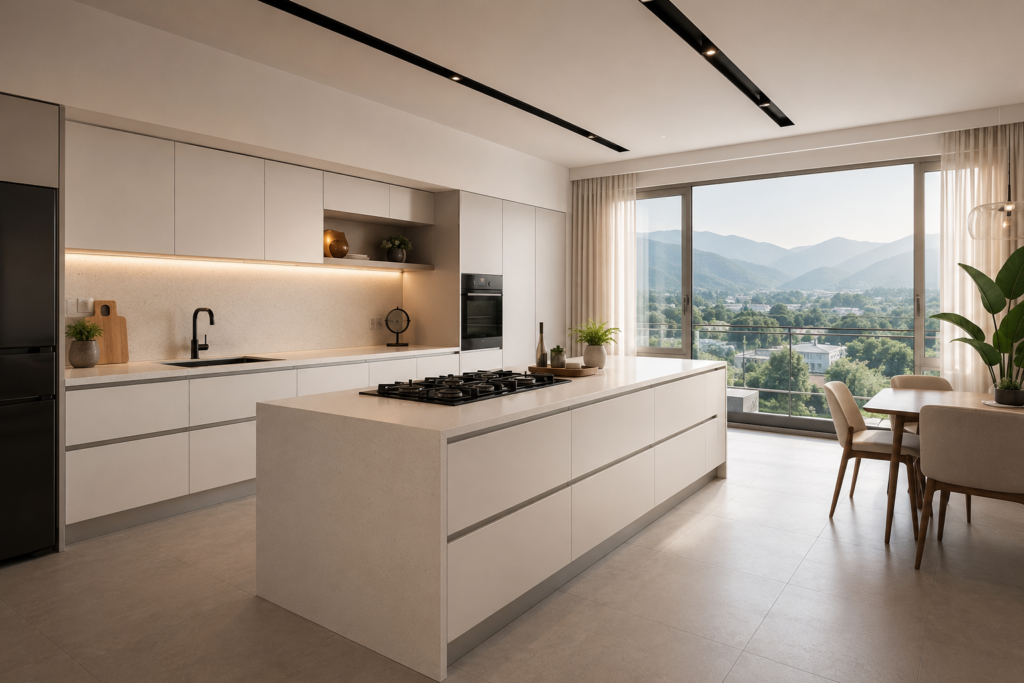
Why German Modular Kitchens Are Getting So Much Attention in 2026
After installing modular kitchens across Dehradun, Haridwar, Noida, and Ghaziabad, the single complaint we hear most often about old kitchens isn’t the layout. It’s the cabinet that swelled shut after two monsoons. Or the drawer channel that started sagging under a pressure cooker’s weight within eighteen months. Or the hinge that rusted somewhere under the sink. These aren’t design failures. They’re manufacturing failures, the result of on-site carpentry that can’t replicate what a controlled factory environment produces.
That’s the honest context for why homeowners in 2026 are searching for German modular kitchen options. It’s not just an aesthetic upgrade. It’s a decision to stop replacing the same kitchen twice.
This guide covers everything you need to evaluate: what makes a kitchen genuinely German, the specific engineering advantages that matter in North Indian climates, a transparent cost breakdown across Dehradun, Noida, Haridwar, and Ghaziabad, and a clear comparison between full imports and the hybrid approach that most homeowners in this region actually choose.
Get started with Beautiful Homes
For expert design consultation, send us your details and we’ll schedule a call
What Makes a Kitchen "German"? Understanding the Real Difference
“German modular kitchen” means two different things in the Indian market, and most sellers won’t explain the difference.
Type 1: Full Imported German Kitchen
The entire cabinet system, carcasses, shutters, and hardware, is manufactured in Germany by established German kitchen manufacturers, then imported and installed in India. These kitchens carry the highest quality standards and the highest price tag, typically ranging from ₹3,500 to ₹8,000+ per square foot in India due to customs duties and freight.
Type 2: Hybrid German Kitchen
The carcass uses high-quality Indian boards, HDHMR (High-Density HMR Board) or BWP-grade plywood, while the hardware uses certified German mechanisms from brands such as Häfele, Blum, or other certified German hardware suppliers. This is by far the most popular approach in North Indian cities in 2026 because it delivers 85–90% of the structural and functional benefits of a full German import at roughly 50% of the cost.
At Bhumim, we work primarily with the hybrid approach for kitchens across Dehradun, Haridwar, Rishikesh, Roorkee, Noida, and Ghaziabad. Here’s why: the difference in real-world performance between a full import and a well-built HDHMR carcass with certified German hardware is marginal for most Indian home users. The difference in price is not.
Core Benefits of a German Modular Kitchen
Moisture-Resistant Edge Banding That Survives Dehradun Monsoons
The most technically significant advantage of German kitchen manufacturing is the edge seal, specifically, PUR (Polyurethane) laser edge banding, which bonds the cabinet’s protective edge layer to the board using laser heat rather than glue.
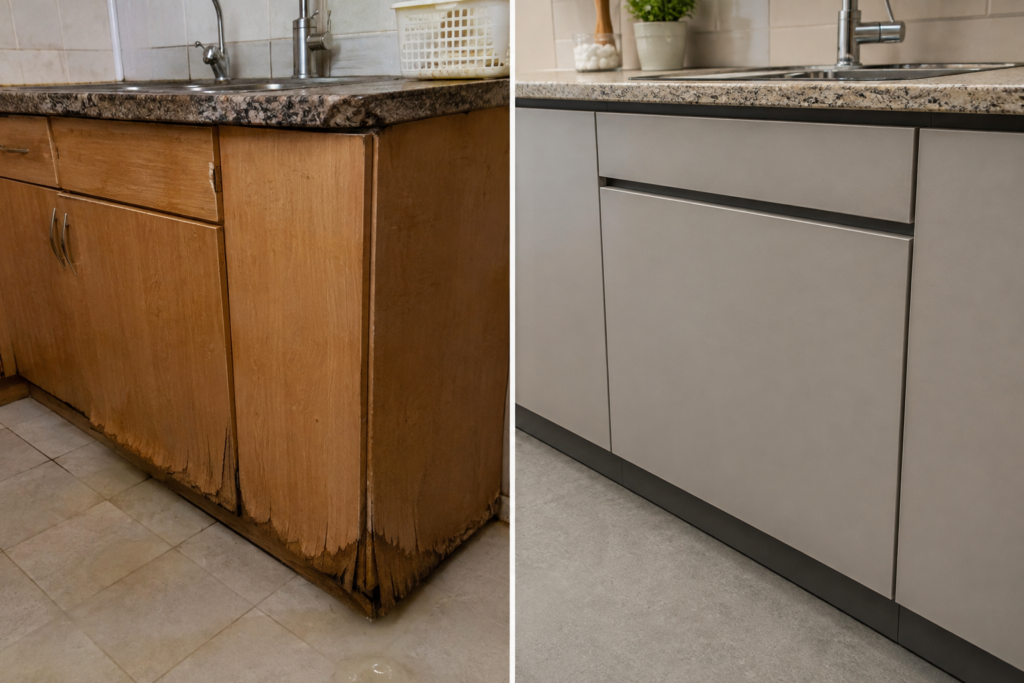
Why does this matter in Dehradun and Rishikesh? Traditional edge banding uses hot-melt adhesive. Over time, especially in environments with the humidity swing that Uttarakhand’s monsoon season delivers, the glue joint develops micro-gaps. Moisture seeps in through those gaps, causing the board, even a decent MDF board, to swell, delaminate, and eventually fail near sink units and hobs.
PUR laser banding creates what technicians call a zero-joint seal: there’s no visible glue line and no adhesive gap for moisture to enter. Cabinets built this way hold their shape through multiple monsoon seasons, which is why German-engineered kitchens consistently outperform locally fabricated cabinets in humid climates like Uttarakhand’s foothills and Rishikesh’s riverbank settlements.
World-Class Hardware, Load Ratings That Suit Indian Cooking
Certified German drawer runner systems, such as the Häfele Matrix and Blum Tandembox series commonly found in the North Indian market, are factory-rated for 30 to 70 kg of dynamic load capacity. That rating matters more in Indian kitchens than in most European ones, because a standard Indian kitchen holds cast iron kadais, steel pressure cookers, and brass utensil sets that no European kitchen designer was engineering around.
The hinge and closing mechanism rating matters equally. Quality German soft-close hydraulic hinges are tested for 80,000+ open-close cycles, the equivalent of roughly 20 years of daily use. Compare that to a locally sourced hinge that may start showing resistance or lateral drift within two to three years of installation.
For homes in Ghaziabad and Noida, where kitchens see long hours of heavy daily use across multi-generational households, this load and cycle rating is the single biggest reason homeowners who invest in German hardware don’t report the same hinge and drawer failures they experienced with previous kitchens.
Smart Space Engineering: Corners, Carousels, and Gola Profiles
German kitchen engineering specifically solves the two storage problems that plague Indian modular kitchens: dead corner space and the handle-dominated aesthetic.
Corner storage solutions, LeMans pull-out units, Magic Corner systems, and carousel trays allow the full depth of an L-shaped or U-shaped corner cabinet to be accessed without reaching into the darkness at the back. A well-designed corner unit in a Dehradun L-shaped kitchen can recover 40–60% of storage space that a simple fixed shelf would waste.
The Gola profile, a continuous recessed aluminium rail running along the top of the cabinet row, creates a handleless kitchen by letting fingers hook into the groove to open doors. This design eliminates external handles that collect grease, dust, and eventually loosen. In a kitchen where daily cooking is heavy and cleaning needs to be quick, handleless design reduces maintenance without reducing functionality.
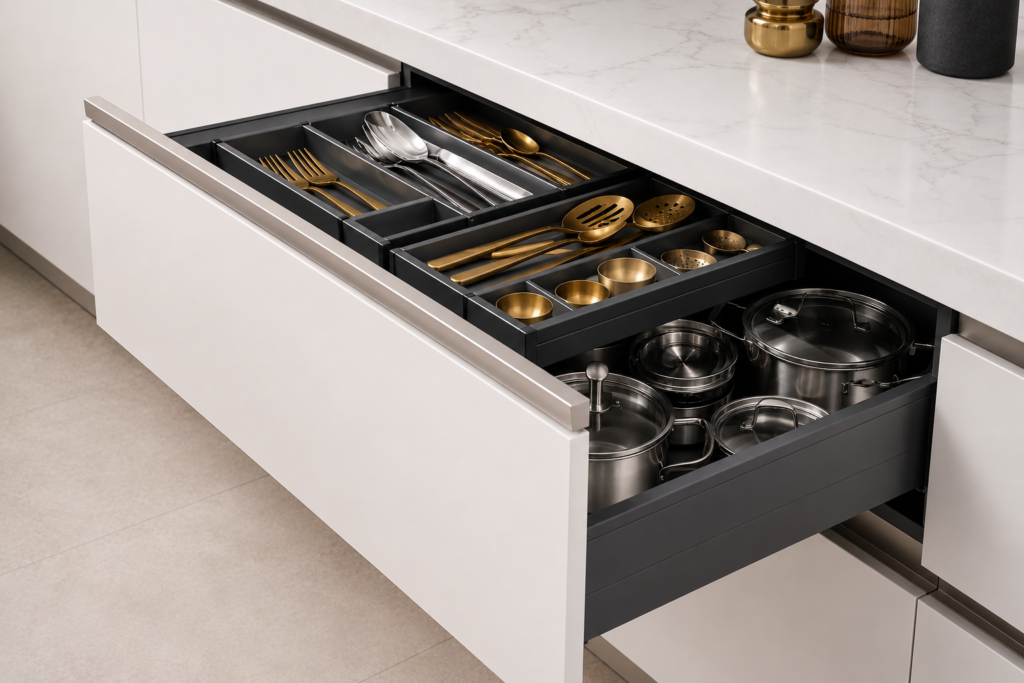
Surface Finishes Built for Heavy Indian Cooking
A common concern in discussions, “Can a German kitchen handle heavy Indian cooking?”, comes from the assumption that European kitchen finishes aren’t built for turmeric, tadka, and heavy oil splatter. That assumption is outdated.
Modern acrylic and lacquer-finish shutters used in German modular kitchens are anti-scratch and specifically formulated for stain resistance. A simple wipe with a microfiber cloth and mild soap is enough to remove turmeric-stained oil splatter from acrylic surfaces, no scrubbing, no abrasives. Matte laminate finishes are similarly forgiving, and unlike high-gloss finishes, they don’t show fingerprints constantly.
That said, the finish isn’t indestructible. We’ll be direct: acrylic scratches more easily than laminate under abrasive contact. If you’re likely to set sharp utensils directly on shutter surfaces, a matte laminate is the more practical choice regardless of the hardware behind it.
Eco-Friendly Standards and Low-Formaldehyde Compliance
Most German-manufactured kitchen boards and shutters conform to European E1 or CARB (California Air Resources Board) standards for formaldehyde emissions, roughly 0.1 mg/m³ or lower. These are the same standards applied to products sold in the EU and North American markets.
This matters for Indian homeowners because lower-grade engineered wood boards, particularly cheap particle boards, can off-gas formaldehyde at levels that affect indoor air quality over time. For families with young children, or for kitchens in smaller Noida or Ghaziabad apartments where ventilation is limited, this is a genuine health consideration, not a marketing claim.
German Modular Kitchen vs. Carpenter-Built Kitchen: An Honest Comparison
Feature | German Modular Kitchen (Hybrid) | Carpenter-Built Kitchen |
Edge banding | PUR laser-sealed, zero-joint, moisture-resistant | Hand-applied tape banding; adhesive joints degrade in monsoon humidity |
Hardware load rating | 30–70 kg per drawer (certified) | Unrated; varies by sourced hardware quality |
Hinge cycle life | 80,000+ cycles (soft-close, tested) | Typically 10,000–30,000 cycles for locally sourced hinges |
Termite resistance | High: HDHMR/BWP boards with resin treatment | Moderate to low: depends on ply grade and site sealing |
Moisture resilience | High: sealed board with laser edge | Moderate: depends on finishing quality and ply grade |
Installation time | 7–12 working days | 4–8 weeks on-site (wet work involved) |
Damaged section repair | Replace individual module | Typically requires rebuilding the affected section |
Typical lifespan | 15–25 years | 5–12 years (varies heavily by material grade) |
Price range (Dehradun) | ₹1,800–₹3,500/sq ft (hybrid) | ₹800–₹1,500/sq ft |
Finish precision | Factory-machined to ±0.1 mm tolerances | Dependent on individual carpenter’s skill |
The carpenter-built option isn’t always wrong. For short-term rentals, a temporary setup, or a very tight budget, it can serve its purpose. However, for a home you’re planning to stay in for five or more years, the maintenance cost of repeated hinge replacements, swollen shutter repairs, and eventual full rebuilds often closes the price gap with a modular kitchen within three to five years.
Full Import vs. Hybrid German Kitchen: Which Is Right for Your Budget?
This is the question most homeowners in Dehradun and NCR are actually trying to answer when they search for German modular kitchen options. The honest answer depends on two factors: your budget, and how much of the benefit you need.
Full Imported German Kitchen | Hybrid German Kitchen | |
What it is | Entire cabinet system manufactured in Germany | German hardware + HDHMR/BWP Indian carcass |
Brands | Leading German kitchen manufacturers (imported) | Certified German hardware brands on Indian HDHMR/BWP boards |
Price in India | ₹3,500–₹8,000+/sq ft | ₹1,800–₹3,500/sq ft |
Lead time | 8–12 weeks (import cycle) | 3–6 weeks |
Carcass warranty | 10–15 years (manufacturer) | 5–10 years (installer-backed, board-dependent) |
Hardware warranty | Lifetime (mechanical components) | 10 years (certified German hardware standard in India) |
Best suited for | Forever-home, ₹15 lakh+ kitchen budget | Mid-to-high budget, wanting German performance within ₹4–10 lakh |
Humidity protection | Factory-treated carcass + laser edge | Laser-edged HDHMR; BWP plywood near wet zones |
For most Dehradun and NCR homeowners in 2026, the hybrid approach is the practical answer. It’s not a compromise, it’s a rational allocation of budget toward the components that actually determine how a kitchen performs over ten years.
German Modular Kitchen Cost in Dehradun, Noida, and Nearby Cities (2026)
Pricing varies by city, carcass material, hardware tier, and layout complexity. The figures below are market estimates for 2026 and should be verified at the time of your site consultation, since material and hardware costs fluctuate.
City | Hybrid German Kitchen (Est. ₹/sq ft) | Full Import German Kitchen (Est. ₹/sq ft) |
Dehradun | ₹1,800–₹3,200 | ₹4,000–₹7,000+ |
Haridwar | ₹1,700–₹3,000 | ₹4,000–₹6,500+ |
Rishikesh | ₹1,800–₹3,200 | Available on request |
Roorkee | ₹1,600–₹2,800 | ₹3,800–₹6,000+ |
Noida | ₹2,000–₹3,500 | ₹4,500–₹8,000+ |
Ghaziabad | ₹1,900–₹3,300 | ₹4,000–₹7,500+ |
What moves the price most:
- Layout: A U-shaped kitchen costs 20–30% more than a straight or L-shaped kitchen of the same floor area, simply because there’s more cabinetry and more linear metres of countertop.
- Hardware tier: Upgrading from standard soft-close hinges to full-extension tandem drawer systems adds ₹15,000–₹40,000 per kitchen, depending on drawer count.
- Corner accessories: A single Magic Corner or LeMans unit adds ₹18,000–₹45,000 but recovers significant storage.
- Carcass material: BWP-grade plywood costs more than HDHMR but is the right call for base cabinets near sinks.
Appliances, chimneys, hobs, built-in ovens, are always quoted separately and are not included in per-square-foot kitchen pricing.
Which Layout Suits Which City?
For Noida and Ghaziabad apartments (Sector 150, Indirapuram, Vasundhara), compact L-shaped and parallel layouts are the most practical; they maximise storage within a 7 to 10 ft kitchen footprint. For Dehradun villas and independent houses on Rajpur Road or Vasant Vihar, U-shaped and island layouts open up. For smaller Haridwar and Roorkee homes, a well-planned L-shaped modular kitchen design with tall pantry units is usually the highest-ROI configuration.
Climate Resilience: How German Kitchen Engineering Handles North India
Why Dehradun and Rishikesh Need Special Attention
Dehradun sits at an elevation of roughly 640 metres, with a monsoon season that delivers sustained high humidity from July through September. Rishikesh adds a riverbank moisture layer that keeps ambient humidity elevated even outside the monsoon window. These conditions expose cabinet carcasses, edge banding, and metal hardware to a level of moisture stress that dry-climate engineering simply doesn’t account for.
German-standard PUR edge banding seals the exposed edge of every board, the most vulnerable entry point for moisture, with a bond that doesn’t soften under humidity or heat. This is specifically why kitchens in Dehradun homes that have invested in properly sealed carcasses remain structurally sound after three or four monsoon seasons, while carpenter-built equivalents often show swelling near the hob and under the sink within two years.
For kitchens near Rishikesh’s AIIMS Road or Muni Ki Reti, and for Haridwar homes in lower-elevation areas near the river, we consistently recommend BWP-grade plywood (Boiling Water Proof, the highest waterproof standard for construction plywood) for the base cabinets and sink section, regardless of what material is used for the upper cabinets. This targeted choice adds durability where it’s most needed without unnecessarily increasing the full kitchen cost.
Termite and Pest Resistance in Ground-Floor Properties
Roorkee homes near irrigation canals and ground-floor flats in Dehradun’s older neighbourhoods face consistent termite risk. HDHMR board is manufactured using high-density resin bonding that termites cannot digest, unlike raw timber or lower-grade plywoods that provide an organic food source. Factory-treated German chipboard carries the same resistance. For ground-floor installations, we always specify HDHMR or BWP plywood as a minimum, and we recommend professional anti-termite treatment of the floor and wall surfaces before kitchen installation.
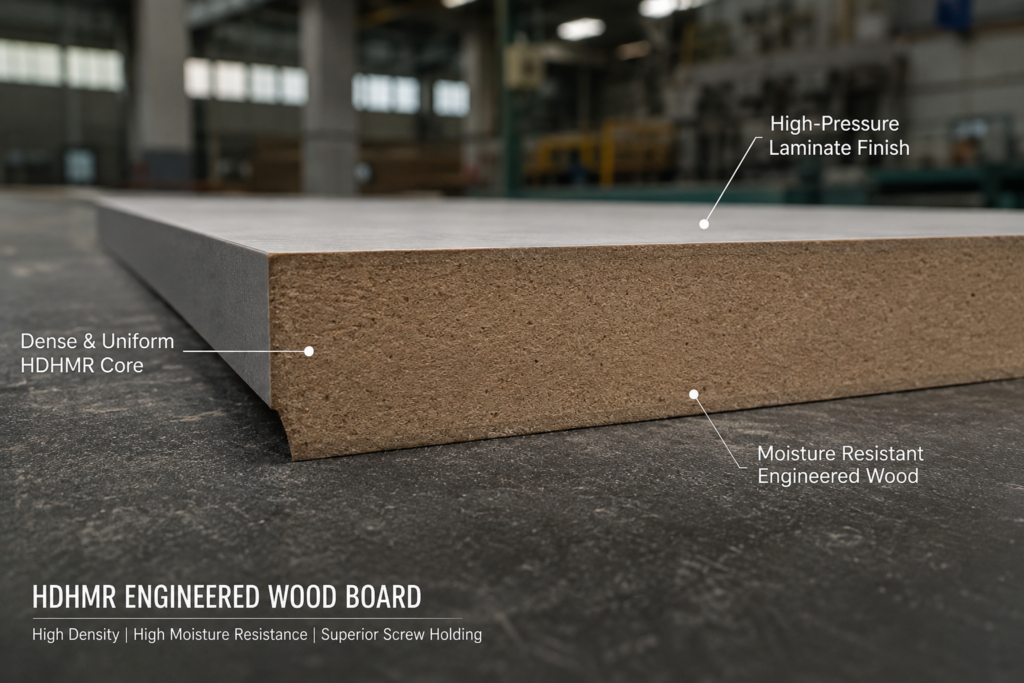
How to Choose the Right German Kitchen Setup for Your Home
The decision comes down to four factors: climate exposure, cooking intensity, budget range, and the size of your footprint. Use this checklist before your site consultation:
Carcass material:
- Kitchen near sink, hob, or high-humidity area >> BWP plywood for base units
- Upper cabinets and wall units in dry zones >> HDHMR is sufficient and more cost-effective
- Ground-floor property with termite risk >> HDHMR or BWP only; anti-termite pre-treatment required
Hardware tier:
- Daily heavy cooking (pressure cookers, cast iron) >> specify 40–70 kg drawer runner systems
- Moderate-use kitchen (2–3 cooking sessions daily) >> standard 30 kg rated runners are adequate
- Corner spaces in L or U-shaped layouts >> budget for Magic Corner or LeMans unit rather than a static shelf
Layout verification:
- Have you confirmed the kitchen layout on a live floor plan, not just a rough sketch?
- Is there an electrical point for a chimney at the planned hob location?
- Does the layout leave a clear working triangle between hob, sink, and refrigerator?
Supplier verification:
- Does the provider show real installed project photos (not renders)?
- Can they name the exact board grade they’re supplying?
- Is the installation team their own, or subcontracted per project?
- Does the warranty cover hardware and carcass separately?
For Bhumim’s service areas, you can verify the modular kitchen design options in person at our Dehradun showroom, or explore our full modular kitchen design range, including parallel kitchen layouts and U-shaped configurations for larger homes.
Common Mistakes to Avoid When Buying a German Modular Kitchen
Choosing the finish before the carcass
Most homeowners spend 80% of their showroom time picking shutter colours and handle styles. The finish is what you’ll see every day, but the carcass is what determines whether the kitchen survives your climate. Start with the board and hardware decisions. The finish comes last.
Assuming all "German hardware" is equivalent
In 2026, there’s a wide range of what gets sold under the label “German hardware” in the Indian market. Häfele and Blum are among the names that carry consistent quality benchmarks and Indian market warranty support. Ask your provider to name the brand and model of the drawer runner and hinge they’re supplying, not just “German hardware.”
Skipping the corner storage budget
The most common regret we hear from homeowners six months after installation: “I wish I’d spent on the corner unit.” A plain fixed shelf in an L-shaped corner wastes more than 60% of available depth. A Magic Corner or LeMans unit adds to the budget upfront but is the one addition homeowners consistently say was worth every rupee.
Not accounting for countertop thickness
Indian granite (typically 18–20 mm) and imported quartz (20 mm) differ in thickness, and the gap between the cabinet top and the countertop needs to be engineered into the cabinet design. Ignoring this at the planning stage causes alignment issues during installation.
Waiting for the post-monsoon season to order
Delivery timelines for modular kitchens range from 3 to 12 weeks depending on whether it’s a hybrid or full import. Ordering in October for a January installation makes sense. Ordering in June for a July installation often doesn’t.
Frequently Asked Questions
The primary benefits are moisture-resistant edge banding that withstands monsoon humidity, high-load-rated drawer runners suited to heavy Indian cookware (30–70 kg per drawer), smart corner storage systems that recover dead space, and surface finishes that resist oil and turmeric stains. These advantages are especially relevant in North Indian cities like Dehradun, Haridwar, and Noida where humidity, heavy cooking, and termite risks are real daily concerns.
For a home you’ll occupy for five or more years, the answer is generally yes, particularly the hybrid version with German hardware on HDHMR or BWP plywood. The upfront cost is higher than a carpenter-built kitchen, but the reduced repair frequency, longer hardware life (80,000+ cycles on quality hinges), and moisture resilience mean the total cost of ownership over ten years is often lower.
A full German kitchen uses cabinets manufactured in Germany by established German kitchen manufacturers and imported to India, costing ₹3,500–₹8,000+ per sq ft. A hybrid German kitchen uses Indian boards (HDHMR or BWP plywood) as the carcass and fits certified German hardware (Häfele, Blum, and similar brands), delivering most of the structural and functional benefit at ₹1,800–₹3,500/sq ft. Most Dehradun and NCR homeowners choose the hybrid approach.
Häfele and Blum are among the most widely available certified German hardware brands through authorized dealers and modular kitchen manufacturers across Dehradun, Haridwar, Roorkee, Noida, and Ghaziabad. Each brand carries a range of drawer runners, hinges, and corner pull-out systems with 10-year to lifetime mechanical warranties in India.
A properly installed German modular kitchen, with laser-sealed edge banding, HDHMR or BWP plywood carcasses, and certified German hardware, typically lasts 15 to 25 years with routine maintenance. The hardware (hinges, drawer runners) is engineered for 80,000+ open-close cycles. The actual limiting factor in most cases is the countertop and shutter finish, both of which can be replaced or updated without touching the carcass.
A hybrid German modular kitchen in Dehradun, using HDHMR carcasses with certified German hardware, typically ranges from ₹1,800 to ₹3,200 per square foot. For a standard apartment kitchen of 40–50 sq ft of cabinetry, that translates to roughly ₹75,000–₹1.6 lakh for the kitchen alone, before countertop and appliances. Full imported German kitchens start from ₹4,000/sq ft and above. Pricing varies by layout, hardware tier, and finish choice.
Yes. Modern acrylic and matte laminate shutter finishes used in German kitchens are stain-resistant and easy to clean after tadka, turmeric, and heavy oil cooking. A wipe-down with a microfiber cloth and mild soap is sufficient for daily cleaning. The key point: avoid abrasive scrubbers on acrylic shutters, as these create micro-scratches over time. Matte laminate is the more forgiving option for kitchens with very heavy daily use.
Specifically suited to it. German kitchen engineering includes space-optimization systems, pull-out pantry towers, overhead cabinet extensions to ceiling height, corner carousel units, and tandem drawer stacks, that allow a 7–9 ft kitchen footprint to hold significantly more storage than the same space with fixed shelves. Handleless Gola rail profiles also visually open up compact spaces by eliminating external handles.
Laser edge banding is a manufacturing process where the protective edge strip on a cabinet board is bonded using laser heat rather than adhesive glue. This creates a zero-joint seal with no glue line, the most common entry point for moisture in Indian kitchen cabinets. In humid climates like Dehradun’s monsoon season or Rishikesh’s riverside zones, this seal is the primary reason German-standard cabinets don’t swell the way adhesive-edged cabinets do over time.
Ask your provider for the brand name, product series name, and load rating of the drawer runner they’re supplying, not just “German hardware.” Legitimate certified German hardware products come with product labels, packaging, and model numbers you can cross-reference on the brand’s official Indian website. If a provider cannot name the specific series, that’s a signal worth taking seriously.
Key Takeaways
- Two types exist: Full German import (₹3,500–₹8,000+/sq ft) vs. hybrid German hardware on Indian HDHMR or BWP carcass (₹1,800–₹3,500/sq ft). Most North Indian homeowners choose hybrid.
- PUR laser edge banding is the core moisture protection advantage, it creates a zero-joint seal that prevents the cabinet swelling common in Dehradun and Rishikesh monsoon conditions.
- Hardware load ratings matter: Certified German hardware systems are tested to 30–70 kg per drawer and 80,000+ hinge cycles, specs that match the demands of heavy Indian cooking utensils.
- Lifespan: 15 to 25+ years with routine maintenance, compared to 5–12 years for most carpenter-built kitchens.
- Corner storage (Magic Corner, LeMans units, carousel systems) is the biggest underinvested category. Budget for it, or plan around it.
- For Dehradun and Rishikesh: Specify BWP plywood for base cabinets and sink sections, regardless of what board is used for upper units.
- Appliances are separate. Per-square-foot kitchen pricing never includes chimneys, hobs, or built-in ovens, always get a combined quote if you need appliances included.
Conclusion
If your current kitchen has a swollen cabinet near the sink, a drawer that’s started to sag, or hinges that wobble under the weight of a full masala rack, you already know what carpenter-built kitchens cost in the long run. A German modular kitchen, especially the hybrid version that pairs certified German hardware with a moisture-resistant HDHMR or BWP carcass, solves these problems by moving the manufacturing out of the site and into a controlled factory environment.
The advantages aren’t theoretical. In Dehradun’s monsoon-prone environment, in Ghaziabad’s heavy-use multi-family homes, in Noida’s compact apartment kitchens, and in Haridwar’s family cooking setups, the performance differences between factory-sealed German-specification kitchens and on-site carpenter builds are visible within two to three years.
The question in 2026 isn’t whether a German modular kitchen is worth it. The question is which type suits your budget, and which partner can deliver it with verified hardware, honest material disclosure, and after-sales accountability.
If you’re evaluating options for a kitchen in Dehradun, Haridwar, Rishikesh, Roorkee, Noida, or Ghaziabad, book a free 3D design consultation with the Bhumim team. We’ll show you finished kitchens in person, confirm exact material grades, and give you a city-specific quote without hidden upgrade fees.
Book a free 3D kitchen design consultation with Bhumim
About This Article
Published by: Bhumim India Private Limited-Modular Kitchen Manufacturer & Installer, Dehradun
GST: 05AAOCB1784F1ZM | ISO 9001:2015 Certified
Service Areas: Dehradun · Haridwar · Rishikesh · Roorkee · Noida · Ghaziabad
Contact: 08044630777 | hello@bhumim.com
Note: This article is written from Bhumim’s on-ground manufacturing and installation experience. All material recommendations are based on what we use in real kitchens across our service areas.