


Modular Kitchen Design
Aluminium Kitchen Cabinet Design: Style & Durability
Types of aluminium kitchen cabinet design: powder-coated, glass-profile, wood-grain & ACP. 2026 price guide for Dehradun.
July 29, 2026
Kitchen cabinet handles should suit how each door opens, who uses it, and how your water treats metal. Use bar pulls on wide drawers, knobs on small doors, and a brushed finish if your water is hard. Buy by hole centres, not overall length, so the handle fits the drilled shutter.
Below, two tables compare handle types and finishes, and a worked example shows how to size and place every handle.
Handles are often chosen last, from a catalogue photo and a quick nod, and then the carpenter drills the shutters the very next day.
Then the wide drawer feels under-sized, the finish may spot within a season, and the screw holes cannot move. This guide reverses that order for modular kitchen handles, so the decision comes before the drill.
It covers the types, the finishes that suit Dehradun’s water and humidity, and a size and placement method you can check with a tape. It ends with a list to carry into your quote review.
Handles are one decision inside your wider modular kitchen design. Handleless doors are a separate route, and Bhumim’s guide to Gola profile, J-pull and push-to-open systems and its handleless ultra-matte shutters guide compare them. This page stays with fitted handles that you can see and grip.
The Houzz guide to knobs and pulls puts the average kitchen at 20 to 40 knobs, so one wrong choice repeats on every door.
Which handle will your hand reach for every single day?
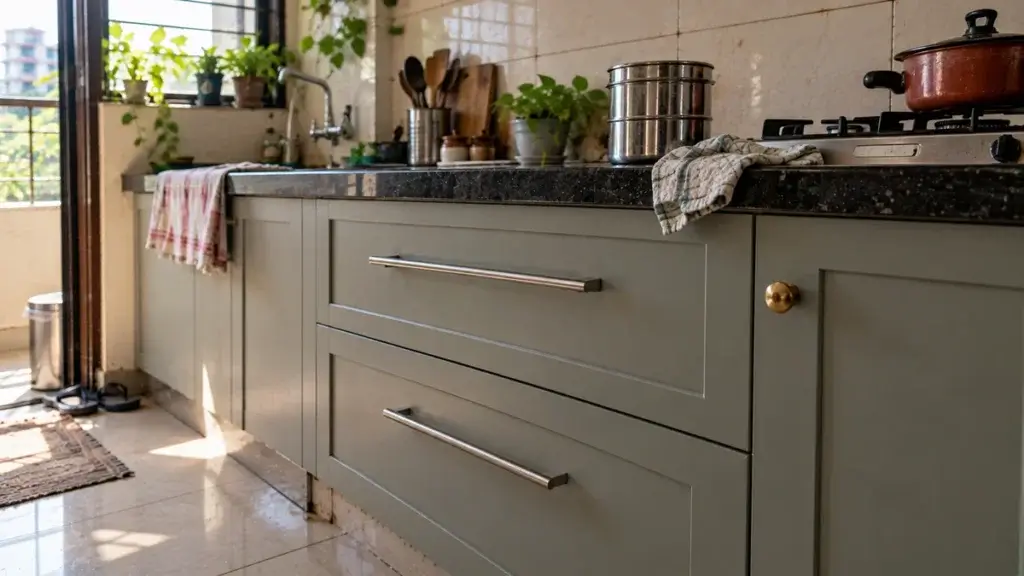
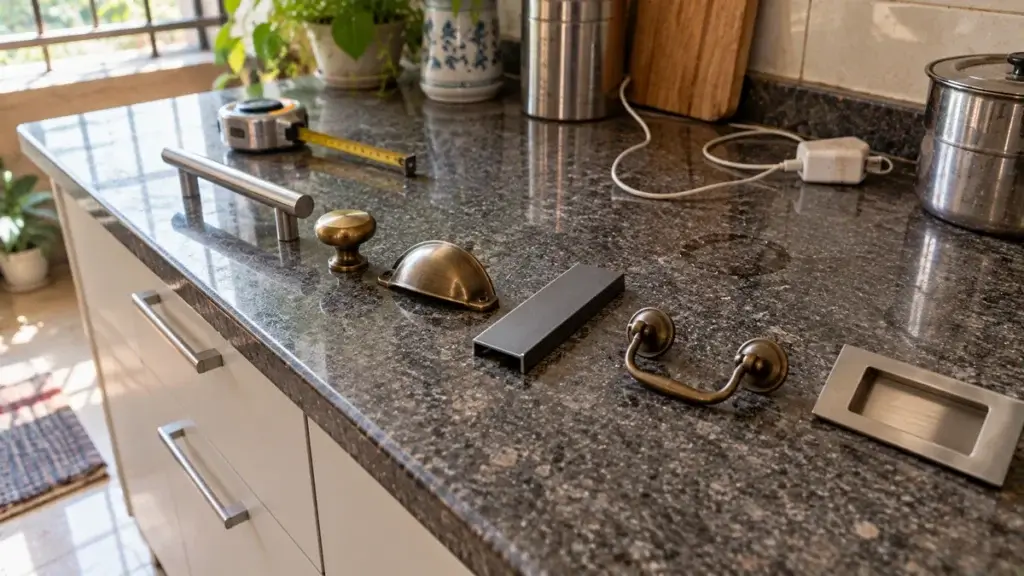
Fitted handles come in six common families, and the table says where each one works and what to watch before you buy.
Type | Where it works | Watch out for |
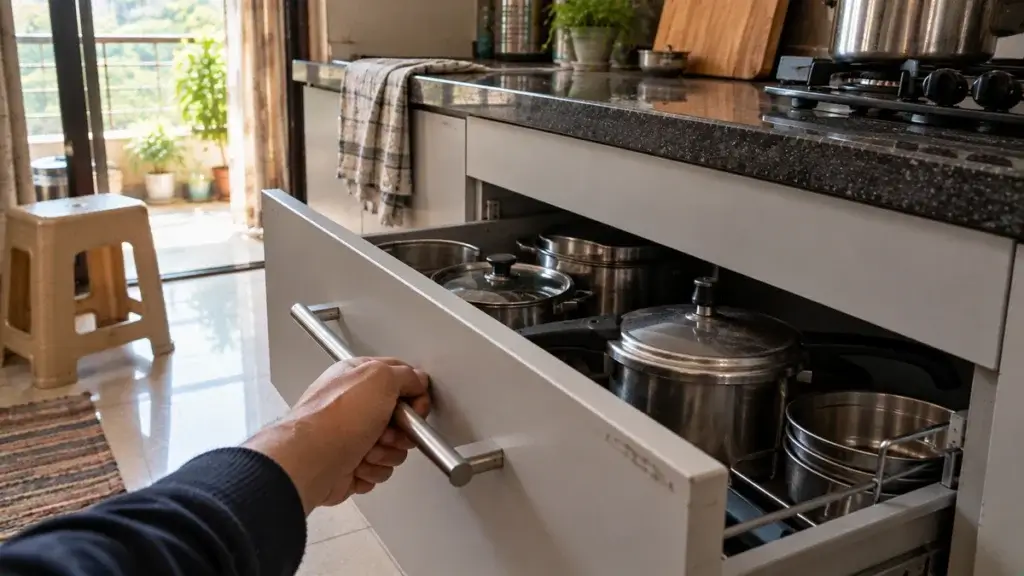
Bar or D pull | Wide drawers and tall doors, because the whole hand can grip it | A long bar on a narrow door looks heavy |
Knob | Small doors and light drawers | Fingertip grip only, and a round knob can spin loose without an anti-twist pin |
Cup or bin pull | Heavy drawers and doors with a traditional profile | Looks fussy on slim, flat shutters |
Edge pull | Flat shutters where you want a clean face with no handle on it | Test the grip with a wet hand, because the fingers hook under the edge |
Drop handle | A furniture look, and harder for toddlers to open | Slower to use, and it can scratch the cabinet over time |
Recessed pull | Narrow walkways, because nothing catches on clothes | Harder to grip, and it must be chosen before the cabinets are made |
Several rows follow a Houzz guide to kitchen knobs and pulls. It says bar pulls give a secure grip and suit older users, while bin pulls cope with heavy drawers. It also advises anti-twist pins on round knobs, and warns that recessed pulls cannot be changed later.
An edge pull is a slim strip fixed along the top edge of a door or drawer, so the face stays clear. The edge pull row and the notes on looks are our own judgment.
Projection matters in a narrow kitchen, because Bhumim’s small kitchen guide notes that a fitted handle sticks out 2 to 4 cm into the room.
Try each type in your hand before you decide, because a shape that looks neat in a photo may feel thin under a wet thumb.
Could you open this drawer with a wet, oily hand?
For expert design consultation, send us your details and we’ll schedule a call
Use the load, the width and the user of each door or drawer to decide, and work through these rules in order.
On the other hand, a knob needs only one screw hole and is quicker to fit than a long pull. We think a mix works well: pulls on drawers and tall doors, and knobs on small doors.
Many families call the kitchen shutters cupboards, so kitchen handles for cupboards simply means the same pulls and knobs on those doors.
Who in your home will use this drawer most?
A finish has to survive daily wiping, kitchen steam and mineral water for years, and showroom light hides all of that.
According to Bhumim’s hard water guide for Dehradun kitchens, polished and matte black finishes show mineral spotting fastest. A brushed or lightly textured steel face hides it far better. The same guide says wiping a fitting dry after use is the most effective habit.
Finish | Look | In hard water and humid air |
Brushed stainless steel | Neutral, suits most themes | Hides mineral spots better than a polished face |
Polished steel or chrome | Bright and mirror-like | Shows spots and scratches fastest |
Brass | Warm tone for wood and deep colours | Choose a satin or brushed face, because shiny faces scratch |
Gold tone | Brighter and more decorative | Ask whether it is solid metal or a thin coating |
Matte black | Strong contrast on pale shutters | Shows white mineral spotting more than lighter finishes |
White | Blends into white shutters | Wipe weekly, because grease shows against a plain colour |
Stainless steel kitchen cabinet handles are the plain default. Steel comes in grades, so we suggest asking the maker for the grade in writing.
Brass kitchen cabinet handles and gold kitchen cabinet handles add warmth. We think a thin coating can wear first at the grip point, so ask how the maker expects it to age.
White kitchen cabinet handles on white shutters nearly disappear, which suits a calm, plain look but shows grease sooner.
Will you really wipe this handle dry every day after cooking?
Climate adds to the problem, and the India Meteorological Department’s Climate of Dehra Dun report shows the daily maximum humidity rising through the monsoon. It climbs from about 55 percent in early June to 90 percent by the third week of July (1971 to 2010 normals).

Chart: Dehradun daily maximum humidity through the monsoon. Source: India Meteorological Department, Climate of Dehra Dun (1971 to 2010 normals)
That damp air meets kitchen steam around the sink and hob, so choose a finish you can wipe dry in seconds.
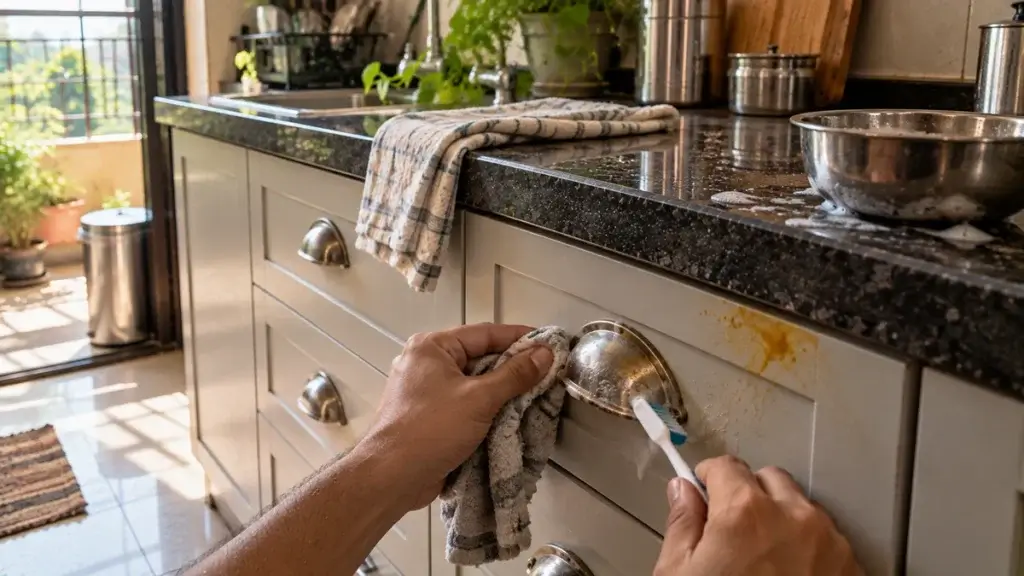
Handles collect grease, turmeric and water spots faster than the rest of the shutter, because every hand touches them. A 2-minute weekly wipe keeps them looking new.
When did you last wipe the handle you use most?
Two numbers describe every pull, and length is the full size of the handle. The hole centre is the distance between the middle of its two screw holes.
Buy by hole centres, because the shutter is drilled for one spacing, and a handle with another spacing means filling holes and refinishing it.
One Hafele UK catalogue sheet pairs each length in one bar handle range with its hole centres. A 136 mm handle has 96 mm centres, a 168 mm handle has 128 mm, and a 230 mm handle has 160 mm. That is a UK sheet from 2017, so check the sheet your own maker uses.
Houzz’s knobs and pulls guide says designers usually keep a bar pull to two-thirds or three-quarters of the drawer width. The Houzz guide to six handle factors adds that one handle length across a run looks more consistent.
On the widest drawers you can choose between two balanced pulls and one long pull. One long pull opens with a single hand while the other hand holds a pan, but two pulls look more even. We think the long pull suits a working kitchen better.
So what is the standard size? There is none, because the drawer decides the length and the drill pattern decides the centres.
Placement changes how easy the kitchen is to use every day, because the reach and the height repeat each time you cook. Settle it with the design, before the carpenter drills anything.
A Houzz guide to placing cabinet hardware lists the common options for drawers.
For doors, the guide calls placement largely a matter of taste, with one rule: match the hardware spacing on wall cabinets to the base cabinets.
The six-factors guide adds that handles run horizontally on drawers and vertically on doors. It also says flush ends stop clothes and knees catching, and that handles should not collide when doors open.
In an L-shaped kitchen, we suggest checking the corner on the 3D design. Does the handle of one door hit its neighbour as it swings?
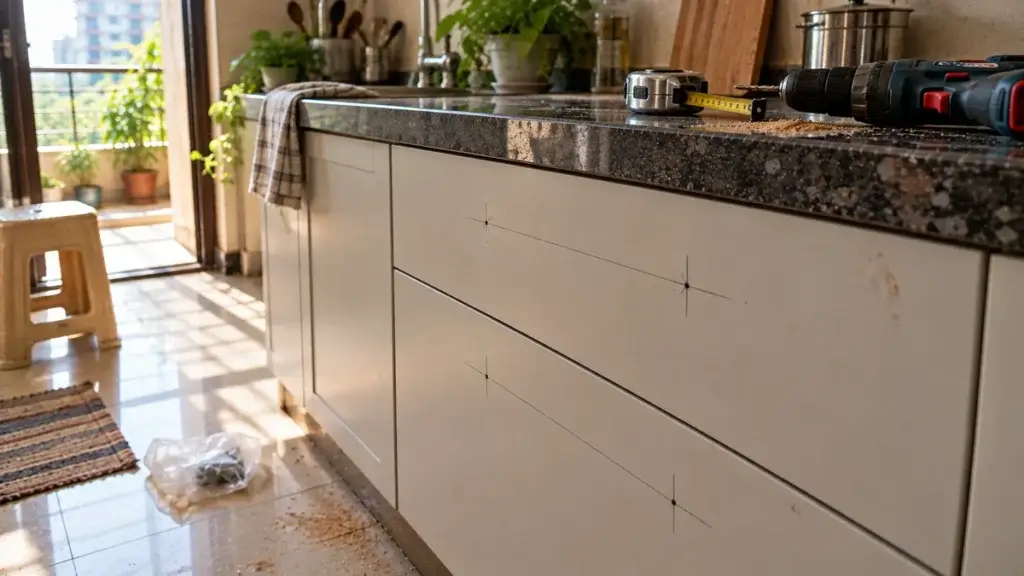
That 20 to 40 knob figure comes from a US guide. Count your own kitchen from the 3D design, door by door and drawer by drawer.
Choosing handles for your kitchen? Bring your kitchen size and the finish you like, and review the handle positions in a free 3D design. Call or WhatsApp 08044630777 or fill in your details at bhumim.com.
Choose fitted handles if you cook heavily every day, want easy replacement, or may change the look in a few years. A handle can be swapped when your taste changes, as long as the new one has the same hole centres.
Choose a handleless system if you want a flat, clean wall of shutters and can plan it before production starts. These systems are built into the cabinets, so they are hard to add later. The free 3D design stage, typically 3 to 7 days, is the time to decide.
Both routes are compared in the two Bhumim handleless guides linked at the start of this article. Read them before you decide, because the choice shapes every other hardware decision.
We think fitted handles suit most family kitchens, while handleless suits homes that value a clean look more than easy replacement.
Most of these are cheap to avoid and costly to fix once the shutters are drilled. Which one worries you most? Sizes and finishes are guides, and small differences between makers always exist.
Houzz’s knobs and pulls guide says designers usually keep a bar pull between two-thirds and three-quarters of the drawer width, and add two pulls on drawers 18 inches (46 cm) or wider. So a 60 cm drawer takes a pull of about 40 to 45 cm. Treat it as a starting point, then test the length with tape.
A Houzz owner asked this about 8-inch and 12-inch pulls. The Houzz placement guide says to match the hardware spacing on wall cabinets to the base cabinets, and the six-factors guide prefers one handle length across a run. Use one family of sizes, and let the larger drawers take the longer pulls.
The common families are bar or D pulls, knobs, cup or bin pulls, edge pulls, drop handles and recessed pulls. Pulls give the whole hand a grip, while knobs rely on the fingertips. Pick the type by the weight and width of each drawer or door, and test a sample in your hand first.
Bhumim’s hard water guide says matte black and polished finishes show mineral spotting fastest, so they need the most wiping. A brushed or lightly textured face hides spots better. If you love the look, keep black handles away from the sink and wipe them dry after use.
The handles themselves are the same shapes and sizes. The difference is timing. A modular kitchen is made in a factory and installed later, so the handle type and hole centres should be fixed at the design stage, before the shutters are cut and finished. Ask your maker exactly when the holes are drilled.
There is no single standard, because the drawer decides the length. What you must match is the hole centres, the distance between the two screw holes. One Hafele UK catalogue sheet pairs a 136 mm handle with 96 mm centres, a 168 mm handle with 128 mm, and a 230 mm handle with 160 mm.
The one-third rule says a pull should be about a third of the drawer width. We think it suits small drawers, but the Houzz knobs and pulls guide keeps bar pulls longer, at two-thirds to three-quarters of the width on wide drawers. The rules disagree, so cut tape to both lengths and look at them on your own drawer.
Wipe them weekly with a soft cloth and mild soap in warm water, then dry them straight away. Bhumim’s hard water guide suggests a diluted vinegar or baking soda paste for limescale on steel, tried on a hidden spot first. Avoid scouring pads and steel wool, and ask your maker before using any acid on brass or gold-tone handles.
Usually yes, if the new handle has the same hole centres as the old one. Different centres mean filling the old holes and refinishing the door, which a carpenter should do. Recessed pulls are harder, because they are built into the door and Houzz notes they cannot be changed later.
Call or WhatsApp Bhumim at 08044630777, or fill in your details at bhumim.com/contact. Share your kitchen size and the finish you like, and the team shows the layout in a free 3D design, typically within 3 to 7 days. Then ask which handle options come with your kitchen package, and which hole centres each drawer uses.
Good handles come from a few measured choices made before the drill comes out: the type, the finish, the hole centres and the position. Settle them with the design, and the first wide drawer will feel right on the day it is fitted.
If you are planning a kitchen in Dehradun, Rishikesh or Haridwar, call or WhatsApp Bhumim at 08044630777 or reach out through bhumim.com/contact for a free 3D design, and ask which handle options suit your modular kitchen cabinet handles plan.
Published by: Bhumim India Private Limited-Modular Kitchen Manufacturer & Installer, Dehradun
GST: 05AAOCB1784F1ZM | ISO 9001:2015 Certified
Service Areas: Dehradun · Haridwar · Rishikesh · Roorkee · Noida · Ghaziabad
Contact: 08044630777 | hello@bhumim.com
Note: This article is written from Bhumim’s on-ground manufacturing and installation experience. All material recommendations are based on what we use in real kitchens across our service areas.
Types of aluminium kitchen cabinet design: powder-coated, glass-profile, wood-grain & ACP. 2026 price guide for Dehradun.
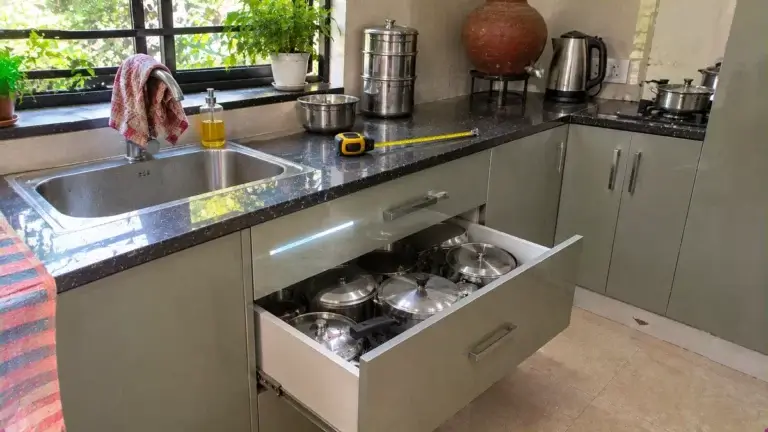
Planning kitchen drawer design? See base-drawer sizes in mm, soft-close runner checks, pots and pans depth and cutlery tray fit.
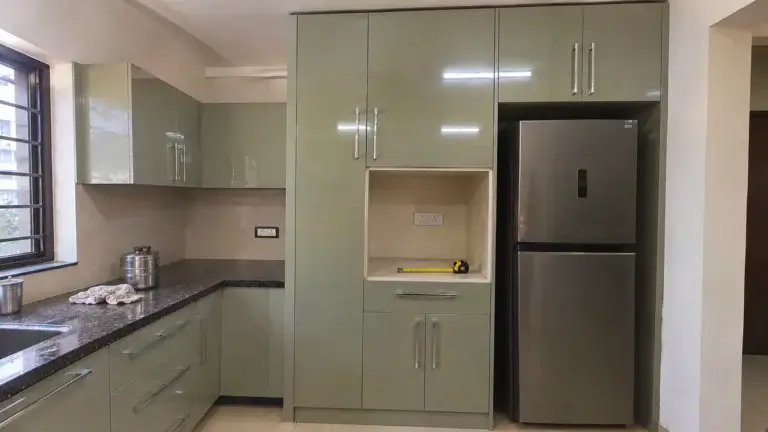
Planning a kitchen tall unit? See sizes in mm, oven and fridge housing rules, a worked cost example and a checklist for 1 to…