

Matte vs Acrylic Modular Kitchen: Which Finish is Best for Your Home?
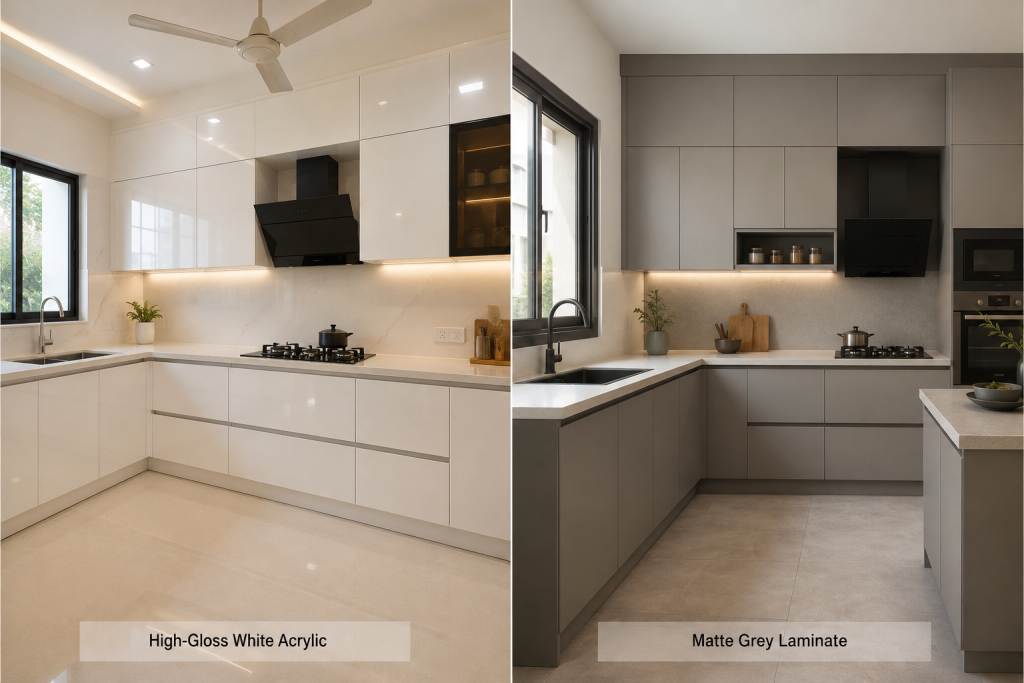
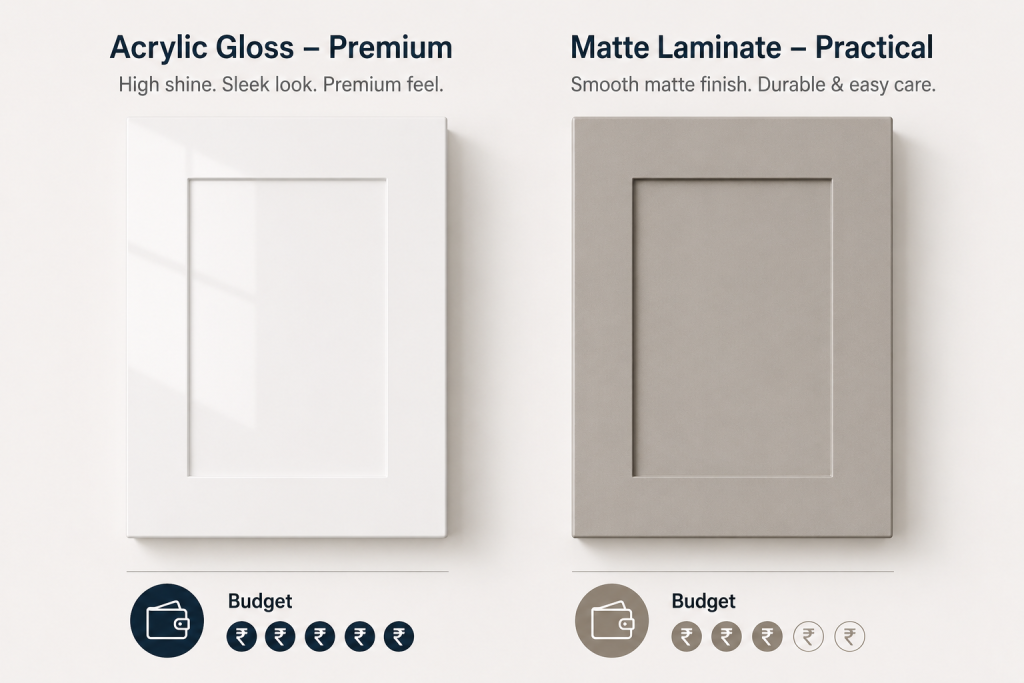
Matte vs acrylic modular kitchen finishes each serve a different purpose: acrylic delivers a high-gloss, mirror-like look best suited to premium kitchens with lighter cooking, while matte laminate offers low-maintenance practicality for daily Indian cooking. For most homes in Dehradun and across Uttarakhand, matte laminate on HDMR or BWR plywood gives the best balance of durability, cost, and ease of cleaning.
Definition: A kitchen finish is the outer decorative surface applied to cabinet shutters and door fronts. It determines how the kitchen looks, how easy it is to clean, and how well it holds up over years of cooking. The three most common finishes in Indian modular kitchens are laminate (available in matte or gloss), acrylic (primarily gloss, though matte variants exist), and matte, which is a finish quality, not a material by itself, that can be achieved through both laminate and acrylic.
Why Your Finish Choice Matters More Than You Think
After installing modular kitchens across Dehradun, Haridwar, Roorkee, and Noida, the single question we hear most consistently from homeowners is not about layout or colour. It is about what holds up after three monsoons, daily oil splatter, and a household that actually cooks.
Most people walk into a showroom, see the acrylic kitchen gleaming under display lighting, and immediately want it. That is a completely natural response. However, what looks stunning under showroom spotlights may tell a different story six months into daily use in an Indian kitchen. This article is written to help you understand each finish on its own terms, so you can pick the one that fits your life, not just your mood board.
What Are These Three Finishes? A Clear Starting Point
Before comparing them, it helps to understand exactly what each term means. These three are often used interchangeably in contractor conversations, and that confusion can lead to costly mistakes.
What Is Laminate Finish?
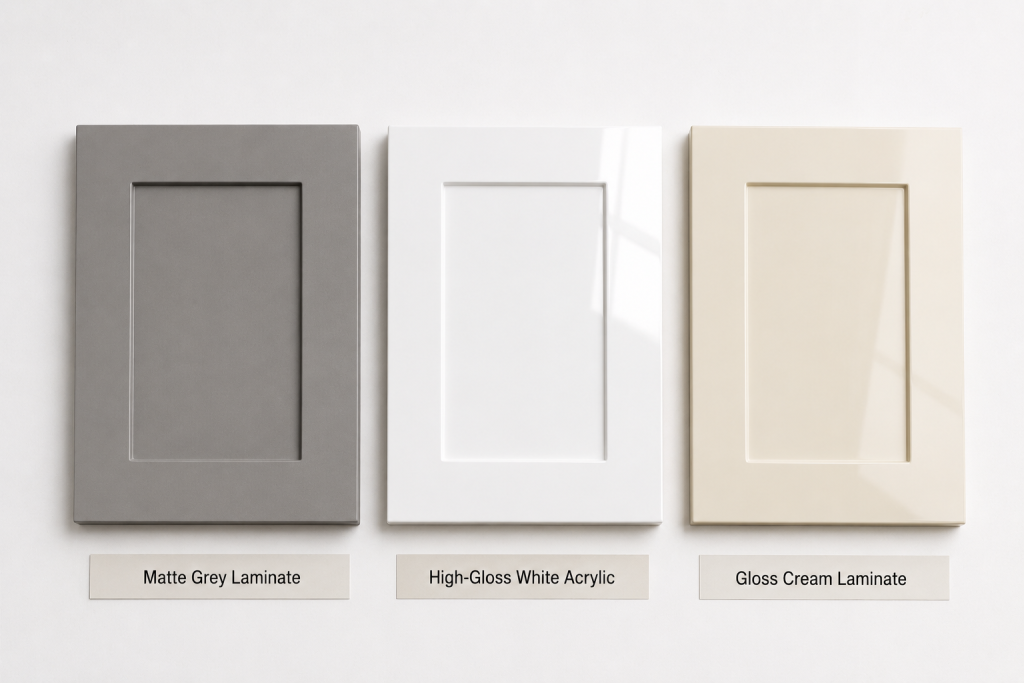
Laminate is a thin decorative sheet made from layers of paper and plastic resin pressed together under high heat and pressure. In Indian kitchens, laminate is applied to the outer surface of cabinet shutters, typically over HDMR board, BWR plywood, or MDF. Reputable brands are commonly used in the modular kitchen industry. Laminate comes in two main types: high-pressure laminate (HPL), which is bonded to plywood for better durability, and low-pressure laminate (LPL), typically used over MDF for lighter applications. For kitchen shutters, HPL on HDMR or plywood is the more durable combination. The most important thing to know: laminate is available in matte, gloss, textured, and wood-grain finishes, which means matte and laminate are not the same thing.
What Is Acrylic Finish?
Acrylic is a plastic-resin-based sheet that is bonded to the surface of a cabinet shutter, usually over MDF or HDMR board. It produces an extremely smooth, non-porous, mirror-like surface. Acrylic does not rely on a topcoat, the glossy quality is inherent to the material. This makes it UV-resistant and colourfast for years. However, this also means scratches cannot be polished away the same way they can on some laminate surfaces. Acrylic is widely used in premium modular kitchens across India and is often positioned as a luxury finish. Matte acrylic variants do exist, but the most commonly available, and most widely specified, form of acrylic finish in Indian kitchens is high-gloss.
What Does "Matte Finish" Mean?
Matte is a finish quality, not an independent material. A matte finish means the surface has very little or no reflectivity. It absorbs light instead of bouncing it. You can achieve a matte finish through matte laminate, matte acrylic, or even PU (polyurethane) matte paint. In everyday kitchen conversations, when someone says “matte finish,” they usually mean matte laminate, because that is by far the most common and cost-accessible matte option available in India.
For this article, we will compare the three most practical combinations: matte laminate, high-gloss acrylic, and regular gloss laminate, with specific notes on where matte acrylic fits in.
Get started with Beautiful Homes
For expert design consultation, send us your details and we’ll schedule a call
Matte vs Acrylic vs Laminate: A Side-by-Side Comparison
The table below compares the three finishes across the factors that matter most for Indian homeowners.
Feature | Matte Laminate | Gloss Acrylic | Gloss Laminate |
Look | Soft, understated, contemporary | Mirror-like, high-end, bold | Shiny but less deep than acrylic |
Hides fingerprints? | Yes, very well | No, shows clearly | Somewhat |
Scratch resistance | Good (HPL on HDMR) | Very good (thick acrylic) | Good |
Heat resistance | Good | Moderate, avoid placing hot pans near shutters | Good |
Maintenance | Low, easy to wipe, forgiving | High, needs frequent cleaning | Moderate |
Cost | Budget to mid-range | Premium (significantly higher) | Budget to mid-range |
Best for | Daily cooking, families, low-maintenance homes | Showroom kitchens, minimal cooking, premium upgrades | Small kitchens needing brightness |
Best substrate | HDMR or BWR plywood | HDMR or MDF (thicker acrylic preferred) | HDMR or BWR plywood |
Design variety | Very high, colours, textures, wood grains | Moderate, mostly solids and bold gloss colours | High |
Which Finish Holds Up Best in Indian Kitchens?
Indian cooking is fundamentally different from the European cooking styles that most global kitchen finish standards are tested against. The combination of high-heat cooking, oil vapour, turmeric, and daily three-meal routines creates a demanding environment for any cabinet finish.
Matte laminate is the most forgiving in this context. Because the surface does not reflect light strongly, grease marks, light scratches, and water droplets are far less visible. Wiping down a matte laminate kitchen after cooking takes seconds, not minutes. Furthermore, if a matte laminate shutter gets a light surface scratch, it tends to be much less noticeable than on a glossy surface.
High-gloss acrylic, on the other hand, shows every fingerprint, every water mark, and every grease splash with sharp clarity. That is not a flaw, it is simply the nature of a mirror-like surface. For homes where the kitchen is used lightly, or where the cooking area is well-separated from the display cabinetry, acrylic performs beautifully. However, for families cooking three meals a day with oil-heavy Indian dishes, acrylic requires daily wiping to look presentable.
Gloss laminate sits in between: brighter than matte but not as demanding as acrylic.
Humidity and Monsoon Considerations for Dehradun Homes
Dehradun and the surrounding Uttarakhand region experience a genuine monsoon season every year, along with significant humidity fluctuations during winter fog. This matters for finish selection because moisture is not just a cleaning issue, over time, it affects how the finish bonds to the substrate beneath it.
For any finish applied over MDF (medium-density fiberboard), moisture is a long-term concern. MDF swells and weakens when it absorbs water, and this can cause laminate or acrylic sheets to bubble or peel, particularly near the sink or cooking hob. This is why we recommend HDMR (High Density Moisture Resistant board) or BWR plywood as the substrate whenever possible, regardless of which finish you choose above it. The finish is only as good as what it sits on.
In kitchens facing Dehradun’s hill-side humidity, particularly in homes along Rajpur Road or in areas with natural ventilation challenges, HDMR with matte HPL laminate remains the most consistently durable combination we have seen across real installations.
Expert Tip: Always ask your modular kitchen manufacturer what substrate sits beneath the finish. A beautiful acrylic shutter on thin, low-grade MDF will peel and swell before an HDMR-backed matte laminate shutter shows any wear at all.
Is Acrylic Worth the Higher Cost?
Acrylic finish is genuinely superior in some specific ways. The surface is non-porous, which means bacteria and food particles cannot seep into it. It is UV-resistant, so the colour does not fade near windows over years of sunlight exposure. Good-quality thick acrylic sheets (those using cell-cast manufacturing rather than extruded sheets) are also harder and more scratch-resistant than standard laminates. Furthermore, acrylic delivers a depth of colour and gloss that no laminate, however premium, can fully replicate.
The question is whether you need those advantages, and whether they are worth the cost difference.
Acrylic vs Laminate Cost in Indian Modular Kitchens
Laminate shutters typically start from around ₹800 per square foot (shutter only), while good-quality acrylic shutters typically start from around ₹1,500 per square foot and can go higher depending on brand and sheet thickness. For a full modular kitchen, this difference compounds significantly across all shutters, base cabinets, and wall units combined. The total project cost difference between a laminate-finished and acrylic-finished modular kitchen can be substantial, especially when premium acrylic on thicker boards is specified. That said, pricing varies by city and supplier, so always confirm current figures directly with your manufacturer.
Acrylic makes clear financial sense if: (a) you are building a premium kitchen where the aesthetic return justifies the investment, (b) you have lighter daily cooking habits, or (c) you want a kitchen that photographs and displays beautifully for a home you are developing or planning to sell.
Acrylic may not be the right choice if:
(a) your household cooks heavily every day,
(b) You have children who touch the cabinets frequently, or
(c) You are working within a mid-range budget where those savings could go toward better hardware or a stronger substrate.
Why Matte Laminate Is the Strongest All-Round Choice for Most Homes
Matte finish kitchen cabinets have become one of the dominant trends in 2025–2026 Indian kitchen design, and that shift is not just aesthetic. It is practical.
First, matte laminate hides fingerprints, a significant advantage in homes with children or multiple users. Second, it does not show grease mist after cooking the way a gloss or acrylic surface does. Third, it is available in a wide variety of colours and textures, including wood-grain finishes, concrete looks, sage greens, and warm neutrals, all of which suit the growing preference for calm, contemporary kitchen interiors. Fourth, and importantly, it is the most maintenance-free option available at a reasonable price point.
For modular kitchens in 2BHK and 3BHK apartments in Noida and Ghaziabad, where the kitchen is typically enclosed and cooking is frequent, matte laminate on HDMR consistently outperforms acrylic in terms of day-to-day livability. Moreover, in Dehradun’s independent homes and hill-facing residences where natural light is plentiful, matte surfaces look rich and textured rather than flat, which addresses the most common concern homeowners raise about choosing a non-glossy finish.
Matte Laminate Kitchen Maintenance Tips
Keeping a matte laminate kitchen looking great is genuinely straightforward. A soft microfibre cloth with mild soapy water handles most daily cleaning. Avoid abrasive scrubbers, as these can dull the surface texture over time. For stubborn oil or turmeric stains near the cooking zone, a mild diluted kitchen cleaner works well. Do not use acid-based cleaners on any laminate surface. Unlike glossy finishes, you do not need to wipe down the cabinet fronts immediately after every cooking session, which is a meaningful time saver for busy households.
Quick Checklist: Signs You Should Choose Matte Laminate
- Your household cooks oil-heavy Indian meals three or more times per day
- You have children or multiple family members using the kitchen regularly
- Your kitchen space has good natural light (matte looks richer in well-lit spaces)
- You want a modern, calm aesthetic without a high-maintenance routine
- Budget is a consideration and you want maximum durability per rupee spent
Choosing Based on Kitchen Size and Layout
Finish choice and kitchen layout are more connected than most homeowners realise.
Gloss Acrylic or High-Gloss Laminate for Smaller Kitchens
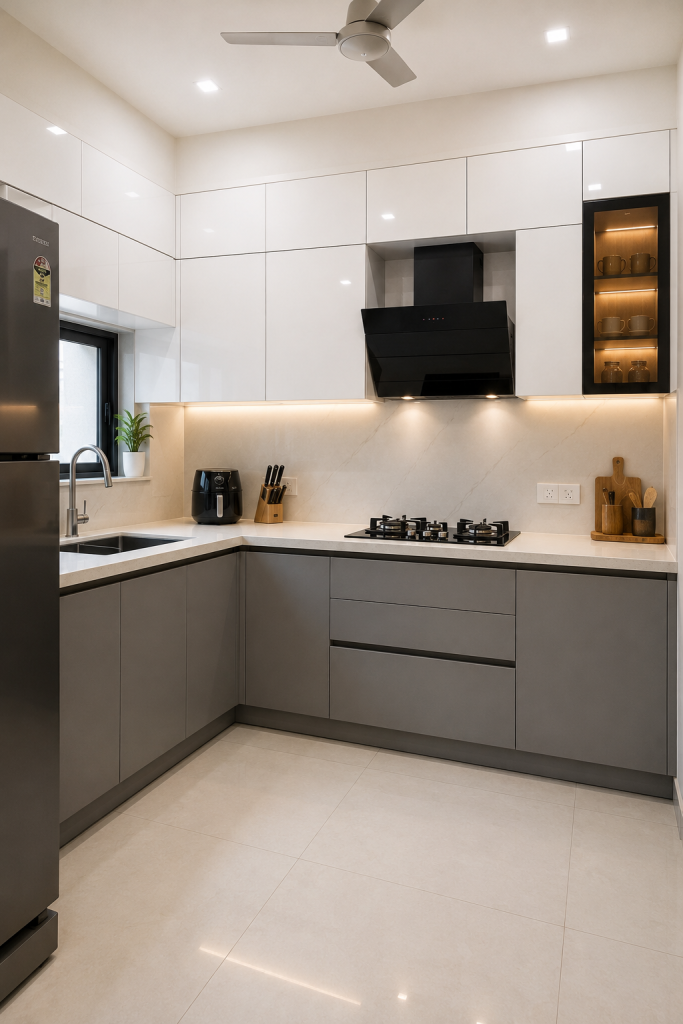
If your kitchen is compact, a straight layout or a small L-shape in a flat with limited natural light, a glossy finish has a genuine functional benefit. Reflective surfaces bounce available light around the space, making the kitchen appear larger and brighter than it actually is. In this specific situation, a high-gloss acrylic or gloss laminate on upper cabinets (combined with matte on lower cabinets for practicality) is a smart combination. For small kitchen design ideas in Dehradun flats, this mixed approach gives you visual spaciousness without the full maintenance commitment of an all-acrylic kitchen.
Matte Laminate in Medium to Larger Kitchens
In L-shaped, parallel, or U-shaped kitchens with more square footage, matte finishes work exceptionally well. The larger surface area of a matte kitchen does not look dull; it looks cohesive and intentional. Combined with under-cabinet LED lighting, warm countertop tones, and open shelving accents, a matte laminate kitchen in a medium-to-large space looks deeply considered and genuinely premium. Furthermore, larger kitchens are typically more active cooking spaces, which further reinforces the practical case for matte.
How to Evaluate Any Modular Kitchen Manufacturer on Finish Quality
When comparing modular kitchen providers, whether in Dehradun, Noida, or Ghaziabad, the finish is only one part of the story. These criteria help you evaluate the actual quality behind any finish, regardless of which provider you work with.
Substrate transparency
Ask what material sits beneath the finish. HDMR board or BWR plywood (IS 303 certified) beneath any finish is a sign of serious quality. MDF is acceptable for wall cabinets with proper moisture control, but not ideal for base cabinets near the sink. A manufacturer who tells you clearly is more trustworthy than one who deflects.
Laminate brand and grade
For laminate finishes, ask which brand and whether it is HPL (high-pressure laminate) or LPL (low-pressure laminate). HPL bonded to HDMR or plywood lasts significantly longer than LPL on particle board.
Acrylic sheet thickness and method
For acrylic, ask whether the sheet is cell-cast or extruded. Cell-cast acrylic is denser, more scratch-resistant, and more colour-stable. Extruded acrylic is cheaper and more prone to yellowing over time in Indian heat conditions.
Hardware quality
Regardless of finish, the hinges, drawer channels, and soft-close mechanisms are what you interact with every single day. Brands like Blum, Grass, and Häfele are recognised benchmarks for hardware quality in Indian modular kitchens.
Warranty terms
Ask specifically what the warranty covers and for how long, and get it in writing. A warranty that only covers manufacturing defects but not finish quality within the first year is worth less than a full materials-and-workmanship warranty.
At Bhumim, every kitchen goes through end-to-end quality control, from material sourcing and manufacturing at our Dehradun facility to installation and after-sales support. We use Blum, Grass, and Häfele hardware as standard, and we match finish recommendations to each client’s actual cooking lifestyle and space, not a showroom display.
Common Mistakes to Avoid When Choosing a Kitchen Finish
Choosing finish before choosing substrate
The finish is the face, but the substrate is the skeleton. Choosing acrylic on cheap MDF will perform worse than matte laminate on good HDMR. Always confirm substrate quality first.
Assuming acrylic is always more durable
Good-quality thick acrylic is very durable. However, low-cost extruded acrylic sheets, which are far more common in India’s mid-market, can yellow, crack at edges, and peel faster than a quality HPL laminate on a good board.
Ignoring kitchen orientation
A north-facing kitchen in Dehradun that gets minimal sun exposure benefits from a brighter, more reflective finish. A south-facing kitchen flooded with afternoon light does not need glossy surfaces to feel bright, and matte will perform better there aesthetically.
Choosing for the showroom, not for your cooking life
This is the most common and most costly mistake. If you cook heavily every day, a matte laminate kitchen that is easy to clean and maintain will give you more long-term satisfaction than a glossy acrylic kitchen that shows every mark.
Frequently Asked Questions
Matte and acrylic refer to different things. Matte describes the surface quality (non-reflective, no shine), while acrylic describes the material (a plastic resin sheet applied to cabinet fronts). You can actually get matte acrylic, though it is less common. In practice, matte usually refers to matte laminate, which is the most affordable and widely available non-reflective finish in Indian modular kitchens.
For most Indian households that cook oil-heavy, high-heat meals daily, matte laminate is the more practical choice. It hides fingerprints and grease better, is easier to maintain, and costs less. Acrylic is better for premium kitchens where aesthetics are the priority and cooking is lighter.
It depends on the quality of the acrylic. Cell-cast acrylic sheets from reputed brands are quite scratch-resistant. However, low-cost extruded acrylic sheets, very common in the mid-market, are softer and scratch more easily. If a scratch does occur, acrylic is harder to repair in-place compared to some laminate finishes.
Yes, absolutely, and this is actually a popular design approach. A common combination is using high-gloss acrylic or gloss laminate on upper wall cabinets (to reflect light and add visual lift) while using matte laminate on lower base cabinets (where fingerprints and kitchen splatter are more frequent). This gives you visual drama without the full maintenance burden of an all-acrylic kitchen.
Matte laminate finish on HDMR or plywood is consistently the most low-maintenance option for busy Indian households. It hides oil mist, water marks, and fingerprints effectively. A quick wipe with a damp microfibre cloth keeps it looking clean, even after daily cooking.
Yes, glossy acrylic or high-gloss laminate on upper cabinets can make a small kitchen appear significantly larger and brighter because the reflective surface bounces light. For small kitchen design in compact Dehradun apartments, a mix of gloss upper shutters and matte lower shutters is a particularly good design strategy.
Humidity is a key concern in Dehradun, Rishikesh, and Haridwar kitchens, especially during July–September. Any finish, whether matte laminate or acrylic, can bubble or peel if the substrate beneath it is low-quality MDF that absorbs moisture. The fix is not the finish; it is the substrate. Specifying HDMR or BWR plywood as the board material under your chosen finish gives you far better long-term protection against humidity-related damage.
Not at all, and this is one of the biggest misconceptions. In 2025–2026, matte finish kitchen cabinets are among the most sought-after aesthetics in modern Indian interior design. Paired with warm countertop tones, undercabinet lighting, and considered hardware, a matte kitchen looks deeply premium and contemporary. The key is quality material and thoughtful design, not surface shine.
Laminate shutters typically start from around ₹800 per square foot, while acrylic shutters typically start from around ₹1,500 per square foot. For a full modular kitchen, the total difference can be significant. However, pricing varies widely by brand, board quality, city, and supplier. Always get a detailed quote that specifies the substrate, laminate/acrylic brand, and hardware grade separately.
Key Takeaways
- Matte, acrylic, and laminate are not all the same category: matte is a finish quality, while laminate and acrylic are materials, both of which can be matte or glossy.
- Matte laminate on HDMR or BWR plywood is the most practical choice for most Indian households, particularly for daily Indian cooking.
- High-gloss acrylic delivers a premium, mirror-like look and genuine UV and moisture resistance, but shows fingerprints and requires frequent cleaning.
- For small kitchens with limited natural light, gloss acrylic or high-gloss laminate on upper cabinets is a smart design move.
- The substrate beneath the finish matters as much as the finish itself. In Dehradun’s monsoon climate, HDMR or BWR plywood is the correct base for any finish.
- Mixing finishes, gloss upper cabinets, matte lower cabinets, is a practical and popular design approach.
- Always ask your manufacturer about the laminate brand, board grade, sheet method (for acrylic), and warranty terms in writing.
Conclusion: Which Finish Is Right for Your Kitchen?
If you walked into this article seeing an acrylic kitchen in a showroom and wondering if you should commit to it, here is the honest answer: it depends entirely on how you actually cook.
For homes where the kitchen is a genuine workhorse, three meals a day, high heat, oil-heavy recipes, a busy family, matte laminate on HDMR is the finish that will look as good in year four as it does in month one. It does not demand your attention every time someone touches the cabinet. It handles the monsoon without drama. And it gives you more design flexibility than most people realise, from warm teak textures to contemporary sage green solids.
If your kitchen is a space where aesthetics and premium feel genuinely matter, and where the cleaning commitment is something you will maintain, a well-specified acrylic kitchen delivers a quality of finish that laminate simply cannot match. Just invest in cell-cast sheets over a strong HDMR board, not extruded sheets on thin MDF.
At Bhumim, we do not recommend a single finish to every homeowner. We look at your cooking style, your kitchen layout, your apartment’s natural light, and your budget, then we suggest what will actually serve you, not just what looks best in a presentation. If you are planning a modular kitchen in Dehradun, Haridwar, Roorkee, Noida, or Ghaziabad, book a free 3D kitchen design consultation with our team, and we will walk you through finish samples that match your real life, not just your reference board.
About This Article
Published by: Bhumim India Private Limited-Modular Kitchen Manufacturer & Installer, Dehradun
GST: 05AAOCB1784F1ZM | ISO 9001:2015 Certified
Service Areas: Dehradun · Haridwar · Rishikesh · Roorkee · Noida · Ghaziabad
Contact: 08044630777 | hello@bhumim.com
Note: This article is written from Bhumim’s on-ground manufacturing and installation experience. All material recommendations are based on what we use in real kitchens across our service areas.