

Modular Kitchen Design
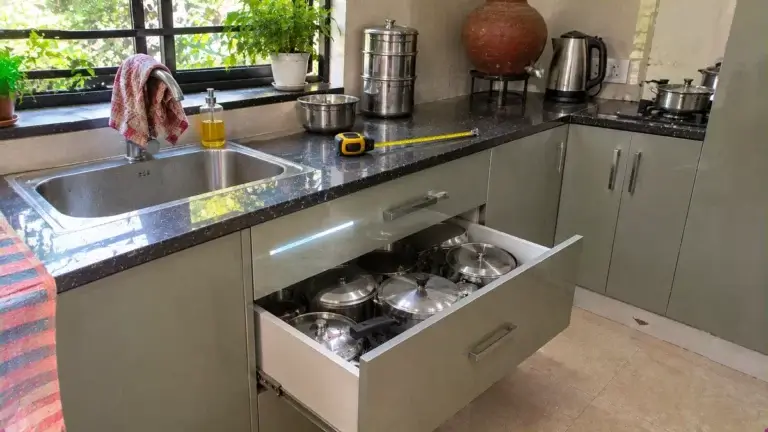
Kitchen Drawer Design: Sizes, Runners and Soft-Close Tips
Planning kitchen drawer design? See base-drawer sizes in mm, soft-close runner checks, pots and pans depth and cutlery tray fit.
November 6, 2026
Modular kitchen accessories are the hardware fittings – pull-out baskets, corner units, cutlery trays, tall units, and bin systems – that organize a kitchen’s storage space. The right mix depends on your kitchen’s layout, how you cook, and your budget, not on buying every accessory available.
Modular kitchen accessories are essentially the internal hardware that turns empty cabinet space into usable, accessible storage. Think of them as the difference between a cabinet you have to crouch into and dig through, and one where everything slides out and sits at eye level. A fitted kitchen or modular kitchen cabinet system is only as functional as the accessories fitted inside it.
If you’ve ever stood in your kitchen holding a bag of onions with nowhere obvious to put them, or dug through three shelves to find a lid that matches your pan, that’s usually not a design problem – it’s an accessory problem. Cabinets without the right internal fittings waste 30-40% of their storage potential because deep corners, tall gaps, and narrow gaps between cabinets go unused.
Expert Tip: Before choosing accessories, walk through your actual cooking routine for a week and note what you reach for most. That list should drive your accessory priorities more than any showroom display.
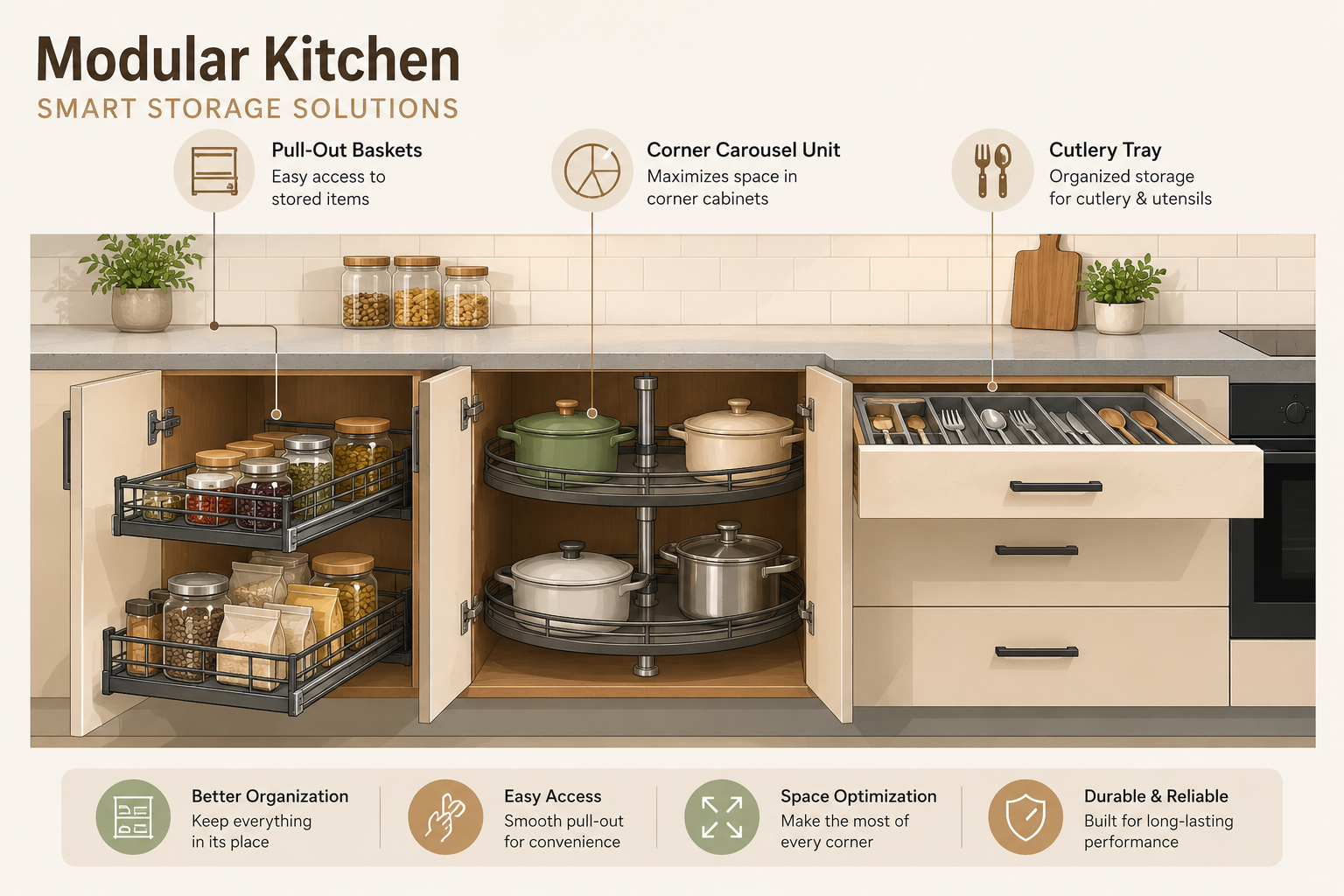
A complete modular kitchen storage system typically covers five categories:
Each category solves a different storage headache, and most kitchens need a combination of all five rather than heavy investment in just one. Wardrobe accessories follow a similar logic on the wardrobe side of a home – internal fittings, not just the box, decide how usable the storage actually is.
Two kitchens can have identical carcass dimensions and look completely different in daily use, purely because of what’s fitted inside. A base unit with a static shelf forces you to remove everything in front just to reach the back. The same unit with a pull-out basket gives you full access in one motion.
This matters even more in Dehradun, Haridwar, and the surrounding hill and plains towns, where kitchens tend to run smaller than in metro apartments, and every inch of a base unit or corner cabinet has to earn its place. A poorly planned corner can waste close to two cubic feet of dead storage in a compact kitchen.
Did You Know? Corner cabinets are typically the single most wasted space in any kitchen layout – without an accessory like a magic corner or carousel, up to half of a corner unit’s volume is functionally unreachable.
For expert design consultation, send us your details and we’ll schedule a call
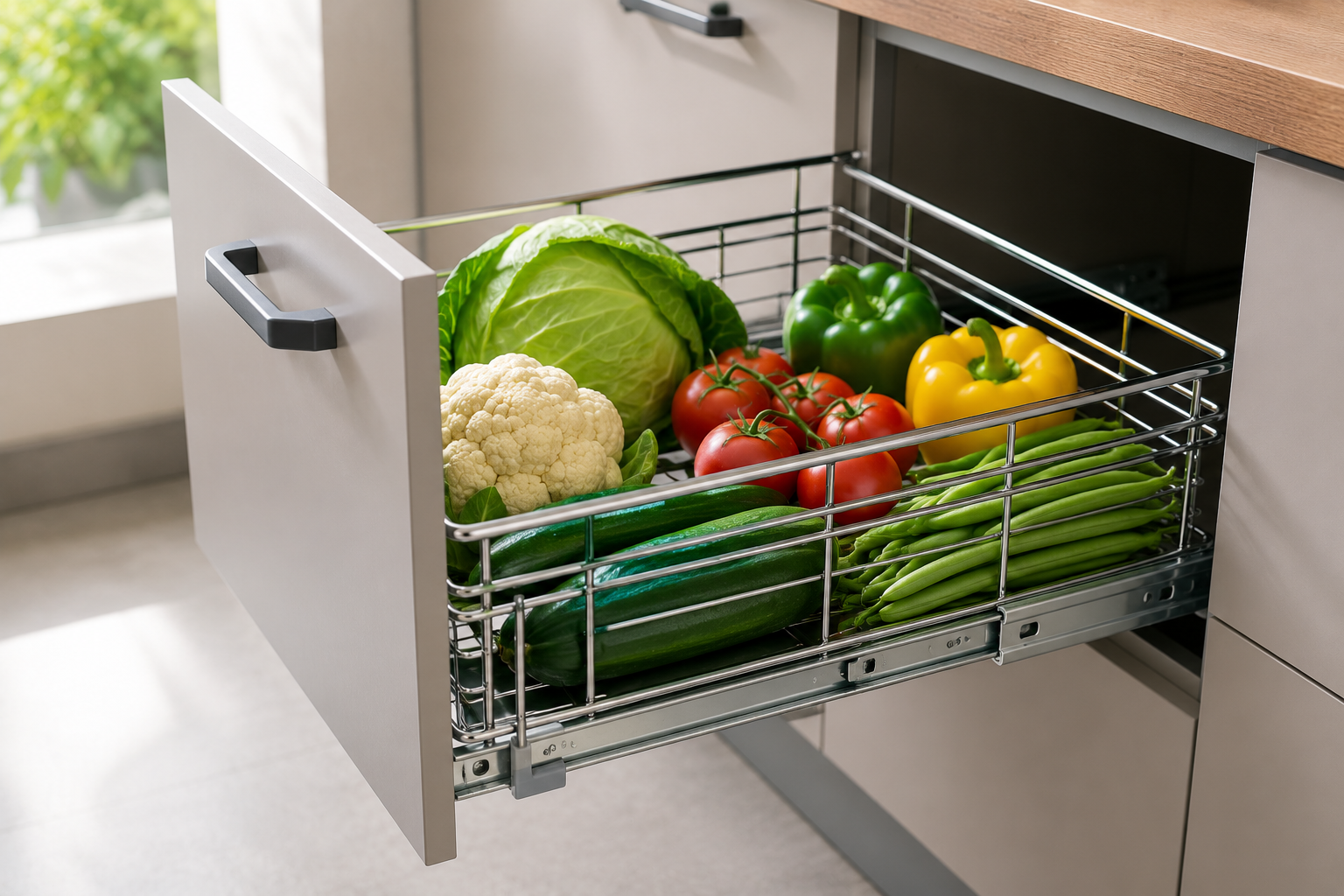
Pull-out baskets are wire or coated-steel baskets mounted on telescopic channels inside base units. They’re used for vegetables, dry rations, or bottles, and they solve the single biggest complaint about traditional cabinets – having to bend and dig.
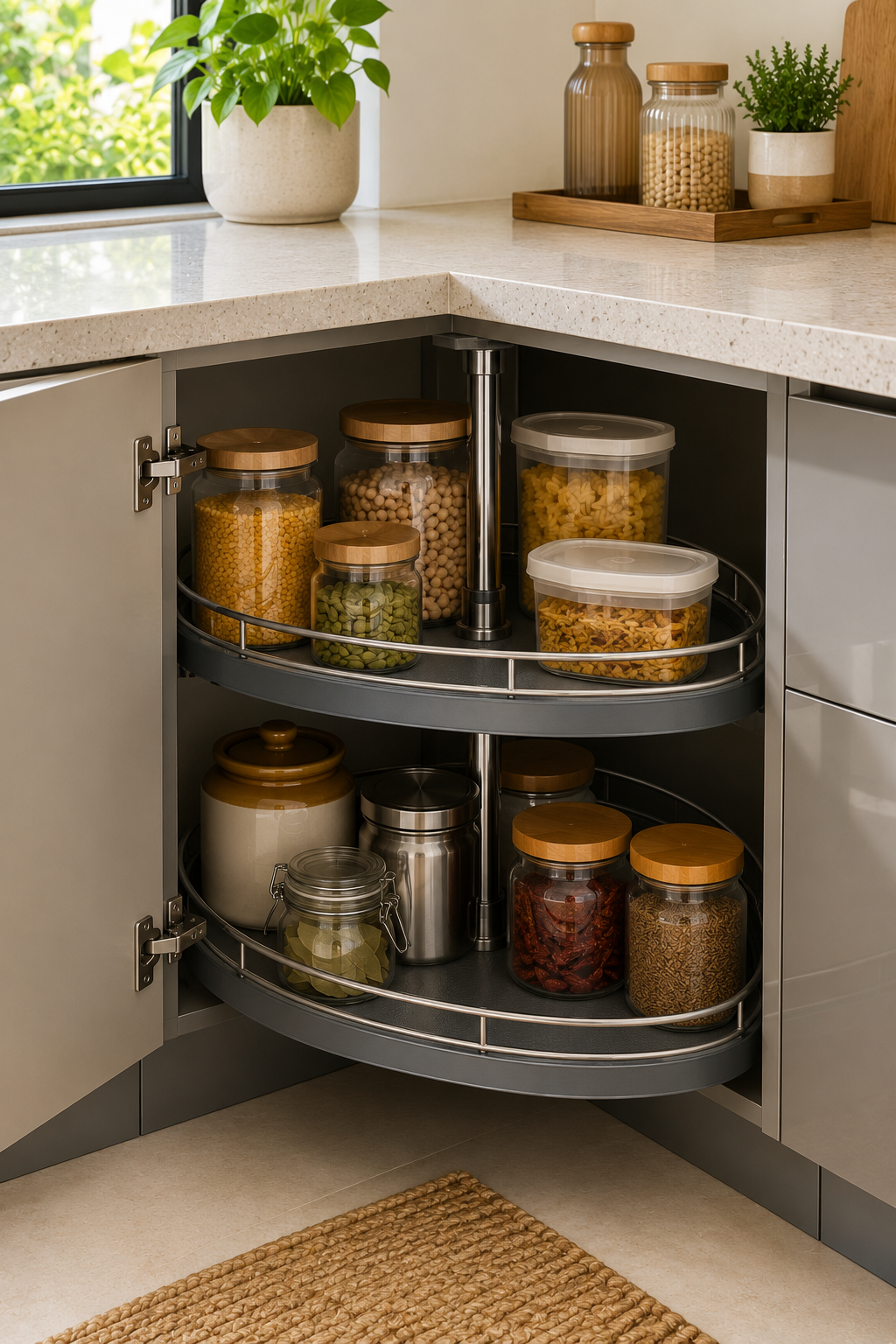
Corner cabinets are notoriously hard to use without an accessory. Two common solutions:
Magic corners generally hold more weight and suit larger corner cabinets, while carousel units work well in tighter spaces. Either way, a corner unit is one of the few accessories where “skip it and use a plain shelf” genuinely costs you usable storage, not just convenience.
A tall unit runs floor to ceiling and, fitted with a larder pull-out, functions like a walk-in pantry compressed into one column. These work especially well for households that stock rations in bulk, which is common where monthly grocery runs are the norm rather than frequent small trips.
Cutlery trays sit inside drawers and divide the space for spoons, knives, and serving ware. Beyond basic cutlery trays, drawer organizer inserts can hold spices, chopping boards, or thalis vertically, which keeps them visible and accessible instead of stacked.
Wall units above the counter benefit from dedicated plate racks, glass racks with integrated drip trays, and small wall organizers for daily-use items – reducing how often you need to reach into deeper wall cabinets.
Accessory Type | Common Material | What to Check |
Pull-out baskets | Powder-coated or chrome-plated steel wire | Coating quality – poor coating chips and rusts faster in humid months |
Drawer channels/runners | Steel with soft-close mechanism | Load rating and soft-close consistency over repeated use |
Corner units | Steel frame with plastic/metal basket trays | Swing mechanism smoothness, weight capacity |
Cutlery trays | Plastic, acrylic, or wood-finish inserts | Fit precision to your drawer size – loose trays shift and rattle |
Tall unit pull-outs | Steel frame, wire or laminate shelves | Full-extension vs partial-extension runners |
Pricing varies by city, material grade, and hardware brand, so treat any number you see online as a rough starting point rather than a fixed quote – the right way to budget is to get a written, itemized quote based on your actual kitchen layout.
Common Mistake: Assuming every accessory needs to be top-of-the-range. A mid-range pull-out basket with a reliable soft-close runner will often outperform a premium-branded static shelf in daily practicality – spend where the accessory does the most work.
Accessories are only as good as the company fitting and standing behind them. Whoever you choose – Bhumim or otherwise – it’s worth checking these points directly:
Bhumim manufactures its own cabinet units and fits accessories using named hardware brands, with an in-house installation team handling the fitting, but this same checklist applies whether you’re evaluating Bhumim or any other manufacturer in Dehradun near me.
The underlying hardware logic is similar – pull-outs, soft-close channels, corner solutions – but kitchen accessories are built to handle moisture, oil residue, and heavier daily use, while wardrobe fittings prioritize garment protection and lighter-weight organization. If you’re planning storage across the whole home, it’s worth reviewing both together – see how dressing table and wardrobe dressing units compare for a related storage decision in the bedroom.
Accessory cost depends on how many units need fitting, the hardware brand chosen, and your city’s material rates – so instead of a fixed number, budget by category:
A written, itemized quote against your actual modular kitchen design is the only reliable way to know your real number, since generic online estimates rarely reflect current material and hardware pricing.
Pull-out baskets for base units and a corner solution (if your layout has one) tend to deliver the biggest functional improvement in a small kitchen, ahead of larger additions like a full larder unit.
No – corner units like magic corners and carousels are specifically for L-shaped or U-shaped layouts with a blind corner cabinet. A straight-line kitchen won’t need one.
Wire baskets ventilate better, which helps with vegetables and onions that need airflow, while solid-base pull-outs suit bottles, jars, or items you don’t want visible from below.
It varies by hardware brand and usage intensity – soft-close runners and hinges are usually the first components to show wear, so checking the brand and warranty terms upfront matters more than guessing a lifespan.
Some accessories, like cutlery trays or small organizers, can be retrofitted easily. Corner units and full pull-out systems are harder to add later since they depend on the original cabinet’s internal dimensions.
A magic corner swings out in a two-part mechanism to pull items from deep in the corner, while a carousel rotates on a curved track – magic corners generally suit larger corners, carousels suit tighter spaces.
Soft-close mechanisms and swing/rotation hardware benefit from periodic checks, but day-to-day maintenance is mostly about keeping runners free of spills and residue, especially near the cooking zone.
Named hardware brands tend to hold up better under years of daily opening and closing – generic hardware is where most long-term sticking, sagging, or loosening issues show up first.
Channel width, drawer depth, and corner cabinet dimensions all need to match the accessory’s specifications – this is best confirmed against your actual carcass measurements before ordering.
After the layout is finalized but before manufacturing begins – accessory choice should follow the cabinet plan, since retrofitting some accessories later is difficult or impossible.
Getting modular kitchen accessories right isn’t about buying the longest list of add-ons – it’s about matching a handful of well-chosen fittings to how you actually cook and store things day to day. Start with your biggest daily frustration, work outward from there, and confirm hardware quality before finalizing anything. If you’d like a layout-specific accessory plan and quote for your kitchen, Bhumim’s design team can walk through your space and put one together.
Published by: Bhumim India Private Limited-Modular Kitchen Manufacturer & Installer, Dehradun
GST: 05AAOCB1784F1ZM | ISO 9001:2015 Certified
Service Areas: Dehradun · Haridwar · Rishikesh · Roorkee · Noida · Ghaziabad
Contact: 08044630777 | hello@bhumim.com
Note: This article is written from Bhumim’s on-ground manufacturing and installation experience. All material recommendations are based on what we use in real kitchens across our service areas.
Planning kitchen drawer design? See base-drawer sizes in mm, soft-close runner checks, pots and pans depth and cutlery tray fit.
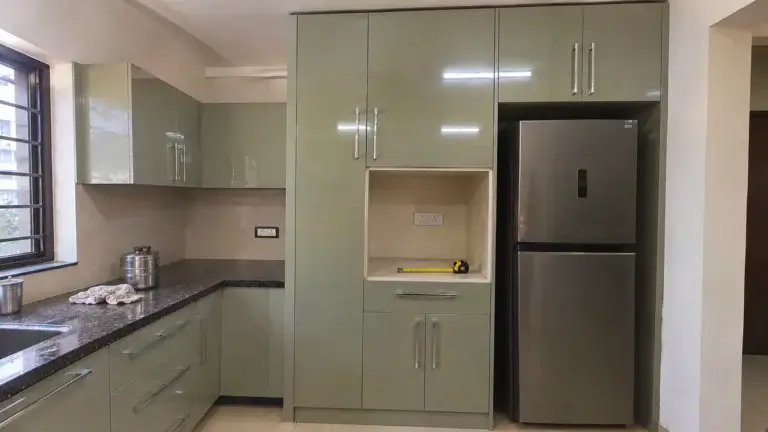
Planning a kitchen tall unit? See sizes in mm, oven and fridge housing rules, a worked cost example and a checklist for 1 to…

Kitchen corner cabinet options compared: blind corner, magic corner, carousel and drawers, with sizes in mm, load limits and cost.