

WPC Board for Modular Kitchen: Pros, Cons, Density Selection & Price (Dehradun, Noida & Haridwar)
WPC board for modular kitchen use is a Wood Plastic Composite panel made from roughly 70% virgin polymer and 30% wood flour-that is 100% waterproof, fully termite-proof, and available in densities from 0.45 to 0.70 g/cm³. For kitchen carcasses in high-humidity cities like Dehradun, Haridwar, and Noida, the correct grade (0.65 g/cm³ minimum for base units) outperforms standard plywood in wet zones-but it comes with real limitations in long-span overhead shelves that most guides won’t tell you about.
Why Dehradun and NCR Homeowners Are Searching for This Right Now
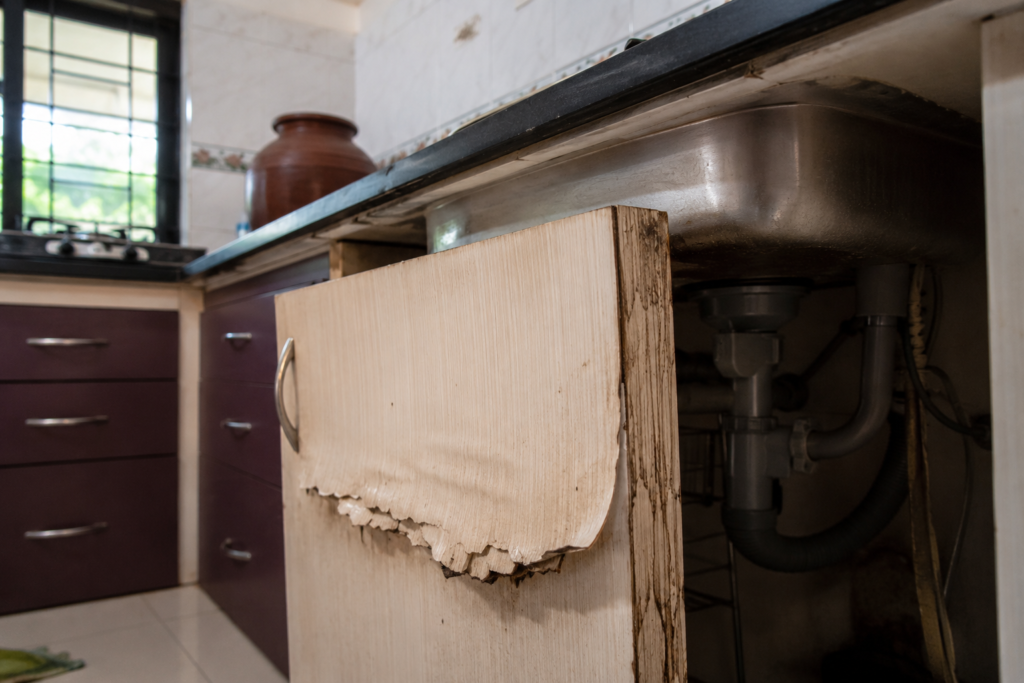
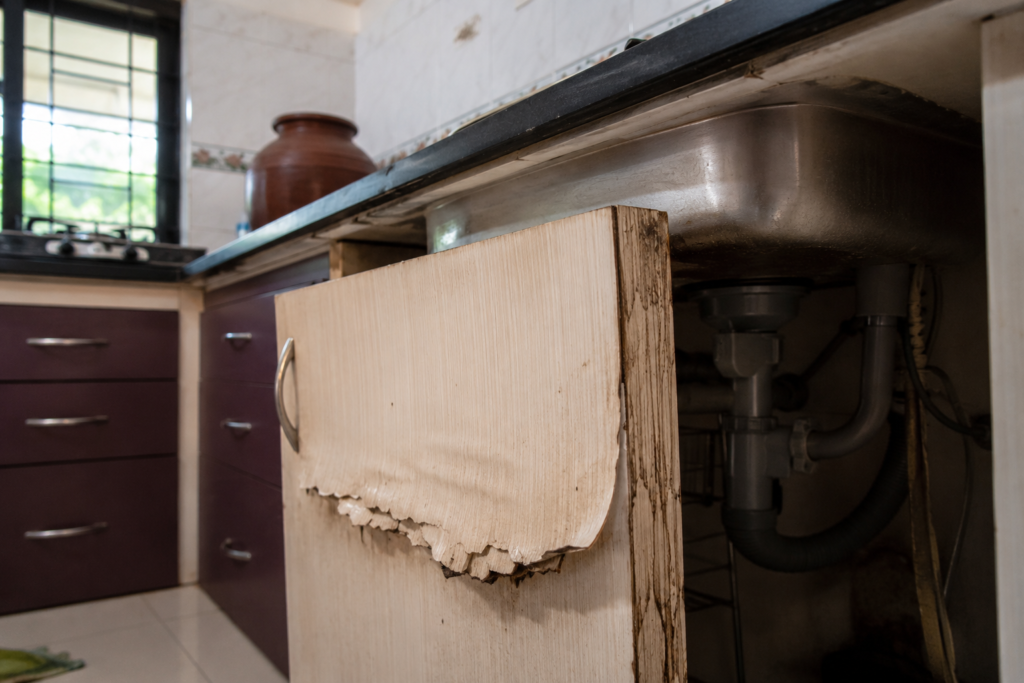
The call usually starts something like this. A homeowner in Clement Town or Prem Nagar notices that the cabinet door under their kitchen sink is swollen shut. It won’t close properly. When they open it fully, the bottom edge of the plywood carcass is dark with moisture, soft to the touch, possibly showing the early grey fuzz of mold. The kitchen is barely four years old.
That’s the moment most people in Dehradun start searching “WPC board for modular kitchen.” And they’re right to look. Dehradun’s valley geography traps moisture in ways that flat-plains cities don’t experience- subsoil seepage along Rajpur Road, termite pressure in Clement Town, and a monsoon humidity swing that pushes indoor relative humidity to 85% or above for weeks at a time. The same problem shows up differently in Noida and Ghaziabad: plumbing leaks from upper-floor flats quietly saturating the kitchen carcass below, or monsoon waterlogging soaking into ground-floor kitchen bases.
WPC boards were built precisely for these conditions. But whether they’re actually right for your kitchen-and which grade, thickness, and hybrid strategy makes sense-depends on a few things this guide will break down completely.
What Is a WPC Board? Composition and Why Density Is Everything
WPC (Wood Plastic Composite) board is an engineered panel made by combining thermoplastic polymers-typically virgin PVC or polypropylene-with finely milled wood flour or wood fibers, plus stabilisers, fire retardants, and processing additives. The result looks like a cross between plywood and plastic: it machines like wood (you can saw, drill, route, and nail it), but it behaves like plastic in the face of moisture and insects.
In the Indian market, WPC boards are sold under several names that cause confusion. Local hardware dealers in Transport Nagar (Dehradun) and Sector 9/10 (Noida) will often call them “PVC board,” “plastic plywood,” or “WPC ply.” They’re the same category of product. What varies-and what matters enormously-is density.
How WPC Boards Are Made
The manufacturing process feeds polymer resin, wood flour, stabilisers, and pigments into a twin-screw extruder. The mixture is compressed under heat and shaped through a die into sheet form, then cooled. This is what gives WPC its uniform internal structure-unlike plywood, there are no glue lines, no voids, and no natural-wood variability. Every square centimetre of the sheet has the same composition.
Density Categories-The Number That Actually Matters
Density is the single most important spec when buying WPC board for a modular kitchen. It determines screw-holding strength, load-bearing ability, and weight. Here’s how the Indian market segments it:
Density Grade | Typical Density (g/cm³) | Suitable For | Not Suitable For |
Low / Foam Grade | 0.40 – 0.50 | Signage, exhibition boards, decorative partitions | Kitchens-screws pull out under hinge load |
Medium Grade | 0.55 – 0.60 | Overhead wall cabinets, light-use panels | Heavy drawer bases, under-sink units with plumbing weight |
High Grade | 0.60 – 0.65 | Modular kitchen carcasses-standard choice | Not recommended for unsupported spans over 3 ft |
Ultra-High Grade | 0.65 – 0.70 | Base carcasses, under-sink modules, heavy drawers-best for Dehradun/Haridwar kitchens | Higher cost; confirm with dealer before purchasing |
The rule of thumb from installers working across Dehradun and Noida: never use a WPC board below 0.60 g/cm³ for any kitchen carcass. Below that threshold, the board is a foam-core product designed for signage-it cannot reliably hold the torque of a hydraulic hinge or the lateral pull of a heavy drawer channel. Ask your dealer for the density certificate before ordering.
Get started with Beautiful Homes
For expert design consultation, send us your details and we’ll schedule a call
Pros of Using WPC Board in Modular Kitchen Cabinets
100% Waterproof-No Swelling Under the Sink
This is WPC’s defining advantage, and it’s not a marketing claim. WPC boards absorb less than 1% of water after a full 24-hour immersion test-compared to 8–15% for standard plywood under the same conditions. In practical terms, this means that even if the pipe under your kitchen sink drips unnoticed for weeks, an 18mm high-density WPC carcass will not swell, delaminate, or rot. The edges stay sharp; the board stays flat.
For kitchens in Dehradun’s Prem Nagar or Haridwar’s flood-prone ground-floor flats, this is a structural benefit that plywood-even BWP (Boiling Water Proof) grade plywood-cannot fully match, because BWP plywood is still an organic material. It resists moisture well; it doesn’t ignore it completely.
Complete Termite and Borer Immunity
WPC boards contain no organic material that termites find nutritious. There is no cellulose in the polymer matrix for borers to digest. As a result, WPC is inherently termite-proof without any chemical treatment-no pesticide injection, no anti-termite paint on the back face, no periodic retreatment. This matters significantly in Dehradun, where termite pressure along the foothills creates real risk for plywood kitchen carcasses within three to five years of installation in some pockets.
Class B1 Fire Retardancy Near Gas Hobs
A common fear-and a common misconception-is that WPC “melts like plastic” when placed near a gas cooktop. Quality WPC boards are manufactured with fire-retardant additives that give them a Class B1 fire resistance rating under the National Building Code of India. B1 means self-extinguishing: the board does not propagate a flame after the ignition source is removed, and it produces low smoke. WPC does not spontaneously combust near a gas hob at normal cooking temperatures. That said, maintain a minimum 150mm (6 inches) clearance between a WPC carcass and a built-in oven or hob surround as a standard installation precaution.
Zero Formaldehyde Emissions and Eco-Friendly Composition
Standard plywood and MDF are manufactured with urea-formaldehyde resins, which off-gas formaldehyde slowly into the kitchen environment over months or years. WPC boards use polymer binders rather than formaldehyde-based adhesives, which means zero formaldehyde off-gassing. For families with young children or members with respiratory sensitivities, this is a genuine health advantage. Additionally, quality WPC uses recycled wood waste-sawdust, shavings-as the wood flour component, reducing virgin timber consumption.
CNC-Ready and Easy to Machine
WPC boards can be CNC-routed cleanly without chipping or splintering. This makes them suitable for profiled shutter edges, decorative routing patterns, and flush-panel designs. They also accept standard woodworking tools: circular saws, jigsaws, routers, and drilling machines all work without special modifications. The cut edges are clean, which reduces finishing time compared to plywood edges.
Cons and Limitations of WPC Board
Screw-Holding Capacity-The Real Story
Here’s the complaint that turns up in homeowner forums from Noida to Bengaluru: “The carpenter said screws fall out of WPC.” And in low-density foam boards (0.45–0.50 g/cm³), they’re right-screw withdrawal resistance is poor. The foam core simply doesn’t have enough material density to grip a thread.
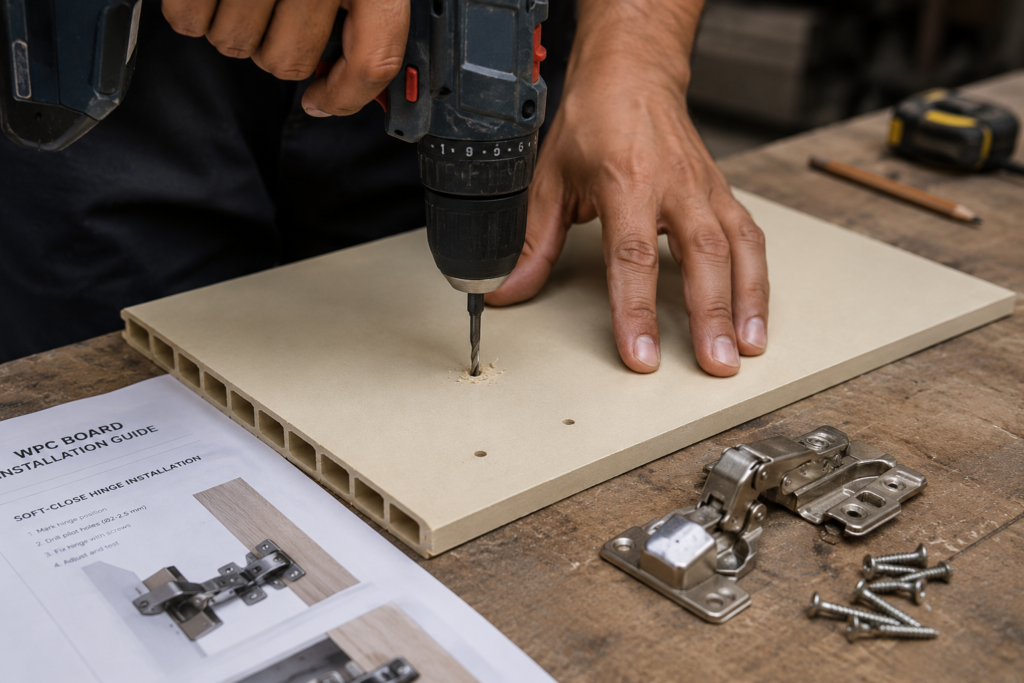
However, this problem is specific to the wrong grade of board, not to WPC as a category. High-density WPC at 0.65 g/cm³ delivers screw withdrawal resistance above 1,200 N on the face and above 800 N on the edge-comparable to BWP plywood at the same thickness. The catch is installation technique:
- Always pre-drill a pilot hole-the diameter should be approximately 70–80% of the screw shank diameter.
- Use stainless steel coarse-thread screws, not fine-thread wood screws designed for softwood. Coarse threads grip the polymer matrix significantly better.
- Add a plastic anchor sleeve or nylon plug for heavy-load points like hydraulic hinge cups and pull-out unit channels.
- For maximum strength at critical joints, apply a small bead of PVC solvent cement to the joint face before screwing-the solvent-bond adds shear resistance to the mechanical fastening.
When carpenters who are used to working only with plywood switch to WPC without adjusting their technique, screw failures happen. The board isn’t the problem; the process is.
Long-Span Overhead Shelves: Where WPC Can Sag
WPC has lower tensile bending modulus than structural plywood. In practical terms: a WPC shelf spanning more than 900mm (roughly 3 feet) horizontally without a vertical support will sag under significant load-think stacked pressure cookers, heavy ceramic serving dishes, or a full set of steel utensils. This is not a defect; it’s a physics constraint.
The solution is design-level, not material-level. For overhead wall cabinets with spans over 900mm, either add a vertical divider panel at the midpoint, or use BWP plywood or HDHMR for those specific members. WPC is correctly used for vertical carcass panels, base units, and under-sink modules-elements that carry weight in compression, not in bending.
Laminate Adhesion Requires the Right Adhesive
WPC’s polymer surface is non-porous. Regular (PVA-based adhesive) does not create a durable bond to a non-porous polymer substrate. Over time-sometimes as quickly as six months in a humid kitchen environment-laminates bonded with standard PVA glue will lift at the edges.
The correct adhesive is a PVC-specific contact adhesive, or a solvent-based contact cement designed for polymer bonding. Some installers also use a thin coat of contact primer on the WPC surface before the adhesive for maximum laminate adhesion life. This step costs very little extra and prevents the most common WPC laminate complaint.
Thermal Expansion Near the Cooking Hob
WPC expands slightly more than plywood under sustained heat. The thermal expansion coefficient is approximately 40–60 × 10⁻⁶/K, which means a 2.4m panel can expand by 1.2–2.4mm across a 10°C temperature change. In most kitchen installations this is manageable, but it requires leaving a 1.5–2mm expansion gap at wall margins during installation. Installers who treat WPC like plywood and push panels tight to walls sometimes see edge buckling near the hob area in summer.
WPC vs BWP Marine Plywood vs HDHMR: Which Should You Choose?
There’s no single “best” kitchen board material. Each excels in specific zones and specific conditions. Here’s an honest comparison based on performance in high-humidity Indian kitchen environments like Dehradun and NCR:
Parameter | WPC Board (0.65 g/cm³, 18mm) | BWP Marine Plywood (IS 710, 18mm) | HDHMR Board (18mm) |
Water Absorption (24-hr immersion) | < 1% | 3–8% | 5–10% |
Termite / Borer Immunity | 100% inherent | Requires anti-termite treatment | Moderate-requires treatment |
Screw Withdrawal Resistance | Good (with correct technique) | Excellent (no special technique needed) | Good |
Tensile / Bending Strength | Moderate-spans max ~900mm unsupported | High-handles heavy loads and long spans | Moderate-High |
Fire Resistance | Class B1 (self-extinguishing) | Naturally combustible; requires treatment | Moderate; better than standard MDF |
Formaldehyde Emissions | Zero | Present (urea-formaldehyde resin) | Low to moderate |
Laminate Adhesion | Requires PVC-specific adhesive | Works with standard contact cement | Works with standard contact cement |
Typical Price-18mm, per sq ft (Dehradun) | ₹115 – ₹160 | ₹120 – ₹180 | ₹90 – ₹130 |
Ideal Kitchen Zone | Under-sink, base carcass, wet zones | Base cabinets, long overhead spans, countertop support | Kitchen carcasses and shutters in semi-humid zones |
What this table actually means for a Dehradun kitchen: WPC is the most waterproof option for wet and termite-risk zones. BWP plywood is structurally stronger for heavy loads and long spans. HDHMR sits in the middle-better moisture resistance than standard MDF, but not fully waterproof. The smartest kitchens in high-humidity cities use a combination of all three.
WPC Board Price Per Sq Ft in Dehradun, Haridwar & Noida/NCR
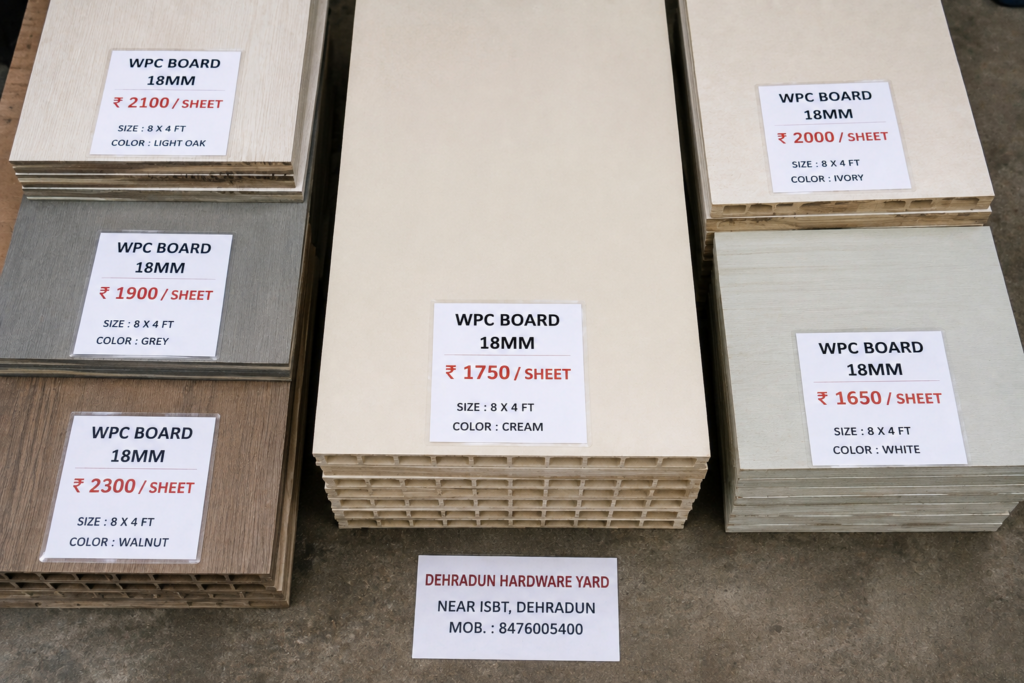
Prices below reflect retail market rates in hardware yards across the primary service regions (Dehradun: Transport Nagar, Patel Nagar; Noida: Sectors 9/10; Haridwar/Rishikesh: Industrial Area and local suppliers). These are indicative ranges as of mid-2026; verify with your local dealer, and always clarify whether the quoted price includes or excludes 18% GST.
Thickness | Density Grade | Dehradun (₹/sq ft) | Noida / Ghaziabad (₹/sq ft) | Haridwar / Rishikesh (₹/sq ft) |
6mm | Medium (0.55 g/cm³) | ₹38 – ₹48 | ₹35 – ₹44 | ₹40 – ₹50 |
12mm | High (0.65 g/cm³) | ₹78 – ₹95 | ₹72 – ₹88 | ₹80 – ₹98 |
18mm | High (0.65 g/cm³) | ₹115 – ₹145 | ₹108 – ₹135 | ₹120 – ₹150 |
18mm | Ultra-High (0.70 g/cm³) | ₹145 – ₹180 | ₹138 – ₹170 | ₹150 – ₹185 |
Why Prices Are Higher in Haridwar and Rishikesh
Haridwar and Rishikesh don’t have the same wholesale infrastructure as Dehradun or Noida. Most WPC boards sold there arrive from Dehradun or Delhi-NCR distributors, adding freight and handling costs. The premium is typically ₹5–₹15 per sq ft above Dehradun rates for comparable grades.
How Many Sheets Does a Standard Kitchen Need?
A standard 10ft × 10ft L-shaped modular kitchen carcass (base units + overhead cabinets) typically requires 60–90 sq ft of 18mm board for the carcass, plus 30–45 sq ft of 6mm or 12mm for internal shelving and backing panels. These are rough estimates; your manufacturer will produce an exact cutting list based on your layout.
The Hybrid Kitchen Formula-Where to Use WPC, Where to Use Plywood
This is the recommendation most guides miss because they’re written by material manufacturers who want you to use only their product. In reality, the best modular kitchens in high-humidity cities don’t use a single substrate throughout-they use each material where it performs best.
Here’s the Hybrid Kitchen Formula for Dehradun, Haridwar, and NCR conditions:
Zone 1-Under-Sink Module (Most Critical)
WPC board, 18mm, minimum 0.65 g/cm³ Why: This zone sees direct moisture exposure from plumbing drips, cleaning water splashes, and condensation on cold pipes. No other board material handles sustained water contact as reliably as high-density WPC. Every kitchen in a hill-zone city or high-rise apartment with overhead plumbing should use WPC here without exception.
Zone 2-Base Carcasses (Floor-Level Units)
WPC board, 18mm, 0.65–0.70 g/cm³, OR BWP plywood if the client prefers Why: Ground-floor and lower-level cabinets are the first to absorb moisture from floor seepage, mopping water, and leaks. WPC is the better choice here unless the kitchen has genuinely heavy stone countertop loads (quartz or granite slabs over 2 inches thick), in which case BWP plywood’s higher structural strength is worth considering.
Zone 3-Overhead Wall Cabinets (Spans Under 900mm)
WPC board, 18mm, 0.60–0.65 g/cm³, or HDHMR Why: Shorter overhead spans have limited sag risk. WPC works well here, keeps weight low (important for wall-fixing hardware), and maintains the moisture resistance needed in steam-heavy kitchen environments.
Zone 4-Long-Span Overhead Cabinets (Spans Over 900mm) and Heavy Pantry Units
BWP marine plywood (IS 710) or HDHMR Why: Spans over 900mm under sustained heavy load benefit from plywood’s superior bending modulus. For a pantry unit storing 20kg of cereals, pulses, and oil bottles, BWP plywood carcass is safer than WPC over long horizontal runs.
Zone 5-Shutters and Finish Panels
HDHMR (for painted or routed finishes), acrylic-faced boards, or WPC with laminate Why: Shutters are visual elements; they carry very little structural load. HDHMR’s smooth, consistent surface is ideal for painted or high-gloss finishes. WPC shutters with laminate work well in moisture-heavy zones; just use the correct PVC-grip adhesive.
Can You Apply Laminate on WPC Board?
Yes-but the process is different from laminates on plywood, and skipping the right step is the most common reason WPC laminate jobs fail within a year.
Standard contact cement does not bond reliably to WPC’s polymer surface. Over time, the bond weakens at the edges and moisture from the kitchen environment causes lifting. Use these instead:
- PVC-Grip or any PVC-specific contact adhesive: apply to both the WPC surface and the laminate back, allow both to become touch-dry (typically 5–10 minutes), then press firmly.
- Solvent cement primer: a light coat on the WPC surface before the contact adhesive dramatically improves bond life in humid environments.
- Pressure application: use a rubber roller or J-roller after bonding to ensure full contact across the surface, eliminating air pockets at the edges.
For acrylic shutters (rather than laminate), the acrylic sheet is typically adhesive-bonded at the factory before reaching site-this step is already handled by the manufacturer.
How to Properly Anchor Hinge Screws in WPC Kitchen Cabinets
The four-step protocol carpenters in Dehradun and Noida who regularly work with WPC have settled on:
- Mark and pre-drill: use a drill bit 2mm smaller than the screw shank diameter. For a standard 4mm Ø hinge screw, use a 2mm pilot bit. Go to 70% of the screw length.
- Insert a nylon anchor/plastic plug for heavy-load hinges: tap the plug into the pilot hole, then drive the screw into the plug. The plug expands and grips the polymer matrix significantly better than the screw alone.
- Use stainless steel coarse-thread screws: SS 304-grade, coarse thread, self-tapping. Not regular woodworking screws and not M.S. screws (which rust in humid environments and then seize).
- Apply PVC solvent cement at the joint face for maximum-strength connections (e.g., where a carcass side panel meets the bottom panel under heavy drawers): a 3mm bead of solvent cement before screwing creates a chemically bonded joint that adds shear resistance beyond the mechanical fastening alone.
Following this protocol, screw-holding performance in 0.65 g/cm³ WPC equals BWP plywood in controlled lab tests (face withdrawal > 1,200 N, edge withdrawal > 800 N, per certified manufacturer technical data sheets available from major WPC board producers).
Local Sourcing-Where to Buy WPC Boards in Dehradun, Haridwar, and Noida
Dehradun: The primary wholesale market for building materials is Transport Nagar, with secondary dealers in Patel Nagar and along the Haridwar Road corridor. Ask specifically for WPC boards at 0.65 g/cm³ or above-dealers who can’t confirm density in writing are selling foam-grade stock.
Haridwar and Rishikesh: Look for dealers in the SIDCUL Industrial Area (Haridwar) for bulk supply. For retail quantities, local hardware shops in Haridwar City and Rishikesh typically stock WPC from Dehradun-based distributors at a small freight premium.
Noida and Ghaziabad: Sector 9 and Sector 10 industrial areas in Noida have multiple WPC stockists. Sahibabad Industrial Area in Ghaziabad is another major hub. For large-quantity orders, Sahibabad distributors can often source from national-brand warehouses directly.
Roorkee: Smaller market; most WPC comes via Dehradun or Haridwar. Educational and institutional renovation work in Roorkee often sources through contractors who have direct supplier relationships.
What to ask every dealer before buying:
- Can you provide the density specification in writing?
- Is this virgin PVC or recycled polymer base?
- Does the price include 18% GST?
- Is this IS 14871-compliant material?
Two Misconceptions That Cost Homeowners Money
Misconception 1: “WPC is just cheap PVC and will melt near the hob.” Quality WPC boards are Class B1 fire-rated-they are self-extinguishing and do not propagate flames. They withstand ambient temperatures up to 70–80°C without deforming. The material that “melts near hobs” is low-grade foam PVC board (0.40–0.45 g/cm³ signage material) that unscrupulous dealers sometimes sell as “WPC.” Verify the density certificate and the fire-retardant rating before purchase.
Misconception 2: “You can use regular Adhesive for laminates on WPC.” PVA-based is designed for porous wood surfaces, where it creates a mechanical bond by penetrating the surface pores. WPC has no pores. The adhesive sits on the surface, dries, and eventually releases-especially in a humid kitchen where thermal cycling repeatedly expands and contracts the laminate. Use PVC-specific contact adhesive instead.
Frequently Asked Questions
Yes, provided you use high-density WPC at 0.65 g/cm³ or above. Dehradun’s moisture levels and termite risk make WPC one of the most suitable carcass materials for under-sink modules and base units. Paired with BWP plywood for long-span overhead sections, it performs reliably for 10+ years without swelling, termite damage, or delamination.
For base carcasses and under-sink units, use a minimum of 0.65 g/cm³ (18mm thickness). For overhead wall cabinets with spans under 900mm, 0.60–0.65 g/cm³ is adequate. Never use foam-grade boards below 0.50 g/cm³ in any kitchen application-they cannot hold hinge and drawer hardware reliably.
As of mid-2026, 18mm high-density WPC (0.65 g/cm³) retails between ₹115 and ₹145 per sq ft in Transport Nagar, Dehradun. Ultra-high-density (0.70 g/cm³) runs ₹145–₹180. These prices typically exclude 18% GST-always confirm with the dealer.
No. Standard PVA glues do not bond durably to WPC’s non-porous polymer surface. Use a PVC-specific contact adhesive or a solvent-based contact cement. Apply a surface primer first for best results in humid kitchen environments.
This happens when foam-grade WPC (0.45–0.50 g/cm³) is used with standard wood-screw technique-no pilot hole, wrong screw type. With high-density WPC (0.65+ g/cm³), pre-drilled pilot holes, coarse-thread stainless steel screws, and nylon anchor plugs at hinge points, screw withdrawal resistance equals that of BWP plywood. The issue is board grade and installation technique, not the material itself.
Quality WPC boards carry a Class B1 fire retardancy rating under the National Building Code of India. B1-rated boards are self-extinguishing-they don’t propagate a flame after the ignition source is removed. Maintain a minimum 150mm clearance between the WPC carcass and a gas hob or built-in oven as a standard precaution.
Yes, for spans up to approximately 900mm without intermediate vertical support. Beyond 900mm (3 feet), WPC’s lower bending modulus creates sag risk under heavy cookware loads. For long-span overhead cabinets, add a vertical divider at the midpoint, or use BWP plywood for that specific member.
No. WPC absorbs less than 1% moisture after 24 hours of direct water immersion in standardised testing. Dehradun’s ambient humidity-even at peak monsoon levels-does not cause WPC to swell, delaminate, or rot. This is the material’s primary advantage over plywood in the region.
WPC is polymer-dominant-it’s essentially a plastic-wood composite with near-zero water absorption. HDHMR is a wood-fibre board with enhanced density and moisture-resistance treatment; it performs significantly better than standard MDF in humid conditions, but it still absorbs some moisture and is not fully waterproof. WPC is the stronger choice for genuinely wet zones; HDHMR offers a smoother surface for shutters and painted finishes.
Sector 9/10 industrial area in Noida has multiple WPC stockists. Sahibabad Industrial Area in Ghaziabad is a major distribution hub, with dealers who carry stock from leading national WPC board manufacturers. For bulk quantities, direct dealer pricing in Sahibabad can be 10–15% below standard retail rates.
Very little. WPC’s non-porous surface doesn’t need sealing, painting, or anti-termite retreatment. Wipe down with a damp cloth and mild detergent. Don’t use solvent-based cleaners (acetone, paint thinner) on WPC-they can cloud the polymer surface. No annual treatment cycles are needed, unlike plywood.
Key Takeaways
- WPC board for modular kitchen use is 100% waterproof and inherently termite-proof-ideal for under-sink units and base carcasses in high-humidity cities like Dehradun, Haridwar, and Noida.
- Density is the single most important spec. Use minimum 0.65 g/cm³ for 18mm kitchen carcasses. Never use foam-grade boards (below 0.50 g/cm³) in a kitchen.
- Screw-holding concerns are real-but they’re technique problems, not material problems. Pre-drill pilot holes, use coarse-thread SS screws, and add nylon anchor plugs at hinge points.
- Don’t use standard Adhesive for laminate on WPC. Use PVC-specific contact adhesive or solvent-based contact cement for durable bonding.
- Long-span overhead shelves (over 900mm without a vertical divider) are not ideal in WPC alone. For those zones, use BWP plywood or add intermediate support.
- The smartest kitchen builds use WPC for wet zones and BWP plywood or HDHMR for heavy-load spans-not one material throughout.
- 18mm high-density WPC (0.65 g/cm³) retails at ₹115–₹160 per sq ft in Dehradun and NCR (mid-2026, ex-GST); verify with your local dealer.
- WPC is Class B1 fire-rated-self-extinguishing, not heat-melting-when buying quality-grade boards from certified manufacturers.
Conclusion: Is WPC Right for Your Kitchen? Here's the Honest Answer
A Dehradun homeowner came to us once who had already replaced the under-sink cabinet in his two-year-old kitchen once. The new one was built with the same plywood as the first. He was already noticing the familiar darkening at the bottom edge. He wanted to know if WPC was “really different or just marketing.”
The answer is: for that specific cabinet, in that specific location, WPC is genuinely different. Not because of marketing-because the material physics are different. Plywood absorbs moisture; WPC doesn’t. Plywood feeds termites; WPC doesn’t. That under-sink unit built in high-density WPC will still be structurally intact in 10–15 years.
The nuance is that WPC is not a universal replacement for plywood in every part of a kitchen. The hybrid approach-WPC where water matters, plywood where load-bearing spans matter-gives you the benefits of both materials without the weaknesses of either.
If you’re planning a modular kitchen in Dehradun, Haridwar, Rishikesh, Roorkee, Noida, or Ghaziabad and want to know which specific zones in your kitchen layout benefit from WPC versus plywood versus HDHMR, Bhumim’s design team can walk you through a free material selection consultation alongside your 3D kitchen design.
Get a free 3D design and material consultation from Bhumim
About This Article
Published by: Bhumim India Private Limited-Modular Kitchen Manufacturer & Installer, Dehradun
GST: 05AAOCB1784F1ZM | ISO 9001:2015 Certified
Service Areas: Dehradun · Haridwar · Rishikesh · Roorkee · Noida · Ghaziabad
Contact: 08044630777 | hello@bhumim.com
Note: This article is written from Bhumim’s on-ground manufacturing and installation experience. All material recommendations are based on what we use in real kitchens across our service areas.