

Transporting a Modular Kitchen to the Hills: What Actually Happens Between Factory and Installation
Modular kitchen installation logistics in hill areas cover everything that happens after manufacturing finishes and before installation begins. This includes how modules get packed, loaded, routed, and handled once a truck leaves the factory for a Dehradun, Rishikesh, Haridwar, or Roorkee address. Hill-facing terrain, narrower access roads, and buildings without service lifts change how this chain works compared to a flat-city delivery.
Most buyers only think about installation day. The three or four days before that decide how smoothly installation day goes. That window runs between a finished module leaving the factory and a truck actually parking outside the building.
What Actually Happens Between the Factory Floor and a Hill-Town Kitchen
After coordinating deliveries across Dehradun, Haridwar, Rishikesh, and Roorkee for years, the question our logistics team answers most is not about design. It is why a delivery scheduled for Tuesday sometimes becomes Thursday. The honest answer almost never involves the kitchen itself. It involves the route, the truck, and the building it has to reach.
Get started with Beautiful Homes
For expert design consultation, send us your details and we’ll schedule a call
What Actually Leaves the Factory
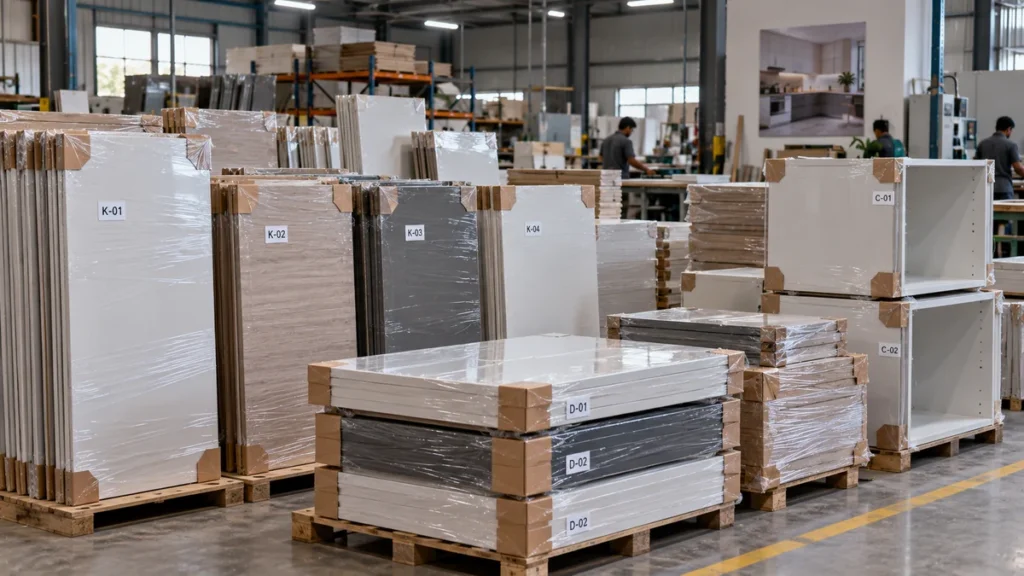
A finished modular kitchen does not leave the factory as a kitchen. It leaves as a stack of individually wrapped components.
Carcasses, shutters, hardware sets, and countertop sections travel separately, each wrapped to survive handling rather than display. Corner protectors go on every exposed edge. Fragile finishes, high-gloss laminate or acrylic in particular, get an additional protective film layer beyond the standard wrap. These finishes scratch far more easily in transit than matte or textured surfaces.
Every component carries a code linking it back to the design drawing and the packing list. This matters more once a truck reaches a hill-town site than it does in a flat city. Re-sorting a mismatched load at the curb is harder when there is nowhere to park and unload comfortably.
Packing and Loading: Built for the Route, Not Just the Distance
How a truck gets loaded depends on where it’s going, not just how far.
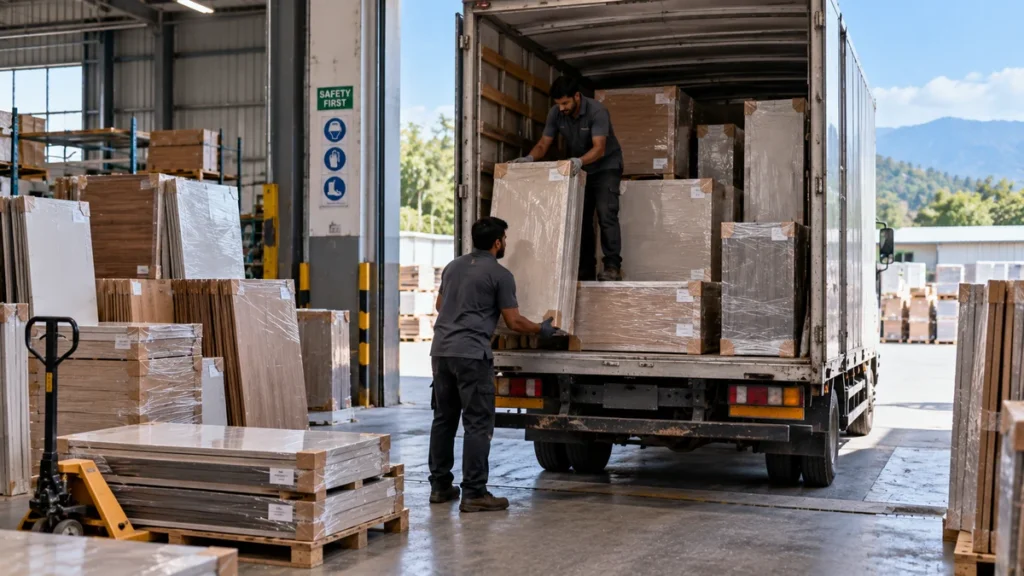
Modules load in reverse installation sequence. The pieces needed last go in first, so the pieces needed first come off last without a full unload-and-resort at the site. For a hill-town delivery, loading also accounts for the truck’s turning radius and parking reality at the destination. A load that would sit fine in an open Noida driveway sometimes needs splitting across two smaller vehicles. A Rishikesh lane too narrow for a full-size truck makes that call for you.
Weight distribution matters on inclines in a way it doesn’t on flat roads. Heavier components, carcasses and countertop sections, sit low and centered. This helps with safe handling, and an unevenly loaded truck handles worse on a climbing or descending grade anyway.
The Route from Factory to a Hill-Town Site
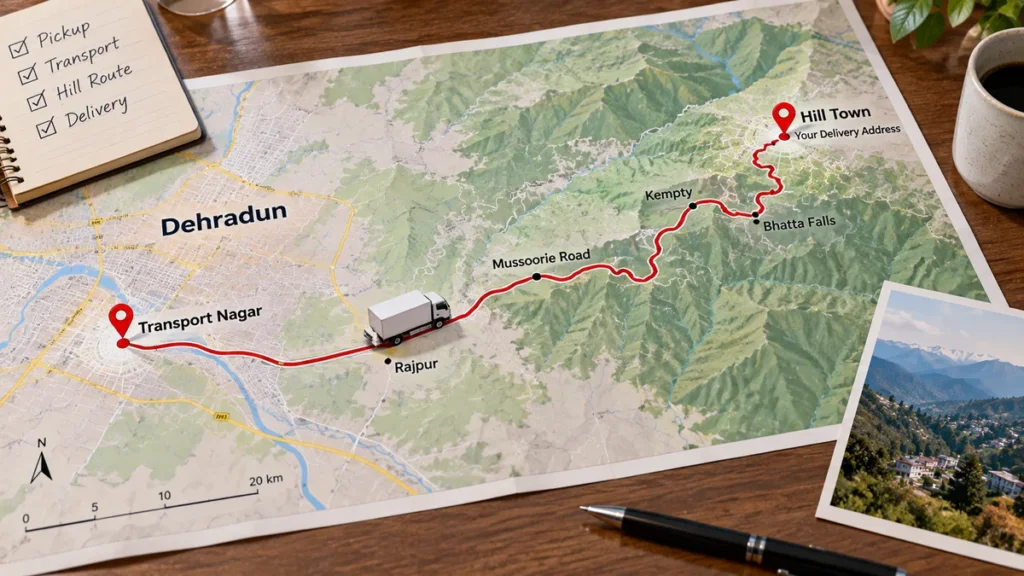
Most deliveries into Dehradun, Haridwar, and Roorkee route through the Delhi-Dehradun corridor on NH-58, the region’s main freight artery. From there they split off toward the final address. Rishikesh deliveries typically continue further along connecting roads once past Haridwar.
Dehradun’s own Transport Nagar functions as the regional hub for this last stretch. It’s the point where a long-haul delivery often transfers to a smaller local vehicle suited to the final few kilometers. This transfer step is where a delivery timeline most commonly slips. Not on the highway, but in the last mile. Road width and building access genuinely vary house to house.
Want your delivery planned around your actual street, not a generic route? Bhumim confirms building access, parking, and vehicle size for your specific address before dispatch, not after the truck is already stuck outside. Call or WhatsApp 08044630777 or fill in your details at bhumim.com to plan your delivery.
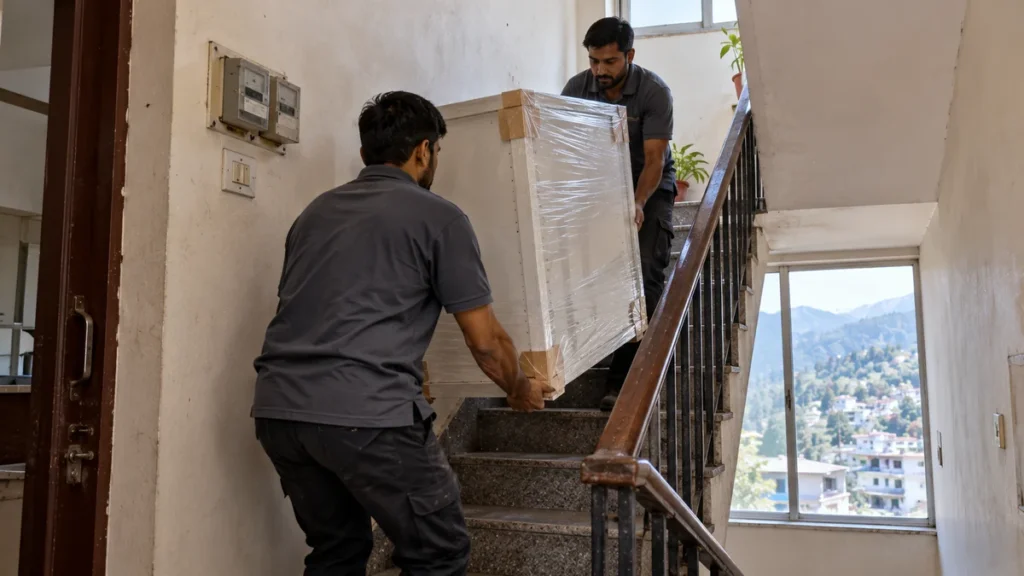
Why Hill Roads Change How a Truck Gets Loaded and Delivered
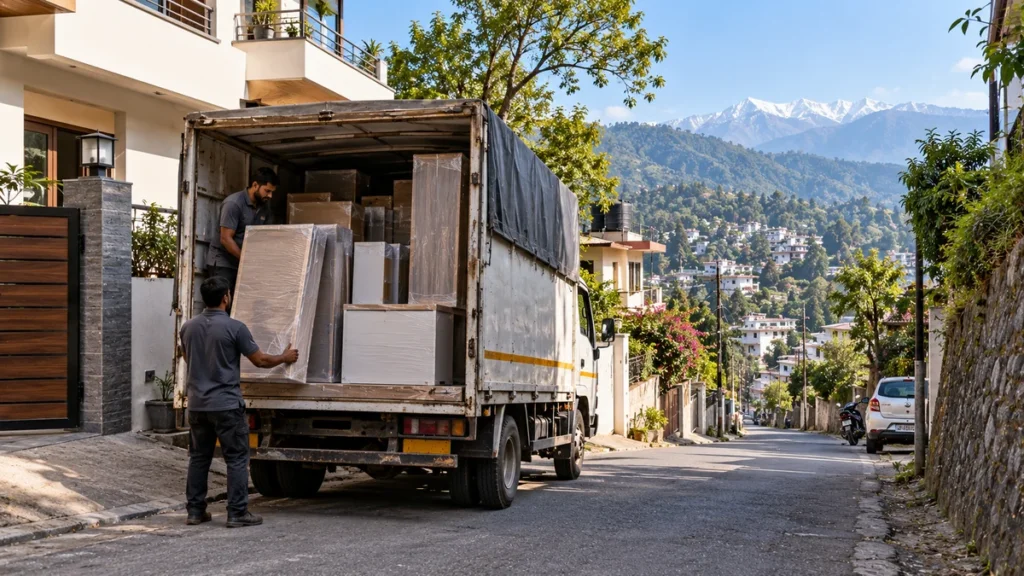
A narrow hill lane or a building without a service lift changes the delivery plan well before the truck leaves the factory.
Older buildings across Dehradun and Rishikesh’s hill-facing colonies frequently lack a service lift sized for kitchen modules. Components sometimes travel up a staircase by hand rather than by trolley because of this. Modules get packed lighter and in smaller units specifically for these addresses. Each box trades fewer components for pieces a two-person team can actually carry up several flights.
Where a full-size truck cannot physically enter a lane, the last stretch shifts to a smaller vehicle. Sometimes it becomes hand-carried loads from the nearest parking point instead. None of this is unusual for the region. It is simply a different plan than the one used for a wide NCR society road with basement parking and a service lift.
What Happens the Moment the Truck Arrives On-Site
Nothing gets installed before every component is checked against the packing list and the approved design drawing.
The installation team cross-checks each labelled component as it comes off the truck. They confirm quantity, match each piece to the drawing, and flag anything that looks off before a single panel goes up. This step exists specifically to catch a shortage or a wrong component while it’s still fixable in minutes. It’s much harder to fix after a cabinet is half-assembled around a piece that turns out to belong to a different section.
Confirming quantities on delivery is also the buyer’s own moment to be present if possible. Not because installers need supervision, but because it’s the easiest point in the entire process to catch and resolve a genuine discrepancy.
Checking for Transit Damage Before Anything Gets Installed
A scratch or a dent from transit is a real, if uncommon, part of shipping physical goods. It’s worth knowing what a reasonable process for it looks like before delivery day arrives.
Every component gets visually checked against its wrapping before installation begins. Damage under intact wrapping tells a different story than damage on a component that was clearly re-wrapped after an issue. A genuine manufacturer replaces a damaged component rather than installing it and hoping it goes unnoticed. Ask directly, before delivery, what the replacement process looks like and how long it typically takes. Any manufacturer confident in its packing standards should answer this without hesitation.
NCR Delivery vs Hill-Town Delivery: Two Different Logistics Problems
Noida and Ghaziabad deliveries and Dehradun-Rishikesh deliveries fail in different ways. That’s worth knowing before assuming one is simply “easier.”
NCR deliveries deal with traffic density and society access rules: security gates, delivery-hour restrictions, and lift-booking systems that slow down an otherwise straightforward route. Hill-town deliveries deal with road width and elevation instead.
A shorter distance can still take longer because of a narrow final stretch or a staircase-only building. Neither problem is bigger than the other. They’re just different enough that a delivery plan built for one region rarely transfers cleanly to the other.
Bhumim plans each delivery around the destination itself, coordinating vehicle size and the last-mile handoff for Dehradun, Haridwar, Rishikesh, Roorkee, Noida, and Ghaziabad individually rather than using one generic plan for all six.
For a full breakdown of how long the entire process takes from signing to handover, see Bhumim’s installation timeline guide. If you’d rather see the factory and loading setup yourself before booking a delivery, you can visit the Dehradun facility on Google Maps.
Frequently Asked Questions
It ships as individually wrapped components: carcasses, shutters, hardware sets, and countertop sections travel separately, each coded to match the design drawing and packing list, and gets assembled on-site rather than delivered whole.
Delivery time varies with customization and hardware lead times, typically ranging from a few weeks depending on the order. Labour, plumbing, and electrical adjustments at the site are usually scoped separately from the delivery itself, worth confirming in writing beforehand.
A genuine manufacturer checks each component against its wrapping on arrival and replaces a damaged piece rather than installing it. Ask before delivery day what the replacement process and timeline look like.
Sometimes, since a narrow lane or a staircase-only building can require a smaller vehicle or additional manual handling. This is worth confirming as part of the written quote rather than assuming it either way.
It helps. Being present when components are checked against the packing list is the easiest point in the process to catch and resolve a genuine shortage or damage issue while it’s still simple to fix.
Call or WhatsApp Bhumim at 08044630777, or fill in your details at bhumim.com/contact. A team member will confirm your building access and street width before dispatch, not after the truck arrives.
Key Takeaways
- A modular kitchen leaves the factory as individually wrapped, coded components, not a finished unit
- Loading and packing account for the destination’s roads and building access, not just distance
- Deliveries into Dehradun, Haridwar, and Rishikesh route through NH-58 and Dehradun’s Transport Nagar hub before a last-mile handoff
- Buildings without a service lift and narrow hill lanes change the delivery plan well before the truck departs
- Checking components against the packing list on arrival is the fastest way to catch a genuine shortage or transit-damage issue
Conclusion
The delivery that slips from Tuesday to Thursday is rarely about the kitchen itself. It’s about a route, a truck, and a building the original plan didn’t quite account for. Knowing that in advance doesn’t remove the variables, hill terrain is hill terrain, but it does mean asking the right question before delivery day instead of being surprised by it.
If you want a delivery genuinely planned around your address rather than a generic route, call or WhatsApp Bhumim at 08044630777 or reach out through bhumim.com/contact, serving Dehradun, Haridwar, Rishikesh, Roorkee, Noida, and Ghaziabad with logistics planned for each address individually.
About This Article
Published by: Bhumim India Private Limited-Modular Kitchen Manufacturer & Installer, Dehradun
GST: 05AAOCB1784F1ZM | ISO 9001:2015 Certified
Service Areas: Dehradun · Haridwar · Rishikesh · Roorkee · Noida · Ghaziabad
Contact: 08044630777 | hello@bhumim.com
Note: This article is written from Bhumim’s on-ground manufacturing and installation experience. All material recommendations are based on what we use in real kitchens across our service areas.