

Festive Wardrobe Organization for Diwali Clothes and Decor
Festive wardrobe organization means decluttering and reorganizing your wardrobe before Diwali to give ethnic wear, accessories, and decor their own dedicated space. Done correctly, with the right folding, hanging, and zoning approach, it means every outfit is findable in under two minutes on the day you actually need it.
Indian wardrobes accumulate festive wear faster than most storage layouts are designed to handle. A few targeted steps before Diwali- decluttering, zoning, and storing each garment type correctly, prevent the end-of-season chaos without requiring a wardrobe replacement.
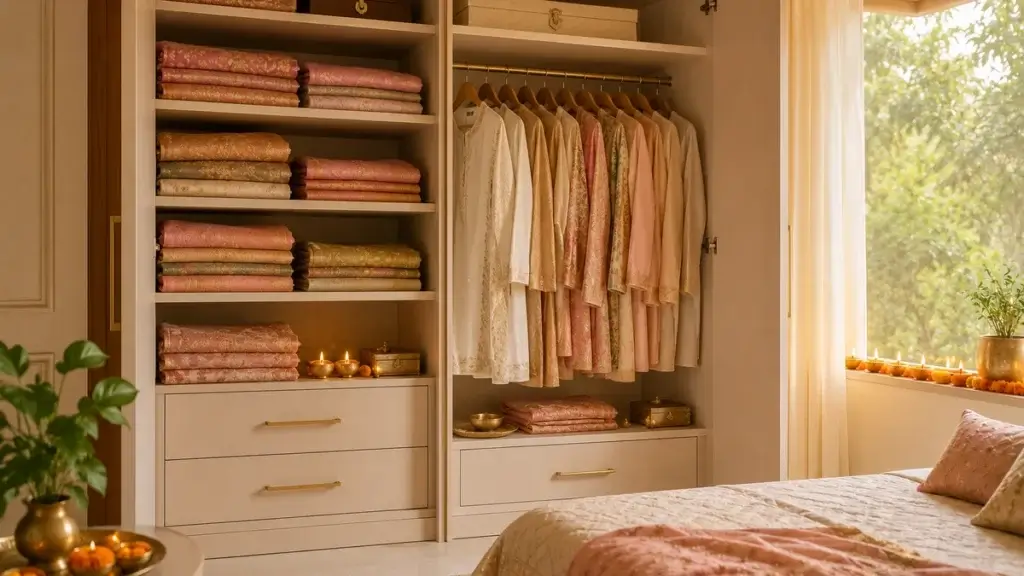
The Pre-Diwali Wardrobe Scramble
You open your wardrobe the evening before a Diwali party and immediately hit a wall. Your best silk kurta is buried behind a row of everyday office shirts. The matching dupatta has gone missing, probably shoved into a corner sometime after last Diwali. Meanwhile, last year’s decorative diyas, wrapped in newspaper, are balanced on top of your winter jackets because there was nowhere else to put them.
This scenario plays out in most Indian homes every October. Not because people don’t care about their wardrobes, but because Indian households accumulate festive clothes faster than most wardrobes are designed to handle. A wedding here, a festival there, a new lehenga for Navratri: the collection grows steadily, while the storage space stays the same.
This guide covers a complete pre-Diwali wardrobe organization approach, from the initial declutter to the specific folding and storage techniques that actually work for Indian ethnic wear. It also covers festive decor storage, so the diyas and string lights stop competing with your clothes for the same shelf.
Why Festive Wardrobe Organization Matters More Than You Think
Most Indian families add 4–6 new festive outfits to their wardrobe during the Navratri–Diwali window alone, before counting gifts, children’s new sets, and the decorative items that inevitably end up stored on wardrobe shelves because they have nowhere else to go.
The result is a wardrobe that’s simultaneously overfull and hard to navigate. Silk sarees sit folded on top of each other for months, developing permanent creases along the edges. Embroidered pieces rub against synthetic fabrics and snag. And every time a festival approaches, a 45-minute search begins before anyone even starts getting dressed.
A structured festive wardrobe organization approach solves this, not just for Diwali, but for every event through the year. The goal is one focused pre-festival session, done well, that makes the wardrobe work for you until the next one.
How most wardrobes handle festive season vs. how they should:
Issue | Typical wardrobe | Organized festive wardrobe |
Ethnic wear location | Mixed with daily clothes | Dedicated zone or section |
Saree folding | Stacked flat on a shelf | Folded with tissue paper, stored vertically |
Decor storage | On shelves, mixed with clothes | Separate labelled bin or drawer |
Finding an outfit | 20–40 minutes of searching | Under 2 minutes |
Post-festival condition | Wrinkled, sometimes snagged | Clean, pressed, and ready to store |
Thinking about a wardrobe redesign before Diwali? Bhumim offers a free 3D design consultation; we’ll plan a wardrobe layout that gives your ethnic wear, everyday clothes, and festive decor their own dedicated space. Call or WhatsApp 08044630777
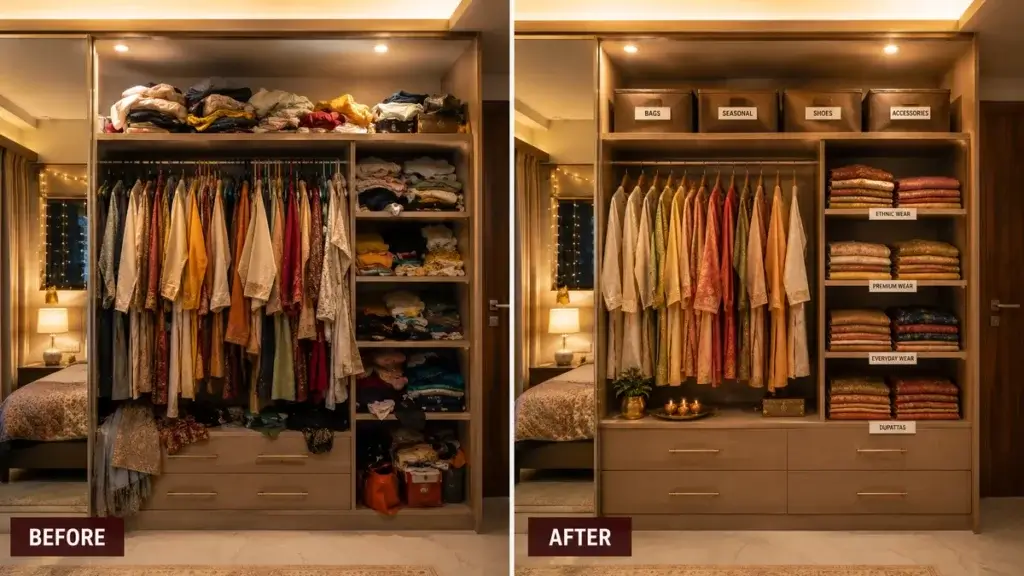
Declutter Before You Organize
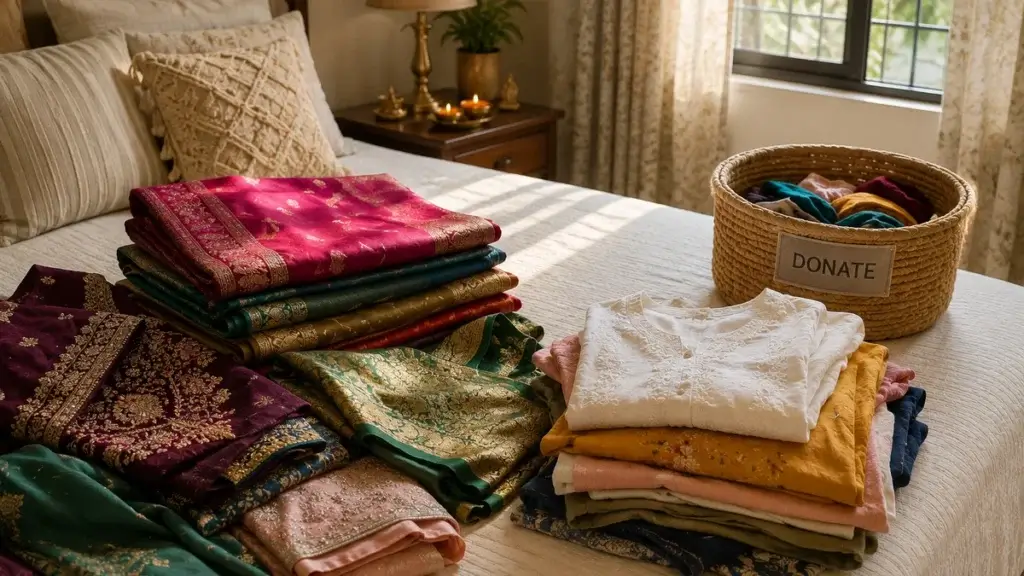
The single biggest mistake in festive wardrobe preparation is organizing without decluttering first. You end up with a neatly arranged wardrobe that’s still 30% full of things you haven’t worn in three years. So before moving a single saree, pull everything out, yes, everything, lay it on the bed, and sort into three groups:
- Keep and organize, clothes worn in the last 12 months that you’ll genuinely wear again
- Store elsewhere, off-season items (heavy woolens in summer, light cottons in peak winter) that are taking prime wardrobe space
- Let go, items that no longer fit, are too damaged to repair, or that you keep “just in case” but never actually use
For most Indian families, the “let go” pile reveals two or three festive outfits bought for a single occasion and never touched again. These are good candidates for donation, particularly before Diwali, when many neighbourhoods and housing societies organize clothes drives for gently used garments.
What to Do With Festive Clothes You're Keeping But Not Using This Season
Store them in breathable fabric bags, muslin or cotton, not plastic covers. Plastic traps humidity, which is a real problem in Dehradun and hill-facing apartments where post-monsoon moisture lingers well into October. A cedar ball or a neem leaf packet inside each bag keeps moths away without chemicals that can damage delicate embroidery.
Label each bag simply: “Navratri, silk lehenga, red” or “Eid, white kurta set.” It takes two minutes now and saves 20 minutes of searching eleven months from now.
Get started with Beautiful Homes
For expert design consultation, send us your details and we’ll schedule a call
How to Store Ethnic Wear by Type, Sarees, Lehengas, Kurtas, and Sherwanis
Different fabrics and garment types need different storage treatment. Handling all ethnic wear the same way is the fastest route to fabric damage and creases that won’t press out before the party.
Sarees:
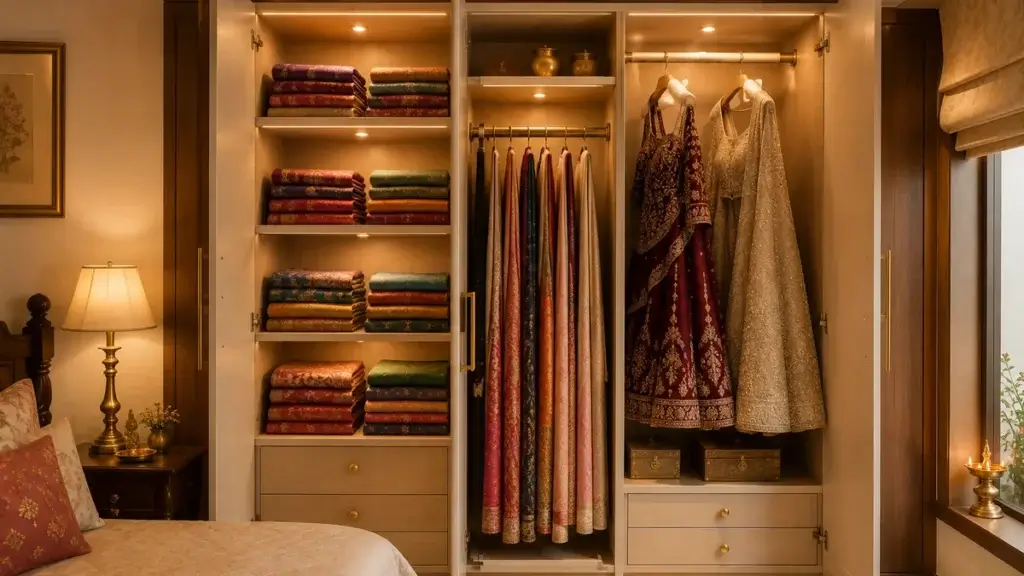
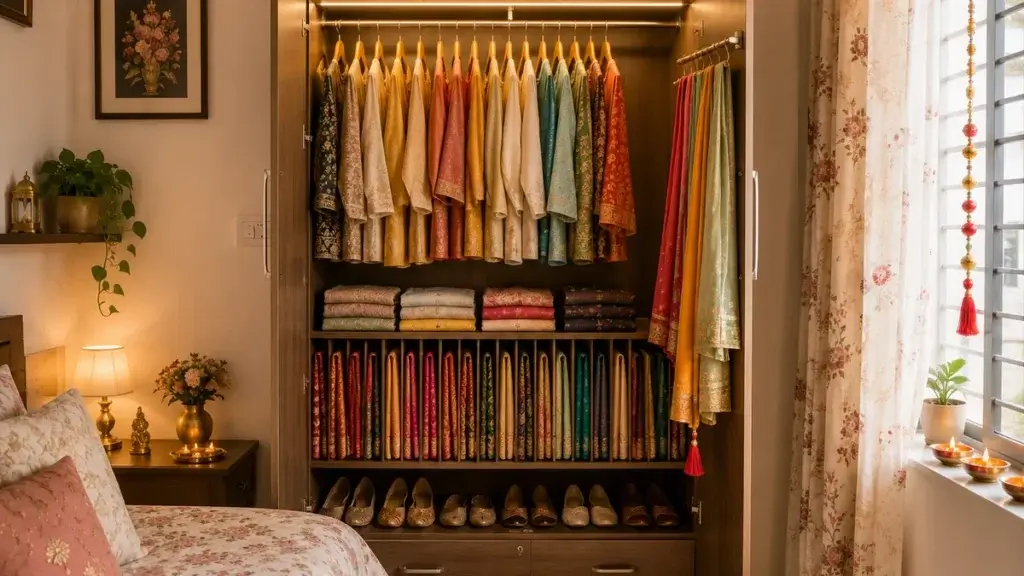
Fold each saree in thirds lengthwise, then in accordion pleats. Place a sheet of acid-free tissue paper between the layers, this prevents the crease forming at the same point every time you store it. Silk sarees kept without tissue paper develop permanent crease lines within 2–3 months. Also, stack sarees vertically, like files in a cabinet, rather than piled flat. This way you can pull one out without disturbing the rest.
Storing Sarees Without Creases in a Modular Wardrobe
A modular wardrobe with a dedicated saree section uses 3–4 shelves set at 300–350 mm depth, deep enough for a full fold without overhang, shallow enough that sarees don’t slide to the back. Bhumim configures this layout in most custom wardrobe designs. For a detailed look at internal configuration options, see our wardrobe design guide for bedrooms.
Lehengas:
Store the skirt and blouse separately. Hang the skirt, particularly heavy lehengas, on a padded hanger to distribute weight evenly across the waistband. Fold the blouse and keep it in the same labelled fabric bag. Dupattas fold best in a single long strip and can drape over a pull-out rod or go into a dedicated dupatta drawer.
Kurtas and sherwanis:
Light cotton kurtas can be folded. However, heavy kurtas with embroidery or handwork should always be hung, embroidered sections crease and distort if folded repeatedly. Sherwanis need a wide, padded hanger with a breathable cloth garment cover. Never use a plastic dry-cleaning bag for long-term storage: the material traps condensation and yellows fabric over time.
Children's festive wear:
Group it together by occasion in labelled drawers or fabric bags, including matching accessories in the same bag. On the morning of the event, you find the entire set in one place, not scattered across three shelves.
Diwali Decor Storage, Diyas, Rangoli Supplies, String Lights, and Gift Boxes
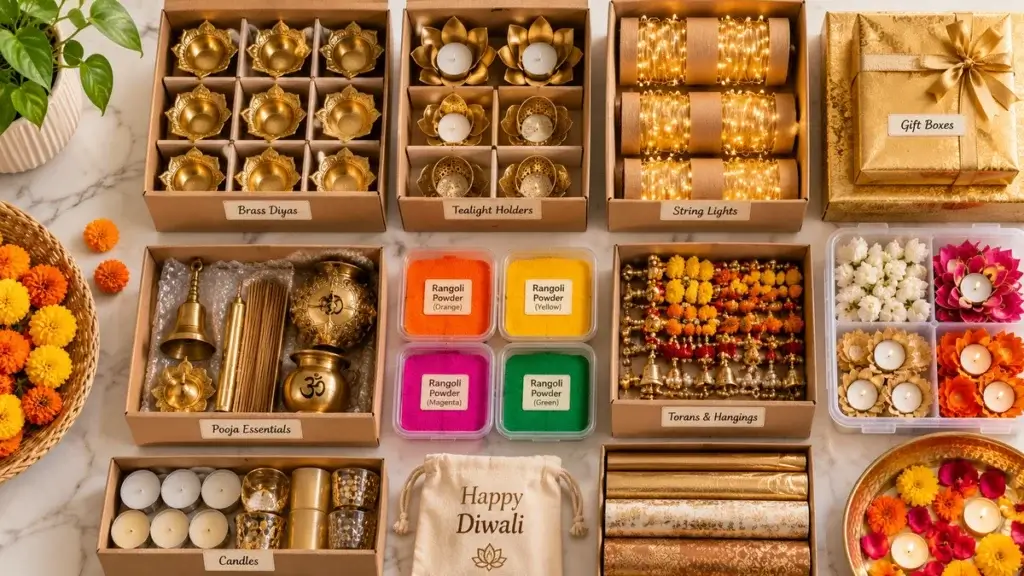
Festive decor is the category most Indian wardrobes aren’t built for, and the one that creates the most recurring chaos. Diyas wrapped in newspaper. String lights in a tangled ball. Rangoli powder in open bags. Gift packaging shoved behind winter jackets. The items are small, but together they fill more wardrobe space than most families realize.
The cleanest solution: a single dedicated decor storage zone that lives separately from clothing, ideally in the top section of a wardrobe or in a separate lidded bin on a shelf. Here’s a practical system for the five main Diwali decor categories:
- Diyas and small brass items: pack individually in small boxes or egg-crate trays to prevent chipping. Stack in a lidded bin labelled “Diwali Decor, Diyas.”
- String lights: coil each strand around a piece of cardboard (a cut cereal box works well) to prevent tangling. Store all strands in one clearly labelled box.
- Rangoli powder: seal any opened packets with rubber bands inside a Ziploc bag, then store in a lidded container. Powder leaks are the main cause of decor-related wardrobe staining.
- Gift boxes and packaging: flatten and store vertically in a shelf section, they take far less space standing up than stacked flat.
- Puja samagri (puja materials): keep these with the mandir unit, not in the bedroom wardrobe. Separating puja items from general festive decor also makes Diwali setup faster.
For Dehradun and hill-facing homes specifically: store all decor in sealed containers rather than open shelves or cardboard boxes. Post-monsoon humidity in October can damage wooden diyas, fabric-backed decor, and paper-based gift boxes within a few days if left exposed.
How Modular Wardrobe Design Makes Festive Storage Easier Year-Round
Everything covered so far, saree shelves, lehenga hanging sections, separate decor zones, can be improvised in any wardrobe using boxes and organizers. But improvised solutions have a ceiling: you can only reorganize the space you have.
For most Indian apartments, the real constraint isn’t the number of clothes, it’s the wardrobe itself. A standard carpenter-built wardrobe typically offers two or three hanging sections and a few shelves with no internal differentiation. That’s a layout designed for western clothing (hung shirts, folded jeans), not for the mix of folded sarees, hanging lehengas, accessory trays, shoe racks, and decor zones that an Indian household actually needs.
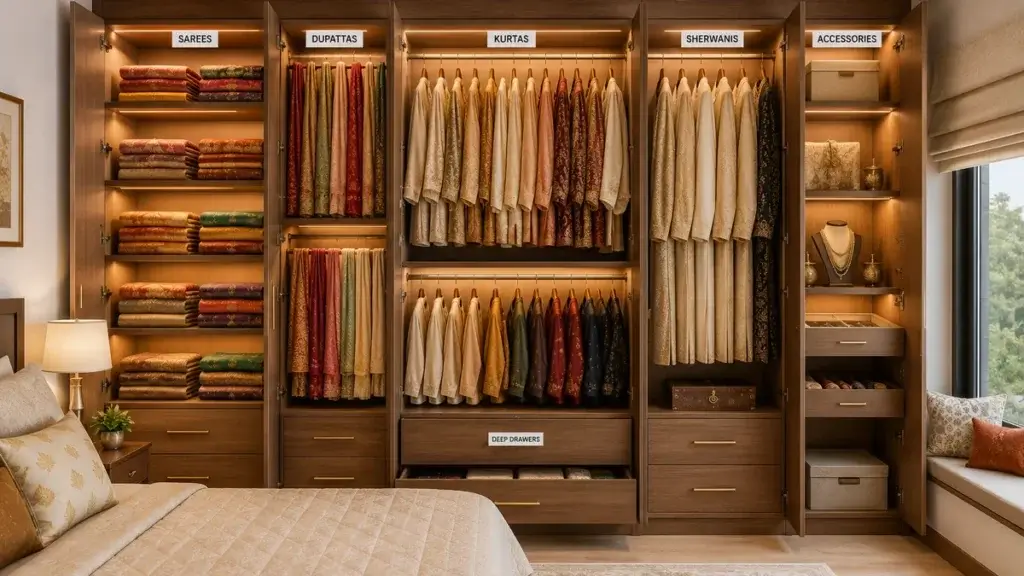
A modular wardrobe built for Indian homes changes the equation entirely. At Bhumim, the wardrobes we design and manufacture across Dehradun, Haridwar, and Noida include features specifically configured for Indian clothes storage:
- Dedicated saree sections, pull-out shelves at 300–350 mm depth with the right vertical clearance for full saree folds without crushing
- Double-hanging zones, two short hanging rods stacked, ideal for kurtas, blouses, and children’s festive wear that don’t need full-length hanging space
- Pull-out accessory trays, for jewellery, bindis, and hair accessories that typically end up loose on shelves and get lost before events
- Deep bottom drawers with Grass drawer runners, smooth even when fully loaded with winter woolens or stored gifts; the Grass tandem system handles up to 40 kg per drawer without sagging or sticking
- Blum soft-close hinges on all hinged sections, the wardrobe closes fully and quietly even when packed, preventing the door-half-open problem that lets dust settle on stored ethnic wear
- Internal LED lighting (optional), particularly useful during early morning dressing when you’d rather not switch on the entire bedroom light
None of this requires a large room. Bhumim designs wardrobes for 2BHK and 3BHK apartments across Noida, Dehradun, and Ghaziabad, including configurations that fit within a 4-foot wall width. For a comparison of hinged and sliding wardrobe formats (which affects how much usable internal space you gain), see our hinged vs sliding wardrobe guide.
You can explore Bhumim’s modular wardrobe configurations at our wardrobe design page, or visit us at our Dehradun showroom on Google Maps to see interior configurations in person before committing to anything.
Small Wardrobe, Big Festival, Organization Tips for 2BHK Apartments
Most of the tips above assume you have a standard full-width wardrobe to work with. For 2BHK flats in Noida, Ghaziabad, or Dehradun’s builder developments, where the master bedroom wardrobe is often 4–5 feet wide and shared between two people, the festive season demands an extra layer of planning.
Use vertical space, not horizontal space. Most people store rarely accessed items on the top shelf out of habit. Before Diwali, reverse this logic: move everyday items down, bring frequently needed festive wear to eye level, and use the top shelf for off-season storage that won’t be touched until after the festive period.
Also, invest in one good saree organizer. A fabric-divided saree organizer that fits on a shelf holds 8–10 sarees in the same space that loosely stacked sarees occupy. These range from ₹200 to ₹500 and eliminate the need to unfold three sarees to reach the one at the bottom.
Finally, consider a twice-yearly rotation. Before Diwali: heavy winter daily wear moves to the top shelf or a suitcase under the bed. Festive ethnic wear moves to the accessible zone. After Diwali: the rotation reverses. This keeps the accessible wardrobe space relevant to what you’re actually wearing, regardless of how many clothes you own.
When a Small Wardrobe Genuinely Can't Cope
After decluttering and reorganizing, some wardrobes still can’t comfortably hold a family’s festive wear without forcing. If that’s where you land after this process, a custom modular wardrobe built to your wall dimensions is the long-term answer, not another round of organizer boxes. Bhumim designs floor-to-ceiling configurations that recover storage space most apartments leave unused. Our bedroom wardrobe storage ideas guide covers what to measure and plan before booking a consultation.
Frequently Asked Questions
Start with a full declutter, pull everything out and sort into keep, store, and let go. Then zone your wardrobe by category: everyday wear, ethnic wear, children’s festive clothes, and accessories. Use the top shelf for off-season storage and bring festive outfits to eye level. Organize ethnic wear by garment type: sarees folded with tissue paper, lehengas and sherwanis hung on padded hangers.
Fold each silk saree in thirds lengthwise, then in accordion pleats. Place a sheet of acid-free tissue paper between the layers, this prevents the crease forming at the same point every time. Store sarees vertically, like files in a cabinet, so you can pull one out without disturbing the others. Avoid stacking silk sarees flat under heavier items, as the pressure causes permanent fold marks within a few months.
Hang embroidered kurtas, sherwanis, and blouses rather than folding, repeated folding distorts the embroidery and creates permanent crease lines at the fold points. Use padded hangers for heavy pieces so the shoulder seam doesn’t stretch out of shape. Cover each garment in a breathable cotton garment bag, not plastic. For items stored for several months, add a cedar ball or neem leaf to deter moths without chemicals that can damage delicate work.
Pack diyas individually in small boxes or an egg-crate tray to prevent chipping. Coil string lights around a piece of cardboard to prevent tangling. Keep rangoli powder in sealed containers inside a Ziploc bag, loose powder leaks cause staining on clothes stored nearby. Store everything in one clearly labelled bin that you can bring out each Diwali and pack away after. For Dehradun homes, use sealed containers to protect from post-monsoon humidity in October.
Yes, if the wardrobe is configured for it. The key is zoning: a dedicated section for ethnic wear separate from daily clothes, and at least one shelf set at the right depth for folded sarees. Most carpenter-built wardrobes mix everything together by default, which is why things get lost before events. A custom modular wardrobe designed for Indian families can include a dedicated festive zone without needing extra floor space.
A full festive organization session twice a year works well for most families, once before the main festive season (August–September for Navratri and Diwali prep), and once after (November, to store festive wear and bring winter daily clothes forward). Between sessions, a quick 15-minute reset after each festival prevents buildup. The twice-yearly approach eliminates the last-minute scramble before every event without requiring constant maintenance.
The most useful features for Indian festive wear storage are: saree-specific shelves at 300–350 mm depth, a double-hanging zone for kurtas and children’s wear, pull-out accessory trays for jewellery and bindis, and deep drawers with Grass runners that hold up to 40 kg without sagging. Blum soft-close hinges ensure the wardrobe fully closes when packed, preventing dust from settling on stored ethnic wear between festivals.
Call or WhatsApp Bhumim at 08044630777 or fill in your details at bhumim.com/contact. Share your bedroom dimensions and what you need to store, a team member will schedule a 3D design session showing your exact wardrobe layout before anything is confirmed. No fee and no obligation at the consultation stage. Bhumim serves Dehradun, Haridwar, Noida, Roorkee, Rishikesh, and Ghaziabad.
Key Takeaways
- Declutter before organizing, remove anything not worn in the past 12 months
- Store sarees with acid-free tissue paper between folds; stand them vertically like files, not stacked flat
- Hang embroidered and embellished pieces; fold only unembellished lightweight garments
- Keep festive decor in sealed, labelled containers, separate from clothing and separate by item type
- A twice-yearly wardrobe rotation (pre-Diwali and post-Diwali) prevents seasonal chaos from building up
- Most Indian wardrobe problems stem from insufficient zoning, not insufficient space
- A modular wardrobe built for Indian homes solves long-term what organizer boxes can only partially fix
- Dehradun and hill-facing homes: store everything in sealed containers, post-monsoon humidity peaks in October
Conclusion
The pre-Diwali wardrobe scramble is entirely avoidable. Most of what causes it isn’t how many clothes you own, it’s how the wardrobe is set up. Everyday wear mixed with festive wear, no dedicated saree section, accessories loose on shelves, decor crammed wherever it fits: these are organization problems that repeat every year until the underlying structure changes.
The declutter and zone setup in this guide fixes the immediate problem. If you work through it this season and still find the wardrobe genuinely undersized for your family’s needs, that’s useful information, it means the space itself needs a redesign, not another round of organizer boxes.
Bhumim designs and manufactures modular wardrobes built for Indian homes across Dehradun, Haridwar, Noida, and Ghaziabad, including compact configurations for 2BHK apartments. If you’d like to see your wardrobe redesigned in 3D before committing to anything, call or WhatsApp us at 08044630777 or reach us at bhumim.com/contact. A design is ready within 5 working days of the site visit, and Diwali approaches faster than it looks.
About This Article
Published by: Bhumim India Private Limited-Modular Kitchen Manufacturer & Installer, Dehradun
GST: 05AAOCB1784F1ZM | ISO 9001:2015 Certified
Service Areas: Dehradun · Haridwar · Rishikesh · Roorkee · Noida · Ghaziabad
Contact: 08044630777 | hello@bhumim.com
Note: This article is written from Bhumim’s on-ground manufacturing and installation experience. All material recommendations are based on what we use in real kitchens across our service areas.