

Luxury Wardrobe Design Ideas for Master Bedrooms
Luxury wardrobe design ideas work when detail beats size. Plan warm layered lighting with a colour rendering index above 90, and pick one or two refined finishes. Add handleless doors, keep walkways at least 3 feet wide, and spend on lighting and hardware first.
Below, a finishes table, a lighting specification and a spend-or-save split lead into a checklist that you can use at your 3D design review.
What Makes a Master Bedroom Wardrobe Feel High-End
A bigger room does not make a wardrobe feel high-end, because careful detail does that job.
A Houzz guide to custom closets says an island needs a 36-inch walkway on each side. It also suggests a jewellery tray in a drawer near the vanity. Both are about planning, not room size.
A master wardrobe is also a place where you start and end each day. That is why a calm layout, warm light and drawers that glide quietly matter more than a long list of features. Treat the list as a menu, and choose only what fits your routine and your room.
Your master bedroom may suit a single wardrobe wall or a walk-in. For sizes, layouts and costs, see our walk-in wardrobe guide linked below. This article covers the details that make either one feel finished.
Layouts, sizes and cost ranges for a walk-in are in our walk-in wardrobe guide. Bhumim’s guide notes that a master walk-in starts at about 9 by 10 feet.
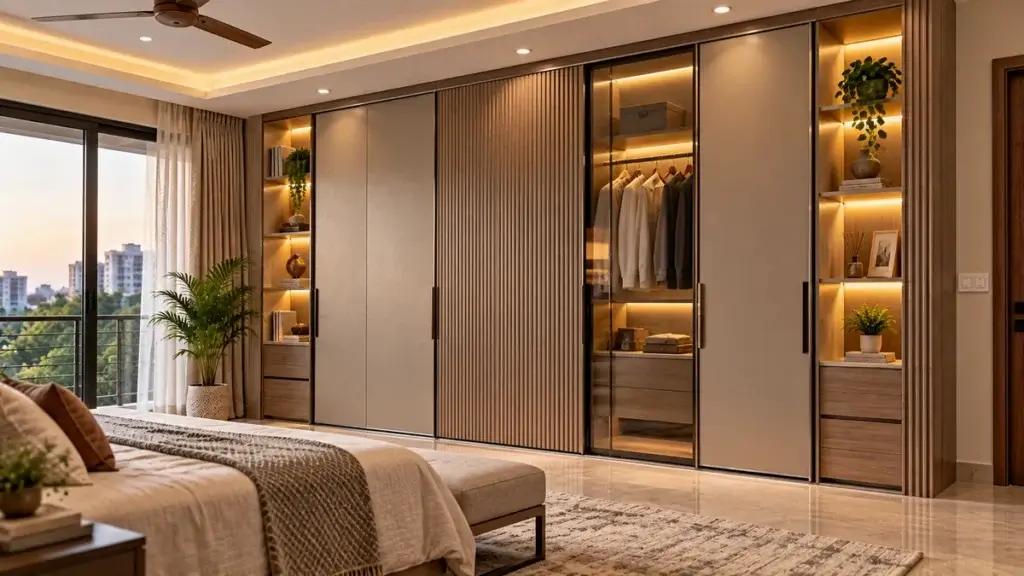
Lighting Specifications That Make the Difference
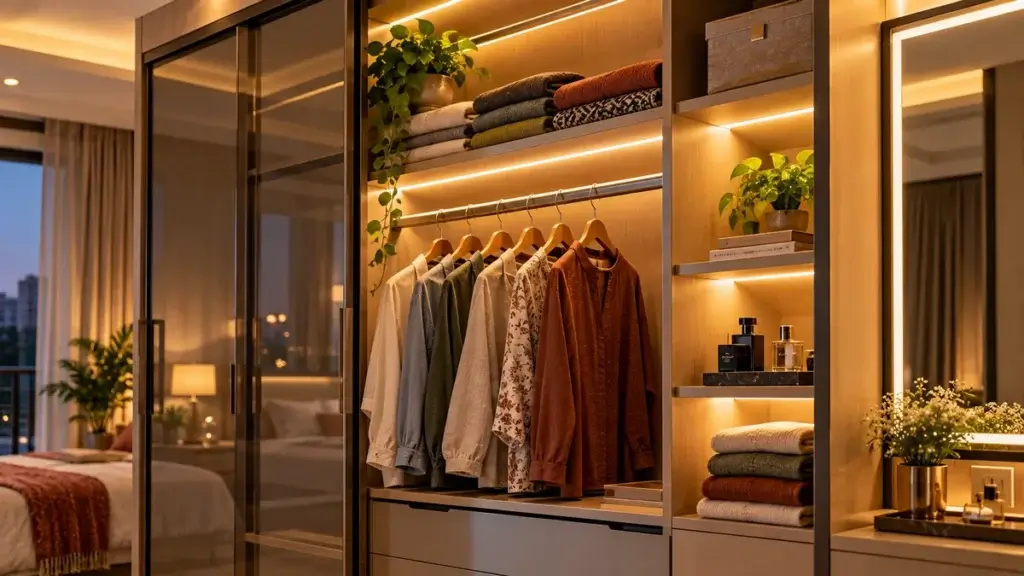
Lighting does more for the feel of a wardrobe than any finish. It is also the cheapest detail to plan early and the costliest to add later.
- Colour temperature: we suggest 3000K to 4000K. It is warm enough to feel like part of the house and neutral enough to tell navy from black.
- Colour rendering: we suggest a colour rendering index of 90 or more, so fabrics show close to their true colour.
- Fixtures: a Houzz dressing-room lighting thread recommends track lighting, because the heads can be moved if you rearrange the space, along with natural-light LED bulbs.
- Placement: run LED strips along the shelf edges above the rods, and add a light above the dressing area.
- Control: a door sensor or a dimmer lets the light switch on and off without you reaching for a wall switch.
On the other hand, LED drivers produce heat and sometimes fail. Ask your designer where the driver sits, and whether a fitter can reach it without taking the wardrobe apart.
Get started with Beautiful Homes
For expert design consultation, send us your details and we’ll schedule a call
High-End Finishes Compared: Look, Care and Climate
The table summarises the usual trade-offs, and the right pick depends on how you live with the wardrobe.
Finish | Look | Care and risk | Suits |
PU or lacquer | Smooth, seamless, deep colour | Needs a skilled finisher, and chips need spot repair | Plain flat doors in a quiet palette |
Acrylic | High gloss, mirror-like | Shows fingerprints and fine scratches | Low-touch doors and bright rooms |
Veneer | Real wood grain | Needs sealed edges and care in humid months | Warm, traditional or Japandi rooms |
Fluted or ribbed laminate | Textured, shadow lines | Grooves collect dust and need a soft brush | Statement doors on one wall |
Glass (lacquered or tinted) | Reflective, light-catching | Heavy, so it needs a rated track or hinge | One or two accent doors |
According to the India Meteorological Department’s Climate of Dehra Dun report (1971 to 2010 normals), daily maximum humidity reaches about 90 percent by late July. We think sealed edges matter more than the finish name on a Dehradun quote.
For door styles and ventilation, our wardrobe door types guide compares louvered, glass, laminate and mirror doors.
Detail Upgrades That Show Every Day
You touch small details every day, so they carry the feel of the whole wardrobe.
- Handleless or push-to-open doors give a clean face, as long as your installer tests the hardware before fixing the doors.
- Soft-close hinges and drawer runners from Blum or Grass reduce slamming and protect panel edges.
- Hafele hardware and fittings suit the visible parts, such as pull-out racks and rods.
- Velvet-lined jewellery and watch drawers keep small items from sliding and scratching.
- A pull-out mirror or a full-length mirror beside a window helps you check an outfit in daylight.
- A valet rod, a fold-out ironing board and a hidden laundry basket make daily use easier.
Hardware also sets the pace of upkeep. Soft-close fittings need little attention, while a heavy glass door needs its track cleaned and its rollers checked twice a year. Ask your installer for a short care note along with the handover, so the wardrobe stays as smooth as it looked on day one.
Which one would you use every morning? Pick the two you would use most, and drop the rest from the brief.
Our wardrobe accessories guide ranks the pull-out fittings that earn their cost.
Planning a Vanity or Dressing Corner Inside the Wardrobe
Plan light, power and seating for a dressing corner together, because adding them later costs more and looks patched.
- Put a mirror light on both sides of the mirror, and not only above it, so shadows do not fall across your face.
- Add two or three sockets inside the unit for a hair dryer, a phone charger and a garment steamer.
- Leave knee space under the dressing top, so a stool or small bench slides in.
- Keep makeup and jewellery in shallow, lined drawers close to the mirror, so you reach them without bending.
Is your room big enough for both a wardrobe wall and a vanity? Our dressing unit guide compares the two layouts, including large master bedrooms.
Compare both layouts in our dressing table vs wardrobe dressing unit guide.
Where to Spend and Where to Save
You do not need every upgrade, and a simple order of priority helps you decide which ones to keep.
- Spend first on lighting and on the hardware you touch daily, such as hinges, runners and rods.
- Spend next on the interior layout, because a good plan of drawers and hanging lengths decides how the wardrobe feels to use.
- Choose one statement finish and keep the rest of the doors plain, since several textures compete with each other.
- Save on decorative panels, extra mouldings and oversized handles, which add cost but little daily value.
- Keep a clear 3 feet of aisle, as Bhumim’s walk-in guide advises, because cramped drawers undo any finish.
We think a calm design with excellent lighting beats a busy design with many finishes. Ask the team to price each upgrade as its own line, so you can decide what to keep.
Common Mistakes in High-End Wardrobe Design
- Choosing glass or mirror doors without checking the track or hinge rating for their weight.
- Planning lighting after the carpentry, which leaves visible wires or no space for drivers.
- Mixing four or five finishes on one wall, so the wardrobe looks busy and unplanned instead of calm.
- Picking a high-gloss finish for doors that your family touches many times a day, which shows every mark.
- Copying a walk-in layout from social media into a room that is too narrow for the aisle.
Which of these would you rather avoid?
Questions to Settle at Your 3D Design Review
- Where does the LED driver sit, and can a fitter reach it for repair without removing panels?
- What colour temperature and colour rendering index are the lights?
- Which finish is on each door, and are the edges sealed against humidity?
- What is the rated door weight for any glass or mirror door?
- Are soft-close hinges and drawer runners included, and from which brand?
- Is each upgrade priced as its own line?
Bring your room plan and photos, and see the doors, lighting and drawers in 3D before anything is made.
Planning a master bedroom wardrobe? Send us your room size and the finishes you like, and we will show a layout in a free 3D design. Call or WhatsApp 08044630777 or fill in your details at bhumim.com.
You can also find Bhumim on Google Maps and visit the Dehradun showroom to see finish samples in person.
Frequently Asked Questions
Detail rather than size. Plan flexible lighting, a clear 36-inch walkway if you add an island, and small fittings such as a lined jewellery tray. Pick one statement finish, plan lighting early, and keep the rest calm. A smaller wardrobe with excellent detail often looks richer than a large plain one.
Start with how you use the room. A single wardrobe wall with a dressing corner suits most Indian master bedrooms, while a walk-in needs about 9 by 10 feet or more. Add layered lighting, a mix of hanging and drawer space, and soft-close fittings. Test the layout in 3D before you decide.
We suggest 3000K to 4000K and a colour rendering index of 90 or more, so fabrics show true colour. Run LED strips along shelf edges above the rods, and add a light near the mirror. Ask where the driver sits so it can be serviced.
It depends on how the wardrobe is used. PU and lacquer give a seamless look, acrylic gives gloss but shows fingerprints, and veneer needs sealed edges in humid months. Dehradun humidity reaches about 90 percent by late July, so ask how edges are sealed before choosing any finish.
Yes, as one or two accent doors. Glass is heavy, so it needs a rated track or hinge, and it shows fingerprints. Tinted or lacquered glass hides contents better than clear glass. Ask for the rated door weight in writing and for toughened glass before you approve the design.
Keep at least 3 feet of clear aisle between facing storage walls, as Bhumim’s walk-in guide advises. Without it, drawers cannot open fully and two people cannot pass. If the room is too narrow, a single wardrobe wall with a dressing corner is usually the better choice.
Spend first on lighting and on hardware you touch daily, such as hinges, runners and rods, then on a well-planned interior of drawers and hanging lengths. Choose one statement finish. Save on decorative panels, extra mouldings and oversized handles, which add cost but little daily value.
Yes. Plan a mirror with side lights, two or three sockets, and knee space for a stool. Keep makeup and jewellery in shallow lined drawers near the mirror. Our dressing unit guide compares a built-in unit with a standalone dressing table, including for large master bedrooms.
Call or WhatsApp Bhumim at 08044630777, or fill in your details at bhumim.com/contact. Share your room size, the finishes you like and your lighting wishes, and the team shows the layout in a free 3D design, typically within 3 to 7 days, in line with the design stage described in our bedroom wardrobe guide. You can then compare options before anything is made.
Key Takeaways
- Detail beats size: lighting, hardware and a calm finish make a wardrobe feel high-end.
- Use warm 3000K to 4000K lights with a colour rendering index of 90 or more, and plan them early.
- Pick one statement finish, and check the edge sealing in humid months.
- Spend on lighting, hardware and interior layout first, and save on decoration.
- Review everything in 3D, and ask for each upgrade to be priced as its own line.
Conclusion
A high-end master wardrobe is built from good lighting, honest finishes and well-chosen hardware, not from extra square feet. Plan those early, keep the design calm, and check every choice in 3D.
If you are planning a master bedroom wardrobe in Dehradun, Rishikesh or Haridwar, call or WhatsApp Bhumim at 08044630777 or reach out through bhumim.com/contact for a free 3D design, and see your lighting and finishes before you approve them.
About This Article
Published by: Bhumim India Private Limited-Modular Kitchen Manufacturer & Installer, Dehradun
GST: 05AAOCB1784F1ZM | ISO 9001:2015 Certified
Service Areas: Dehradun · Haridwar · Rishikesh · Roorkee · Noida · Ghaziabad
Contact: 08044630777 | hello@bhumim.com
Note: This article is written from Bhumim’s on-ground manufacturing and installation experience. All material recommendations are based on what we use in real kitchens across our service areas.