

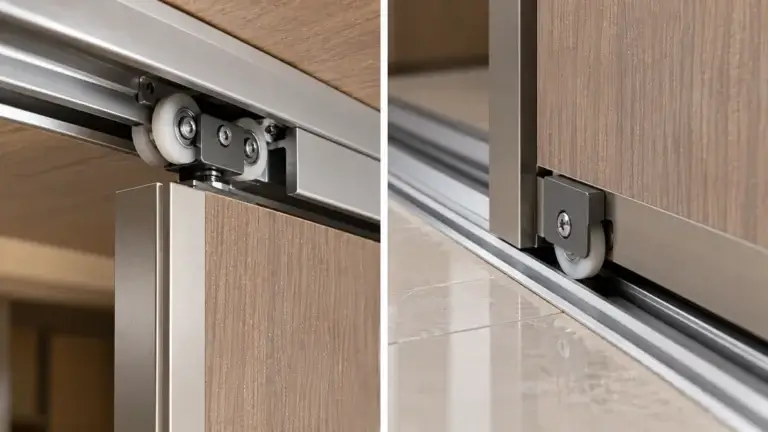
Wardrobe Design
Sliding Wardrobe Hardware Guide: Top-Hung vs Roller
Sliding wardrobe hardware guide: top-hung vs bottom-roller tracks compared, soft-close and anti-jump features, upkeep and a buying checklist.
October 6, 2026
Sliding wardrobe laminate design starts with the door panels. Choose a pattern family, split two colours across the panels, then check the laminate type, thickness and shade code behind the catalogue photo. Ask for those details in writing, because they decide how the doors look and age.
Below, a laminate type table, a pattern table and a panel-split table help you choose. A checklist then lists what to ask on the quote.
A sliding wardrobe is a row of flat panels on a track, so any wardrobe laminate design you choose is really a layout of rectangles.
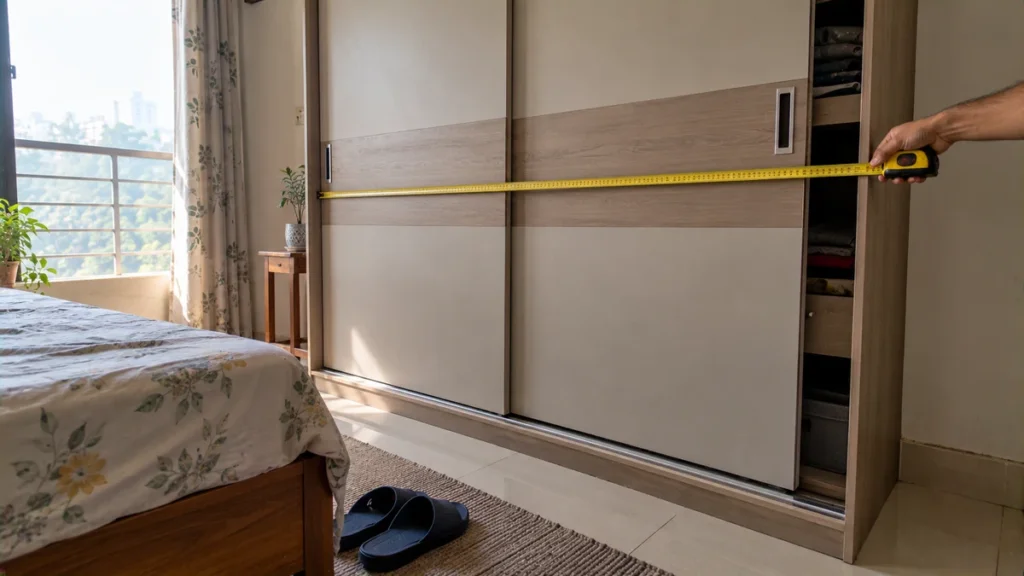
Panel size sets the limits. A Raumplus datasheet for its S1200 system lists standard doors up to 1,500 mm wide and 2,750 mm high. It also gives a maximum of 1,500 by 3,500 mm and a mounting depth of 42 mm.
Bhumim’s bedroom wardrobe guide limits a wardrobe in a compact bedroom, under 100 sq ft, to about 6 feet wide. That is roughly 1,830 mm, so two panels of about 915 mm each fill it.
The same guide names the trade-off, because a two-panel slider opens only half the wardrobe at a time. Sliding doors still need only 18 to 20 inches of clear floor, against 24 to 30 inches for hinged doors.
Bhumim’s sliding wardrobe designs page shows the layouts. Before you pick a laminate, ask how many panels your wall will take and which one your eye will land on first.
Which panel will your eye land on first?
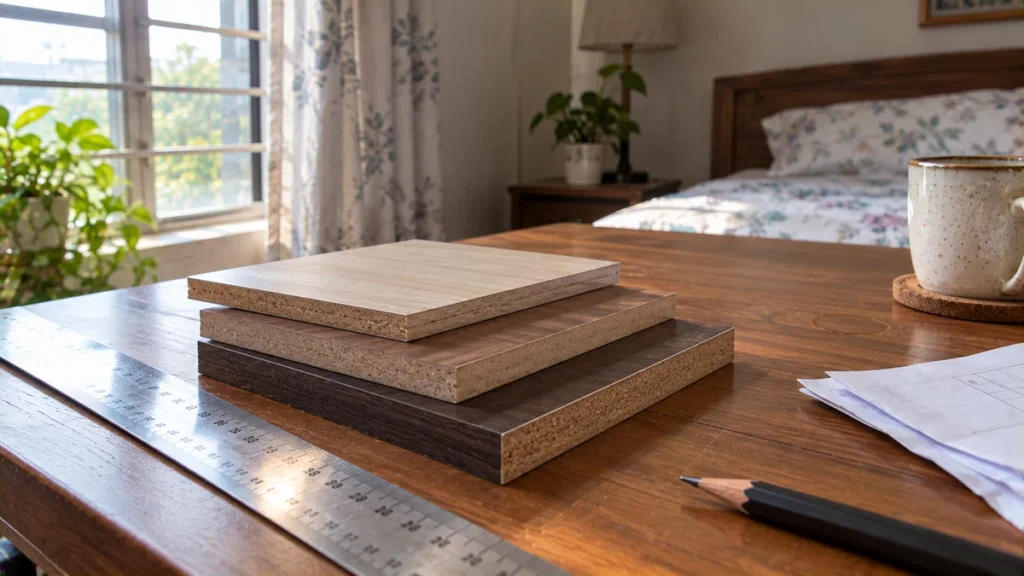
A board supplier on a Houzz forum thread says the word laminate is used loosely. In his account, an embossed melamine board is MDF or particle board with a decorative paper bonded on, with a clear resin coat over it. A texture such as woodgrain is pressed in during the same process, and he separates these boards from high-pressure laminate (HPL).
Bhumim’s finish guide describes HPL as layers of kraft paper soaked in phenolic resin, topped with a printed decorative paper sealed with melamine. The sheet is typically 0.8 to 1.5 mm thick and pressed onto plywood or HDHMR board.
Type | What it is | Where the sources place it | Ask |
HPL sheet | 0.8 to 1.5 mm resin-and-paper sheet, pressed onto plywood or HDHMR | Door shutters, in Bhumim’s finish guide | Thickness in mm and the shade code |
Low-pressure melamine | 0.2 to 0.4 mm paper-and-resin coat on a board | Mainly interior surfaces in Bhumim’s guide | Which parts of the wardrobe use it |
Embossed melamine board | Texture pressed into the coating as it is made | Textured woodgrain doors, in the Houzz account | Whether the grain is synchronised |
In our reading, the Houzz supplier’s embossed boards and Bhumim’s low-pressure melamine are the same family. Bhumim’s guide does not recommend that thin type for kitchen shutter faces. A bedroom is gentler on a door, but we think you should still ask.
Indian standard IS 2046:1995 covers decorative resin-bonded laminated sheets. The BIS product manual for IS 2046 sorts them into 17 performance varieties, including vertical grades. Its tests cover surface wear, immersion in boiling water, scratching, staining and colour change in light. Ask whether your sheet carries the Standard Mark, and which variety it is.
Do you know which of these three your quote means?
For expert design consultation, send us your details and we’ll schedule a call
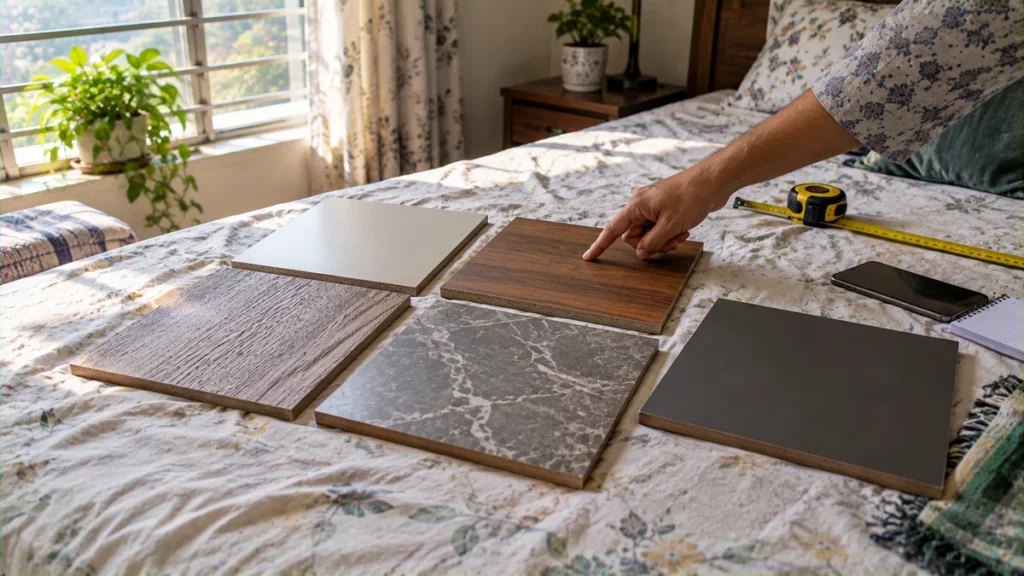
Our wardrobe door types guide already compares matte and gloss, so this table covers pattern, not sheen. Bhumim’s finish guide says textured and woodgrain laminates carry digitally printed layers that copy stone, wood, concrete or metal. It adds that a quality woodgrain is hard to tell from veneer at normal viewing distance.
Pattern family | Looks like | Suits (our reading) | Watch out for |
Solid colour | One flat shade | Small rooms and plain walls | Dark shades show dust and marks |
Woodgrain | A printed wood pattern | Warm bedrooms | Grain direction across panels |
Textured woodgrain | Texture pressed into the surface | Doors touched every day | It can hold grime between wipes |
Stone, concrete or metal print | A digital print of the material | One accent panel | A busy pattern repeat beside a joint |
Anti-fingerprint matte | A micro-structured matte coating | Dark colours and handle zones | Ask which sheet has it, and its thickness |
Bhumim’s finish guide describes the anti-fingerprint type as a specialty matte coating that repels oils from fingers. Its colour guide says textured laminates hide marks the most but can hold grime.
We think one busy pattern per wardrobe is enough. For a sliding door wardrobe laminate design, that choice matters more than the brand of the sheet. A stone print on one panel, with calm woodgrain or solid panels beside it, looks planned. Three loud panels look like a sample board.
Which pattern family would you be happy to see every morning for ten years?
On a sliding wardrobe, panels sit on separate tracks and overlap when open, so a mismatched panel ends up next to its neighbour.
The Houzz supplier explains synchronised grain, where the pressed texture lines up with the printed grain on the paper. He says the better boards have it.
Shade is the other risk. Bhumim’s finish guide says a single shutter can be replaced only if the exact shade code was recorded at installation. A limited-run shade can be hard to match five years later.
A new shade in a catalogue is exciting, but a shade that stays in production is easier to live with.
Would you notice a shade mismatch at the joint?
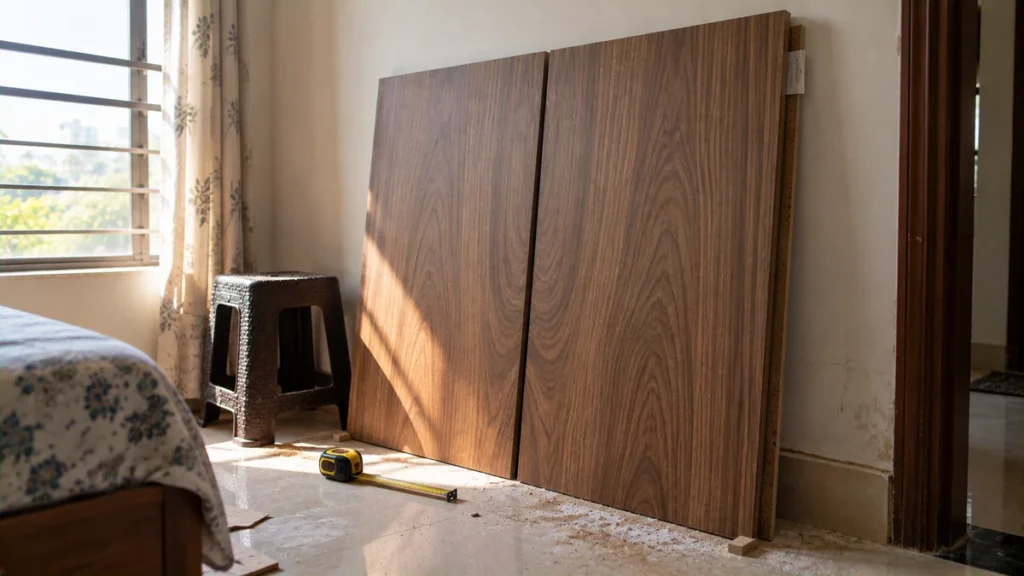
Searches for color combinations sliding wardrobe laminate usually mean two-colour pairs. Our colour trends guide lists six pairs and explains how bedroom light changes them, so this page does not repeat them. It answers the other half: where each colour goes on the doors.
Split (our suggestion) | On two panels | On three or four panels | Watch out for |
One colour per panel | Left light, right wood | Alternate A, B, A (and B) | The open door hides one panel behind another |
One accent panel | Not suited | One panel in the second colour | Pick the panel you open daily, not the corner one |
Tone on tone | Two shades of one colour | Alternate the two shades | The difference can vanish in dim light |
Band at the loft line | Top section in the second colour | Same, across all panels | Needs a loft with a clean seam |
These splits are our design suggestions, not a standard. A two-panel door is the hardest case, because each colour covers half the wall, and a half-open door always overlaps one colour with the other.
Ask whether the edge band matches the face or the second colour. A band in the wrong shade shows as a thin line on every panel edge.
Hold the two sample sheets together in your own bedroom light before you decide. Does the pair still look right at 7 pm?
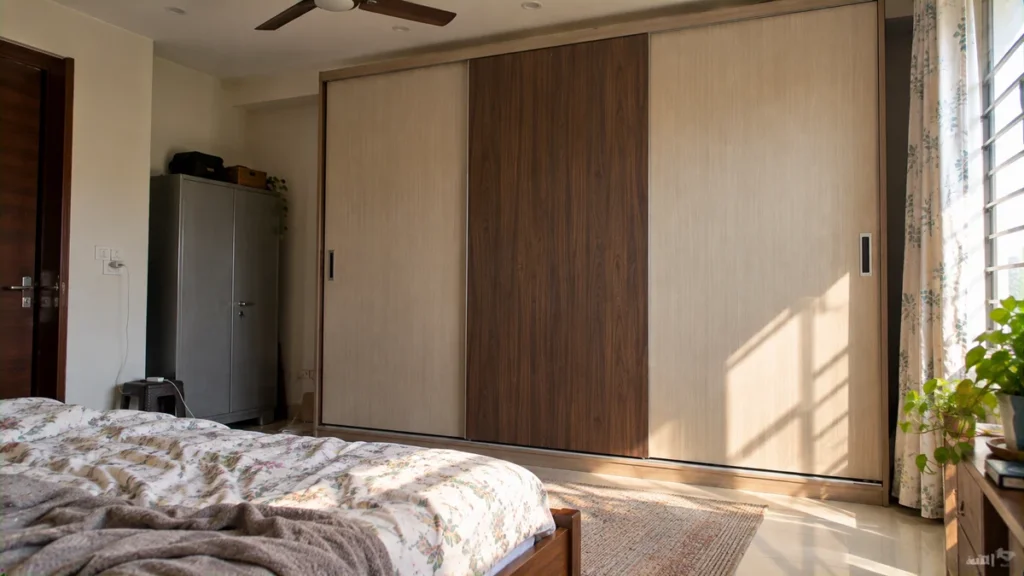
The sheet face usually outlasts the edge. Bhumim’s finish guide blames lifting edges on thin PVC tape set with EVA hot-melt glue. It says EVA weakens in steam, moisture or heat above 60°C, while factory-applied PUR glue resists moisture and about 150°C.
That finding comes from kitchens, where steam is constant. A bedroom wardrobe has no cooker, so the risk is lower, but the edge is still the weak point, so ask which glue is used.
The same guide covers repairs. A single shutter can be swapped if its shade code was recorded. A fitted laminate can be repainted, it says, by sanding with 180 to 220 grit paper and applying a laminate bonding primer. Two coats of enamel or PU paint follow, though the result will not match a factory finish.
The Houzz poster worried that laminate is hard to touch up after a scratch or peel. We think that is fair, so choose a calmer pattern if you expect knocks.
On the other hand, a repaint beats living with a lifting edge.
Which edge on your doors gets touched most?
A catalogue shows a pattern and a finish name. It does not show the board under the sheet, the thickness, the edge glue or the shade code.
Light changes the picture too. Our colour guide says the same laminate can look warm at noon and grey at 7 pm. Ask the team for the current catalogue and see physical samples in the room, at the showroom if you can.
Take care with the latest wardrobe laminate design, because a new shade can be a limited run, which makes a later shutter replacement harder.
A catalogue answers what it looks like. The quote must answer what it is made of.
Does your catalogue photo show the board underneath?
Dehradun’s monsoon is humid. The India Meteorological Department’s Climate of Dehra Dun report puts daily maximum humidity near 90 percent by late July (1971 to 2010 normals). A laminate sheet is only a skin, so the board under it must cope with that air.
Bhumim’s bedroom guide pairs a BWP plywood carcass with MDF or HDHMR board shutters, and calls the carcass material more important than the finish. For a bedroom wardrobe laminate design in Dehradun, Haridwar or Rishikesh, ask for that board in writing.
For Noida and Ghaziabad flats, Bhumim’s finish guide, written about kitchens, says anti-fingerprint matte laminate handles Noida’s dust and daily cleaning well. The same idea suits sliding doors that you wipe often.
Bhumim’s team typically takes 3 to 7 days for the design and 3D preview. That is the window to see your panel split and your sample sheets together.
Is your board ready for the July humidity?
Most of these cost nothing to avoid before the doors are cut, so which one could catch you?
Want the panels and colours seen in your room? Share your wall size and two shades you like, and review the split in a free 3D design. Call or WhatsApp 08044630777 or fill in your details at bhumim.com.
Have you counted the panels before you picked the colours?
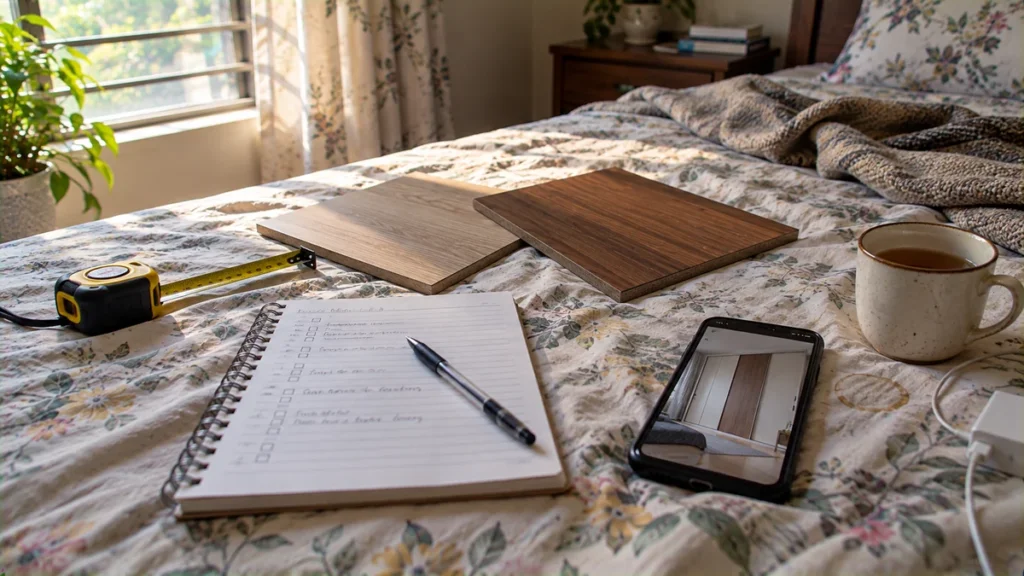
No single brand or shade is right for everyone, so ask for facts instead. Bhumim’s finish guide calls high-pressure laminate with a factory-applied PUR edge the most reliable choice in its kitchen comparison. For a wardrobe, ask the sheet type, thickness in mm, shade code, the board underneath and the edge glue.
A board supplier on Houzz says the word laminate is used loosely. In his account, melamine boards have a decorative paper bonded to MDF or particle board under a clear resin coat, while high-pressure laminate is a separate resin-and-paper sheet. Bhumim’s guide gives HPL as 0.8 to 1.5 mm thick. Ask which one your quote means.
A board supplier on a Houzz thread calls textured melamine doors more durable and less expensive than real wood veneer, and says the better ones have synchronised graining. That is one forum opinion from the US. We think you should see a sample, ask the sheet type, and check how the edge is sealed.
Yes, with limits. Bhumim’s finish guide says to sand the laminate with 180 to 220 grit paper, apply a laminate bonding primer, then two coats of enamel or PU paint. The result will not match a factory finish. A single shutter can be replaced if its shade code was recorded at installation.
Pick the pair first, using bedroom light, then decide where each colour goes. On three or four panels, an accent panel or an alternating split works well. A two-panel door is harder, because each colour covers half the wall. Hold both samples together in your own room before deciding.
There is no single standard we could source. A Raumplus datasheet lists a mounting depth of 42 mm for the track system, not the door thickness. The laminate sheet itself is 0.8 to 1.5 mm in Bhumim’s guide. Ask your maker for the door board thickness in mm, and the sheet thickness, on the quote.
It depends on the system. A Raumplus S1200 datasheet lists standard doors up to 1,500 mm wide and 2,750 mm high, and a maximum of 1,500 by 3,500 mm. A 6 foot wardrobe, about 1,830 mm, therefore takes two panels of about 915 mm. Confirm the limits for your own system with the maker.
A Quora reply from a modular kitchen director says the result depends partly on how the carpenter applies the laminate without bubbles and closes the edges. Bhumim’s bedroom guide pairs BWP plywood carcasses with MDF or HDHMR shutters, and calls the carcass more important than the finish. Ask for the boards in writing.
No. A two-panel slider opens only half the wardrobe at a time, according to Bhumim’s bedroom guide. Sliding doors need 18 to 20 inches of floor clearance, against 24 to 30 for hinged doors. On the other hand, hinged doors suit a medium or large room where you want to see everything at once.
Ask Bhumim’s team for the current catalogue, then see physical samples in your own room light. Our colour guide says the same laminate can look warm at noon and grey at 7 pm. The Dehradun showroom shows laminate samples in person, and the free 3D design shows your panels together.
Call or WhatsApp Bhumim at 08044630777, or fill in your details at bhumim.com/contact. Share your wall size and two shades you like, and the team shows the panels and colour split in a free 3D design, typically within 3 to 7 days. Then ask for the sheet type, thickness and shade code on the quote.
A good sliding wardrobe laminate design is chosen in the order panels, pattern, pair, then specification. The photo comes last, because it is the one thing that tells you nothing about how the doors will age.
If you are planning a wardrobe in Dehradun, Haridwar, Noida or nearby, call or WhatsApp Bhumim at 08044630777 or reach out through bhumim.com/contact for a free 3D design, and ask how your panels and laminate should be laid out.
Published by: Bhumim India Private Limited-Modular Kitchen Manufacturer & Installer, Dehradun
GST: 05AAOCB1784F1ZM | ISO 9001:2015 Certified
Service Areas: Dehradun · Haridwar · Rishikesh · Roorkee · Noida · Ghaziabad
Contact: 08044630777 | hello@bhumim.com
Note: This article is written from Bhumim’s on-ground manufacturing and installation experience. All material recommendations are based on what we use in real kitchens across our service areas.
Sliding wardrobe hardware guide: top-hung vs bottom-roller tracks compared, soft-close and anti-jump features, upkeep and a buying checklist.
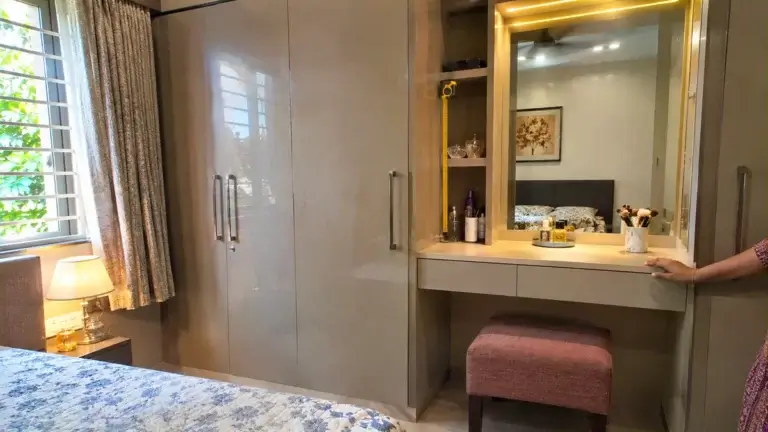
Wardrobe with dressing table design for Indian bedrooms: five layouts, bay size, mirror and light tips, and cost ranges for each option.
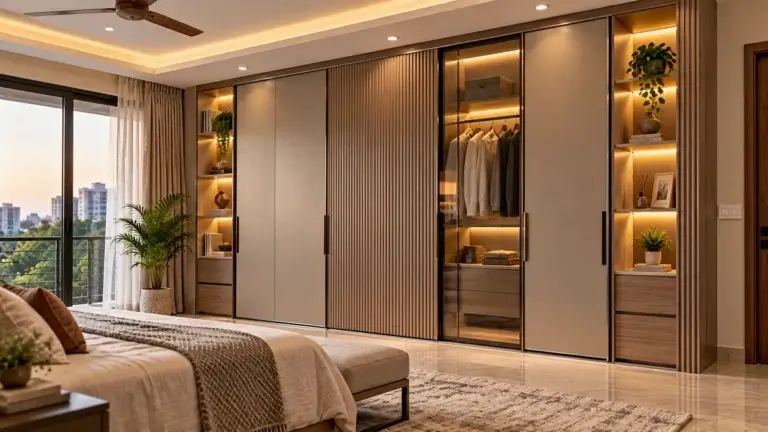
Luxury wardrobe design ideas for master bedrooms: lighting specs, finishes compared, detail upgrades, and where to spend or save.