

Sage Green & Terracotta Modular Kitchen: 2026 Color Palette & Design
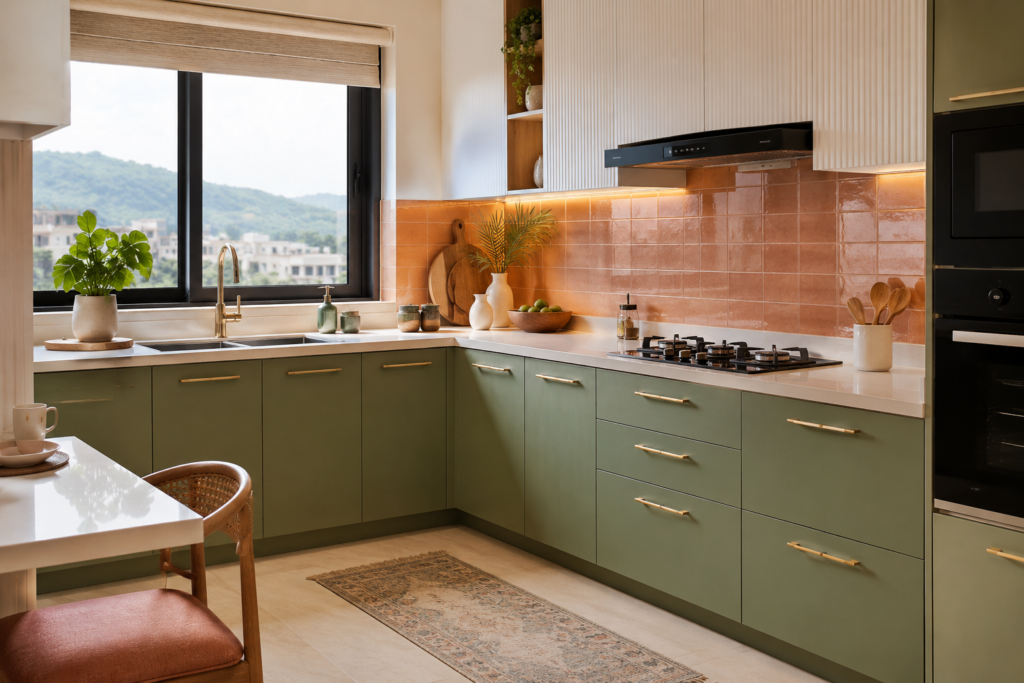
A sage green modular kitchen pairs muted, grey-toned green cabinetry with warm sun-baked terracotta accents to create a biophilic, nature-inspired kitchen that holds up to Indian cooking conditions. For 2026, this combination uses the 60-30-10 interior rule-60% sage green on base cabinets, 30% terracotta on the backsplash or accent wall, and 10% brushed brass or natural wood on hardware and lighting.
Why Sage Green and Terracotta Are the Kitchen Combination India Is Talking About in 2026
After installing modular kitchens across Dehradun, Haridwar, Rishikesh, and Noida, the single colour conversation we have most often is no longer about white or beige. It is about sage green. Specifically, whether it will look good after three years of heavy Indian cooking, whether it will survive Uttarakhand’s monsoon humidity, and whether pairing it with terracotta is a real design choice.
Sage green is a muted, grey-undertoned green that sits between olive and mint on the colour spectrum. It is not the bright green you associate with vegetables. It reads more like a forest seen through morning mist-calm, grounded, and surprisingly easy to live with over the long term. Terracotta, on the other hand, is the warm rust-orange of sun-dried clay. Together, they recreate the feeling of a hillside garden: cool greenery against warm earth tones.
That combination resonates strongly in Dehradun and the surrounding Himalayan foothills, where homeowners are surrounded by exactly that scenery. It also works in Noida and Ghaziabad apartments, where the biophilic pull-nature brought indoors-is even stronger precisely because the immediate environment is urban and dense.
What Is the 60-30-10 Rule for a Sage Green Modular Kitchen?
The 60-30-10 rule is an interior design principle that divides colour across a space into three proportions-a dominant colour (60%), a secondary colour (30%), and an accent (10%). Applied to a sage green and terracotta kitchen, it looks like this:
- 60%-Sage Green: Lower base cabinets, pantry units, and tall storage columns. This is where the bulk of the colour lives. It grounds the kitchen without overwhelming it.
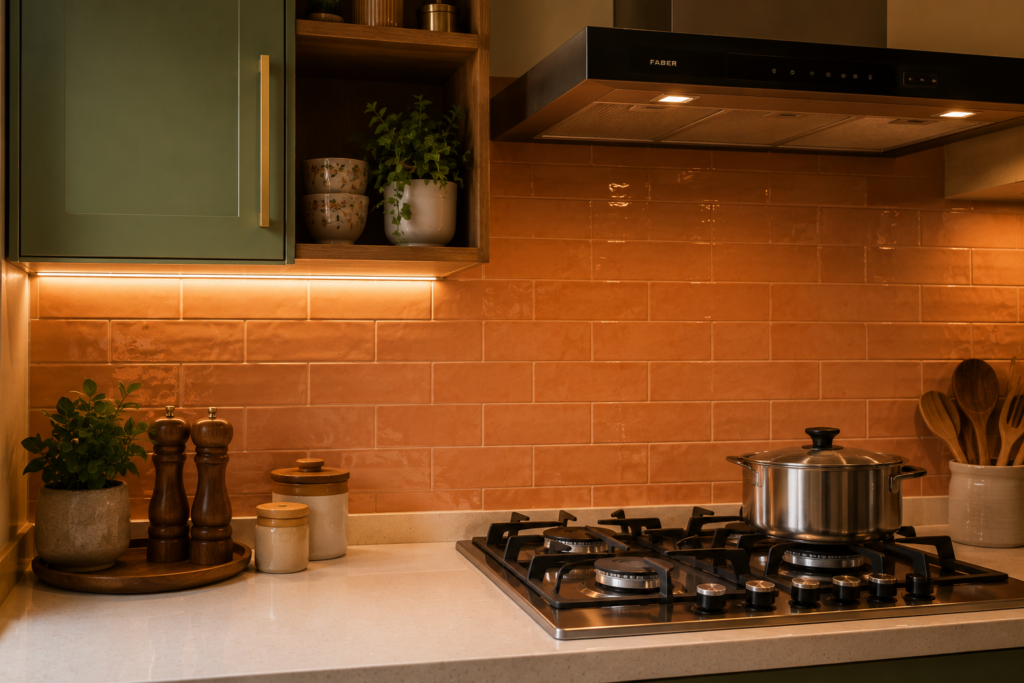
- 30%-Terracotta: The backsplash tiles behind the hob and counter, or a single accent wall if you have an open-plan kitchen. This is the warmth that stops the sage green from feeling cold or clinical.
- 10%-Brushed Brass / Natural Wood: Cabinet handles, chimney surround, under-cabinet LED strip housings, or a small herb shelf. This accent unifies the earthy palette without competing with either main colour.
A common mistake is reversing the proportions-putting terracotta on the cabinets and sage green as the accent. The result usually feels overwhelming because terracotta at full cabinet coverage reads as orange, not earthy. The 60-30-10 balance keeps everything calm and liveable.
Quick visual test: Stand at the kitchen entrance and scan the room. If sage green is the first colour that registers, terracotta the warmth you notice next, and brass the detail that ties it together-your proportions are right.
Get started with Beautiful Homes
For expert design consultation, send us your details and we’ll schedule a call
Is Sage Green Good for a Kitchen as per Vastu Shastra?
Yes-and in a specific way that makes the sage green and terracotta combination more than just a trend choice.
In Vastu Shastra, the kitchen is governed by Agni (fire), and the South-East direction of a home is considered the Agni corner. Green, representing the Wood or Nature element, is associated with East and North-East zones, and is linked to health, vitality, and growth. When a kitchen has its main cooking area or entrance in the East or North-East zone, sage green cabinetry aligns naturally with the elemental energy of that direction.
Terracotta, as an Earth and Fire element colour, complements the South-East zone beautifully. Placing the terracotta backsplash behind your hob-which is ideally positioned in the South-East-creates a purposeful Vastu alignment where the fire element (cooking flame + terracotta colour) occupies the correct directional zone.
For kitchens in South-facing configurations, Vastu guidance suggests keeping green tones softer and lighter rather than deep or saturated. Sage green’s naturally muted, greyish tone makes it one of the most Vastu-flexible shades of green available.
Practical Vastu considerations for sage green kitchens:
- Place the cooking hob facing East or South-East when the layout allows
- Keep the North-East zone free of heavy storage; open shelving or a window works well here
- A white quartz countertop in the North-East zone supports the water element (the sink is ideally North-East)
- Avoid dark, saturated green shades in South-facing kitchens; light sage always works
Which Shutter Finish Is Right for Your Sage Green Cabinets?
This is where most colour decisions fall apart. You can choose the perfect shade of sage green, but if the shutter finish is wrong for your kitchen environment, the colour will look flat, stain permanently, or fade within two years.
Here is a direct breakdown of what works and what does not in Indian cooking conditions:
Matte Anti-Fingerprint Laminate-Best Value for Indian Kitchens
Anti-fingerprint thermal laminates in sage green are the most practical choice for most Indian kitchens. The matte surface is oil-resistant, and the fingerprint-resistant coating means daily handling around the gas hob and sink does not leave permanent marks. Cleaning requires nothing more than a damp cloth or mild dish soap-no special products needed.
One honest note: standard matte laminates without the anti-fingerprint treatment will stain from turmeric splatters. The treatment matters. When you are selecting a laminate, look specifically for anti-fingerprint or acrylic-impregnated matte laminates-not basic decorative paper laminates applied over particle board.
Lacquered Glass Shutters-The Easiest to Clean, and the Most Reflective
Lacquered glass in sage green gives the colour a depth that laminates cannot replicate. The glass backing creates a richness and slight luminosity in the tone. More practically, lacquered glass wipes completely clean with a dry microfibre cloth. Turmeric, mustard oil, and masala splatter wipe off without leaving a trace.
The trade-off: lacquered glass costs noticeably more per square foot than laminate, and chips at corners if hit hard. For households with children, this is worth factoring in.
PU (Polyurethane) Matte Paint-The Most Colour-Accurate Option
If you want to match an exact hex code-say, achieving precisely the shade #8A9A86 rather than an approximation from a laminate catalogue-factory-applied PU matte paint is your option. The finish is seamless, with no visible substrate texture. It also handles Indian cooking conditions well when factory-cured, as the curing process leaves zero volatile organic compounds once the shutters arrive on site.
PU paint does require slightly more careful handling during installation and is more difficult to touch up if scratched years later.
What to Avoid: Standard Matte Acrylic Without Heat Resistance
High-gloss acrylic in sage green looks striking but shows heat discolouration near gas hobs over time. If you choose acrylic, ensure the manufacturer specifies heat-resistant grade acrylic, and keep the hob at least 300mm from the cabinet face wherever possible.
Finish | Stain Resistance | Heat Tolerance | Ease of Cleaning | Cost Tier |
Anti-fingerprint Laminate | High | Good | Very Easy | Entry–Mid |
Lacquered Glass | Very High | Good | Effortless | Mid–Upper |
PU Matte Paint | High | Good | Easy | Mid–Upper |
Standard Acrylic | Moderate | Lower near hob | Easy (glossy) | Mid |
Plain Matte Laminate | Low (stains) | Good | Moderate | Entry |
Which Carcass Material Holds Up in Dehradun, Rishikesh, and Haridwar?
The carcass-the structural box behind every cabinet door-is the decision that determines whether your kitchen lasts 5 years or 25. And in Dehradun, Rishikesh, and Haridwar, where annual rainfall exceeds 1,000mm and monsoon humidity regularly pushes above 80%, the carcass material matters more than in almost any other region in India.
We have seen standard commercial particle board (PLPB) kitchen carcasses swell and delaminate within two to three monsoon seasons in hill-facing Dehradun flats. It is not a rare occurrence-it is the expected outcome when the wrong material is specified.
Here is the honest breakdown:
BWP Marine Plywood (IS 710)-The Gold Standard for Wet Zones
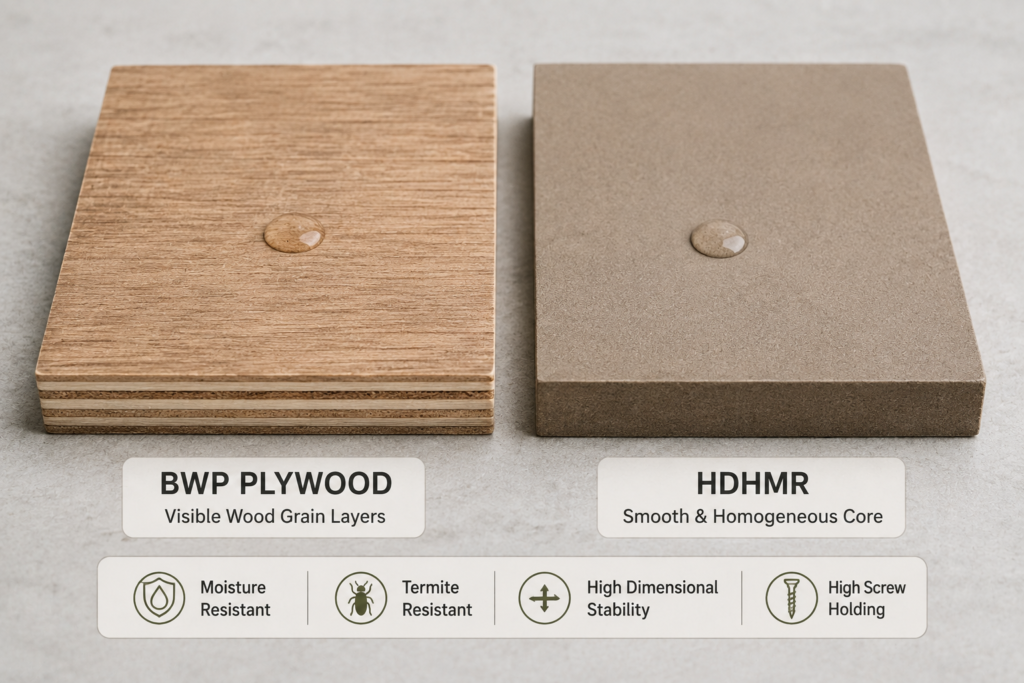
Boiling Waterproof plywood-certified to Bureau of Indian Standards IS 710:1976-is manufactured with phenol-formaldehyde resin under high pressure. The “boiling” designation means it has been tested to withstand prolonged exposure to water without delaminating. For base units near the sink, dishwasher zones, and any floor-contact cabinet in a monsoon-prone region, BWP plywood is the safest structural choice.
The downside is cost: an 18mm BWP sheet in the ₹3,000–5,000+ range, compared to standard MR plywood at ₹1,500–2,500. For a full kitchen, this adds up. That is why a hybrid approach makes sense.
HDHMR Board-Best for Wall Cabinets and Shutters in High Humidity
HDHMR (High-Density High-Moisture Resistant) board is an engineered composite with a homogeneous core-no layers to delaminate, consistent density throughout. It handles Dehradun’s continuous ambient humidity well, absorbs only 8–12% moisture compared to standard MDF’s 20%+ in humid conditions, and provides a perfectly smooth surface for laminate application.
HDHMR is our first choice for wall-mounted cabinets, tall pantry units, and shutter boards in Uttarakhand homes. For carcasses that will never contact water directly, it outperforms standard MR plywood in dimensional stability through multiple monsoon cycles.
The real-world answer for most Dehradun kitchens is a zone-based hybrid:
- Under-sink base unit and floor-touching base carcasses: BWP IS 710 plywood
- Wall-mounted cabinets and upper shutters: HDHMR board
- Under-sink cabinet interior (base board): WPC (Wood Plastic Composite)-100% waterproof and termite-proof
All cut edges on HDHMR should be sealed with 1mm PVC edge banding glued via PUR (Polyurethane Reactive) adhesive. This is the step most budget manufacturers skip, and it is the reason edge delamination happens in humid kitchens. Ask specifically for PUR-bonded edge banding-not hot-melt (EVA) glue, which fails in heat and humidity.
Material | Moisture Resistance | Termite Resistance | Screw Holding | Best Used For |
BWP Plywood (IS 710) | Exceptional (72-hr boil test) | High (chemical treated) | Maximum | Wet-zone base carcasses, floor contact |
HDHMR Board | High (ambient humidity) | High | Moderate-High | Wall cabinets, upper carcasses, shutters |
WPC (Wood Plastic Composite) | 100% Waterproof | 100% Termite-Proof | Moderate | Under-sink base interior |
Commercial Particle Board (PLPB) | Low (swells in water) | Low | Low | Not recommended for kitchens |
Which Kitchen Layout Works Best for Sage Green and Terracotta?
The colour combination looks different depending on the layout-and some layouts make it easier to implement the 60-30-10 rule than others.
L-Shaped Layout-The Standard for Indian Apartments
L-shaped kitchens, which account for over 57% of modular kitchen sales in India according to Mordor Intelligence (2026), naturally accommodate the sage green and terracotta split. The longer run of base cabinets carries the sage green. The backsplash along the cooking wall-typically the shorter run-carries the terracotta tiles. The proportions almost achieve themselves.
For smaller L-shaped kitchens (8×8 sq ft or under), keep the upper cabinets in off-white or natural wood finish rather than sage green. This opens the space visually. You can also use open-shelf upper cabinets to break the colour and add a lighter, airier feel. Consider corner Magic Corner pull-outs or Le Mans carousel units to maximise the dead corner typical of L-shaped kitchens.
Parallel Layout-Best for Clean Visual Symmetry
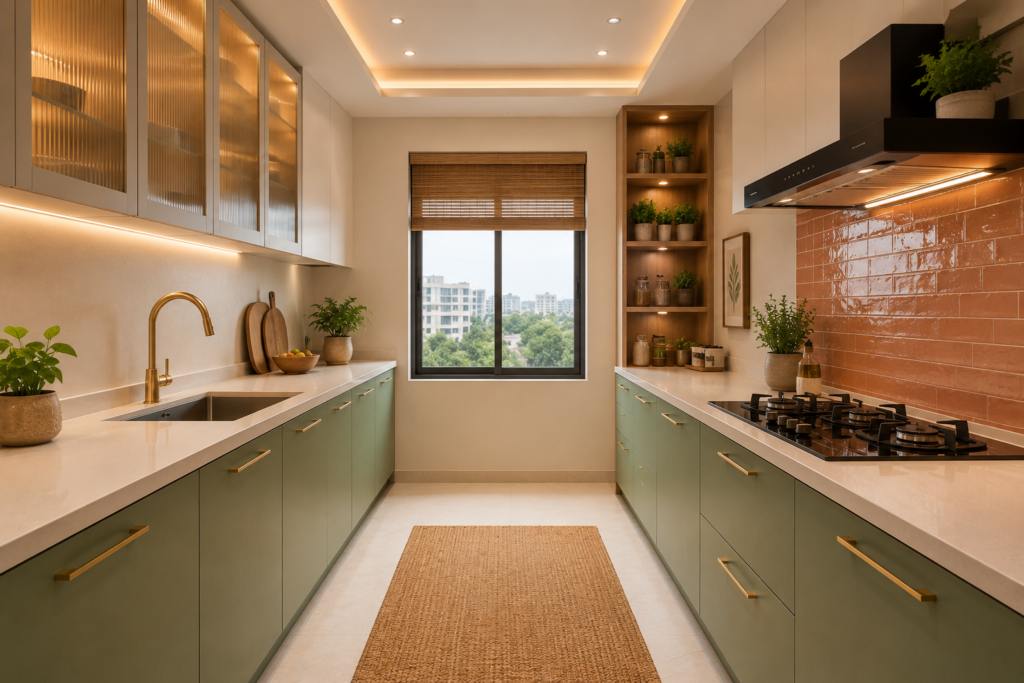
A parallel modular kitchen gives you two runs of cabinets facing each other. Sage green on the lower cabinets of both runs, terracotta tile backsplash on one wall (the cooking side), and white or cream tile on the prep side creates a composed, symmetrical visual effect that is very satisfying in compact kitchens of 6–9 feet width.
This layout also works well for homes in Noida and Ghaziabad high-rises, where kitchen widths tend to be narrow and the parallel configuration is the most efficient use of the available space.
U-Shaped and Island Layouts-For Villas in Dehradun and Rishikesh
Larger independent homes in areas like Rajpur Road or Dalanwala in Dehradun-or resort-facing properties in Tapovan, Rishikesh-have the space for U-shaped and island configurations. Here, the sage green has more surface area to work with, which deepens its visual impact. A terracotta-finished kitchen island top or a breakfast bar counter in a warm clay shade adds a design focal point that the 60-30-10 rule handles naturally.
For small kitchen spaces, sage green in a lighter tone (closer to sage grey) with terracotta limited to a single backsplash strip keeps the combination feeling open rather than enclosed.
What Countertop Goes with Sage Green Cabinets?
The countertop is the horizontal canvas that connects sage green cabinets to the terracotta backsplash. Get this right, and the whole kitchen clicks together.
White or light grey quartz with fine veining is the most widely used and most forgiving option. It reflects light well (important in kitchens without a natural window), provides sharp contrast against the sage green, and the neutral tone does not compete with the terracotta accents. For Indian cooking, quartz’s non-porous surface handles turmeric and oil stains without sealing requirements.
Nano-White engineered stone achieves a similar effect with a slightly warmer tone-closer to cream-which reduces the visual sharpness and makes the kitchen feel a little softer. Works especially well in kitchens with warm LED lighting (3000K range).
Jet Black or deep charcoal granite creates a bold contrast with sage green that reads as moody and dramatic rather than earthy and serene. It works in larger kitchens where the sage green has room to breathe. For kitchens under 8×10 sq ft, the darkness can feel heavy.
One countertop to avoid with sage green: beige or warm brown quartz. The undertones compete with the terracotta backsplash, and the overall effect reads as muddy rather than earthy.
How to Keep a Sage Green Kitchen Clean Under Indian Cooking Conditions
This is the question that does not appear in most design articles-and it is the most important practical question for anyone seriously considering this colour scheme.
Indian cooking is hard on light-coloured cabinets. High-pressure cooking, heavy oil use, turmeric splatters, and the cumulative effect of daily tadka smoke create maintenance challenges that a Pinterest image never shows you. Here is what actually works:
Turmeric Stains on Sage Green Shutters
The response time matters. Turmeric stains on any shutter finish set faster than most people realise-within minutes on a hot surface near the hob. The correct approach: wipe immediately with warm water and a few drops of mild dish soap. If the stain has already set, a paste of baking soda and a small amount of water, left for two minutes and gently wiped with a soft microfibre cloth, removes most residue without scratching.
Do not use abrasive sponges or powder-based cleaners on any shutter finish-they micro-scratch the surface, and the scratches accumulate over years into a dulling that cannot be reversed.
Oil Mist and Fumes on the Cabinet Face Near the Hob
A chimney rated at 1,100 to 1,350 m³/hr suction capacity is your first line of defence. For sage green kitchens in particular, where a light-toned shutter will show oil film more visibly than a dark cabinet, this is not optional. A weekly wipe-down with warm soapy water and a microfibre cloth prevents the film from polymerising into a sticky layer.
Terracotta Backsplash Tiles-Glazed, Not Raw
This is something forum members on r/IndianHomeDecor frequently warn about, and they are right. Unglazed raw terracotta tiles absorb oil behind the tadka zone. The grease penetrates the porous surface and is nearly impossible to clean without damaging the tile. The solution: use glazed terracotta-look porcelain tiles-not raw clay tiles-for the backsplash behind the hob. You get the same visual warmth with zero porosity. Alternatively, sealed terracotta tiles with an oleophobic sealant work if you have your heart set on real terracotta material.
Under-Cabinet LED Lighting-3000K Warm White
Under-cabinet 3000K warm-white LED strips enhance the terracotta backsplash and bring out the golden undertone in brushed brass hardware. They also improve visibility on the countertop during evening cooking. The warmth of the light source completes the biophilic mood that the sage-and-terracotta palette is trying to achieve.
Sage Green Modular Kitchen Cost per Sq Ft: Dehradun, Noida, and Rishikesh
Pricing for modular kitchens varies by carcass material, shutter finish, hardware selection, and city. The ranges below reflect current market benchmarks for northern India.
City / Region | Laminate Finish (HDHMR carcass) | Acrylic / PU Finish (BWP Ply) | Lacquered Glass (BWP Ply) |
Dehradun | ₹1,550 – ₹1,800 / sq ft | ₹1,900 – ₹2,200 / sq ft | ₹2,300 – ₹2,500 / sq ft |
Noida / NCR | ₹1,650 – ₹1,850 / sq ft | ₹2,000 – ₹2,300 / sq ft | ₹2,400 – ₹2,700 / sq ft |
Ghaziabad | ₹1,500 – ₹1,750 / sq ft | ₹1,850 – ₹2,150 / sq ft | ₹2,250 – ₹2,500 / sq ft |
Rishikesh / Haridwar | ₹1,600 – ₹1,850 / sq ft | ₹1,950 – ₹2,250 / sq ft | ₹2,350 – ₹2,600 / sq ft |
These are carcass + shutter + basic installation estimates. They do not include countertop, chimney, sink, backsplash tiles, or appliances. Hardware selection adds further cost-Blum or Häfele soft-close tandem drawer runners and Häfele or Hettich soft-close hinges are more expensive upfront than no-brand alternatives, but they are the components you interact with every single day. In our experience installing modular kitchens across all these regions, the hardware is the one area most clients wish they had not compromised on.
For Dehradun and Rishikesh specifically: transportation and site access charges in hilly areas can add 5–10% to the base cost compared to flat NCR regions. Factor this in if you are budgeting for a hill-facing property.
Factory manufacturing for a standard modular kitchen takes 21–30 working days. On-site installation typically takes 3–5 days.
To get an accurate estimate for your space, get a free design consultation with kitchen dimensions and layout preference ready-the per-sq-ft number means very little without a floor plan.
What Hardware and Accessories Work Best with Sage Green?
The 10% accent in your 60-30-10 palette is largely defined by hardware choices. Here is what the combination supports:
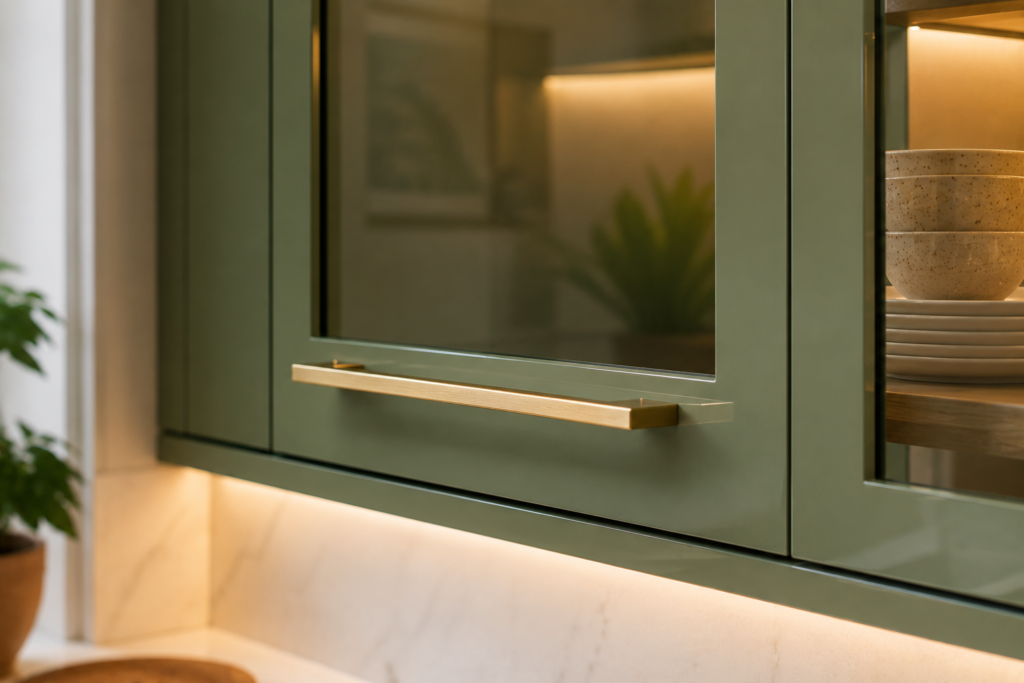
Brushed brass or satin gold handles are the natural partner for sage green. They add warmth, draw out the yellow undertones in the terracotta, and look intentional rather than coincidental. Profile handles (a horizontal bar running the full width of the door) work particularly well on flat-shutter sage green cabinets.
Matte black handles are a valid alternative if you prefer a more industrial-modern interpretation of the palette. They create sharper contrast and add a graphic quality that works well in Noida apartments with clean, minimal architecture.
Avoid polished chrome with sage green-the cold brightness of chrome pulls against the warm earthy palette and creates a colour tension that is difficult to resolve.
For internal hardware, Blum or Häfele soft-close tandem box drawer runners are Bhumim’s standard specification across kitchen projects. The closing mechanism on a tandem box drawer means you never deal with a slamming drawer again-and the structural integrity of the box allows significantly heavier loads than standard wooden box drawers with metal runners.
Frequently Asked Questions
Yes, and specifically because it works with Indian home contexts rather than against them. Sage green is a muted, grey-undertoned shade that reads as natural and calm under both warm LED and natural daylight. Unlike brighter greens, it does not compete with the warm tones of Indian wood laminates, terracotta tiles, or natural stone countertops. In 2026, it is the most-requested earthy cabinet colour in northern India, aligning with the biophilic design direction that sees homeowners wanting to bring natural tones indoors.
White or light grey quartz with fine veining is the most versatile choice. It reflects light well, provides clean contrast against the sage green, and is non-porous-an important quality for Indian cooking. Nano-White engineered stone (with a slightly warmer, creamier tone) also works well in kitchens with warm LED lighting. Avoid warm beige or brown-toned countertops, as the undertones compete with a terracotta backsplash and the result reads muddy rather than earthy.
In Vastu Shastra, green represents the Wood or Nature element and is associated with East and North-East zones-directions linked to health, clarity, and growth. A sage green modular kitchen is considered Vastu-aligned when the primary cabinetry faces East or occupies the East wall. For South-facing kitchens, use lighter, more muted sage tones and confine the green to cabinets rather than walls. Terracotta as a fire-and-earth accent in the South-East (Agni) zone complements the elemental balance.
Act immediately-turmeric sets faster on warm surfaces near the hob. Wipe with warm water and a few drops of mild dish soap as soon as possible. For stains that have already dried, apply a small paste of baking soda and water to the area, leave for two minutes, and wipe gently with a soft microfibre cloth. Do not use abrasive scourers or powder cleaners on any shutter finish-the micro-scratches accumulate into permanent surface damage. Anti-fingerprint matte laminates and lacquered glass handles this cleaning routine without issue. Standard matte paint finishes stain permanently.
For Dehradun and the Uttarakhand foothills, neither alone is the complete answer. A zone-based hybrid gives the best outcome: BWP Marine Plywood (IS 710) for base carcasses in direct contact with the floor or near the sink, where water immersion risk is real. HDHMR for wall-mounted cabinets, upper shutters, and dry-zone base units, where ambient humidity is the challenge rather than direct water contact. Under-sink base interiors benefit from WPC (Wood Plastic Composite), which is 100% waterproof and termite-proof. All cut edges should be sealed with PUR-bonded 1mm PVC edge banding.
In Dehradun, current pricing ranges from approximately ₹1,550 to ₹1,800 per sq ft for HDHMR carcass with matte laminate finish, ₹1,900 to ₹2,200 for acrylic or PU finish on BWP plywood, and ₹2,300 to ₹2,500 for lacquered glass finish on BWP plywood. These estimates cover carcass, shutters, and basic installation. Countertop, backsplash tiles, chimney, and German hardware (Blum, Häfele) are priced separately. Hill-access properties may add a 5–10% site logistics charge.
Use glazed terracotta-look porcelain tiles rather than raw unglazed terracotta near the cooking zone. Raw terracotta is porous-cooking oil and masala splatter penetrate the surface and cannot be fully cleaned. Glazed porcelain in a terracotta shade (#E2725B range) gives you the same visual warmth with a fully non-porous, heat-resistant surface. If you prefer authentic terracotta texture, real terracotta tiles must be sealed with an oleophobic (oil-repelling) stone sealant before installation and re-sealed every 12–18 months.
You can, but it is not the approach most people are happy with long-term. Full-perimeter sage green creates a colour-heavy kitchen that can feel darker than expected, particularly in kitchens without large windows. The combination that holds up better over years: sage green on lower base cabinets, off-white or natural oak-finish laminates on upper wall cabinets. The lighter upper cabinets reflect light downward onto the countertop and keep the kitchen feeling open. Reserve full sage green upper cabinets for very well-lit kitchens with generous natural daylight.
Yes-more so than many homeowners expect. Sage green’s grey undertone means it reads as a near-neutral rather than a dominant colour in small spaces. In an 8×8 or 8×10 sq ft kitchen, sage green lower cabinets with off-white uppers and a terracotta backsplash strip behind the hob create a layered, interesting visual without making the kitchen feel smaller. Avoid deep or saturated greens in small kitchens-those do compress space. Light-to-medium sage (closer to the #8A9A86 range) is the one that opens rooms.
A minimum suction capacity of 1,100 to 1,350 m³/hr is recommended for kitchens with light-coloured cabinets where oil mist deposition is visible. For Indian cooking with daily high heat and heavy oil use, the higher end of this range-1,200 to 1,350 m³/hr-gives you a meaningful buffer. The chimney is your first line of protection against oil film accumulating on sage green shutters and dulling the colour over time.
Key Takeaways
- Sage green modular kitchen combines hex #8A9A86 base cabinets with terracotta backsplash tiles in a 60-30-10 ratio for a balanced biophilic palette
- In Vastu Shastra, sage green aligns with East and North-East kitchen zones; terracotta complements the South-East Agni corner
- For humid regions like Dehradun, Rishikesh, and Haridwar, use BWP IS 710 plywood for wet-zone base carcasses and HDHMR board for wall cabinets-avoid commercial particle board entirely
- Choose anti-fingerprint matte laminate or lacquered glass shutters for Indian cooking conditions; standard matte paint stains permanently with turmeric
- Use glazed terracotta-look porcelain tiles near the hob-not raw unglazed terracotta, which is too porous for cooking splatter
- Countertops: white or light grey quartz is the most compatible option; avoid warm beige tones that compete with the terracotta
- Brushed brass handles complete the earthy palette; install 3000K warm-white under-cabinet LED strips to enhance the terracotta backsplash at night
- Pricing in Dehradun: ₹1,550–₹2,500 per sq ft depending on finish tier; Noida/NCR runs slightly higher
Conclusion-Your Kitchen Is Waiting for the Right Colours
You started thinking about sage green and terracotta because something about the combination felt right. Not trendy-right. Genuinely, liveable-right. That instinct is worth following-this is a palette that ages well, complies with Vastu principles that matter to many Indian families, and works with the cooking realities of an Indian kitchen rather than pretending they do not exist.
The questions that matter are not really about colour anymore. They are about which shutter finish handles your cooking style, which carcass material holds up in your city’s climate, and which layout gets the most from your floor plan. Those decisions are where a modular kitchen manufacturer who has installed kitchens in your specific city can add more value than any design guide.
If you are planning a sage green modular kitchen in Dehradun, Haridwar, Rishikesh, Roorkee, Noida, or Ghaziabad, book a free 3D design consultation with Bhumim. We will map your floor plan, walk you through material options for your specific climate and cooking habits, and show you exactly what your kitchen will look like before manufacturing begins. No commitment required to see the design.