

Wardrobe Accessories Worth Adding: Pull-Out Trays, Tie Racks & Jewellery Drawers
A wardrobe accessories guide starts with one rule. Add the fittings you will fill and use every week, and skip the rest. For most Indian wardrobes that means a pull-out trouser rack, a shallow jewellery drawer and a tie and belt organiser. Everything else depends on what you actually own and how you dress each day.
Pay for the few that earn their place, and plan them before the wardrobe is built.
Why Accessories Decide How a Wardrobe Feels After a Year
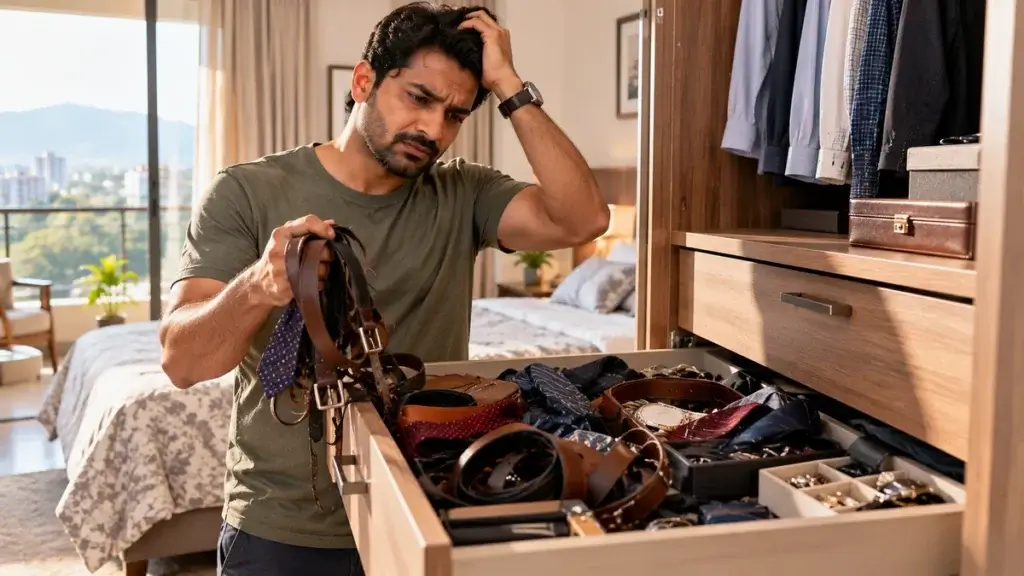
A new wardrobe looks the same on day one, with or without accessories. The difference shows up in month six, when belts end up in a heap and rings vanish into a drawer of loose cables. Trousers sit in a stack, and the one you want is always at the bottom.
Which of these annoyances sounds familiar?
Accessories fix those small daily annoyances, though the trade-off is cost and wasted fittings, which is why this guide ranks them instead of listing them. For the basic shelf, drawer and rod layout first, see our wardrobe interior design guide.
Which Wardrobe Accessories Are Worth It, Ranked by Daily Use
Accessory | Worth it when | Skip it when |
Pull-out trouser rack | You wear trousers or pants most days | You mostly wear ethnic or folded clothes |
Jewellery drawer | You own more than a few pieces and want them sorted | Your jewellery lives in a bank locker or safe |
Tie and belt organiser | You wear ties or several belts regularly | You own two belts and no ties |
Pull-out shoe rack | The wardrobe is deep and floor space is short | A separate shoe cabinet already exists |
Pull-out basket or tray | You store folded casuals or accessories | You rarely fold clothes |
We think most homes need only three or four of these, because the rest look good in a showroom but sit empty a year later.
Get started with Beautiful Homes
For expert design consultation, send us your details and we’ll schedule a call
Pull-Out Trays and Trouser Racks: What to Check Before You Order
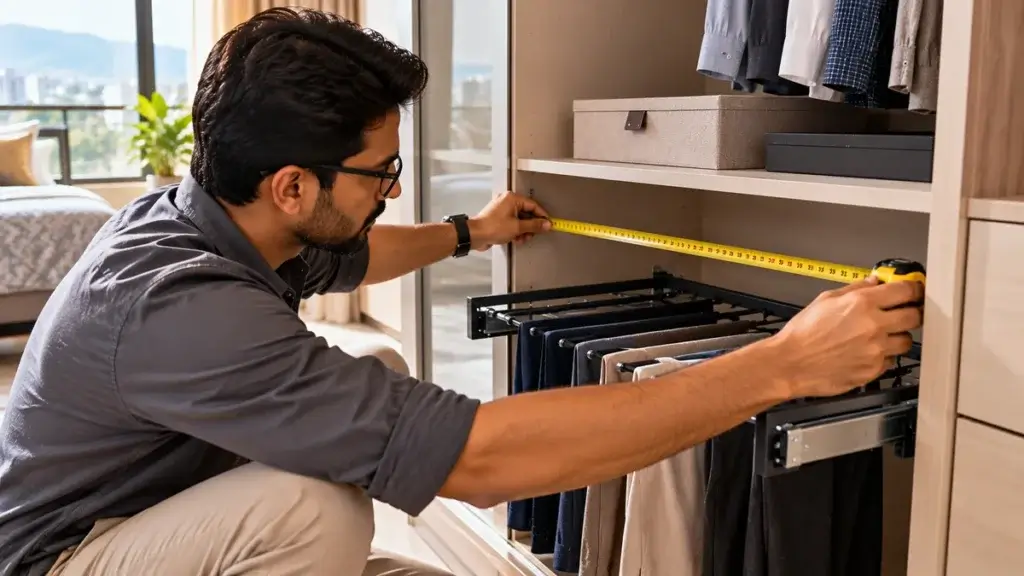
A pull-out trouser rack keeps trousers visible and wrinkle-free, instead of leaving them folded in a stack. A typical rack sits in a section about 600 mm wide, though module sizes vary by manufacturer. Ask for the exact size in writing before the carcass is cut, so nothing changes at the last minute.
Measure first, order second.
This is the part most guides skip, yet an accessory cannot be squeezed into a finished wardrobe. The section width, depth and runner type are decided when the carcass is planned. A pull-out added later usually means a modification, or a smaller tray than you hoped for.
Check the runner too, because a rack full of folded trousers is heavy. Ask whether the runners are full-extension, soft-close and rated for that load. For runners and fittings of this kind, Bhumim works with Hafele, Blum and Grass.
Jewellery Drawers: The Monsoon Detail Most Guides Skip
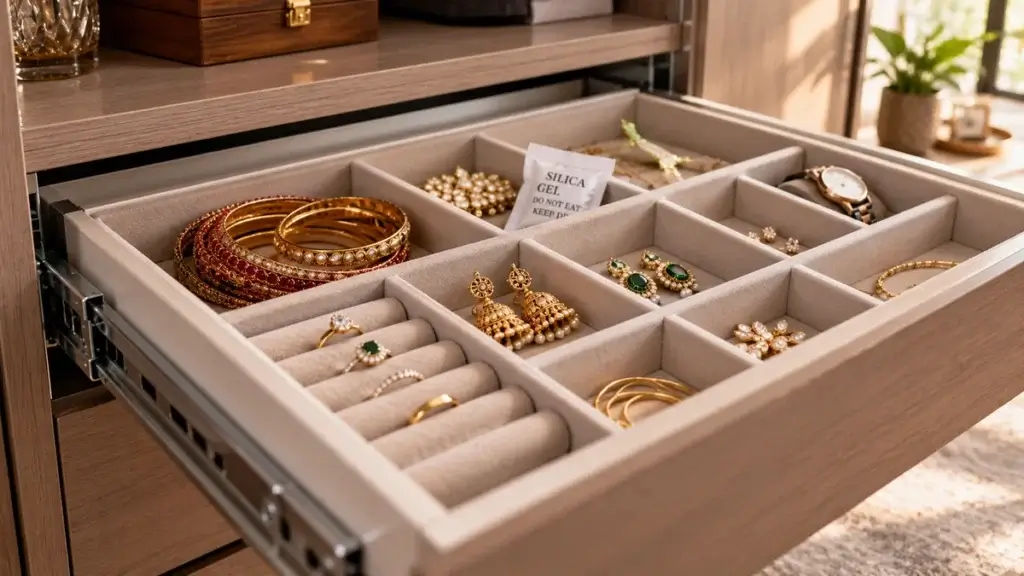
A shallow jewellery drawer, often about 100 to 120 mm deep, with small compartments keeps rings, bangles and earrings sorted. Many guides recommend a velvet lining, which works well in a dry room.
Humidity is not a small detail in Dehradun. The India Meteorological Department’s Climate of Dehra Dun report puts daily mean maximum relative humidity near 90 percent by the third week of July. That comes from 1971 to 2010 normals.
Lined fabric can hold moisture through those weeks. Silver tarnishes faster when damp air stays trapped around it. On the other hand, a plain smooth tray with a few silica gel sachets stays drier and is easy to wipe.
So choose the lining for the climate, not the catalogue photo. A lockable drawer is worth asking for if you keep valuable pieces at home, since Houzz homeowners and designers often rate lockable jewellery drawers highly.
Light inside the drawer helps too, and our wardrobe lighting guide covers sensor and strip options.
Tie and Belt Racks: Small, Cheap and Easy to Skip
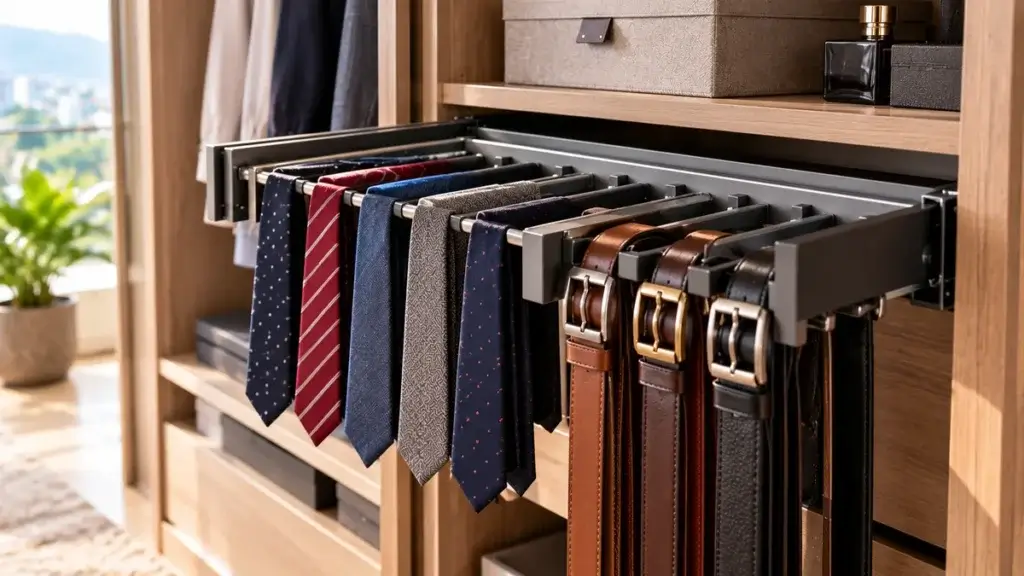
A tie and belt organiser is the cheapest accessory here, and the easiest to justify or skip. If you wear ties or own five or more belts, it pays back in minutes saved each morning.
Do you really wear ties?
If you own two belts and no ties, a row of hooks inside the door does the job. Skip the pull-out you would fill with two items.
What Wardrobe Accessories Cost in India
Prices vary by city, brand and runner quality, so no single number applies to every home. The table shows indicative market ranges seen across Indian suppliers in 2026. These are not Bhumim quotes, so confirm current figures with Bhumim for your wardrobe.
Accessory | Indicative market range |
Pull-out trouser rack | ₹3,000 to ₹6,000 |
Jewellery tray or drawer insert | ₹1,500 to ₹6,000 |
Tie and belt organiser | ₹1,000 to ₹3,000 |
Pull-out shoe rack | ₹2,000 to ₹7,000 |
Pull-out basket | ₹2,500 to ₹6,000 |
Is the cheapest unbranded accessory really a saving? We think it rarely is, because weak runners and thin rails fail first, and replacing them means opening the wardrobe again. Spend more on the fitting you will use daily, and less on the one you will touch twice a year.
Not sure which accessories your wardrobe really needs? Tell us what you store, and we will plan only the fittings you will use in a free 3D design. Call or WhatsApp 08044630777 or fill in your details at bhumim.com.
Three Sensible Accessory Packages and What They Add Up To
Instead of picking items one by one, it helps to choose a package. The totals below simply add the indicative market ranges from the table above, so treat them as a rough budget, not a quote.
Package | What it includes | Rough add-on cost |
Lean | Trouser rack and tie and belt organiser | ₹4,000 to ₹9,000 |
Balanced | Lean package plus a jewellery tray | ₹5,500 to ₹15,000 |
Full | Balanced package plus a shoe rack and a basket | ₹10,000 to ₹28,000 |
In Bhumim’s project experience, the balanced package suits most households that wear daily trousers and keep jewellery at home. The full package makes sense only when the wardrobe is deep and every item has a clear job.
The same worth-it logic applies in the kitchen, where our modular kitchen accessories guide explains which fittings earn their cost.
Common Wardrobe Accessory Mistakes to Avoid
- Buying every accessory in the catalogue, when several of them end up mostly empty within a year.
- Adding a pull-out after the carcass is built, when the width and depth are already fixed.
- Choosing velvet lining for a humid room without any plan for keeping the moisture out.
- Picking unbranded runners that sag or jam once the rack is loaded with real clothes.
- Ignoring how you actually dress, then paying for a tie rack when you own no ties.
Frequently Asked Questions
The ones you will fill every week. For most households that is a pull-out trouser rack, a shallow jewellery drawer and a tie and belt organiser. Baskets and shoe racks depend on your storage. Skip anything that would hold only a few items.
Sometimes, but it is harder. Width, depth and runner type are set when the carcass is built, so a later pull-out may need a modification or a smaller unit. Plan accessories at the design stage and ask for module sizes in writing.
A shallow drawer, often about 100 to 120 mm deep, suits rings, bangles and earrings. Deeper drawers waste height and bury small pieces under larger ones. Add dividers so each type stays separate. Confirm the exact internal size with your manufacturer, since modules vary by make and section width.
It can be a problem. IMD normals put Dehradun’s daily maximum humidity at about 90 percent by late July, and lined fabric may hold that moisture. Damp air tarnishes silver faster, so a smooth tray with silica gel sachets is easier to keep dry.
It is worth asking for if you keep valuable pieces at home. A lockable drawer adds a layer of security and keeps pieces sorted. It does not replace a bank locker or safe for high-value items, and the lock is only as strong as the drawer front around it.
Often not for moving parts. The runners and rails take the load every day, and weak ones sag or jam. A cheaper tie rack with no moving parts is a fair saving. Spend on the pull-outs you will use daily.
Indicative market ranges are about ₹3,000 to ₹6,000 for a trouser rack, ₹1,500 to ₹6,000 for a jewellery tray, and ₹1,000 to ₹3,000 for a tie and belt organiser. These are not Bhumim quotes, so confirm current figures with Bhumim.
Usually not. If you own two belts and no ties, a row of hooks inside the door does the same job for far less. A pull-out organiser pays off when you wear ties or own five or more belts, because each one then gets its own visible slot.
Call or WhatsApp Bhumim at 08044630777, or fill in your details at bhumim.com/contact. Share what you store and your wardrobe size, and the team plans only the fittings you will use in a free 3D design, typically within 3 to 5 working days. You can then compare it with any other quote before you decide.
Key Takeaways
- Add the accessories you will fill every week, and skip the rest of the catalogue.
- Plan pull-outs when the carcass is designed, because width and depth cannot change later.
- Choose the jewellery drawer lining to suit your humidity, not the catalogue photo.
- Spend on good runners for the daily pull-outs, and save on simple fittings without moving parts.
- Treat any price you see online as a market range, and confirm it with Bhumim before you decide.
Conclusion
The right wardrobe accessory is the one you use without thinking. List what you store, pick three or four fittings that match, and plan them into the design before anything is built.
If you are planning a wardrobe in Dehradun, Rishikesh or Haridwar, call or WhatsApp Bhumim at 08044630777 or reach out through bhumim.com/contact for a free 3D design with only the accessories you need, or visit the Dehradun showroom to try the runners yourself.