

What Is a Modular Kitchen? Meaning, Types & How It Differs from Carpenter-Built
Modular kitchen meaning refers to a kitchen built from factory-manufactured cabinet modules, standardised units for storage, cooking, and countertop space. Installers assemble these on-site rather than build them there. The word “modular” describes the construction method, not a style or price tier. This differs from a semi-modular kitchen (part factory, part on-site carpentry) or a fully carpenter-built kitchen, which a carpenter constructs entirely on-site.
A modular kitchen is a kitchen made of interchangeable factory units, not a design style. That distinction matters more than it sounds. Most of the confusion buyers run into starts with treating “modular” as a look rather than a construction method.

Why This Word Gets Misunderstood So Often
After explaining “modular kitchen” to Dehradun and Noida homeowners for years, the same mix-up shows up constantly. Someone points at a glossy showroom photo and calls it “modular” because it looks sleek and handle-less. A plain white cabinet kitchen built by a local carpenter gets dismissed as “not modular” because it looks old-fashioned. Neither judgment is actually about the word’s real meaning.
Modular has nothing to do with how a kitchen looks. It describes how a factory builds it, in separate, interchangeable units, versus building it on-site from scratch. As of 2026, this confusion still drives a lot of buyer regret. People compare quotes without realising they are comparing genuinely different construction methods, not just different finishes.
If you already understand the basics and want layout-specific options like L-shaped or island kitchens, our types of modular kitchen layouts guide covers that separately. This article focuses on what “modular” actually means and how construction method, not layout, is the real dividing line.
Get started with Beautiful Homes
For expert design consultation, send us your details and we’ll schedule a call
What Does "Modular" Actually Mean in a Modular Kitchen?
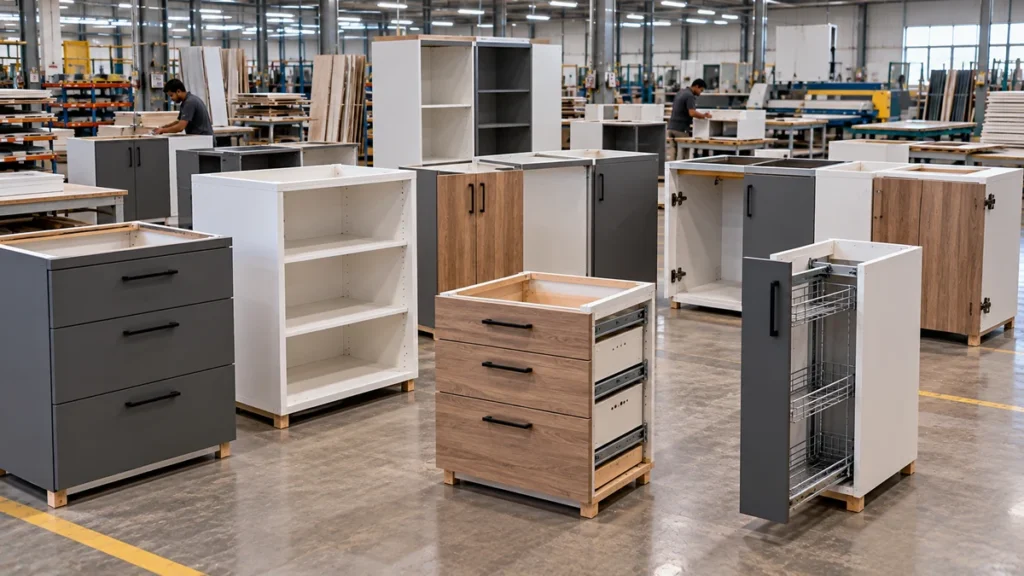
The word “modular” means built from standardised, interchangeable units called modules, not one continuous structure. A factory manufactures each module, a base cabinet, a wall cabinet, a drawer unit, to fixed dimensions. Installers then bolt these together on-site to form the complete kitchen.
This is the same underlying idea behind modular furniture in general, and even modular phone cases or modular sofas. The defining feature is not the finish or the price. It is that a single module can be unbolted and replaced without touching the rest of the structure. A carpenter-built kitchen has no equivalent unit boundary, since a carpenter builds the whole thing as one continuous piece of joinery.
What Are the Real Types of Modular Kitchen, by Construction Method?
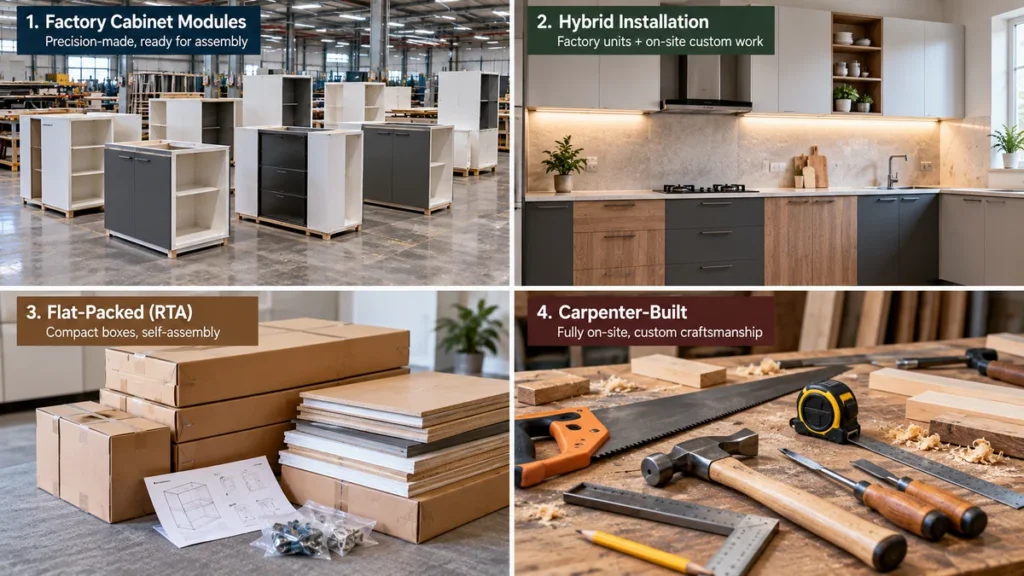
There are four real construction categories a kitchen can fall into: fully modular, semi-modular, ready-to-assemble (RTA/knockdown), and fully carpenter-built. Most buying guides only classify kitchens by layout, L-shaped, U-shaped, and so on. That answers a different question entirely, how the kitchen is arranged, not how it is built.
Construction Type | How It Is Built | Best Fit |
Fully modular | All units factory-manufactured, assembled on-site only | Primary kitchens used daily, factory consistency matters |
Semi-modular | Some units factory-made, some finished by an on-site carpenter | Tighter budgets, willing to trade some consistency for cost |
RTA / knockdown | Flat-packed factory units, self-assembled or simple on-site fitting | Rental kitchens, quick budget upgrades |
Carpenter-built | Entire kitchen constructed on-site from raw material | Highly irregular spaces, fully custom one-off requirements |
This construction-method classification is the one that actually predicts your experience, timeline, and long-term reliability. Layout choices like L-shaped versus U-shaped change how the kitchen feels to cook in. Construction-method choices like modular versus carpenter-built change how consistent the finish is, how fast installation happens, and how easily a damaged section gets replaced later.
RTA, or ready-to-assemble, is the least talked-about category in India, though it exists here too, mostly for small budget projects and rental properties. These arrive as flat-packed factory units, similar in principle to a well-known Swedish furniture brand’s approach. The trade-off is that self-assembly, or simple on-site fitting, usually skips the precision installation a professional team provides for a fully modular kitchen.
How Does a Modular Kitchen Differ from a Carpenter-Built Kitchen?
A factory manufactures a modular kitchen off-site in standardised units, then installers assemble it at your home. A carpenter constructs a carpenter-built kitchen entirely on-site from raw material instead. This single difference drives most of the practical gaps between the two: consistency, installation speed, and how repairs happen later.
Factory manufacturing means every cabinet in a modular kitchen goes through the same quality-control process, so dimensions and finish stay consistent across the whole kitchen. A carpenter-built kitchen depends entirely on one person’s skill and mood on a given day, which can vary noticeably even within the same kitchen.
Repairs work differently too. A modular kitchen only needs the damaged module replaced, since each unit is a self-contained, bolted piece. A carpenter-built kitchen often needs the surrounding joinery reworked as well, since the original build never separated it into standalone units.
That installation-speed gap is worth seeing in actual days, not just in general terms. Our modular kitchen installation timeline guide breaks down exactly how long each construction method takes, stage by stage.
Honest limitation: A carpenter-built kitchen is not automatically the worse choice. Take a genuinely irregular space, a sloped ceiling, an oddly placed pillar. A skilled local carpenter can sometimes solve a layout problem a standardised module cannot. The trade-off is consistency and speed, not quality in every case.
Is a Semi-Modular Kitchen a Good Middle Ground?
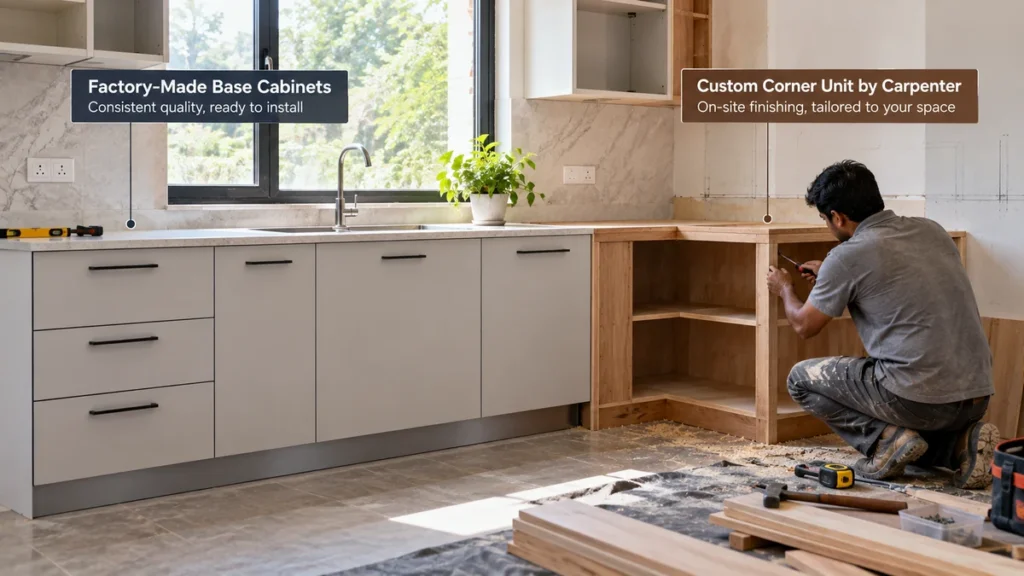
Yes, for the right budget and situation. A semi-modular kitchen combines factory-made cabinets for the main storage units with on-site carpentry for finishing touches. This covers corner adjustments, or custom fittings the standard modules do not handle. It typically costs 10 to 15 percent less than a fully modular kitchen of the same size.
The trade-off is exactly what you would expect from mixing two construction methods. Consistency drops slightly, since the on-site carpentry portion depends on individual skill the same way a fully carpenter-built kitchen does. Installation also tends to take longer than a fully modular kitchen, since part of the work still happens on-site rather than arriving pre-finished.
For a full picture of what a fully modular kitchen costs, our modular kitchen guide for India breaks down current pricing and materials. It also covers buyer benefits in more depth than this article does.
Where Does the Word "Modular" Actually Come From?
The term borrows directly from manufacturing and engineering, where “modular” has described standardised, interchangeable components for decades before kitchens ever adopted the word. Modular electronics, modular housing, and modular furniture all share the same core idea. Build once in a factory, then assemble many times on-site, in whatever combination the space needs.
Kitchens picked up the term for a genuine reason, not just marketing borrowing a trendy word. A kitchen has natural functional zones, storage, cooking, washing, that map cleanly onto separate physical units. That mapping is exactly what makes a kitchen a good candidate for modular construction. A staircase or a roof genuinely needs to be one continuous piece instead.
Knowing this origin helps explain why modular construction fits kitchens so naturally. Each functional zone, a base cabinet under the counter, a tall unit for a pantry, a wall cabinet above, already has a clear boundary. A factory can build each boundary as its own unit without losing anything a continuous structure would have offered.
What Materials Actually Go Into a Modular Kitchen?
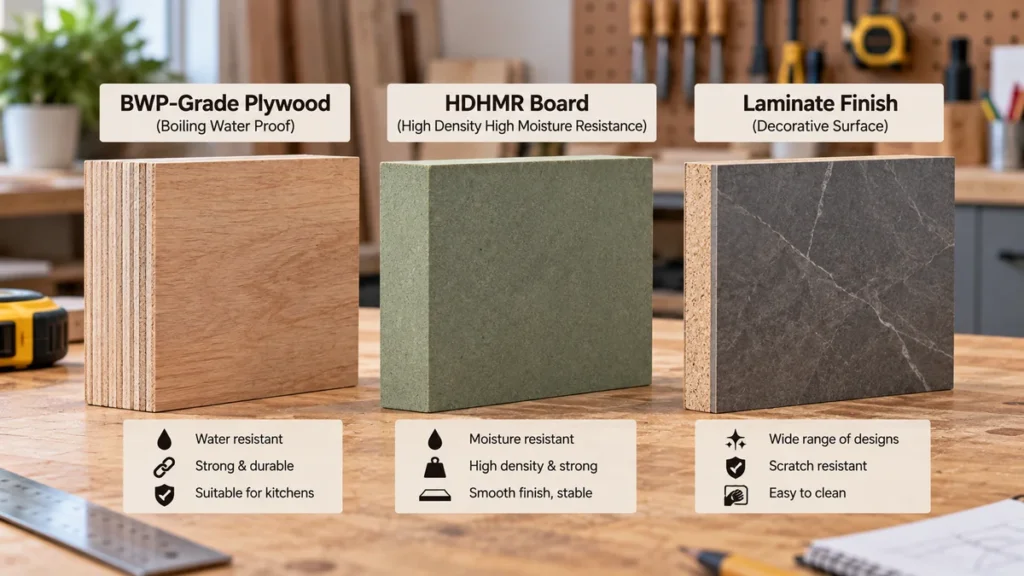
A modular kitchen carcass is typically built from BWP-grade plywood or HDHMR board, both moisture-resistant grades suited to Indian kitchen conditions. Shutters commonly use HPL laminate, acrylic, or PU paint finishes, and countertops are most often granite, chosen for cost and durability together.
BWP-grade plywood, built to the IS:710 boiling-waterproof standard, resists water penetration well. This matters directly under the sink and near the hob, where spills are routine. HDHMR offers a denser, moisture-resistant alternative at a somewhat lower cost. Hardware quality matters as much as the carcass material. Two names worth recognising when comparing quotes are soft-close Hafele hinges and Blum tandem box drawer runners. Unnamed generic hardware wears differently over years of daily use.
What Parts Actually Make Up a Complete Modular Kitchen?
A complete modular kitchen is made of four core parts. These are the carcass (the cabinet box), the shutter (the visible door front), the hardware (hinges, runners, and channels), and the countertop. Each part is typically chosen and priced separately, which is exactly why two kitchens with the same layout can cost noticeably different amounts.
- Carcass, the structural cabinet box behind the doors, usually the largest cost driver
- Shutter, the visible door front, available in laminate, acrylic, PU, or membrane finishes
- Hardware, hinges, drawer runners, and channels, the mechanical parts that see daily wear
- Countertop, typically granite or quartz, priced and chosen independently of the cabinets
Understanding these four parts is what turns a vague “modular kitchen quote” into something you can actually compare across manufacturers. Ask which grade of material backs each part, not just the total price. A manufacturer who can answer this question part by part is usually a more reliable choice than one who only quotes a single bundled number.
Common Misconceptions About What "Modular" Actually Means
The biggest misconception is that “modular” means a specific look, usually glossy, minimal, and handle-less. In reality, modular describes construction method only. A modular kitchen can be built in almost any style, including designs that intentionally look traditional or rustic.
A second common misconception is that modular always costs more than carpenter-built. This depends entirely on material grade and hardware quality chosen, not the construction method itself. A basic modular kitchen with particle board and generic hardware can cost less than an elaborate carpenter-built kitchen using solid teak.
A third misconception treats “semi-modular” and “modular” as interchangeable marketing terms. They describe genuinely different construction splits. If a showroom uses the words loosely, ask them to clarify specifically, per component, which parts are factory-made and which are finished on-site.
When Is a Modular Kitchen NOT the Right Choice?
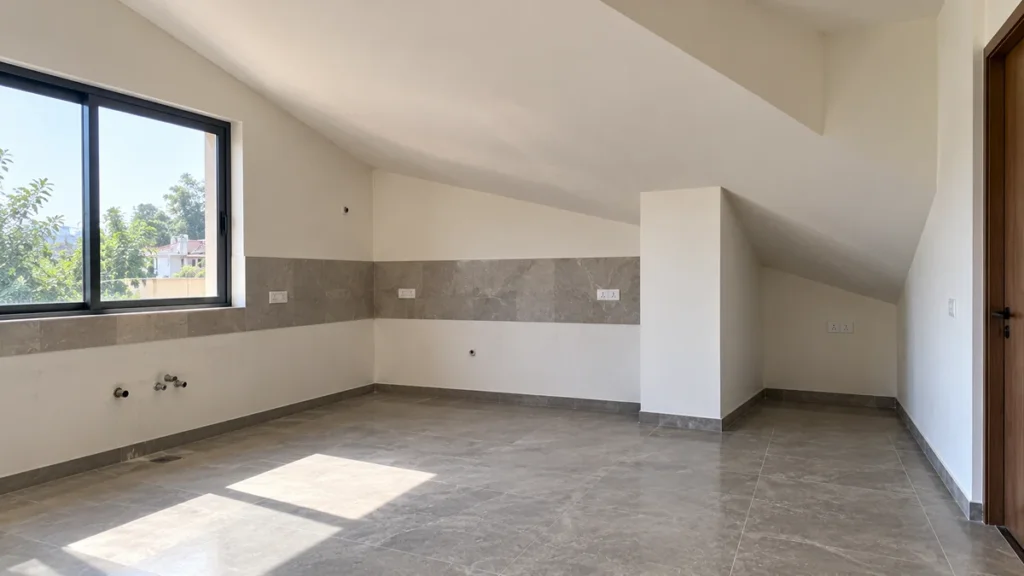
A modular kitchen is not the right choice for a severely irregular space where no standard module size fits cleanly. It is also not ideal for a one-time-use space, like a very short-term rental where the upfront cost cannot be recovered. In these specific situations, a carpenter-built or semi-modular approach can genuinely make more sense.
This is worth naming honestly rather than glossing over. Modular manufacturing depends on standardised dimensions. A kitchen with an unusually sloped wall, an oddly placed structural column, or extremely tight custom corners can sometimes need on-site carpentry. That kind of fix solves what a factory module physically cannot.
How Do You Decide Between Modular, Semi-Modular, and Carpenter-Built?
Decide using three questions. How regular is your kitchen space? Will you use this kitchen for years or just a short stretch? And how much does daily consistency actually matter to you? A straightforward, standard-dimension kitchen used as a primary home for years almost always favours fully modular. A short-term or highly irregular space shifts the decision toward semi-modular or carpenter-built.
If budget is the deciding factor rather than space or timeline, semi-modular is usually the more honest middle ground. Pushing a fully modular quote down to the cheapest possible material grade rarely serves you as well. A lower-grade fully modular kitchen and a well-planned semi-modular kitchen can land at a similar price, with genuinely different trade-offs behind that number.
Not sure which construction type actually fits your space? Bhumim offers a free 3D design consultation, we will assess your kitchen and walk you through modular, semi-modular, and material options honestly, with no obligation. Call or WhatsApp 08044630777 or fill in your details at bhumim.com.
Frequently Asked Questions
A modular kitchen means a kitchen built from factory-made cabinet units, called modules, that are assembled at your home rather than constructed there. The word describes how it is built, not a specific style or price range, and any single module can be replaced without redoing the rest.
A fully modular kitchen has all units factory-manufactured, while a semi-modular kitchen combines factory units with on-site carpentry for finishing or custom sections. Semi-modular typically costs 10 to 15 percent less but trades away some of the consistency a fully modular kitchen offers.
Not always. Cost depends on material grade and hardware quality chosen, not the construction method itself. A basic modular kitchen with standard materials can cost less than an elaborate carpenter-built kitchen using premium hardwood and custom joinery.
The four real construction types are fully modular, semi-modular, ready-to-assemble (RTA/knockdown), and fully carpenter-built. This differs from layout types like L-shaped or U-shaped, which describe arrangement, not how the kitchen is actually built.
To a point, yes, but severely irregular spaces, a sloped ceiling or an unusually placed structural column, can exceed what standardised modules handle cleanly. For these specific cases, semi-modular or fully carpenter-built construction is often the more practical choice.
A complete modular kitchen has four core parts: the carcass (cabinet box), the shutter (visible door front), the hardware (hinges and drawer runners), and the countertop. Each part is priced and chosen separately, which is why total quotes vary so much between manufacturers.
Choose modular for a standard-dimension kitchen you plan to use as your primary home for years, since factory consistency and easy repairs matter most there. Choose carpenter-built or semi-modular for a highly irregular space where standard modules genuinely cannot fit.
Most modular kitchen installations complete on-site fitting in 7 to 12 working days once the cabinets arrive, considerably faster than a fully carpenter-built kitchen, which can take 3 to 6 weeks of continuous on-site work.
It is worth it if you value consistent finish quality and plan to use the kitchen daily for years, since fully modular kitchens go through the same factory quality control across every unit. For a tighter budget or short-term use, semi-modular is a reasonable trade-off.
Call or WhatsApp Bhumim at 08044630777, or fill in your details at bhumim.com/contact. A team member will confirm your city, assess your space, and typically schedule a free 3D design consultation within 3 to 5 working days. There is no fee and no obligation at the consultation stage.
Key Takeaways
- “Modular” describes construction method, factory-made interchangeable units, not a specific look, style, or price tier.
- The real types are construction-based: fully modular, semi-modular, RTA/knockdown, and carpenter-built, a different axis from layout types like L-shaped or U-shaped.
- A modular kitchen differs from carpenter-built mainly in consistency, installation speed, and how repairs happen, replacing one module versus reworking surrounding joinery.
- Semi-modular typically costs 10-15% less than fully modular but trades away some construction consistency.
- Severely irregular spaces or short-term-use kitchens are the genuine cases where modular is not the right choice.
Conclusion
Coming back to that showroom-photo confusion from the start: “modular” was never about how glossy a kitchen looks. It is about whether the kitchen in front of you was built from separate factory units or constructed on-site as one piece, a distinction worth understanding before comparing a single quote.
If you would like help deciding between modular, semi-modular, and carpenter-built for your actual space, Bhumim’s team can walk you through the honest trade-offs in a free 3D design consultation, serving Dehradun, Haridwar, Rishikesh, Roorkee, Noida, and Ghaziabad. Call or WhatsApp 08044630777, fill in your details at bhumim.com/contact, or find our Dehradun showroom on Google Maps.
About This Article
Published by: Bhumim India Private Limited-Modular Kitchen Manufacturer & Installer, Dehradun
GST: 05AAOCB1784F1ZM | ISO 9001:2015 Certified
Service Areas: Dehradun · Haridwar · Rishikesh · Roorkee · Noida · Ghaziabad
Contact: 08044630777 | hello@bhumim.com
Note: This article is written from Bhumim’s on-ground manufacturing and installation experience. All material recommendations are based on what we use in real kitchens across our service areas.