

Modular Kitchen Showroom Visit: 10 Questions to Ask Before You Buy
A modular kitchen showroom checklist should cover ten questions before you sign anything. Ask what you are actually getting versus the display model, who manufactures it, which hardware brand is used, and the full written price breakdown. Then confirm warranty by component, the installation timeline in writing, and sample finishes in daylight. Finally, check real customisation limits, mid-project change costs, and a genuine multi-year installed kitchen you can inspect.
A showroom visit is where most modular kitchen decisions actually get made, often within a single conversation. Showroom lighting, display units, and a confident sales pitch are built to make every kitchen look finished and every promise sound solid. Asking the right questions, in the right order, is what separates a showroom visit that protects you from one that just sells you.
Why the Showroom Visit Decides More Than People Realise
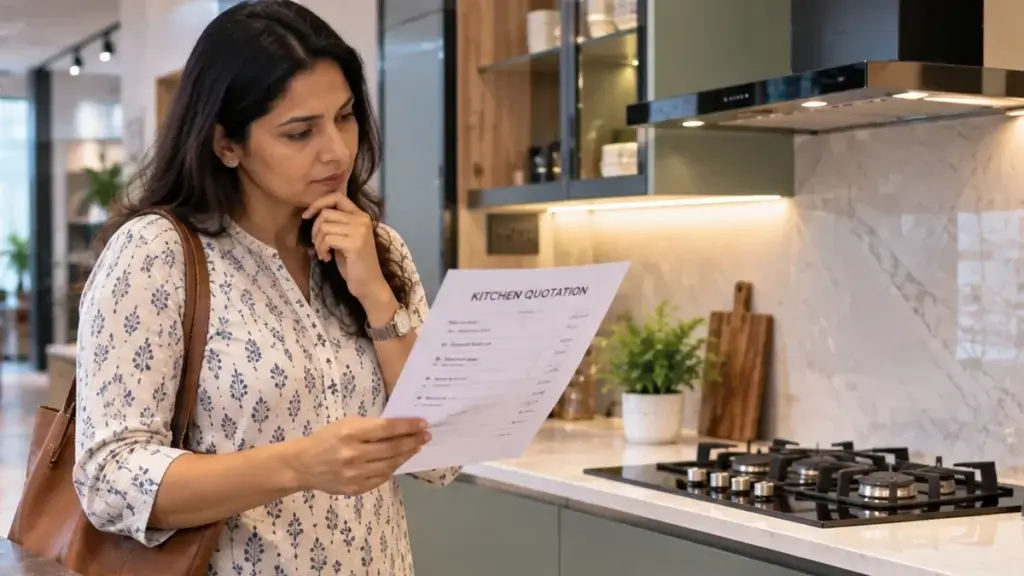
After walking Dehradun and Noida homeowners through showroom visits for years, the same pattern shows up constantly. Someone falls in love with a display kitchen, asks a handful of style questions, and signs a quotation within the hour. Then three months later, the actual delivered kitchen looks nothing like what they remember from the showroom floor.
That gap is rarely dishonesty. It is usually a mismatch between what a display model is built to show and what a real, budget-matched kitchen actually includes. As of 2026, this gap has only widened as showroom displays lean further toward aspirational finishes that few buyers actually order. This guide walks through the ten questions worth asking before you commit, in the order that actually protects you.
If you are still comparing manufacturers on more than a single showroom visit, our modular kitchen buying guide checklist is worth reading first. It covers the wider pre-purchase process, layout planning, and material comparisons this article assumes you have already started.
Question 1: Is This Exact Unit What I Am Getting, or Just a Display Model?
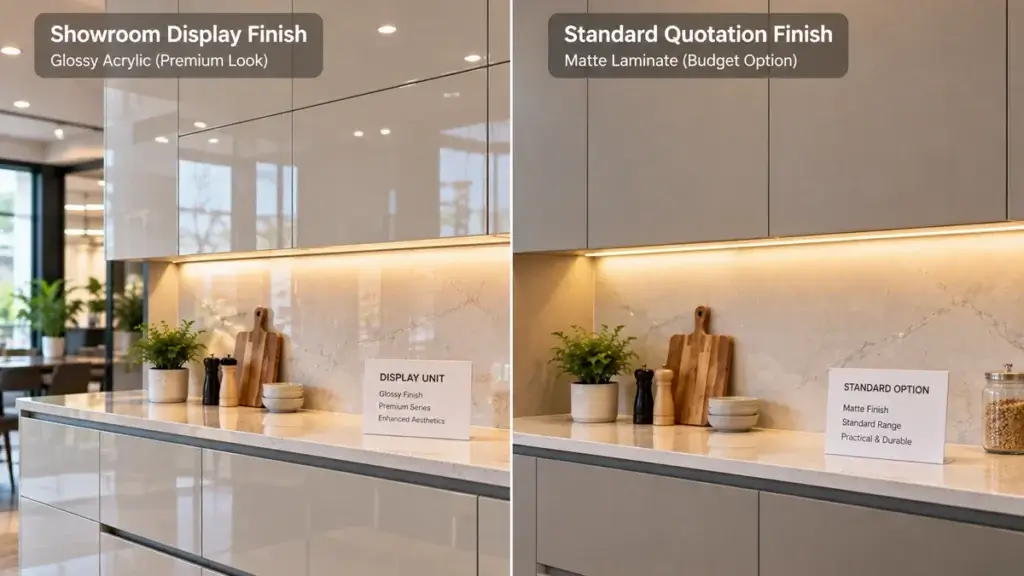
Ask this before anything else, because it reframes every other question that follows. Most showroom display kitchens use higher-grade finishes, upgraded hardware, and better lighting than a standard-budget order. A manufacturer showing you an acrylic-finish, soft-close-everywhere display while quoting a laminate-finish kitchen is not being dishonest, just optimistic in what they show you.
A direct answer names the exact material grade, finish type, and hardware brand behind your specific quote, not the display unit’s specs. If a salesperson answers this vaguely, that vagueness is itself useful information.
Get started with Beautiful Homes
For expert design consultation, send us your details and we’ll schedule a call
Question 2: Who Actually Manufactures This, In-House or Outsourced?
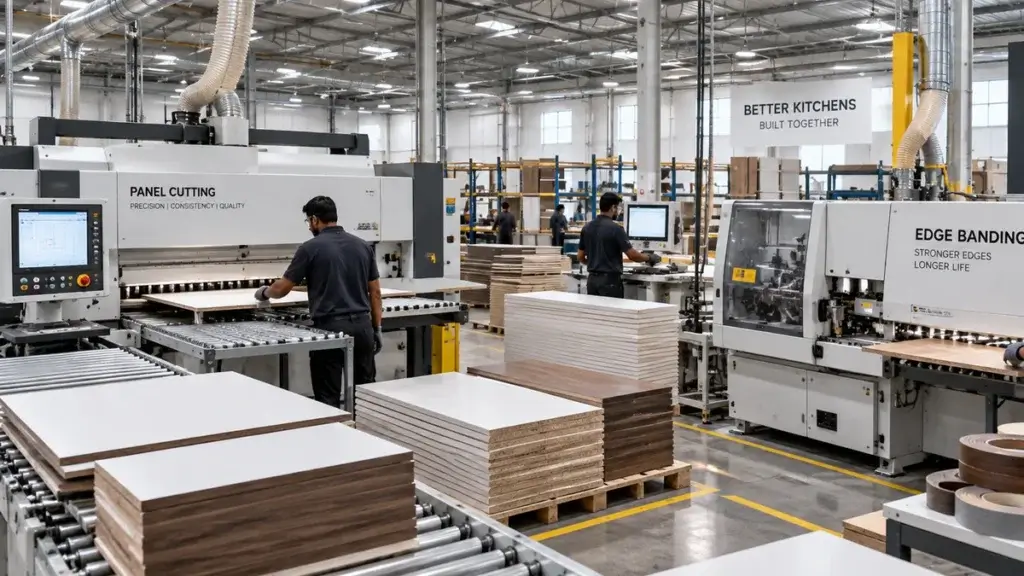
A manufacturer who builds in-house controls material sourcing, quality control, and timeline far more reliably than one outsourcing to third-party carpenters or a franchise network. This single question predicts your after-sales experience better than almost anything else discussed in a showroom.
A franchise reseller can still deliver a good kitchen. Responsibility for defects and delays gets split between the local showroom and the parent brand’s factory, though, which can slow down resolution. Ask specifically where the factory is located and whether the showroom staff can name it without hesitation.
This question also matters for a reason most buyers miss: whether the kitchen is genuinely modular at all. Our guide to what modular kitchen actually means explains how construction method, not the showroom pitch, is what actually decides that.
Question 3: What Hardware Brand Is Used, and Can You Name It?
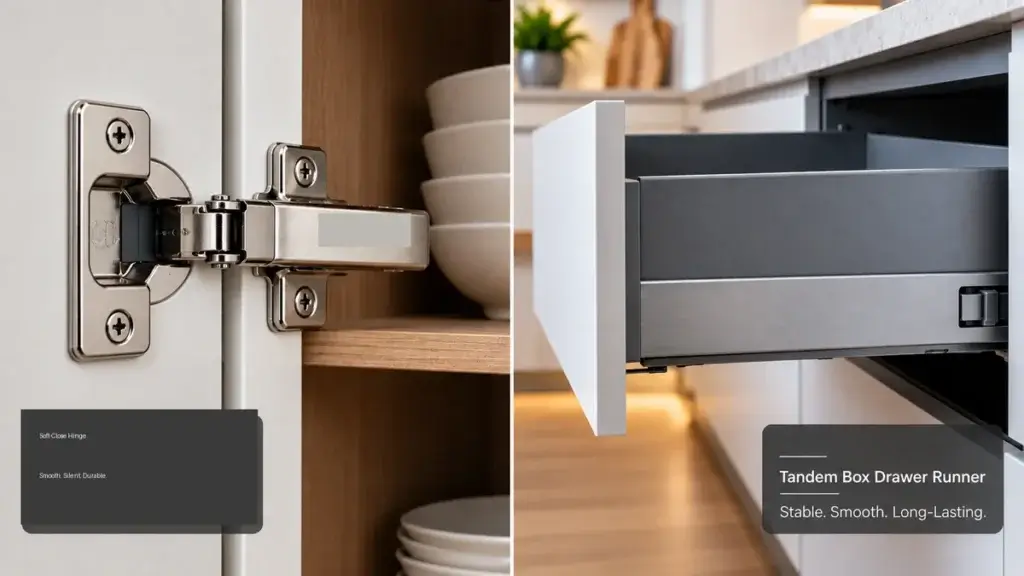
Ask for the specific hardware brand behind the hinges and drawer runners, not a generic “branded hardware” answer. Soft-close hinges from an established brand and unnamed generic hinges can look identical in a showroom demo. They behave very differently after two years of daily use, though, when the soft-close mechanism starts to matter most.
Hafele soft-close hinges and Blum tandem box drawer runners are two names worth listening for specifically. They represent a recognisable quality tier in the Indian modular kitchen market that both readers and showroom staff can verify independently. A written quotation that says “branded hardware” without naming the brand is worth pushing back on before you sign.
Also ask how many years the hardware itself is expected to function smoothly under normal daily use, separate from the warranty period. A hinge that stiffens after a year of ordinary opening and closing is a genuine quality signal. So is a drawer runner that starts to stick. Weigh both before you commit to any showroom’s quote.
Question 4: What Is the Full, Written Price Breakdown?
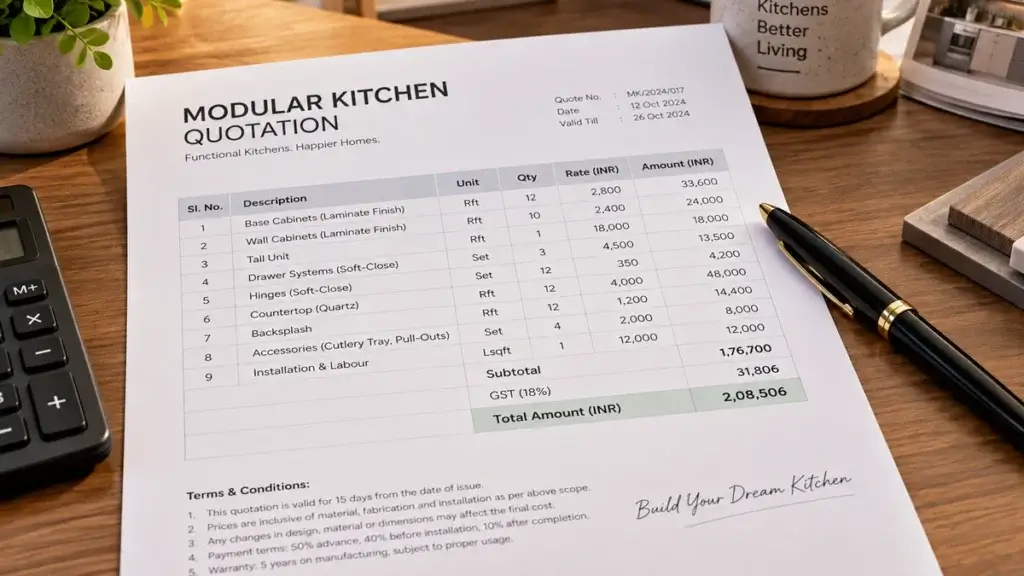
Ask for an itemised quotation covering cabinet boxes, shutters, hardware, countertop, installation labour, and any appliances, not a single lump-sum figure. A single-line quote is one of the clearest showroom red flags, since it hides exactly which category absorbs a later price increase if something changes.
For most Bhumim kitchens, cabinets typically make up around 60 percent of the real total, with countertop, installation, and accessories filling the rest. Ask the showroom to break their own quote down the same way, and compare that structure across manufacturers rather than comparing only the bottom-line number.
Also ask whether the price includes plumbing or electrical modifications, since these are commonly billed separately once the installation team is already on-site. Discovering an extra charge mid-installation is a far weaker negotiating position. Asking about it at the showroom, while you still have other options and full price transparency, protects you instead.
Quote Category | What to Confirm in Writing |
Cabinets | Material grade and running-foot rate, not just a total |
Shutters and finish | Finish type and whether it matches the sample shown |
Hardware | Named brand for hinges and drawer runners |
Installation | Whether labour is included or billed separately |
Appliances | Whether chimney, hob, or oven are quoted separately |
Question 5: What Warranty Applies to Which Component?
Ask the showroom to name the warranty duration for the cabinet carcass, shutters, and hardware separately, since these rarely share one number. A “10-year warranty” claim usually applies only to the carcass in a specific material grade, while shutters and hardware often carry their own, shorter terms.
Warranty terms and coverage vary by product category and material grade, so confirm current terms directly with whichever manufacturer you are considering. Our modular kitchen warranty guide breaks down exactly what a warranty claim typically covers. It also lists the specific exclusions almost every manufacturer applies, so you know precisely what to ask for in writing at the showroom.
Also ask what a “lifetime warranty” claim actually applies to, if a showroom uses that phrase. There is no universal definition of lifetime for a modular kitchen in India. The term can mean the whole kitchen or just one hardware component. It depends entirely on the manufacturer’s own written document, so push for that document before you leave.

Question 6: What Is the Actual Installation Timeline, in Writing?
Ask for a stage-by-stage timeline covering measurement, manufacturing, and installation. Do not accept a single vague number like “a few weeks,” even if it sounds reassuring in the moment. A dependable manufacturer can usually name each stage’s duration on the spot, since they control and schedule their own factory production.
Most Bhumim modular kitchens complete on-site installation in 7 to 12 working days once the cabinets arrive. The full process from measurement to handover typically runs 30 to 60 days, depending on layout complexity. Our modular kitchen installation timeline guide breaks this down stage by stage. Read it before your visit, so you know exactly what a realistic written schedule should look like before the showroom hands you one.

Question 7: Can I See This Finish in Daylight, Not Just Showroom Lighting?
Ask for a physical sample swatch you can take home, especially for high-gloss acrylic or dark finishes. Showroom lighting is deliberately warm and directional. It consistently makes finishes look richer and more even than they appear under your own kitchen’s natural or tube lighting.
This matters more for darker colours and glossy surfaces. Scratches, fingerprints, and colour shifts under daylight are far more visible than under a showroom’s curated spotlighting. A manufacturer confident in their finish will hand over a sample without hesitation.
Take the sample to the actual room where the kitchen will go, not just any window at home. A north-facing kitchen in a Noida high-rise catches different light than a south-facing kitchen in a Dehradun bungalow. The same finish can read noticeably warmer or cooler, depending entirely on which direction your own kitchen faces.
Question 8: Can This Layout Actually Be Customised to My Space?
Ask whether the showroom measures your actual kitchen before finalising a layout, or simply fits your space into their nearest catalogue template. A manufacturer who insists on a site visit is protecting you from a real risk. Cabinets manufactured to the wrong dimensions become an expensive mismatch to discover after delivery.
Catalogue layouts are a reasonable starting point for browsing ideas. Every real kitchen has a window position, a door swing, or a plumbing point a generic template does not account for, though. Push for a specific answer on whether site measurement happens before or after you pay any advance.
A hill-facing flat in Dehradun or Rishikesh often has less standard wall geometry than a newer builder flat in Noida or Ghaziabad. This makes this question especially relevant if you live in one of the older or hill-station-adjacent properties across Bhumim’s service area. A showroom that treats every layout as interchangeable, regardless of your city or building type, is worth a second look.
Question 9: What Happens If I Need a Design Change Mid-Project?
Ask this before signing. It is the single most commonly skipped question in a showroom visit, and the one that causes the most frustration later. A design change requested after manufacturing has started usually means re-manufacturing the affected cabinets, adding real weeks to the timeline.
Honest limitation: No manufacturer can absorb a mid-project design change for free once cabinets are already cut. What varies is transparency. Ask specifically what a change costs and how many extra days it adds, in writing, rather than accepting a vague “we’ll work something out” answer. Decide on layout, material, and appliances before requesting a final quote, not during manufacturing. That single habit is the most effective way to avoid needing this question at all.
Question 10: Can I See a Kitchen You Installed Two or Three Years Ago?
Ask to visit or video-call a real customer’s kitchen installed several years earlier. Do not settle for a showroom display or a recent installation still under its honeymoon period. This is the single most revealing question on this list, since it tests durability claims against real daily use rather than a sales pitch.
A manufacturer confident in their material and hardware choices will usually arrange this without much resistance. Sometimes it happens through existing customers who are happy to share their experience directly. Hesitation or a flat refusal here is worth weighing seriously against everything else discussed in the showroom.
If an in-person visit is not practical, a short video call with the homeowner walking through their kitchen is a reasonable substitute. Look for honest wear: hinges that still close smoothly, a countertop that has not stained, shutters that have not swollen at the edges. A kitchen that still looks and functions well after real years of use tells you far more than any showroom display ever could.
How Do You Fairly Compare Two Showrooms Against Each Other?
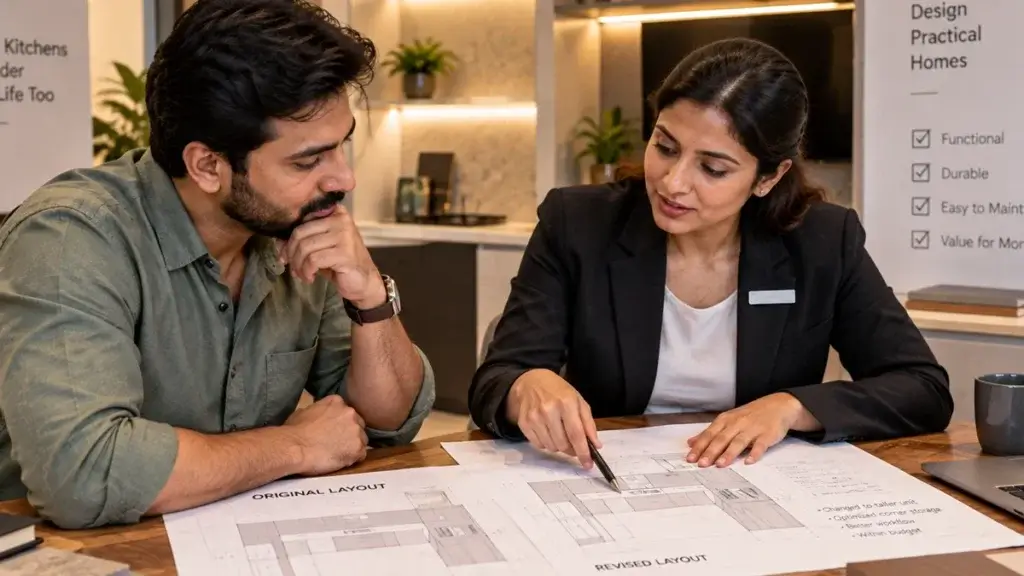
Compare two showrooms fairly by asking all ten questions above at both visits. Then line up the answers side by side, rather than comparing only the final quoted price. A lower number from one showroom means very little on its own. It could come from a thinner material grade, an unnamed hardware brand, or a shorter warranty term.
Write down each showroom’s answer to the same question in the same column. This turns a subjective “which one felt better” decision into an objective, line-by-line comparison. It also exposes which showrooms answer specifically and which stay vague. That gap is itself useful information about how each one will handle problems after you have paid.
Comparison Point | Showroom A | Showroom B |
Carcass material grade | Fill in from visit | Fill in from visit |
Named hardware brand | Fill in from visit | Fill in from visit |
Warranty by component | Fill in from visit | Fill in from visit |
Installation timeline (days) | Fill in from visit | Fill in from visit |
Total itemised price | Fill in from visit | Fill in from visit |
Two showrooms quoting a similar total price can still represent very different value once you fill in this table honestly. The one with a named hardware brand and a component-specific warranty is usually the safer choice. A written timeline matters too, even if its headline number is a few thousand rupees higher.
Visiting a third showroom rarely changes the outcome once two comparisons are filled in honestly. It mostly adds fatigue rather than fresh information. Two thorough, well-documented visits almost always beat three rushed ones. They leave you with a clearer decision, not a longer list of half-remembered promises.
Quick Reference: All 10 Questions Before You Sign
Bring this list with you rather than trying to remember it mid-conversation. Showrooms tend to give sharper, more specific answers this way. They respond differently when they can see the actual questions written down. Fielding them from memory alone tends to produce vaguer, more general answers instead.
- Is this exact unit what I am getting, or just a display model?
- Who actually manufactures this, in-house or outsourced?
- What hardware brand is used, and can you name it?
- What is the full, written price breakdown?
- What warranty applies to which component?
- What is the actual installation timeline, in writing?
- Can I see this finish in daylight, not just showroom lighting?
- Can this layout actually be customised to my space?
- What happens if I need a design change mid-project?
- Can I see a kitchen you installed two or three years ago?
Want these questions answered before you even visit? Bhumim offers a free 3D design consultation, we will walk you through material, hardware, and timeline specifics for your actual kitchen, with no obligation. Call or WhatsApp 08044630777 or fill in your details at bhumim.com.
Frequently Asked Questions
Ask about the exact material and finish behind your quote (not the display model), who manufactures it, the named hardware brand, a written itemised price, warranty by component, the installation timeline, and whether you can see a kitchen installed several years ago. These ten questions catch most showroom-to-delivery mismatches.
Not always. Showroom display units often use higher-grade finishes and upgraded hardware to look their best. Always confirm the exact material grade, finish, and hardware brand behind your specific quote, not the display unit’s specifications.
Ask directly where the factory is located and whether the showroom staff can name it without hesitation. A manufacturer who builds in-house can usually answer this immediately, while an outsourced or franchise reseller often gives a vaguer response.
Yes, always. Ask for an itemised quotation covering cabinets, shutters, hardware, countertop, and installation labour separately. A single-line total price is one of the clearest showroom red flags, since it hides which category could increase later.
Yes, and you should. Asking to visit or video-call a real customer’s kitchen installed two or three years earlier tests durability claims against actual daily use, not a showroom display or a recent installation still in its early months.
A design change after manufacturing starts usually means re-manufacturing the affected cabinets, adding real weeks to your timeline. Ask upfront what a change costs and how many days it adds, in writing, rather than accepting a vague verbal answer.
Yes, comparing at least two showrooms using the same ten questions is the only way to know if a price or promise is actually competitive. A single visit rarely gives enough context to judge whether a quote is reasonable.
A thorough visit covering all ten questions, material samples, and a written quote discussion typically takes 45 minutes to an hour. Rushing through in 15 minutes usually means skipping the questions that matter most.
Most manufacturers can adapt a catalogue layout, but confirm whether they measure your actual space before finalising the design. A layout fitted to a generic template without a site visit risks mismatches discovered only after cabinets are manufactured.
Call or WhatsApp Bhumim at 08044630777, or fill in your details at bhumim.com/contact. A team member will confirm your city and typically schedule a free 3D design consultation within 3 to 5 working days, with no fee or obligation at the consultation stage.
Key Takeaways
- Always confirm the exact material, finish, and hardware brand behind your specific quote, not the showroom display unit’s specifications.
- Ask for an itemised, written price breakdown and a stage-by-stage installation timeline, never a single lump-sum figure or a vague verbal promise.
- Warranty terms almost always differ by component (carcass, shutters, hardware), so ask for each one separately rather than accepting one headline number.
- Asking to see a kitchen installed two or three years ago is the single most revealing question, since it tests real durability rather than a sales pitch.
- Bring these ten questions in writing to your visit, vendors tend to give sharper, more specific answers when they can see the question in front of them.
Conclusion
Coming back to that showroom-to-delivery gap from the start: it almost never happens because a manufacturer lied. It happens because the ten questions above never got asked before the quotation got signed. Ask them in order, get every answer in writing, and that gap mostly disappears before it ever has a chance to become an installation-day surprise.
If you would like these questions answered honestly before you even walk into a showroom, Bhumim’s team can walk you through material, hardware, warranty, and timeline specifics in a free 3D design consultation, serving Dehradun, Haridwar, Rishikesh, Roorkee, Noida, and Ghaziabad. Call or WhatsApp 08044630777, fill in your details at bhumim.com/contact, or find our Dehradun showroom on Google Maps.
About This Article
Published by: Bhumim India Private Limited-Modular Kitchen Manufacturer & Installer, Dehradun
GST: 05AAOCB1784F1ZM | ISO 9001:2015 Certified
Service Areas: Dehradun · Haridwar · Rishikesh · Roorkee · Noida · Ghaziabad
Contact: 08044630777 | hello@bhumim.com
Note: This article is written from Bhumim’s on-ground manufacturing and installation experience. All material recommendations are based on what we use in real kitchens across our service areas.