

Best Plywood for Modular Kitchen Dehradun: MDF vs BWP vs HDMR
The best plywood for a modular kitchen in Dehradun is BWP-grade plywood (IS 710) for base cabinets and wet zones, and HDMR board for shutters and dry wall units. Standard MDF should be avoided in kitchen interiors. Each material has a specific zone-using the wrong one is one of the most common and costly mistakes homeowners make.
What is BWP plywood?
It stands for Boiling Water Proof, and it conforms to IS 710-India’s Bureau of Indian Standards certification for truly waterproof plywood. It is made by bonding thin wood veneers with phenol-formaldehyde resin under high pressure. HDMR (High-Density Moisture Resistant) board is an engineered panel made from compressed wood fibers treated with moisture-resistant resin-stronger than MDF but not as waterproof as BWP plywood. MDF (Medium Density Fiberboard) is the most affordable of the three, but absorbs moisture irreversibly when exposed to kitchen conditions.
After Three Monsoons, What Holds Up in a Dehradun Kitchen?
After working on modular kitchens across Dehradun, Haridwar, and Noida-in hill-facing flats near Rajpur Road, compact apartments in Jogiwala, and spacious homes in Sahastradhara-the one question that comes up more than any design question is about material.
Not which colour. Not which finish. Not even which layout. It is: what is this cabinet actually made of?
And in Dehradun specifically, this question matters more than most vendors will tell you upfront. The city sits at over 2,000 feet in the Himalayan foothills. Monsoon humidity between July and September regularly exceeds 80%. Steam from Indian cooking-pressure cookers, boiling dals, simmering curries-adds to the moisture load every single day. After three monsoons, kitchens built with the wrong board show it: swollen base cabinets, delaminating shutters, hinges pulling loose from softened edges.
This guide explains the three materials-MDF, BWP plywood, and HDMR board-so you can walk into any showroom or vendor meeting knowing exactly what to ask for, and exactly what to reject.
Why Material Choice Matters More Than Design in a Modular Kitchen
Most homeowners plan their kitchen around finishes and layouts, which is entirely reasonable-those are the things you see. However, the structure underneath those finishes, the carcass (the actual box of each cabinet), is what determines whether a kitchen lasts five years or twenty-five.
A modular kitchen design is only as durable as the material it is built with. Furthermore, kitchens are the most demanding environment for wood-based materials in any home. They face:
- Daily steam and heat from cooking, especially with Indian gas hobs and pressure cookers
- Water splashes near the sink and dishwasher zone
- Humidity cycles-especially critical in Dehradun during the monsoon months
- Mechanical stress-doors opened and shut dozens of times each day, drawers bearing the weight of heavy utensils
Because of these demands, the material that works well in a wardrobe or TV unit will not automatically hold up in a kitchen. This distinction is one reason the modular kitchen buying guide places material verification as one of the top five decisions you must get right before signing any contract.
What Happens When the Wrong Board Meets Dehradun's Humidity
Standard MDF and lower-grade boards absorb moisture through their cut edges. Once this happens, the fiber swells outward-permanently. In a Dehradun kitchen, this typically first appears in the base cabinets under the sink, or in the carcass of the cabinet directly beside the hob. The laminate on the face looks fine, but inside, the board has already started to deteriorate. By the second monsoon, the swelling pushes against hinges and drawer channels, causing doors to misalign and drawer runners to stick. By the third, the carcass may need full replacement-which means redoing a significant portion of the kitchen.
This is avoidable. The answer lies in understanding what each material is genuinely designed to do.
BWP Plywood-The Gold Standard for Wet Zones
BWP stands for Boiling Water Proof. It is made by bonding multiple thin layers of wood veneer together using phenol-formaldehyde (PF) resin-the same type of resin used in outdoor and marine applications. The IS 710 standard requires that the board withstand immersion in boiling water for 72 hours without delamination. No engineered board-including HDMR-matches this specification.
For modular kitchen base cabinets, particularly those near the sink, beside the hob, or below a dishwasher, BWP plywood is the correct material and nothing else substitutes for it.
Key properties of BWP plywood:
- Genuinely waterproof (not just moisture resistant)
- Superior screw-holding strength-hinges and drawer runners stay fixed over years of use
- Handles heavy loads-base cabinets carrying utensils, appliances, and cookware
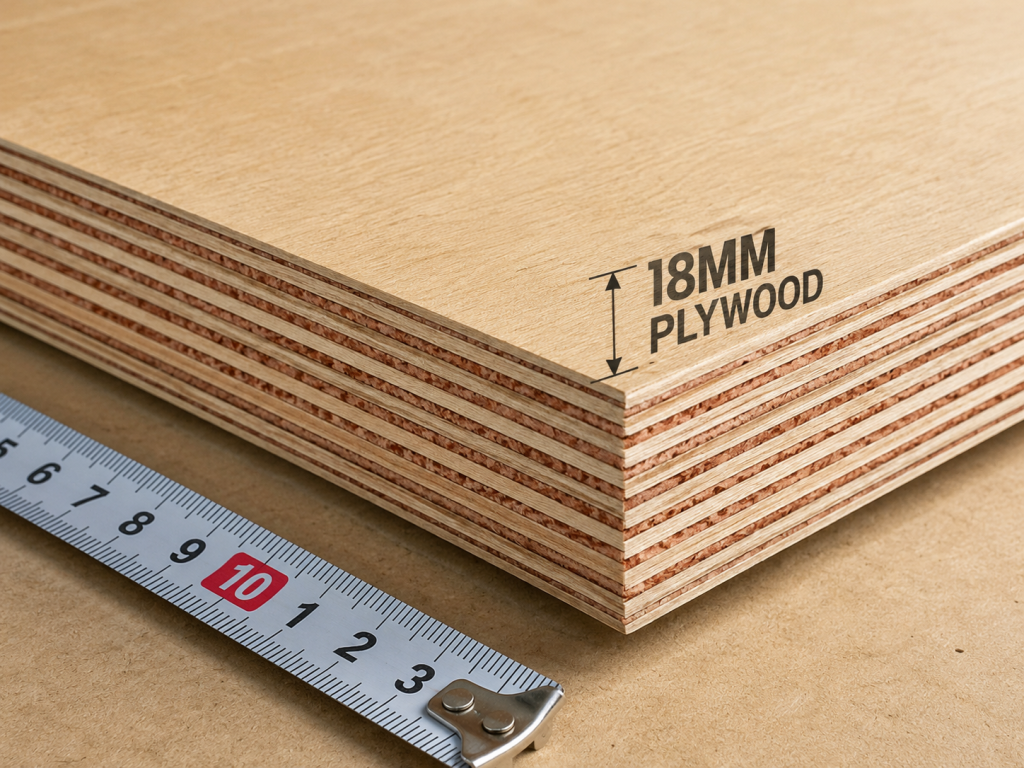
- Available in 12mm and 18mm thickness; 18mm is standard for base cabinet carcasses
- More expensive than HDMR and significantly more expensive than MDF
How to Verify Genuine IS 710 BWP Plywood Before Buying
Market availability of fake IS marks is a known problem in India. Before accepting any plywood sheet claimed to be BWP, run these checks:
- Look for the IS 710 stamp from BIS (Bureau of Indian Standards) on the sheet face or edge
- Examine the edge glue line-genuine BWP plywood bonded with PF resin shows a dark reddish-brown adhesive line; lighter or yellowish glue indicates lower-grade (BWR or MR) plywood
- Count the ply layers on the edge-a genuine 18mm BWP sheet should have 13 to 15 layers
- Ask for a GST bill with the IS certification number; reputable suppliers provide this
Additionally, ask your kitchen vendor to specify the plywood brand in writing in the quotation. This protects you if a substitution is made during manufacturing.
Where to Use BWP Plywood in a Dehradun Kitchen
Use BWP-grade plywood for:
- All base cabinet carcasses (floor-level cabinets)
- Under-sink unit (this takes the most water exposure)
- Dishwasher zone (if applicable)
- Any cabinet in contact with the floor-Dehradun’s monsoon season brings mopping water and occasional seepage
HDMR Board-The Smart Middle Ground for Shutters and Dry Zones
HDMR (High-Density Moisture Resistant) board is an engineered panel made from compressed wood fibers bonded with moisture-resistant resin. It is denser than standard MDF-typically 800 to 900 kg/m³ versus 650 to 700 kg/m³ for regular MDF-and it handles humidity far better. However, it is not waterproof. If submerged or exposed to standing water at its cut edges, HDMR will eventually swell.
That distinction defines exactly where HDMR belongs in a kitchen: on parts that face moisture and heat indirectly, but never in contact with water.
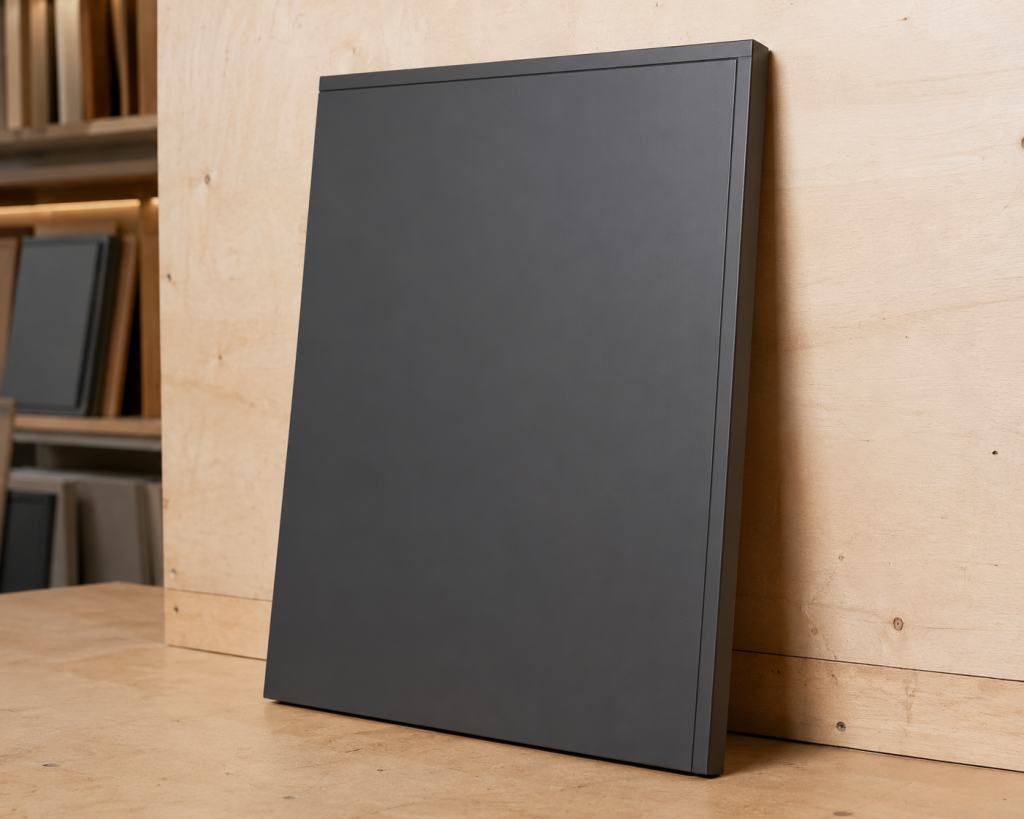
HDMR’s real advantage is its surface quality. Because it is made from fine, uniform fibers with no visible grain, it takes laminates, acrylic, PU paint, and membrane-press finishes far more smoothly than plywood. As a result, shutters (cabinet doors) and drawer fronts built from HDMR produce a cleaner, more consistent finish-especially in high-gloss, matte, or fluted designs that are popular in 2025–2026 kitchen aesthetics.
Furthermore, HDMR is easier to machine with CNC equipment, which allows for precision cuts and routing that create the clean, modern profiles common in contemporary modular kitchens in Dehradun and Noida.
HDMR vs MDF: Why the Difference Matters for Kitchen Shutters
Many vendors label HDMR and MDF interchangeably on quotations. They are not the same. The density difference of roughly 150–200 kg/m³ translates directly into moisture resistance: HDMR uses moisture-resistant resin at the bonding stage, while standard MDF uses urea-formaldehyde, which breaks down in humid conditions. Ask your vendor specifically whether the shutter substrate is HDMR (High-Density Moisture Resistant) or standard MDF, and request the IS 12406 certification number for the board. The price difference between genuine HDMR and MDF is typically ₹15–25 per sq ft; if a quote prices them the same, question what you are actually getting.
Where HDMR Works-and Where It Doesn't
Use HDMR for:
- Kitchen shutters (cabinet doors and drawer fronts)
- Wall-mounted overhead cabinets (dry zone, no floor or water contact)
- Decorative panels and fluted finish applications
- Wardrobe carcasses and shutters (not in kitchens-in bedrooms)
Do not use HDMR for:
- Base cabinet carcasses (especially near sink or hob)
- Any zone with direct water exposure
- Floor-touching cabinets in areas with mopping or seepage risk
MDF-When It's Acceptable and When to Walk Away
Standard MDF is the most widely available engineered board in India. It is smooth, easy to work with, affordable, and excellent for dry, interior decorative applications. In modular furniture, MDF is commonly used for panels in TV units, bookshelves, and bedroom furniture-areas that see very little moisture.
In a kitchen? The rules are strict. MDF is acceptable for:
- Decorative panels in completely dry overhead sections (well away from steam)
- Kitchen cabinets in dry storage areas-a pantry tall unit that stores only dry goods, sealed from cooking zones
MDF should be firmly rejected for:
- Base cabinet carcasses anywhere in the kitchen
- Any cabinet near the sink, hob, or floor
- Shutters in high-steam cooking zones
If a vendor’s quotation uses the phrase “marine ply shutters” but specifies “MDF carcass,” that is a combination worth questioning carefully. The carcass carries the structural load and faces the most moisture-precisely where MDF performs worst. Common kitchen design mistakes often start with accepting a vendor’s material specification without verifying what each material is actually used for.
MDF vs BWP vs HDMR-Side-by-Side Comparison
Feature | MDF | HDMR | BWP Plywood (IS 710) |
Moisture Resistance | Poor-swells when wet | Good-handles humidity, not submersion | Excellent-waterproof |
Screw Holding | Weak at edges | Moderate | Strong-hinges stay fixed |
Surface Finish | Smooth, excellent for paint | Very smooth, best for high-gloss laminate | Textured grain-requires laminate overlay |
Structural Strength | Moderate | Good | Excellent |
Weight | Heavy | Heavy | Moderate |
CNC Machinability | Good | Excellent | Good |
Cost (relative) | Lowest | Mid-range | Highest |
Best Use in Kitchen | Dry decorative panels only | Shutters, wall cabinets | All base cabinets, wet zones |
IS Standard | IS 12406 (standard MDF) | IS 12406 (high-density variant) | IS 710 |
Verdict for Dehradun | Avoid in kitchen | Ideal for shutters and dry units | Mandatory for base carcasses |
Zone-Wise Material Recommendation for Dehradun Kitchens
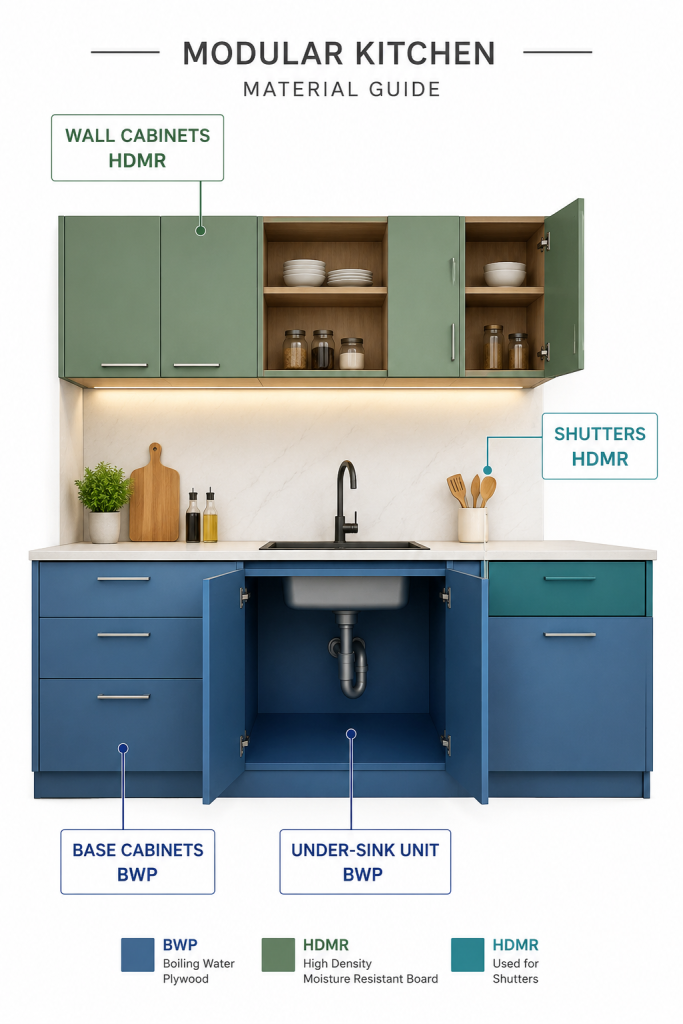
The most durable approach to a modular kitchen is not picking one material for everything-it is using the right material for each zone. Below is a clear breakdown:
Zone 1-Base Cabinets (Floor Level)
Use 18mm BWP plywood (IS 710). These cabinets sit closest to the floor, which means mopping water, drain condensation, and monsoon humidity all accumulate here first. There is no compromise on this zone.
Zone 2-Under-Sink Cabinet
Use 18mm BWP plywood (IS 710). This is the highest-risk zone in any kitchen. Pipe condensation, drain leaks, and daily cleaning splashes make BWP non-negotiable here.
Zone 3-Wall-Mounted Overhead Cabinets
Use 18mm HDMR or 18mm BWP plywood. These cabinets sit above counter level, see steam but rarely direct water. HDMR is a cost-effective choice here when properly edge-banded.
Zone 4-Shutters (All Cabinet Doors and Drawer Fronts)
Use 18mm HDMR board. The smooth, uniform surface takes laminate, acrylic, and PU paint finishes better than plywood, and it handles steam and daily cleaning without warping.
Zone 5-Tall Pantry Units and Dry Storage Columns
Use HDMR or BWP plywood based on proximity to cooking zone. If directly beside the hob, use BWP. If placed away from the cooking triangle, HDMR is appropriate.
For small kitchen designs in compact Dehradun apartments-where every cabinet is closer to every moisture source-defaulting to BWP for all carcasses and HDMR for shutters is the cleaner and more protective choice.
What to Check Before You Sign Any Kitchen Quotation
Before committing to a vendor, ask for the material specification in writing-not just the brand name of the kitchen, but the specific board for each part. A proper specification should read something like: “Base carcass: 18mm BWP plywood IS 710; Shutters: 18mm HDMR IS 12406 with edge banding; Back panel: 9mm BWR plywood IS 303.”
If a quotation says only “marine ply” or “premium board” without the IS certification number, those are not verifiable claims. Additionally, look for these specifics in any modular kitchen accessories and storage planning discussion-the hardware quality (drawer runners, hinges) is directly related to whether the board it is fixed to will hold.
IS Certification Stamps to Look for on Every Sheet
Material | IS Standard | What It Means |
BWP Plywood | IS 710 | Boiling water proof-truly waterproof |
BWR Plywood | IS 303 | Boiling water resistant-moisture resistant, not waterproof |
MR Plywood | IS 303 (commercial) | Moisture resistant only-not suitable for kitchens |
HDMR/HDHMR Board | IS 12406 (high-density) | High-density, moisture-resistant engineered board |
Quick check tip: Ask to see the stamped sheet before manufacturing begins. A genuine BWP sheet has the IS 710 mark along with the manufacturer’s BIS license number. If the supplier cannot produce this, treat the board as unverified.
How Bhumim Approaches Material Selection in Dehradun
At Bhumim, material specification is not a last-minute decision made at the quotation stage. It starts during the design process-once the kitchen layout is mapped out, the zones are defined and the correct board grade is assigned to each part of the structure.
For Dehradun kitchens specifically, Bhumim’s approach accounts for the city’s monsoon humidity cycle. Base cabinets in every project use BWP-grade plywood for the carcass. Shutters use HDMR board, which also gives the clean finish required by modern matte and high-gloss laminate choices. For kitchens in ground-floor apartments or homes near water bodies, we recommend BWP plywood for the overhead units as well-because in Dehradun’s hill terrain, humidity does not always come from just the cooking zone.
Hardware brands like Blum and Häfele are used for hinges and drawer systems-not because they are premium labels, but because their fixing specifications are designed for plywood carcasses of a certain board density. Using cheaper alternatives on a BWP carcass defeats the durability advantage the board provides. Refer to the modular kitchen maintenance guide for how to protect and clean whichever material combination your kitchen uses after installation.
If you are planning a new modular kitchen and want to understand which material makes sense for your specific space, Bhumim offers a free 3D design consultation at its Dehradun showroom. Bring your kitchen dimensions, and the team can walk you through the full zone-wise material plan before any commitment is made.
- 2nd Floor, Ashville Complex, Main, Badripur Rd, Jogiwala, Badripur, Dehradun, Uttarakhand 248005
- Toll-Free: 08044630777
- Email: hello@bhumim.com
Frequently Asked Questions
BWP plywood conforming to IS 710 is the best for base cabinets and wet zones in a Dehradun modular kitchen. HDMR board is the best choice for shutters. Standard MDF should be avoided in kitchen environments. Dehradun’s monsoon humidity makes BWP the non-negotiable choice for any floor-touching or water-adjacent cabinet.
HDMR (High-Density Moisture Resistant) board is significantly denser than standard MDF-typically 800–900 kg/m³ versus 650–700 kg/m³-and is bonded with moisture-resistant resin rather than urea-formaldehyde. This makes HDMR suitable for kitchen shutters and wall cabinets where MDF would swell and delaminate over time. Standard MDF absorbs moisture at cut edges and is not appropriate for kitchen cabinet use.
They are similar but not identical. BWP (Boiling Water Proof) plywood conforms to IS 710 and is waterproof. Marine plywood often meets the same standard but is specifically manufactured for prolonged water immersion applications. In practice, for modular kitchen use, IS 710 certified BWP plywood is the correct specification to ask for-it covers all the moisture demands a kitchen creates.
18mm thickness is standard for base cabinet carcasses in modular kitchens. Thinner boards (12mm) are used for back panels and upper cabinet sections where structural load is lower. Using 18mm BWP plywood for the base carcass ensures the cabinet can carry the weight of a countertop, appliances, and heavy utensils without deflection over time.
HDMR board should not be used for kitchen base cabinets. Despite its name including “moisture resistant,” HDMR is not waterproof-its edges will absorb moisture when exposed to standing water, mopping, or plumbing leaks, which are realistic risks in any base cabinet zone. BWP plywood (IS 710) is the correct material for base carcasses. HDMR works well as shutters and for wall-mounted dry cabinets.
Check the IS 710 stamp on the sheet surface or edge, along with the manufacturer’s BIS license number. Genuine BWP plywood bonded with phenol-formaldehyde resin shows a dark reddish-brown glue line visible on the cut edge. An 18mm BWP sheet should have 13 to 15 visible ply layers on the edge. If the adhesive line is light or yellowish, the board is likely MR or BWR grade, not BWP.
The under-sink cabinet sees the highest moisture exposure in any kitchen-from drain condensation, cleaning, and occasional pipe weepage. Only IS 710 BWP plywood should be used here. HDMR and MDF will both swell and delaminate in this zone within 12–24 months under normal conditions. In Dehradun, where monsoon humidity adds to the baseline moisture load, this recommendation is especially critical.
MDF is acceptable in very limited kitchen applications: dry pantry storage units placed away from the cooking zone, and completely dry decorative panels in overhead cabinets. However, it should never be used for base carcasses, shutters in high-steam zones, or any cabinet with floor contact. If a vendor is proposing MDF for the kitchen carcass to reduce cost, ask for HDMR or BWP plywood instead and compare the price difference.
Pricing varies by brand, thickness, city, and supplier. In general terms, MDF is the least expensive, HDMR is mid-range (typically 15–30% more than MDF), and BWP plywood is the most expensive-roughly 40–60% more than MDF per square foot at the same thickness. The cost difference is real but proportional: a kitchen built with BWP carcasses costs more upfront and significantly less to repair or replace over a 10–15 year lifespan. Confirm current pricing with your supplier, as board prices fluctuate with timber and resin costs.
Several established plywood brands supply IS 710 BWP-grade boards through authorized dealers in Uttarakhand. When choosing, prioritize boards with visible BIS certification numbers, a consistent edge finish, and dry storage at the dealer’s yard-wet-stored boards lose their resistance properties before they are ever installed. For HDMR, brands like Action Tesa, GreenPanel, and Greenply HDMR are commonly referenced for modular kitchen shutters. Always ask for a bill and the IS certification documentation.
Key Takeaways
- BWP plywood (IS 710) is the only waterproof option-use it for all base cabinets, the under-sink unit, and any floor-touching cabinet in a Dehradun kitchen.
- HDMR board handles humidity well and gives a superior finish for shutters, drawer fronts, and dry overhead cabinets-but do not use it for base carcasses.
- Standard MDF is not suitable for kitchen cabinets. Accept it only for completely dry decorative applications and nothing else.
- Zone-wise material mixing-BWP for wet zones, HDMR for shutters and dry units-gives the best balance of durability and cost.
- Verify before you commit: Ask for IS certification numbers in writing, check the glue line colour on BWP sheets, and confirm board thickness with a measuring tool.
- Dehradun’s monsoon humidity (80%+ in peak months) makes material choice more consequential here than in drier cities-plan accordingly.
- The difference between a kitchen that lasts 5 years and one that lasts 20 often comes down to the ₹2,000–5,000 difference in the carcass board-not the finish.
Conclusion
When we started laying out kitchens in Dehradun’s apartments and independent homes, material questions came from curious homeowners. Today, they come from homeowners who have seen what the wrong board does after two or three monsoons, and want to make sure it does not happen to them.
The answer has not changed: BWP for the base, HDMR for the shutters, and a clear written spec from any vendor you hire. That combination holds up in this climate. Everything else is a gamble on how long the kitchen is expected to last.
If you are planning a modular kitchen in Dehradun and want a clear material plan before signing anything, Bhumim’s team is happy to walk you through a zone-wise specification during a free 3D design consultation. Book one at the showroom on Badripur Road, or reach out via WhatsApp or the contact form at bhumim.com.