

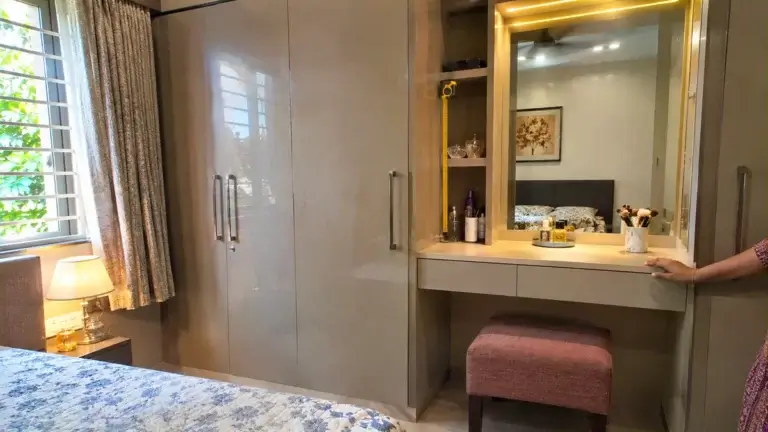
Wardrobe Design
Wardrobe with Dressing Table Design: Layouts, Size, Cost
Wardrobe with dressing table design for Indian bedrooms: five layouts, bay size, mirror and light tips, and cost ranges for each option.
November 9, 2026
Wardrobe moisture proofing Dehradun starts before the monsoon, not after it. Seal every board edge, use moisture-resistant plywood where damp reaches, and keep the unit off the floor and away from damp walls. Fix any wall seepage first, then dry your clothes fully and air the wardrobe on dry days.
No wardrobe is truly waterproof, but a well-built and well-placed one handles the rains easily.
Below, IMD rainfall data with a chart, a board-by-part table and a five-step install order show how to protect it.
You open the wardrobe in August and find a door that sticks. The base has swollen at the edge, your shirts smell musty and the hinges show orange spots. None of this happens overnight, and none of it is the fault of the clothes you stored.
Sounds familiar?
A wardrobe is a closed box in a damp room, built from boards that take in moisture. Once damp air and a poorly sealed board meet, the damage follows a predictable path.

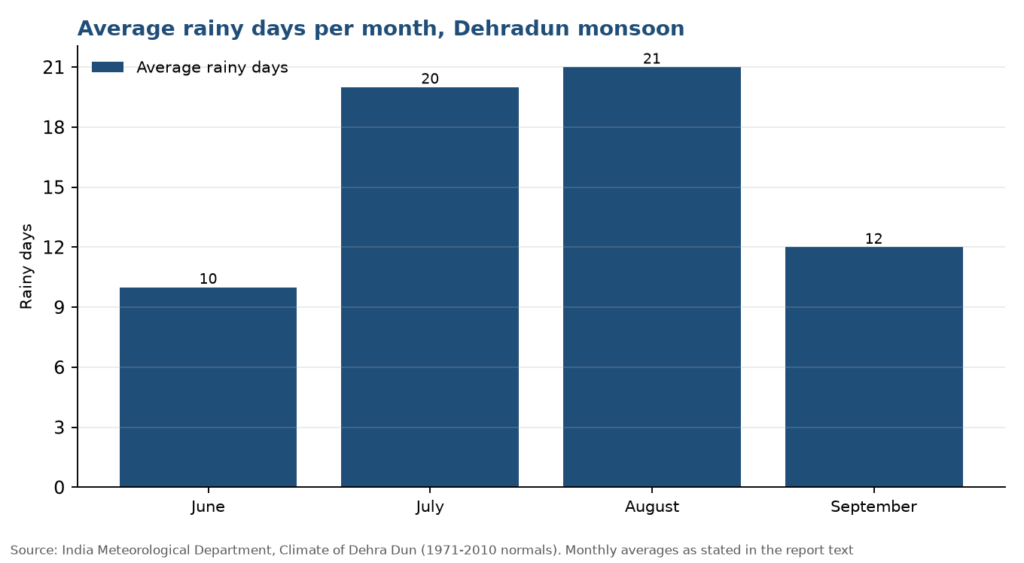
Chart: Average rainy days per month during the Dehradun monsoon, 1971 to 2010 normals. Source: India Meteorological Department, Climate of Dehra Dun report
The India Meteorological Department’s Climate of Dehra Dun report gives the numbers. Monsoon-season rainfall totals 2242 mm, with July and August together delivering about 61 percent of it (1971 to 2010 normals).
It also counts rainy days: on average 10 in June, 20 in July, 21 in August and 12 in September. That is damp air for weeks at a stretch, not a few wet afternoons.
India Meteorological Department, Climate of Dehra Dun report
Humidity climbs with the rain, and the same report puts daily maximum humidity near 90 percent by the third week of July.
How long can a closed wardrobe stay damp?
For expert design consultation, send us your details and we’ll schedule a call
Most damage starts in four places, and a good board alone does not stop any of them.
Wall seepage is the fifth cause and the most overlooked. A Houzz thread on closet mildew explains that a poorly insulated cold exterior wall collects condensation. A cold glass does the same on a warm day. Fix the wall, not just the wardrobe.
Not every wardrobe faces the same risk, so look at where yours stands before you decide how much to upgrade.
Which wall is yours?
In these spots, upgrade the boards on the exposed parts, seal the edges with extra care and add ventilation at the top or back. In a dry, sunny upper-floor room, a basic moisture-resistant build with good airing is often enough.
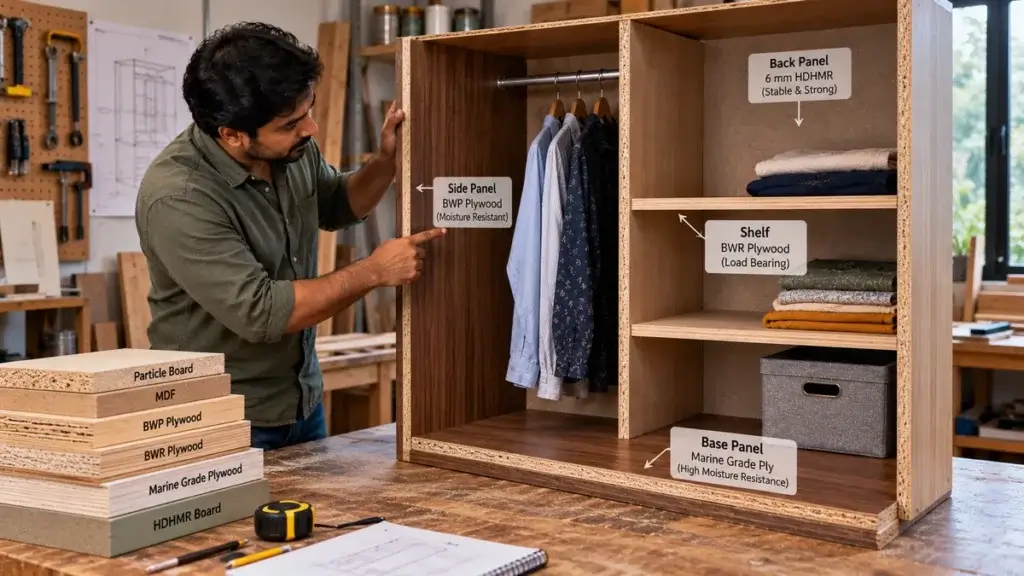
Part of the wardrobe | Moisture-smart choice | Why it matters |
Base panel and plinth | BWR or BWP plywood, edges sealed | Closest to floor splashes and rising damp |
Side panel on an outer wall | BWR or BWP plywood, with an air gap behind | Outer walls are the usual source of damp |
Back panel | Plywood, not thin particle board | It faces the wall, so damp collects there |
Inner shelves | MR plywood or HDHMR in a dry, ventilated unit | Less exposed, but still keep particle board out |
Shutters | Laminate on sealed plywood or HDHMR; louvered panels for airflow | Edge sealing matters more than the face colour |
Our Dehradun wardrobe ideas guide calls BWR plywood the most recommended material for Dehradun wardrobes. It also warns that particle board swells with moisture over time. The table is general guidance, so confirm the exact board for each part with your manufacturer.
We think paying for a better board only on the parts that meet damp is smarter than upgrading the whole wardrobe.
Edge banding is the seal on a board, and a thin or badly glued seal lets damp reach the core of any board.
Ask for all exposed edges to be sealed, especially the base and any edge near a wall. Our waterproof modular kitchen guide explains why edge banding and sealing are where waterproof claims often fail, and the same logic applies to wardrobes.
Leave a ventilation gap at the back or top of the unit, as our Dehradun guide suggests. Air that can move dries out, while air that cannot move turns musty.
Small gap, big difference.
For hardware, choose stainless or marine-grade fittings and anti-rust components. On the other hand, a cheap iron hinge may look the same on day one and show rust within a monsoon or two.
If airflow matters to you, louvered shutters let air move through the unit. They cover a few clothes less neatly, but dry out faster.
Planning a wardrobe for an outer wall or a ground-floor room? Send us the room and wall details, and we will show a moisture-aware layout with the right boards and hardware in a free 3D design. Call or WhatsApp 08044630777 or fill in your details at bhumim.com.
Our Dehradun guide also suggests cedar blocks to keep the musty smell away. Jewellery needs extra care too, and our wardrobe accessories guide explains why a velvet-lined drawer can hold moisture.
Dry clothes first, always.

Act early: fix the source of damp first, then repair or replace the damaged part.
Which of these have you already noticed?
Do you want a wardrobe that survives one monsoon, or ten?
BWR or BWP plywood suits Dehradun best for the parts that meet damp, such as the base, plinth and outer-wall side panels. MR plywood or HDHMR can work for inner shelves in a dry, ventilated unit. Particle board is the weakest choice, because it tends to swell with moisture over time.
No wardrobe is fully waterproof. Moisture-resistant boards, sealed edges and stainless hardware slow damage a great deal, but damp air still enters a closed box. Good placement, airing on dry days and dry clothes do the rest. Treat any claim of a fully waterproof wardrobe with caution.
Store only fully dry clothes, skip plastic bags, and add silica gel, charcoal or camphor to absorb moisture. Air the wardrobe on dry days with the doors open, and avoid packing it tight. If the smell returns, check for a damp wall behind the unit, because the source of the water matters most.
Boards take in moisture from humid air and swell slightly, especially where edges are unsealed or the board is a weaker grade. A swollen base or side panel then pushes the door out of true. Sealed edges, moisture-resistant boards and a small air gap around the unit reduce the problem.
It is better to leave a small air gap and make sure the wall is dry. Cold exterior walls let humid air condense, which feeds mildew behind and inside a closet. Fixing seepage and improving airflow help more than adding products to the wardrobe itself.
They help, but they treat the symptom. Silica gel and charcoal absorb moisture inside drawers, and a dehumidifier is a low-cost way to cut room humidity. Neither fixes a leaking wall, a wet floor or unsealed board edges, so deal with those sources first and use these as support.
Louvered shutters let air move through the wardrobe, so the inside dries out faster. The trade-off is that they show the contents slightly and collect dust in the slats. For a damp room, they are worth considering, especially for a ground-floor or outer-wall wardrobe.
Call early if doors stick, edges swell, rust spreads, a musty smell keeps returning, or you see mud tubes near hinges or corners, which can point to termites. Fix the source of damp first, then repair or replace the affected part before the next monsoon arrives.
Call or WhatsApp Bhumim at 08044630777, or fill in your details at bhumim.com/contact. Share your room and wall details, and the team shows a moisture-aware layout in a free 3D design, typically within 3 to 7 days, in line with the design stage described in our bedroom wardrobe guide. You can then compare it with any other quote.
Moisture does not beat a good wardrobe in one season. It beats a wardrobe that was sealed badly, placed against a wet wall, or packed with damp clothes. Fix the water source, choose the right board for each part, seal the edges, and the monsoon becomes just another season.
If you are planning a wardrobe in Dehradun, Rishikesh or Haridwar, call or WhatsApp Bhumim at 08044630777 or reach out through bhumim.com/contact for a free 3D design, or visit the Dehradun showroom to see board and edge samples in person.
Published by: Bhumim India Private Limited-Modular Kitchen Manufacturer & Installer, Dehradun
GST: 05AAOCB1784F1ZM | ISO 9001:2015 Certified
Service Areas: Dehradun · Haridwar · Rishikesh · Roorkee · Noida · Ghaziabad
Contact: 08044630777 | hello@bhumim.com
Note: This article is written from Bhumim’s on-ground manufacturing and installation experience. All material recommendations are based on what we use in real kitchens across our service areas.
Wardrobe with dressing table design for Indian bedrooms: five layouts, bay size, mirror and light tips, and cost ranges for each option.

Sliding wardrobe laminate design guide: pattern types, two-colour panel splits, laminate grade and a catalogue checklist for Indian homes.
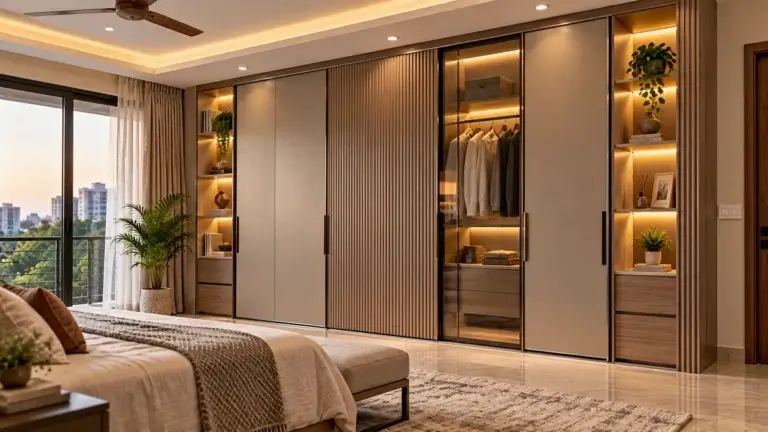
Luxury wardrobe design ideas for master bedrooms: lighting specs, finishes compared, detail upgrades, and where to spend or save.