


Modular Kitchen Design
Benefits of German Modular Kitchen
Benefits of German modular kitchen: PUR edge banding, hardware ratings and pricing in Dehradun, Noida & Ghaziabad.
August 19, 2026
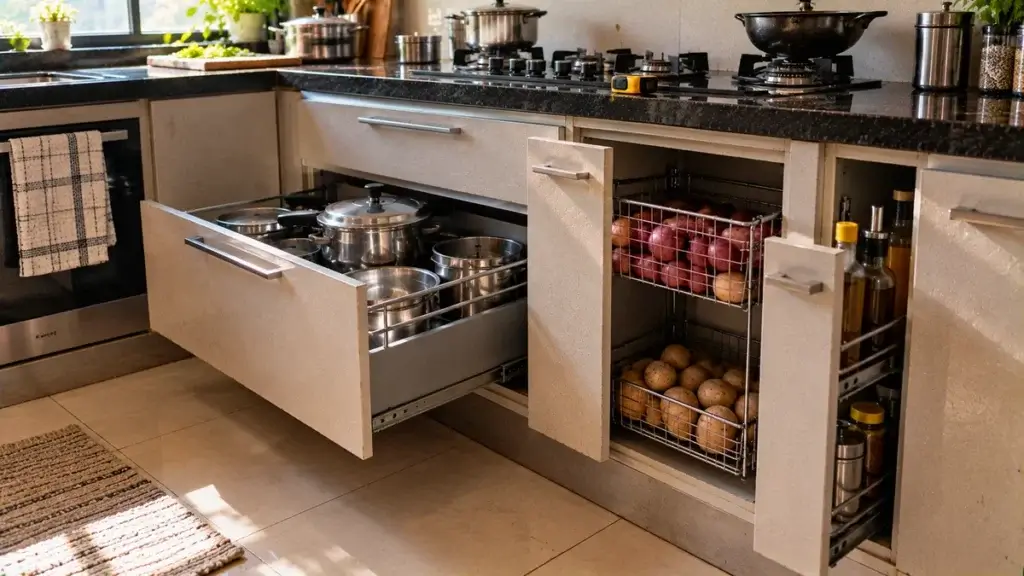
Kitchen trolley design starts with the job each unit does. Choose deep drawers for heavy pots, baskets for vegetables, and narrow pull-outs for bottles and masalas. Then fix the width from standard module sizes, and match the runner load class to what the unit will hold.
Below, a unit table, a width table and a load check help you choose, and the last sections cover fronts, colours and kitchen size.
In many Indian homes, trolley means the pull-out units inside the base cabinets: drawers, baskets and narrow pull-outs. It does not mean the rolling cart.
The rolling cart is a separate piece of furniture, and Bhumim’s small kitchen guide covers it as one idea among ten. Galleries offer kitchen trolley design ideas by the dozen, while this page covers the fixed units and the choices that galleries skip.
Corner units, tall larder pull-outs and pantry towers have their own pages: see the accessories guide and the pantry units guide. A trolley plan is one part of your wider modular kitchen design, so settle it while the layout is on screen.
Which job should each of your base cabinets do every day, and how heavy is what it holds?

Each unit type suits a different job, and the table lists what to put where and what to watch before you choose.
Unit | Best for | Watch out for |
Deep drawer | Pots, pans and a pressure cooker, seen from above | A stack of pans must be lifted to reach the bottom one |
Wire basket pull-out | Vegetables and onions that need air | Small items can fall through the wires |
Narrow bottle or masala pull-out | Oil bottles, tall jars and spice jars beside the hob | Needs a clear slim gap in the run |
Door with roll-out shelf | Awkward spaces and adjustable shelf heights | Two or three actions to open, and the shelf edges are shallow |
A Houzz forum thread argues both sides of this choice. Its most-quoted reply says drawers need one movement while roll-outs behind doors need two or three, and that drawer sides stop things falling off. A dissenting reply prefers roll-outs for pots, because the shallow sides let you reach the bottom pan.
That thread is US opinion, and it also notes that the roll-out base cost about $140 more than the drawer base. We think deep drawers suit pots and heavy cookware, while baskets suit vegetables. On the other hand, a door with roll-out suits an awkward space.
Which of your kitchen jobs needs a drawer, and which needs a basket?
For expert design consultation, send us your details and we’ll schedule a call
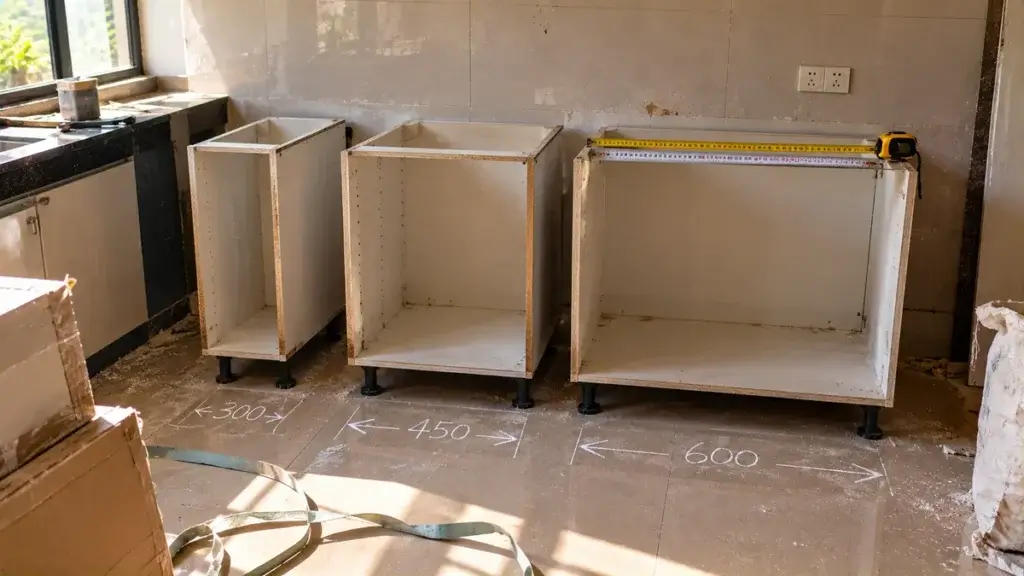
Modular manufacturers build standard cabinet widths of 300, 450, 600 and 900 mm. Bhumim’s designs guide says custom widths add 15 to 25 percent to the cabinetry, so plan the trolleys around these sizes.
Cabinet width | In inches | A sensible use (our suggestion) |
300 mm | 11.8 | Masala or bottle pull-out beside the hob |
450 mm | 17.7 | Single basket or a drawer for everyday utensils |
600 mm | 23.6 | Deep drawer for pots, or a double basket |
900 mm | 35.4 | Wide drawer for large cookware, or two units behind one front |
The pantry units guide lists slim pull-outs from 150 to 300 mm wide, and you should use them only where a gap that small exists.
Measure the inside width after the side panels, not the outside size. A runner needs room on each side, so the usable drawer is narrower than the cabinet.
We suggest keeping the cooking zone to 300 and 600 mm units, so everything sits within a step of the hob. On the other hand, a 900 mm drawer is harder to pull when it is full of cookware. Do your cooking zone and prep zone need a 300 mm unit, or a 600 mm one?
The runner decides how long a trolley keeps working under daily load. Blum India lists its LEGRABOX drawers in two load classes, 40 and 70 kg, with slim 12.8 mm drawer sides and soft-close. The TANDEMBOX range comes in 30 and 65 kg classes.
Do a simple weight check by adding up what the unit will hold, then choose a class above that total. A drawer for a pressure cooker and a stack of steel pans could reach 25 kg. That is close to the limit of a 30 kg class, so we would choose 40 kg or more.
The same Houzz thread says full-extension runners are a must, because they give full access to the whole drawer. It calls soft-close nice to have, and it warns that soft-close on roll-out shelves delays the door closing.
Is the runner class written on your quote, or only the brand name?

Bhumim’s finish comparison guide says acrylic is a high-gloss sheet, 1.5 to 2 mm thick, bonded to a smooth HDHMR or MDF board. Ask the grade and the thickness, because a 2 mm sheet and a 1 mm sheet are both called acrylic on a quote.
Trolley fronts get touched, wiped and bumped by pots, so the finish matters more here. The same guide says a dry cloth or a rough sponge leaves micro-scratches that show in sunlight. Clean it with a wet microfibre cloth and nothing rougher.
Haldi is the other question Indian cooks ask. According to the guide, turmeric wiped off at once with warm soapy water does not stain good acrylic. Left overnight, it can leave a yellow shadow on lower-grade sheets.
We think acrylic fronts suit a cook who wipes up daily. On the other hand, laminate scratches less, so we would choose it for the busy drawers under the hob.
Trolley fronts are mostly base-cabinet fronts, so their colour follows your lower cabinets. Bhumim’s colour guide suggests a light reflective tone for the uppers and a slightly warmer mid-tone for the lowers in compact kitchens.
It also says matte mid-tone finishes hide daily marks better than high-gloss white, which shows every fingerprint and spatter. That matters for fronts that you touch with oily hands.
Which colour combination would your morning light make look warmer?
For a small kitchen trolley design, use narrow units and tandem drawers. Bhumim’s small kitchen furniture guide recommends tandem drawers in base cabinets. A tandem kitchen trolley design replaces static shelves with full-extension drawers. It also recommends a masala pull-out beside the hob, holding 20 to 30 jars in one column.
In an L shape kitchen trolley design, the corner needs its own planned unit. Do not push a drawer into the corner, because the door and the drawer will clash.
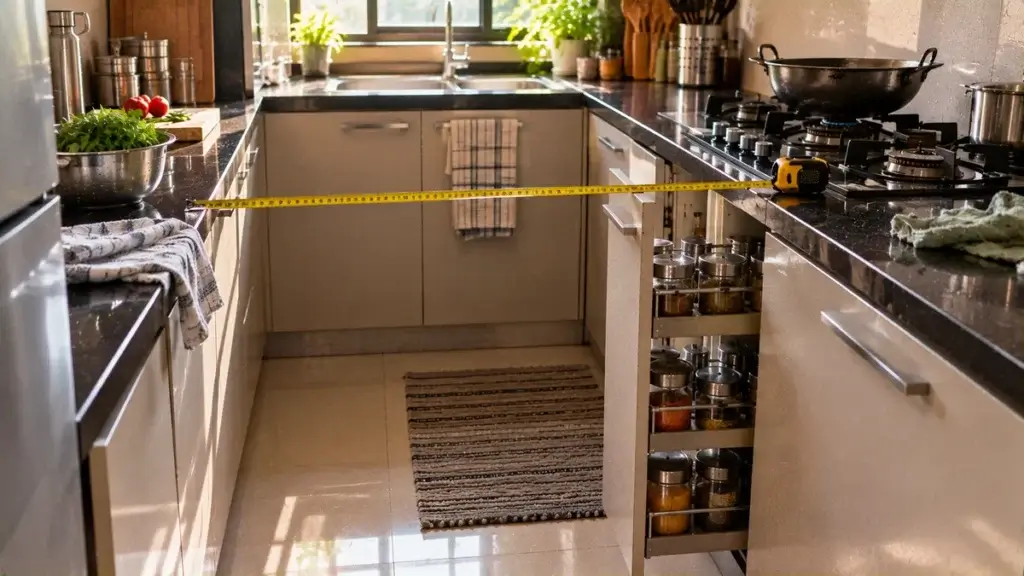
In a large or parallel kitchen, wide drawers of 600 or 900 mm work well. Keep the aisle at least 90 cm so a fully open drawer still leaves room to stand. Make it 100 to 120 cm if two people cook.
Houzz’s thread adds a caution for tight spaces: if the doors cannot open fully, roll-out shelves can strike the door corners, so drawers are safer. Is your cooking aisle wider than 90 cm?
Dehradun’s monsoon makes storage choices harder. The India Meteorological Department’s Climate of Dehra Dun report puts daily maximum humidity near 90 percent by late July (1971 to 2010 normals). Onions and potatoes keep better in ventilated wire baskets, which Bhumim’s accessories guide recommends for vegetables.
We think a basket for vegetables and a closed drawer for dry rations is a sensible split in a humid kitchen. On the other hand, a closed drawer holds damp air, so keep onions out of it.
In Noida and Ghaziabad apartments, the finish guide says high-gloss acrylic can make a small or medium kitchen feel larger. Pair it with laminate on the hidden sides to hold the total cost down.
Indian cooking also decides the position, because a masala pull-out beside the hob earns its place in every kitchen where tadka is made daily. Is yours within one step of the hob?
Most of these cost nothing to avoid before the cabinets are made, so which one could catch you?
Planning your kitchen trolleys now? Share your kitchen size and the jobs you want each unit to do, and review the layout in a free 3D design. Call or WhatsApp 08044630777 or fill in your details at bhumim.com.
Have you listed the jobs of every base cabinet before you picked the sizes?
It depends on the job. A deep drawer suits pots, a basket suits vegetables, and a narrow pull-out suits bottles and masalas. Pick the unit for each base cabinet by what it holds, then choose a standard width and a runner load class above the weight. A trolley that suits one cook may not suit another.
A Houzz forum thread favours drawers: one movement to open, sides that stop things falling, and a lower cost in its example. A dissenting reply prefers roll-out shelves for reaching the bottom pan. For heavy pots we think deep drawers suit most cooks, and a door with roll-out suits awkward spaces.
Full extension is worth having on every unit you reach into from above, because it gives access to the whole drawer. The same Houzz thread calls soft-close nice to have, and warns that on roll-out shelves it can delay the door closing. Blum India lists soft-close on its LEGRABOX drawers.
We do not track trend lists, so we will not invent one. What you can check is hardware: slim drawer sides of 12.8 mm, soft-close, and high load classes of 40 and 70 kg on one drawer range. Choose by the job each unit does, and treat photo trends as secondary.
Use the standard cabinet widths of 300, 450, 600 and 900 mm, which are 11.8, 17.7, 23.6 and 35.4 inches. Bhumim’s designs guide says custom widths add 15 to 25 percent to the cabinetry. Measure the inside width after the side panels, because the runners need room too.
It depends on the runner class. Blum India lists 40 and 70 kg classes for LEGRABOX drawers and 30 and 65 kg for TANDEMBOX. Add up what the unit will hold, then choose a class above it. A pressure cooker with a stack of pans can reach 25 kg, so a 30 kg class is close to its limit.
It gives a high-gloss look, and Bhumim’s finish guide says good acrylic is a 1.5 to 2 mm sheet on HDHMR or MDF. On the other hand, a dry cloth leaves micro-scratches, and haldi left overnight can stain lower-grade sheets. We think laminate suits the busiest drawers under the hob.
Use narrow units and tandem drawers. Bhumim’s small kitchen guide recommends tandem drawers in base cabinets and a masala pull-out beside the hob that holds 20 to 30 jars. Check that a fully open drawer still leaves an aisle of at least 90 cm, and avoid forcing a drawer into the corner.
Rather than a trend list, look at what the hardware now offers: soft-close, slim sides and handleless opening on a drawer range. Our colour guide notes two-tone schemes with lighter uppers and warmer lowers. Choose by your jobs and your light, because a trend dates faster than a runner wears out.
Call or WhatsApp Bhumim at 08044630777, or fill in your details at bhumim.com/contact. Share your kitchen size and the jobs you want each unit to do, and the team shows the layout in a free 3D design, typically within 3 to 7 days. Then ask for the unit types, widths and runner classes to be written on the quote.
A good trolley plan starts with what each cabinet holds, then fixes the width and the runner. Do those two, and the front finish and colour become the easy part.
If you are planning a kitchen in Dehradun, Haridwar, Noida or nearby, call or WhatsApp Bhumim at 08044630777 or reach out through bhumim.com/contact for a free 3D design, and ask which modular kitchen trolley design suits your jobs.
Published by: Bhumim India Private Limited-Modular Kitchen Manufacturer & Installer, Dehradun
GST: 05AAOCB1784F1ZM | ISO 9001:2015 Certified
Service Areas: Dehradun · Haridwar · Rishikesh · Roorkee · Noida · Ghaziabad
Contact: 08044630777 | hello@bhumim.com
Note: This article is written from Bhumim’s on-ground manufacturing and installation experience. All material recommendations are based on what we use in real kitchens across our service areas.
Benefits of German modular kitchen: PUR edge banding, hardware ratings and pricing in Dehradun, Noida & Ghaziabad.
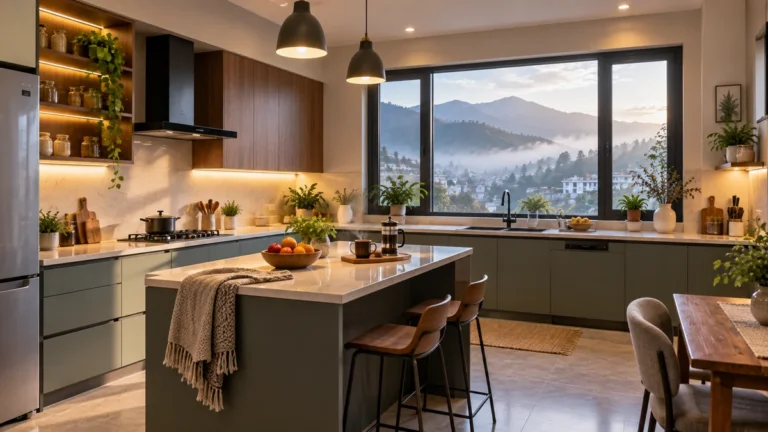
Modular kitchen for cold climate India: why Dehradun and Rishikesh winters affect hardware differently than Delhi, and which materials to pick.
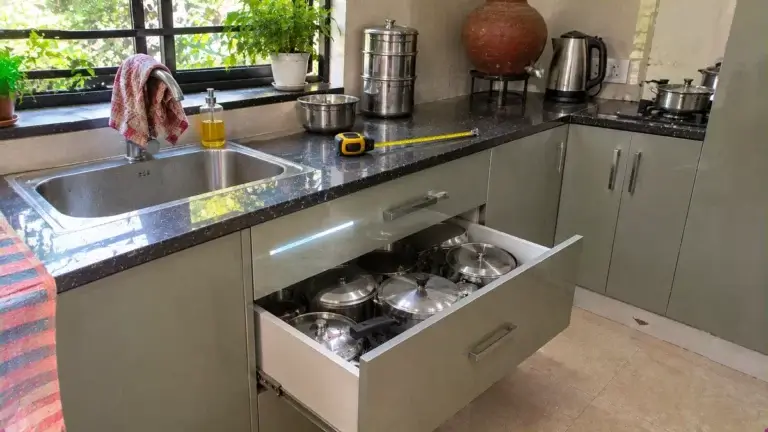
Planning kitchen drawer design? See base-drawer sizes in mm, soft-close runner checks, pots and pans depth and cutlery tray fit.