

Modular Kitchen Upgrade Before Diwali: 10-Day Plan
A modular kitchen upgrade before Diwali is achievable in 10–14 working days for factory manufacturing and on-site installation, if the site is civil-ready, the design is signed off, and the manufacturer has a confirmed production slot. The 10-day window refers to the combined manufacturing and installation phase, not the full project from first inquiry to handover.
A modular kitchen is a factory-manufactured system made of pre-built cabinet modules, base units, wall units, tall units, assembled on-site in your kitchen footprint. Unlike a carpenter-built kitchen constructed entirely on-site, modular units are cut and finished in a controlled factory, then brought to your home for installation. The result: tighter tolerances, consistent finishes, and a faster on-site timeline.
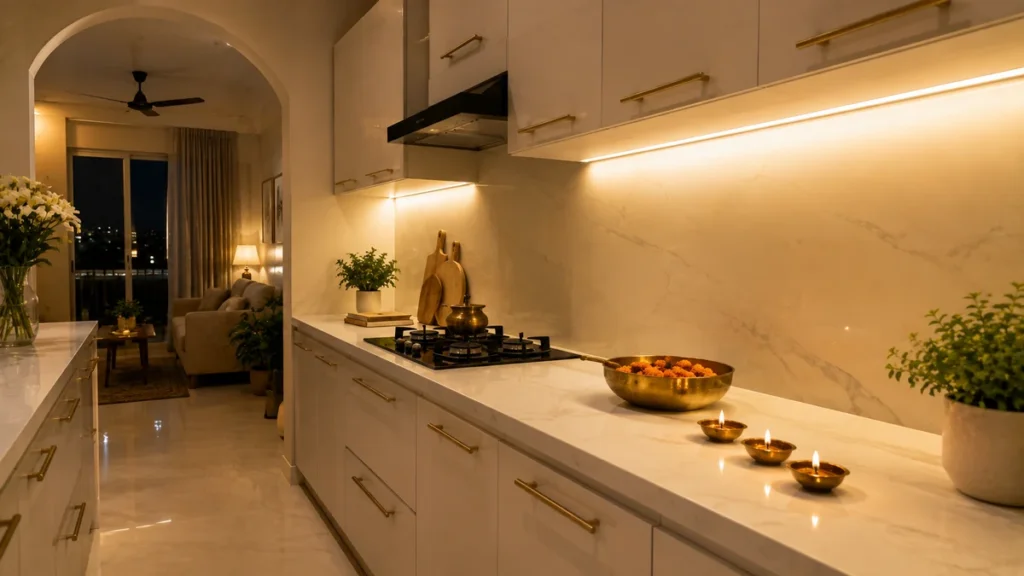
Why Pre-Diwali Is the Right Window for a Modular Kitchen Upgrade
Every year, the six to eight weeks before Diwali are the most active renovation period in Indian homes, and not just for deep-cleaning or repainting. The kitchen sees the most festive cooking traffic of any room in the house, and most homeowners who have been putting off a kitchen upgrade act during this window.
After running kitchen installations across Dehradun, Noida, and Haridwar through Diwali season, one pattern appears consistently: homeowners who book in late September or early October are eating in their new kitchen by the festival. The ones who call in mid-October usually are not. That is not a sales pitch. It is how factory production slots and installation schedules actually work, Diwali is one of the busiest booking periods for modular kitchen manufacturers across India, and the comfortable 10-day window closes fast.
There is also a practical climate reason specific to Dehradun and Uttarakhand. October marks the transition out of monsoon season. Civil work, plastering, tiling, electrical work, is harder and slower in cold weather. A kitchen installed before Diwali also gets a season of warm temperatures for adhesives, sealants, and laminate finishes to cure properly, reducing the chance of early peeling or joint failure.
One more consideration: the kitchen gets its single hardest annual use during Diwali, multiple cooking sessions a day, pressure cookers going, heavy vessels on countertops, constant surface wiping. A new kitchen handles that load better than a worn-out old one. The right time to upgrade is before that load arrives, not after.
What Does a "10-Day Express" Modular Kitchen Upgrade Actually Mean?
A “10-day express” modular kitchen upgrade refers to the combined factory manufacturing and on-site installation phase, not the full project timeline from first inquiry. That distinction matters before you book.
The full project, realistically, looks like this for a standard Dehradun 2BHK kitchen in an L-shaped or parallel layout:
- Day 0–2: Site visit, 3D design session, initial layout and material discussion
- Day 2–4: 3D design review, one round of revisions, client sign-off on design and material sheet
- Day 4–14: Factory manufacturing of all cabinet modules
- Day 14–19: On-site installation, base units, wall units, countertop, hardware fitting
- Day 19–21: Snagging, alignment checks, soft-close hinge adjustment, silicone sealing, final clean and handover
The “10-day” window is accurate for Days 4–14 (factory manufacturing: 7–10 working days) plus Days 14–19 (on-site installation: 3–5 working days for a standard kitchen). It is achievable when the site is civil-ready on Day 1 and the design is locked without revision after sign-off.
Where projects overrun: almost always in two places. First, civil readiness, walls not yet plastered, electrician has not finished, tiles not done. Second, design revisions after sign-off, which require re-running modules in the factory. Both are within the homeowner’s control before booking. Handle them upfront, and the 10-day window holds.
For a small straight-line kitchen in a 1BHK apartment, on-site installation takes 2–3 days. For a full U-shaped kitchen with chimney cutout, extensive upper cabinets, and a breakfast counter, expect 5–7 days on-site. A large island kitchen is not typically achievable in a 10-day window.
Get started with Beautiful Homes
For expert design consultation, send us your details and we’ll schedule a call
Your Pre-Diwali Modular Kitchen Timeline: Phase by Phase
Planning a modular kitchen upgrade before Diwali requires working backwards from the festival date. For Diwali in late October, the latest practical booking date for a completed kitchen is early October, assuming civil work is already done on booking day. Booking in September is the comfortable window. Here is the full phase-by-phase breakdown:
Phase 1, Design and Sign-Off (Day 1–4)
- Site visit by Bhumim’s design team: measurements, site readiness check, initial discussion on layout, material preferences, and budget range
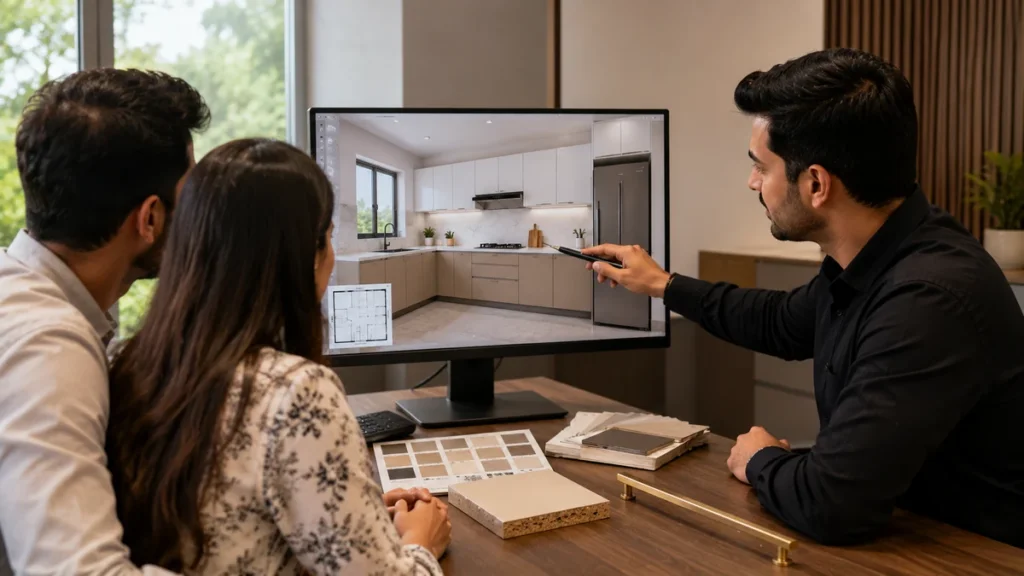
- 3D design rendered in CAD: you see your actual kitchen, not a generic template, cabinet positions, storage layout, finish colours, hardware placement
- Design review and revisions: typically one round; most clients lock in within two sessions
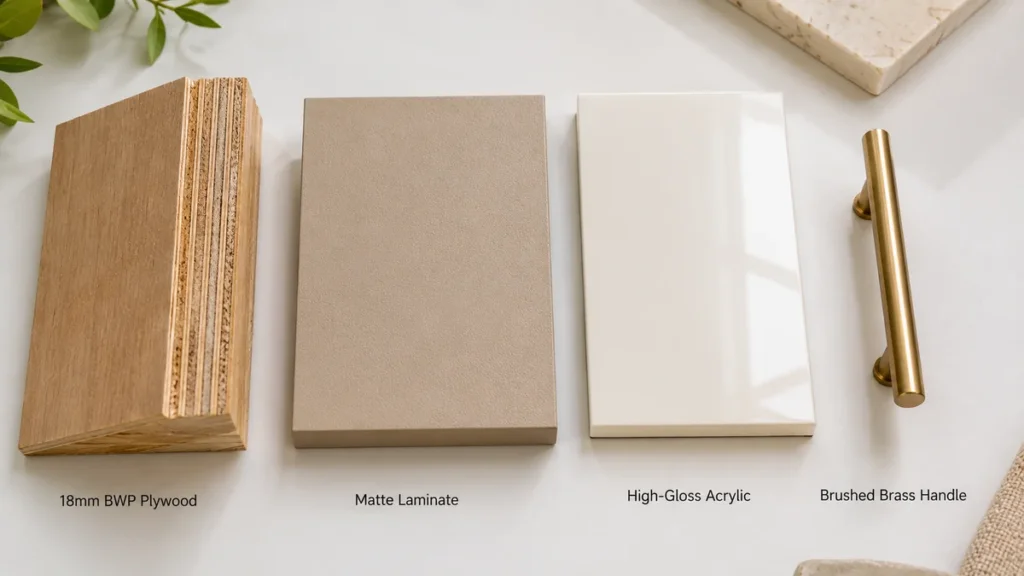
- Material finalization: carcass board (BWP-grade IS:710 plywood or HDHMR), shutter finish (matte laminate, acrylic, membrane, or PU), and hardware selection (Hafele handles, Blum hinges, Grass drawer runners)
- Client sign-off on design and material sheet, factory manufacturing begins immediately after sign-off, same working day
Phase 2, Factory Manufacturing (Day 5–14)
- CNC-cut cabinet carcasses from specified board grade, factory precision delivers tolerances that on-site carpentry cannot replicate
- Shutter fabrication: laminate bonded under press for matte and wood-grain finishes; membrane or acrylic applied in controlled temperature conditions
- Hardware fitting: Blum hinge cups pre-mounted on carcass doors before delivery; Grass drawer runner channels fitted to carcass sides at the factory
- Module QC check: each cabinet box is checked for dimension accuracy, surface quality, and hardware function before it is loaded onto the delivery vehicle
- Delivery to site: modules arrive wrapped and labeled in installation sequence
Phase 3, On-Site Installation (Day 14–19)
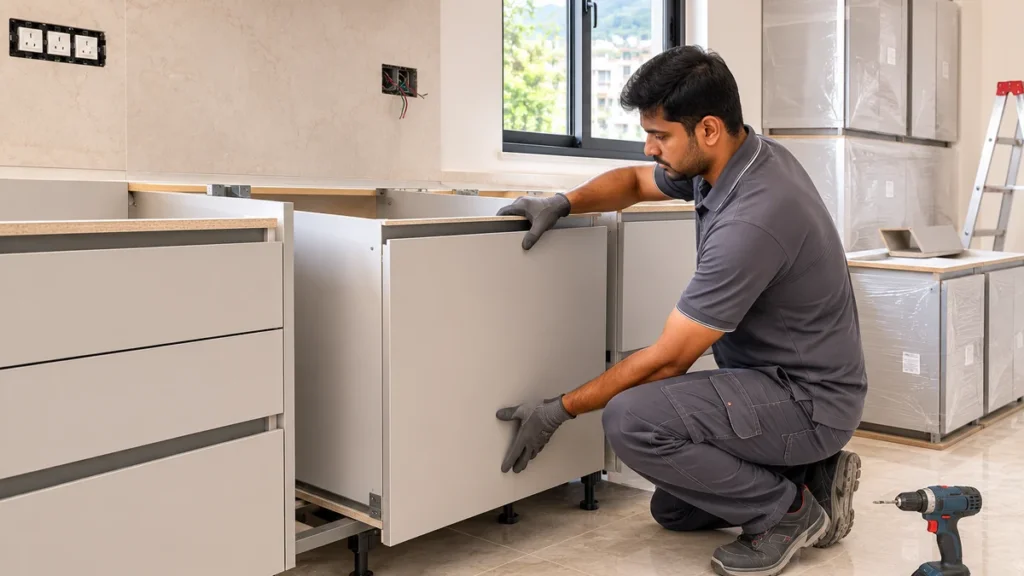
- Base cabinet installation: levelling and shimming to account for floor variation, which is common in Dehradun apartments with uneven concrete subfloors
- Wall cabinet installation: anchored to structural wall with Fischer plugs, not plaster anchors, which pull out under cabinet weight over time
- Countertop installation: engineered stone, granite, or laminate sheet fitted, cut to depth, and sealed at wall junction
- Chimney, sink, and faucet integration: aligned with pre-planned cutouts in countertop, sealed after plumber connects the supply lines
- Shutter hanging and adjustment: all Blum soft-close hinges adjusted for even gap and consistent damping speed across every cabinet door
Phase 4, Snagging and Handover (Day 19–21)
- Alignment check: every drawer, door, and pull-out unit checked and adjusted
- Silicone sealing: junction between wall tiles and countertop, sink cutout edges, and any gap at wall-cabinet interface
- Final clean: all surfaces cleaned before handover
- Handover walkthrough: team walks through every element, how to adjust hinge tension, how to clean each finish type, and what the warranty covers and who handles it
The 21-working-day total is the honest number for a complete, high-quality kitchen. The “10-day express” is Phases 2 and 3, factory-to-handover, when site readiness and design sign-off are handled upfront before manufacturing starts.
Site Preparation: What Needs to Be Ready Before Day 1 of Installation
The most common reason a pre-Diwali kitchen misses the festival date is not the manufacturer. It is the site arriving incomplete when the delivery truck shows up. Civil readiness is non-negotiable for an express timeline. Every day the site is not ready is a day added to the end of the project.
Before a Bhumim installation team arrives, these must all be finished:
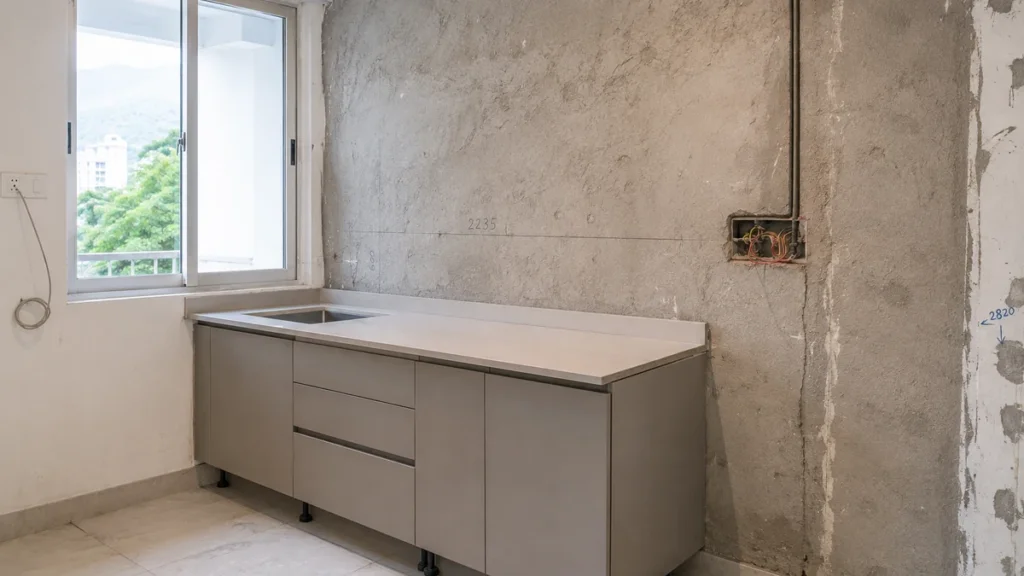
- Walls plastered and dried (minimum 10–14 days of curing before wall cabinets can be anchored, wet plaster will not hold Fischer plug anchors under cabinet weight)
- Wall tiling complete in the kitchen area, cabinets install after tiles, not before
- All electrical points in place: chimney socket, refrigerator socket, microwave socket, general appliance circuit, the electrician must be finished before upper cabinets go up
- Plumbing rough-in confirmed: sink drain and supply line positions at the correct height; the plumber connects after countertop cutting, but the rough-in must be right before base units are fixed
- Floor tiled or finished, base cabinets sit on the finished floor; adding floor tiles after cabinet installation requires removing cabinets
- Old kitchen demolished and completely cleared, if this is a replacement, demo is not part of the modular kitchen installation scope; the site must be empty and clean on delivery day

Which Materials and Finishes Hold Up After the Festive Season?
The Diwali cooking period is genuinely hard on a kitchen. Most Indian homes see multiple cooking sessions a day for 2–3 weeks, with hot vessels on countertops, steam from pressure cookers, oil splatter near the hob, and constant surface wiping. In Dehradun, October also marks the transition out of monsoon season, residual humidity in walls and floors takes another 4–6 weeks to fully dissipate. The materials that hold through this:
Carcass (cabinet body) options:
- 18mm BWP-grade IS:710 plywood, IS:710 is the Bureau of Indian Standards moisture-resistance specification. Plywood meeting this grade will not delaminate or swell through Dehradun’s monsoon cycle. If you are choosing between carcass materials, see the HDHMR vs BWP plywood comparison for a breakdown of where each one makes sense.
- HDHMR (High Density High Moisture Resistant board), denser and heavier than BWP plywood; well-suited for wardrobes and living room units; used in kitchens where the 15–20% additional cost is acceptable and the moisture exposure is indirect
- WPC (Wood Plastic Composite), the right choice for the sink base cabinet, where direct water contact is frequent; fully moisture-proof, more expensive per square foot than BWP plywood
Shutter and finish options:
- Matte laminate, durable, hides fingerprints, available in a wide colour range; the easiest surface to wipe down during heavy festive cooking. For a detailed comparison across all finish types, see the matte vs acrylic vs membrane kitchen finish guide.
- High-gloss acrylic, striking finish that reflects light well; shows fingerprints more than matte, which is a real consideration when the kitchen is in constant Diwali use
- PU (polyurethane) paint, smooth, flat surface on HDHMR or MDF; excellent for a soft-sheen look; best avoided in kitchens with heavy steam exposure unless the surface has had adequate curing time
- Membrane (PVC-wrapped), soft-edged, no visible seam line; popular for wardrobes and for kitchen shutters in dry areas
Hardware for a Diwali-ready kitchen:
- Hafele handles and fittings, available in brushed brass, brushed nickel, and matte black; brushed brass paired with matte or off-white cabinets is the festive finish combination most commonly requested in 2026 Diwali upgrades
- Blum soft-close hinges, slows cabinet doors before they close; the feature most people notice by its absence, particularly after a full day of cooking when doors get opened and shut hundreds of times
- Grass drawer runners, tandem-style runners for smooth, level extension even when loaded with heavy Indian cookware; a weak drawer system is the first hardware failure in a high-use kitchen
Which Kitchen Layout Works Best for a Pre-Diwali Express Timeline?
Not all kitchen layouts are equal in installation speed. The layout affects both factory manufacturing complexity and on-site time. For a tight pre-Diwali window, this difference matters.
Here is how each layout compares:
- Straight-line (single-wall): 2–3 days on-site. One run of base and wall cabinets. Works only for smaller kitchens under 50 sq ft, most common in Dehradun studio and 1BHK apartments.
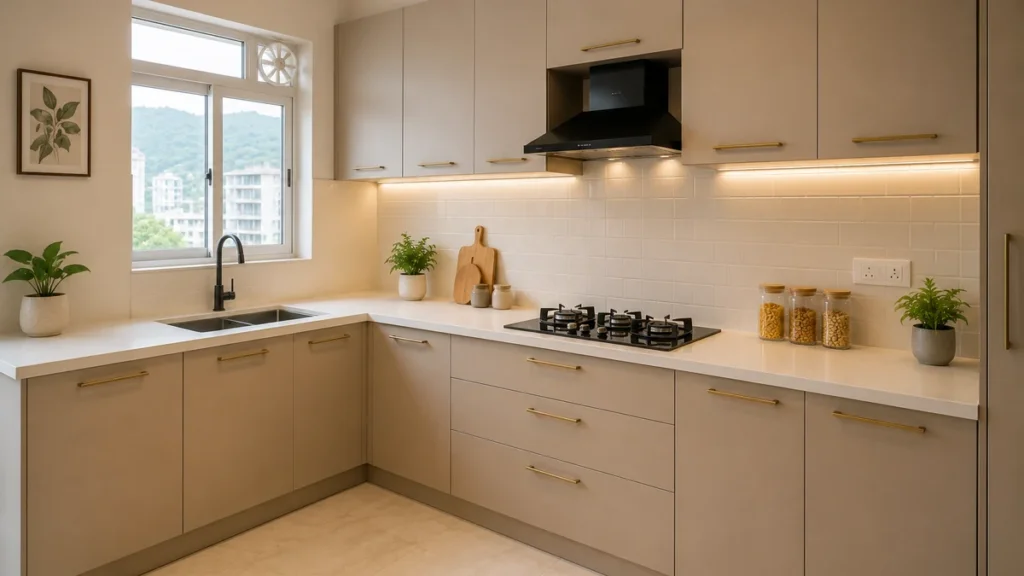
- L-shaped: 3–5 days on-site. Two runs meeting at a corner, with a corner solution (blind corner unit or pull-out magic corner). The workhorse layout for Dehradun 2BHK kitchens and the best choice for an express Diwali installation.
- Parallel (double-galley): 4–5 days on-site. Two facing runs with no corner unit. Well-suited to long, narrow kitchen passages common in Noida builder-flat layouts.
- U-shaped: 6–8 days on-site. Three runs, two corners. Still achievable before Diwali if design is signed off by late September.
- Island kitchen: 8–10 days on-site minimum, plus countertop cutting, plumbing connection, and electrical for island sockets. Not suitable for a 10-day express window unless the island is a standalone mobile unit, not a built-in.
The practical recommendation for a guaranteed pre-Diwali handover: if your kitchen footprint allows an L-shaped or parallel layout, that is the path that keeps the timeline reliable. See the modular kitchen layout guide for standard dimensions and planning rules for each layout type, and the full modular kitchen design guide for the complete product range.
Common Mistakes That Push a Pre-Diwali Kitchen Project Past the Deadline
Most Diwali kitchen projects that miss the festival date do so for predictable reasons. After installations across Dehradun, Noida, and Haridwar, these are the ones that come up repeatedly:
Booking too late. Calling the manufacturer in the last two weeks of October. Factory production has no open slots, installation teams are committed through the festive period. The kitchen lands after Diwali. Book in September for an October handover, that is the actual window, not a marketing nudge.
Design changes after sign-off. Switching the layout or shutter colour after manufacturing has started adds 5–10 days because modules need to be re-run in the factory. The free-revision phase is the 3D design session, use it fully. Once the sign-off sheet is signed, manufacturing begins the same day.
Civil work sequenced incorrectly. Tiling the kitchen after cabinet installation instead of before it. Plastering walls after the electrician has boxed in conduits. Both require installation to stop and wait. The correct civil sequence: demolition >> plumbing rough-in >> electrical conduit and points >> plastering >> tile >> modular kitchen delivery.
Using a manufacturer that outsources installation. Some manufacturers hire per-project contractors near Diwali when their own team is overbooked. Near the festival, contractors are scarce and expensive. Bhumim uses its own installation team, the team that manufactured the kitchen is the team that installs it. For the checklist of questions to ask any manufacturer before booking, see the modular kitchen buying guide.
Not checking for hidden civil surprises. An electrical line inside a wall not shown on the original building plan. A plumbing pipe at the wrong height. A wall that is hollow instead of RCC, which will not hold wall cabinet anchors. None of this is avoidable without a physical site visit before commitment. The full list of kitchen renovation mistakes to avoid covers the site-side surprises that catch homeowners and first-time renovators off guard.
Frequently Asked Questions
Book at least 6–8 weeks before Diwali for a comfortable timeline. The design-sign-off-to-handover window is 3–4 weeks, but factory production slots and installation teams fill fast during the festive season. Booking in September for an October Diwali gives you buffer for one round of design revisions and any civil prep delays without putting the deadline at risk.
Yes, for the combined factory manufacturing and on-site installation phase. For a standard L-shaped or parallel kitchen in a 60–90 sq ft space, factory manufacturing takes 7–10 working days and on-site installation takes 3–5 working days. The 10-day timeline holds when the site is civil-ready on Day 1 and the design is locked before manufacturing starts. Total project from first inquiry to handover is typically 3–4 weeks.
Before any modular kitchen delivery, the site needs: walls plastered and fully cured (10–14 days minimum), wall tiling complete, all electrical points installed (chimney, refrigerator, microwave, general circuit), plumbing rough-in at the correct height, floor finished, and the old kitchen demolished and cleared. Incomplete civil work on delivery day is the leading cause of pre-Diwali kitchen projects missing the festival deadline.
Yes, Bhumim prepares a full 3D design before any material is selected or manufacturing starts. The 3D session is part of the free consultation. You see your actual kitchen layout, not a generic template: cabinet positions, storage configurations, finish colours, handle options, and chimney placement. Changes at this stage cost nothing. Changes after sign-off add to the manufacturing timeline, so this session is worth taking seriously.
L-shaped and parallel layouts are the fastest to install, 3–5 days on-site for a standard 60–90 sq ft kitchen. Straight-line layouts take 2–3 days but suit only smaller spaces. U-shaped kitchens take 6–8 days on-site. Island kitchens typically need 8–10 days and are not recommended for an express pre-Diwali window unless the island is a standalone mobile unit.
For the carcass, BWP-grade IS:710 plywood is the recommended choice for Indian kitchens, it resists moisture and will not swell or delaminate through Dehradun’s post-monsoon humidity. Use WPC board for the sink base cabinet where direct water contact is regular. For shutters, matte laminate is the easiest to maintain under heavy cooking use. Hafele handles, Blum soft-close hinges, and Grass drawer runners are the hardware combination that holds up under daily high-frequency use.
A modular kitchen installation is a full structural upgrade, new carcass, shutters, countertop, and hardware, not a cosmetic change. Diwali is a good time precisely because the kitchen faces its hardest annual use during the festive period. A new kitchen handles that load better than a worn one. The key is timing: a full renovation requires booking 6–8 weeks before Diwali. Cosmetic refreshes (new handles, laminate overlays on existing shutters) can be done in shorter windows.
Call or WhatsApp Bhumim at 08044630777, or fill in your details at bhumim.com/contact-interior-designer-experts. A team member will confirm your city, ask about your kitchen space and layout, and schedule a site visit and 3D design session, typically within 3–5 working days. There is no fee and no obligation at the consultation stage. For Dehradun homeowners, you can also visit the showroom to see material samples and hardware before booking.
Bhumim’s own installation team handles all post-installation adjustments during the snagging phase, the 2-day alignment and check period that is part of every project. After handover, any defect covered under warranty is handled by the same team, not redirected to a third party or sub-contractor. Soft-close hinge adjustment, drawer alignment, and silicone resealing are among the most common post-installation service requests. Confirm warranty terms directly at the design consultation stage.
Yes, Bhumim serves Dehradun, Haridwar, Rishikesh, Roorkee, Noida, and Ghaziabad. Timelines are consistent across all cities. The key variable is site readiness on delivery day, not the city. For Noida and Ghaziabad projects, factory manufacturing follows the same production cycle. Book 6–8 weeks before the festival for all locations.
Key Takeaways
- A modular kitchen upgrade before Diwali is achievable in 10–14 working days for the factory manufacturing and installation phase, when site is civil-ready and design is signed off
- The full project from first inquiry to handover is 3–4 weeks, booking in September is the realistic path for an October Diwali kitchen
- Civil readiness is the leading cause of delays: walls must be plastered and cured, tiling done, all electrical and plumbing rough-in complete before delivery day
- L-shaped and parallel layouts install fastest (3–5 days on-site); U-shaped takes 6–8 days; island kitchens are not suitable for a 10-day express window
- Material choices for a Diwali upgrade that holds: BWP-grade IS:710 plywood carcass, matte laminate shutters, WPC for the sink base, Hafele handles, Blum soft-close hinges, Grass drawer runners
- The single most common reason a pre-Diwali kitchen misses the festival: booking was made 3 weeks too late. Book by mid-September for a late-October handover.

Conclusion
Most kitchens that do not make it by Diwali are not delayed by the manufacturer. They are delayed by a booking that happened three weeks too late, or a site that was not ready when the delivery truck arrived, both entirely within the homeowner’s control.
If you are reading this in August or September, the window is open. The 3D design session costs nothing. The site visit costs nothing. And a conversation with Bhumim’s team will tell you, within one hour, whether your kitchen can be done before Diwali, what it will involve, and what it will cost, with no obligation to proceed.
The kitchen is the room that carries the most weight during the festival. It is worth doing once, well, before Diwali, not rushing into a mid-November project after the celebration has already passed.
About This Article
Published by: Bhumim India Private Limited-Modular Kitchen Manufacturer & Installer, Dehradun
GST: 05AAOCB1784F1ZM | ISO 9001:2015 Certified
Service Areas: Dehradun · Haridwar · Rishikesh · Roorkee · Noida · Ghaziabad
Contact: 08044630777 | hello@bhumim.com
Note: This article is written from Bhumim’s on-ground manufacturing and installation experience. All material recommendations are based on what we use in real kitchens across our service areas.